
.webp)
Post Summary
A district manager gets a call at 2 am. One of his six convenience stores is short-staffed overnight. Nobody flagged it until the shift had already started.
The schedule existed. The gap did not get caught until it became a crisis.
This happens across three industries more than any other: convenience stores, hospitality, and security. Each faces a different version of the same problem.
In security, a gap is more than an operational miss. Many posts require continuous coverage by contract or regulation. A gap may be a contract breach or a safety liability. In hospitality, a front desk gap hits guest experience immediately. In c-stores, overnight coverage is a safety and compliance issue at the same time.
This article covers the models, the staffing math, and the failure points to design around. For foundational shift structure context, see shift types before choosing a rotation model.
.webp)
.svg)

Priced on per user or per location basis
Available on iOS, Android and Web


What makes 24/7 scheduling different
Round-the-clock scheduling is a structurally different problem. Not more shifts. A different kind of problem entirely. Three things make it distinct from standard operations.
**
Difference, What it means in practice
No natural reset point, Any gap is immediate. There is no buffer to absorb a missing crew member
Fatigue is structural, The model you choose determines overnight exposure and recovery time
Small gaps compound fast, A 3 am problem grows the longer it goes unaddressed with no management backup
**
The staffing math before you build the schedule
Before any model is chosen, operators need to know their coverage number. Here is the logic for calculating minimum crew size to staff a single 24/7 position continuously.
Hours to cover per week
24/7 means 168 hours per week per position. One employee working 40 hours covers roughly 24% of those hours.
That is why 24/7 coverage requires a minimum crew size before you even account for days off, sick leave, or turnover. The math applies whether the operation is a c-store, a hotel front desk, or a security post.
**
Coverage need, Hours per week, Minimum employees at 40hrs
1 position-24/7, 168, 4.2
2 positions-24/7, 336, 8.4
3 positions-24/7, 504, 12.6
**
Always round up. These are floors, not targets.
Accounting for days off
A 5-day workweek means every employee is unavailable 2 days out of 7. To maintain 7-day coverage for a single position, you need at minimum 1.4 employees per shift slot (7 divided by 5).
Round up further to account for overlapping days off across the crew. Security operations often have contractual minimum staffing levels per post. This calculation gives you the minimum. You need to build above it.
Building in an absence buffer
Sick leave, turnover, and training pull people out of rotation without notice. Operators who build at minimum staffing have no buffer when one person calls out.
A practical buffer is 15–20% above minimum headcount. For security and hospitality where coverage gaps carry compliance or guest-experience consequences, this buffer is not optional. It is the difference between a manageable call-out and a 2am crisis.
The three main 24/7 shift schedule models
Three models cover the vast majority of round-the-clock operations. Each has a different structure, a different crew requirement, and a different tradeoff.
The 4-crew 8-hour rotation
Four crews rotate across three 8-hour shifts: days, evenings, nights. Each crew works 5 days and has 2 days off on a rotating basis.
This is the primary model for most 24/7 frontline operations. Most predictable for employees. Most common in c-stores and security where consistent post coverage and compliance documentation are required.
Typical rotation pattern:
**
Days, Crew A, Crew B, Crew C, Crew D
Days 1–5, Days, Evenings, Nights, Off
Days 6–7, Off, Days, Evenings, Nights
Continues rotating forward each week, -, -,-,-
**
The tradeoff: Requires true 4-crew headcount. Any crew falling below minimum creates immediate coverage risk. Understaffing one crew affects every rotation going forward.
The 4-crew 10-hour rotation
Four crews cover 24 hours using 10-hour shifts with planned 2-hour overlap windows. Each crew works 4 days and has 3 days off.
Common in hospitality and security where handoff quality matters. The overlap window is where shift briefings happen, tasks get reviewed, and issues get escalated before the outgoing crew leaves.
The tradeoff: 10-hour shifts increase fatigue risk over time, particularly overnight. The overlap window must be actively used. If teams skip the handoff, the overlap adds labor cost without adding any value at all.
The 2-2-3 (Panama) rotation: 12-hour option
Crews rotate on a 2-days-on, 2-days-off, 3-days-on pattern, alternating each week. Requires 4 crews. Employees work an average of 42 hours one week and 36 the next.
Popular in c-stores and security because longer off-periods appeal to employees. Employees who like the model stay longer. In industries with chronic turnover problems, that is a real retention advantage.
The tradeoff: 12-hour shifts demand more from overnight crew. Fatigue management and shift handoff discipline become critical. For security operations, regulatory or contractual requirements may restrict 12-hour configurations at certain post types. Verify before implementing.
All three models compared:
**
Model, Shift length, Days on / off, Overlap, Fatigue risk, Best for
4-crew 8-hour, 8 hours, 5 on / 2 off, None, Lower, C-stores-security posts-compliance-heavy environments
4-crew 10-hour, 10 hours, 4 on / 3 off, 2-hour window, Medium, Hospitality-security where handoff quality matters
2-2-3 (Panama), 12 hours, Variable, Minimal, Higher, C-stores and security where retention is the priority
**
How to choose the right model for your operation
No single model suits every operation. Four questions narrow the decision fast.
How long can your employees sustainably work per shift?
8-hour rotations suit operations where concentration and compliance precision are required across the full shift. Security posts, food safety environments, cash handling.
12-hour rotations can work where workload is variable and employees have pacing autonomy. Research consistently shows performance degradation in the final hours of 12-hour shifts. For high-compliance environments, that is a real risk.
How many qualified employees do you currently have on the roster?
Model choice is constrained by headcount. A 4-crew 8-hour model requires more total employees than a 2-2-3 model for the same coverage level.
If the operation is understaffed today, the model requiring fewer crew members reduces immediate gap risk. It does not resolve the underlying headcount problem. But it buys time without creating a schedule that cannot be executed.
How critical is shift handoff quality at your locations?
10-hour overlapping models build handoff time into the schedule structure. If locations have documented issues with shift transitions, built-in overlap is worth the added complexity.
This matters most for hospitality front desk and security posts. What the outgoing crew knows directly affects what the incoming crew can do.
What does your compliance environment require?
Predictive scheduling laws, break requirements, and overtime rules vary by state. Some 12-hour configurations trigger daily overtime in California. Security operations may face contractual or regulatory staffing minimums per shift.
Operators with multi-state portfolios must run each model against the compliance requirements of each market before committing. The cheapest model on paper can become the most expensive model in practice.
Decision framework at a glance:
**
Your situation, Recommended starting point
High compliance requirements-consistent demand, 4-crew 8-hour
Handoff quality is a documented problem, 4-crew 10-hour with overlap
Retention is the top priority-flexible workload, 2-2-3 Panama
Understaffed-need to reduce gap risk now, 2-2-3 Panama (lower headcount requirement)
Multi-state operation with California locations, 4-crew 8-hour (avoids daily OT trigger)
**
The shift handoff problem in 24/7 operations
The biggest execution failure in round-the-clock operations is not the schedule. It is what happens between shifts.
Three handoff failures show up consistently across all three industries.
Undocumented issues at shift end
Equipment problems, customer incidents, compliance flags, and safety observations not logged at shift end do not exist for the incoming crew. They walk in blind.
What goes undocumented by industry:
- C-stores: Failing cooler temperatures, cash handling discrepancies, equipment faults
- Hospitality: Guest complaints, maintenance requests, room status issues
- Security: Incident reports, access violations, equipment malfunctions
Every one of these creates liability or operational gaps if the next crew does not know about them. A mandatory end-of-shift documentation process closes that gap. In security operations, it is often contractually required. Everywhere else, it should be policy.
Incomplete tasks passed forward without status
Tasks started but not finished create ambiguity about responsibility. The incoming crew assumes the outgoing crew finished. The outgoing crew assumes the incoming crew will continue.
The result: the task falls through entirely.
Requires task status visible at shift handoff: open, in-progress, or complete, with owner clearly noted. Employee accountability records that capture task status and handoff notes give every incoming crew a clear picture before their shift starts.
No visibility for above-store leaders overnight
District managers overseeing multiple 24/7 locations cannot be on-site for every overnight shift. Without centralized reporting, the overnight period is invisible until something goes wrong.
For security operations managing multiple posts, this is a liability gap. For c-store operators, it is an execution and compliance gap. Frontline reporting that surfaces shift activity and incident flags across all locations overnight gives above-store leaders visibility without requiring physical presence.
Managing fatigue and turnover in round-the-clock teams
24/7 operations have structurally higher turnover than standard-hours operations. Overnight and rotating shifts are where it hurts most. Three practices reduce attrition caused by schedule structure.
Rotate overnight shifts fairly
When the same employees permanently hold the overnight window, they burn out and leave.
Rotating overnight exposure across the crew distributes the burden. Day-shift employees will push back. Address it in policy before implementation, not after the first complaints. The case is simple: if the operation needs overnight coverage, the burden should not fall on the same people every week.
Build days-off patterns employees can plan around
Unpredictable days off make personal life planning impossible. A fixed rotation pattern, even one that includes weekends and nights, is more sustainable because employees can plan around it.
Predictability costs nothing once the rotation is set. The cost of not providing it shows up in turnover numbers.
Avoid clopening across shift boundaries
Closing one shift and opening the next compresses rest time below what most people can sustain.
Some jurisdictions restrict this by law. Every 24/7 operation should restrict it by policy regardless. For security operations, flag it in scheduling protocols. Fatigue at a security post is a safety risk. Full stop.
Related resources
- Types of Work Shifts
- Workforce Scheduling Guide
- Employee Scheduling Guide
- Predictive Scheduling Laws
- Overtime Laws Explained
Conclusion
The 2 am call was not a staffing problem. It was a visibility problem.
The schedule had a gap nobody saw until it became a crisis. Round-the-clock operations fail because gaps are not visible until they are already happening. And because shift handoffs do not pass on what the next crew needs to know.
The right rotation model reduces structural risk. Documentation and above-store reporting close the visibility gap. Employee accountability systems that capture task status and handoff records give every incoming crew a clean starting point, at every location, every shift.
See how Xenia works to bring shift documentation, handoff visibility, and above-store reporting together in one place.
Frequently Asked Questions
Got a question? Find our FAQs here. If your question hasn't been answered here, contact us.
How far in advance should a 24/7 rotation schedule be published?

At minimum, two weeks. The longer the rotation cycle, the more lead time employees need to plan around it. Fair workweek jurisdictions may require more by law. Publishing a full cycle in advance reduces call-outs and last-minute coverage scrambles.
What happens to a 24/7 schedule when a location is temporarily short-staffed?
Gaps in coverage, overtime for the remaining crew, or both. The fix is a defined call-out protocol, a prioritized list of who gets contacted first when a shift goes uncovered. Without it, the decision falls to whoever picks up the phone at 3 am.
How do you manage pay differentials for overnight shifts?
Most operators pay a 10-15% shift differential for evening and overnight hours. Factor it into the labor budget when choosing a rotation model. Rotating overnight exposure across the crew distributes that differential cost more evenly.
Can part-time employees be included in a 24/7 rotation?
Yes, but as window fillers, not full rotation slots. They work well for covering specific shift gaps. The risk is overtime exposure if their hours are not tracked carefully alongside the rest of the crew.

A Modern, AI-Powered Platform Built Specifically for Frontline Operations
Xenia brings daily operations, maintenance, audits, and compliance into one mobile-first platform. Frontline teams execute work consistently across locations while leadership gets real-time visibility.
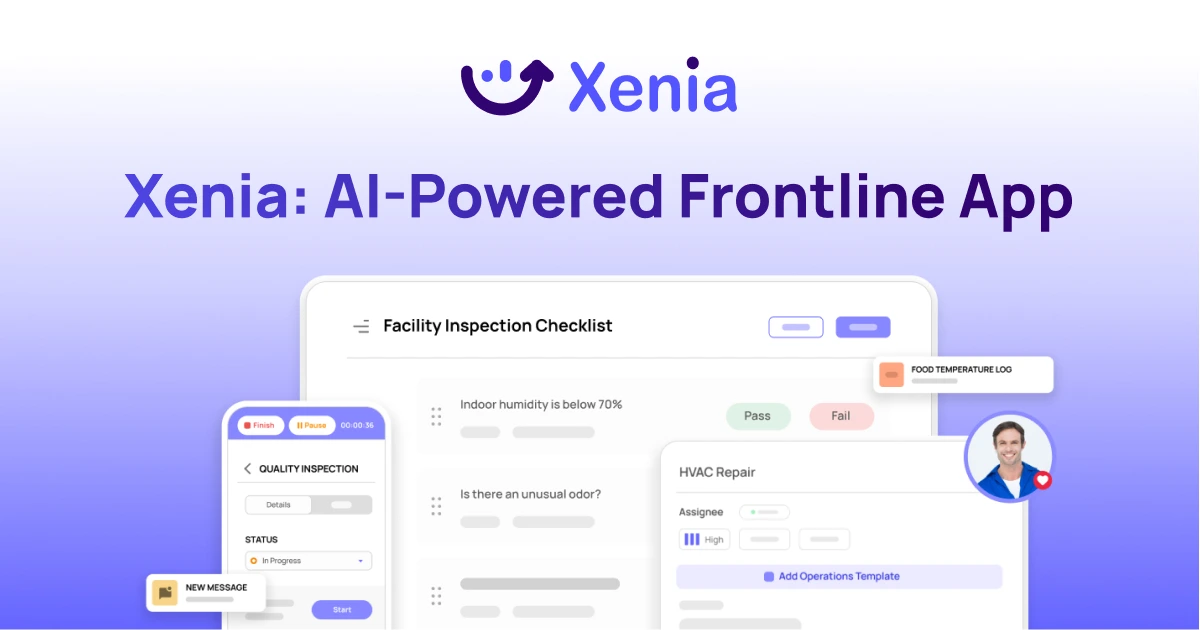
Why Multi-Location Operators Choose Xenia:
🤖 AI-Powered Operations, Create digital checklists instantly or convert paper forms with AI. Verify compliance automatically with photo analysis and get instant answers from your operational data.
✅ Daily Operations & Maintenance, Assign work across hundreds of locations in minutes. Report and route issues instantly. Schedule preventive maintenance to catch problems before downtime.
📊 Real-Time Visibility, Track completion, work orders, and performance across all locations through dashboards. Filter by site or asset to spot trends and take action.
Manage operations, maintenance, and compliance across all your locations from one platform

.svg)
.webp)
%201%20(1).webp)

.svg)
%201%20(2).webp)