
Post Summary
Most equipment does not just stop working one day.
It gives you signs. Small inefficiencies. Unusual sounds. Slightly longer cycle times.
Teams that catch these signs early keep operations running. Teams that miss them end up in emergency repair mode at the worst possible time.
Unplanned downtime costs businesses thousands per hour. Compliance failures add fines on top of that. And reactive repairs cost 3 to 5 times more than preventive maintenance.
The real problem? Most operations teams are still tracking maintenance through spreadsheets, binders, and text messages sent to personal phones.
Corporate teams have no visibility into what is happening at store level. Nobody finds out there is a problem until an inspector shows up.
A preventive maintenance schedule is how you get ahead of all of that.
.svg)

Priced on per user or per location basis
Available on iOS, Android and Web


What Is a Preventive Maintenance Schedule?
A preventive maintenance schedule is a planned calendar of maintenance tasks done before equipment fails. What gets serviced, how often, who does it, and when.
Think of it as your maintenance operation running on a plan instead of on panic.
Fixed vs Floating Preventive Maintenance Scheduling
Before building your schedule, understand the two ways PM scheduling works.
Fixed Scheduling happens on a set date regardless of when the last task was completed. The calendar drives the schedule. Best for compliance tasks and regulatory inspections.
Floating Scheduling calculates the next due date from when the previous work order actually closed. If a task completed March 15th instead of March 1st, the next one floats to June 15th. Best for usage-based equipment.
**
Aspect, Fixed Scheduling, Floating Scheduling
Trigger, Set calendar date, Completion of previous task
Best for, Compliance-regulatory inspections, Usage-based-high-volume equipment
Example, Fire suppression check every January, HVAC filter change 90 days after last service
**
Most operations teams need both. Compliance tasks run fixed. Equipment-based tasks run floating.
How to Make a Preventive Maintenance Schedule
Here is the process that works. Follow it in order.
Step 1: Identify Your Assets
Start with a full list of every piece of equipment that needs maintenance. For each asset capture the name and location, model number, age, manufacturer-recommended service intervals, and current service history.
One of the biggest pain points operations teams face is having no asset history at all. No warranty information. No serial numbers. No record of when the equipment was last serviced. A proper equipment management system solves this from day one. Building this list from scratch is the most important first step you will take.
Step 2: Categorize by Criticality
Not all equipment deserves the same attention. Sort assets into three tiers:
**
Tier, Definition, Example
Critical, Failure causes immediate shutdown, Walk-in cooler-HVAC-fuel systems
Important, Failure causes disruption but not shutdown, Ice machine-exhaust fan
Non-critical, Failure is inconvenient but manageable, Storage shelving-floor mats
**
Start with critical equipment first. Refrigeration, HVAC, fuel systems, and fire safety equipment before anything else.
Step 3: Define Tasks and Frequency
For each asset define exactly what the maintenance task involves and how often it runs. Be specific. "Check HVAC" is not a PM task. "Replace air filters, clean condenser coils, inspect belts" is. This is also the stage where you build out your checklists and SOPs so technicians know exactly what to do every time.
Common frequencies: daily, weekly, monthly, quarterly, semi-annual, annual.
Step 4: Decide Fixed or Floating
Assign a scheduling type to each asset. Compliance tasks get fixed schedules. Equipment-based tasks get floating schedules tied to actual completion.
Step 5: Assign Ownership
Every PM task needs a named owner. Not a team. A person. Internal technician or external vendor. Document it per task. Ambiguous ownership means tasks get skipped.
Vendor management is one of the most common failure points in PM programs. When a service provider is supposed to show up the next day but takes four or five days, and there is no centralized record, there is no accountability. Employee accountability tools and named ownership fix that.
Step 6: Build the Schedule
Put it all together. Your schedule should show asset name and location, task description, frequency and next due date, assigned technician or vendor, and fixed or floating designation.
Start with a monthly preventive maintenance schedule. Then layer in quarterly, semi-annual, and annual tasks. Use a preventive maintenance calendar to map this out before moving it into software.
Step 7: Automate It
A schedule that lives in a spreadsheet depends on someone remembering to check it. That is not a system.
Teams that email spreadsheets to maintenance personnel miss tasks constantly. No automatic reminders. No escalation when something is overdue. No visibility for anyone outside the email chain.
Use a preventative maintenance scheduler to auto-create work orders on your defined intervals. The right task goes to the right person at the right time without anyone manually triggering it.
Step 8: Review Quarterly
Your schedule is not set and forget. Review every quarter. Are tasks completing on time? Is any equipment generating more reactive work orders than expected? Do any intervals need adjusting based on actual wear patterns?
Track your PM compliance rate and mean time to resolution. The data tells you exactly where to make changes. This is where frontline reporting pays off. You can see across every location without chasing anyone down.
Preventive Maintenance Schedule Format
Your format does not need to be complicated. Clear, consistent, and actionable is all that matters.
Here is what a monthly preventive maintenance schedule format looks like:
**
Asset, Location, Task, Frequency, Due Date, Assigned To, Type
Walk-in Cooler, Store 12 Kitchen, Check door seals-clean condenser coils, Monthly, March 1, HVAC Vendor, Fixed
Exhaust Hood, Store 12 Kitchen, Degrease filters-inspect fans, Monthly, March 1, Internal Tech, Fixed
HVAC Unit, Store 12 Roof, Replace air filters-inspect belts, Quarterly, March 15, HVAC Vendor, Floating
Fire Suppression, Store 12 Kitchen, Full system inspection, Semi-annual, June 1, Licensed Vendor, Fixed
Generator, Store 12 Back Office, Test run-check fluid levels, Monthly, March 1, Internal Tech, Floating
**
Keep this format consistent across every location. Simpler format means more consistent usage.
Preventive Maintenance Schedule Examples by Industry
Different industries have different equipment. Here is what scheduled preventive maintenance looks like in practice.
Restaurants
**
Equipment, PM Task, Frequency
Walk-in cooler, Door seal check-condenser cleaning-temp verification, Monthly
Exhaust hood, Filter degreasing-fan inspection, Monthly
Fryer, Oil filtration check-thermostat calibration, Weekly
Grease trap, Pump out and inspection, Quarterly
**
Restaurant equipment maintenance is one of the highest-stakes areas in any PM program. A fryer or walk-in failure during a dinner rush is not just costly. It shuts down revenue entirely.
Retail
**
Equipment, PM Task, Frequency
HVAC, Filter replacement-coil cleaning-belt inspection, Quarterly
Refrigerated display cases, Condenser cleaning-door gasket check, Monthly
Lighting systems, Bulb replacement-fixture cleaning, Quarterly
POS systems, Hardware cleaning-backup verification, Monthly
**
For retail operations teams managing 25 or more locations, the challenge is not knowing what to maintain. It is making sure it actually happens consistently across every site.
Convenience Stores
**
Equipment, PM Task, Frequency
Fuel dispensers, Nozzle inspection-leak check-meter calibration, Monthly
Walk-in cooler, Condenser cleaning-door seal inspection, Monthly
Car wash equipment, Belt inspection-spray nozzle cleaning, Weekly
Fire suppression, Full system inspection, Semi-annual
**
Convenience store facilities management is uniquely complex because the equipment mix spans fuel systems, refrigeration, food service, and car wash in a single location.
HVAC Systems
**
Task, Frequency
Air filter replacement, Monthly or quarterly
Condenser and evaporator coil cleaning, Semi-annual
Belt and pulley inspection, Quarterly
Refrigerant level check, Annual
**
From Reactive to Preventive to Predictive
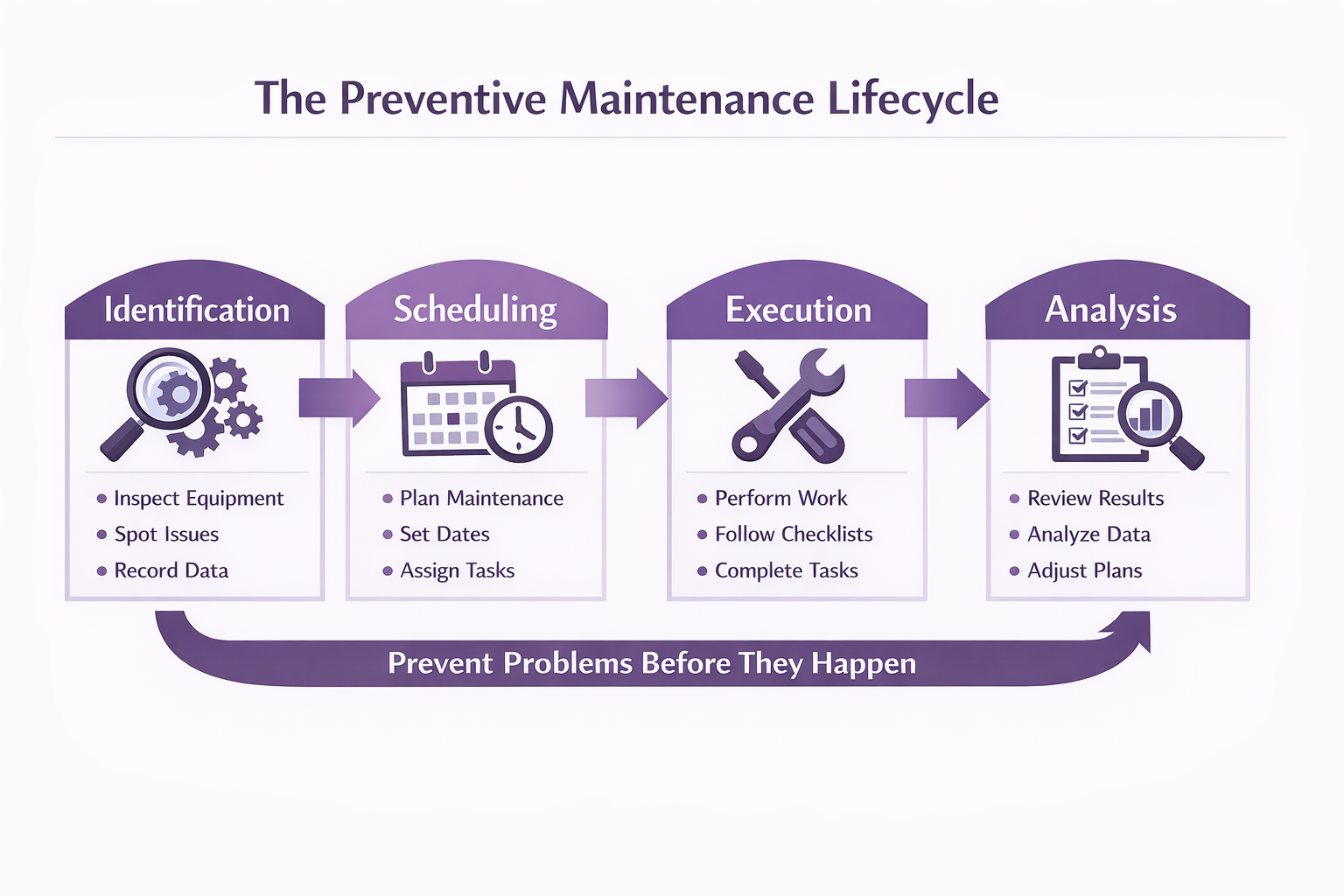
Most operations teams start in reactive mode. Something breaks. Someone fixes it. Repeat.
That is the most expensive way to manage equipment.
Reactive means waiting for failure. High repair costs. Unplanned downtime. Constant disruption.
Preventive means scheduling service before failure. Lower costs. Planned downtime windows. Predictable operations.
Predictive goes further. IoT sensors monitor equipment in real time. Temperature, vibration, pressure, energy consumption. When readings deviate, a work order triggers automatically before anything fails.
**
Stage, How It Works, Disruption
Reactive, Fix after failure, Unplanned
Preventive, Schedule before failure, Planned
Predictive, Trigger from sensor data, Near zero
**
A solid preventive maintenance schedule is the bridge that gets you from reactive to preventive, and positions you for predictive as your operation matures.
Xenia supports this transition. Start with scheduled PM work orders today. As your operation grows, layer in sensor-triggered automation that moves you toward predictive. The same platform handles both.
Preventive Maintenance Schedule Software
Spreadsheets break down fast when you are managing PM schedules across 10, 25, or 50 locations.
Tasks get missed. Ownership is unclear. Maintenance requests get lost in text threads on personal phones. Corporate teams have no visibility. No escalation when tasks go overdue.
Xenia's preventative maintenance schedule software is built for multi-location frontline operations teams.
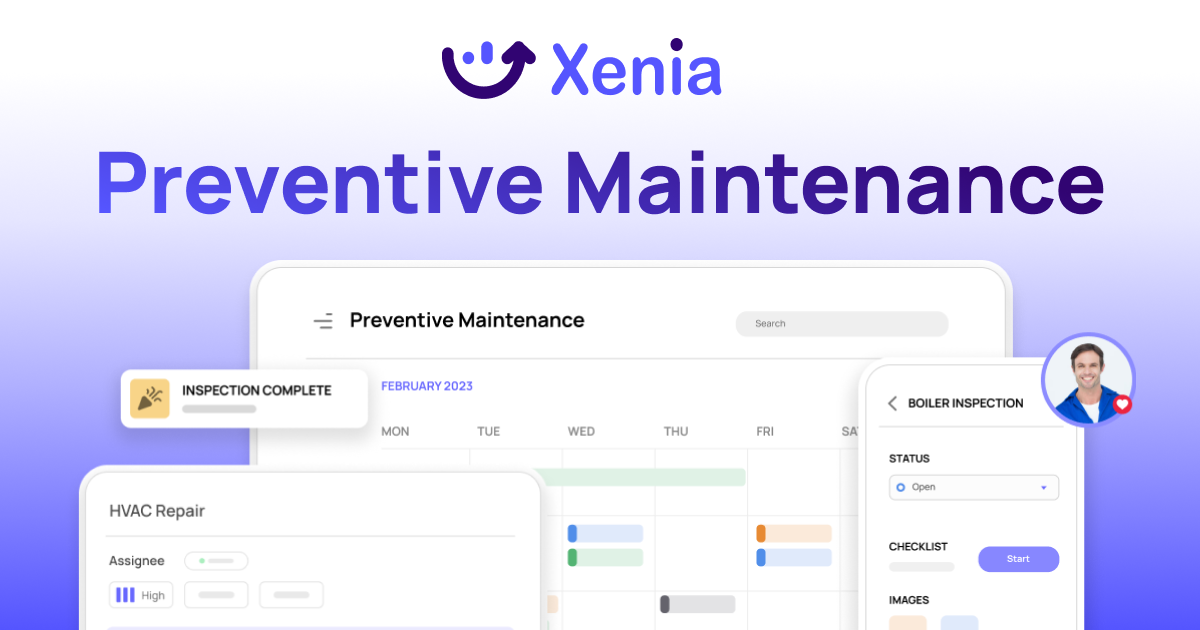
Auto-created work orders. Define your schedule once. Xenia creates work orders automatically on your fixed or floating intervals. Nobody has to remember.
Mobile-first execution. Technicians receive assignments on their phones. Complete the task, log notes, attach photos, close the work order from anywhere on the floor. See how the mobile app works for field teams.
QR code asset identification. Place a QR code on every piece of equipment. Each asset gets a full digital profile with serial number, warranty info, and complete service history. Technicians scan to access everything instantly.
Automatic routing by category. Work requests route automatically to the right team or vendor. HVAC goes to the HVAC team. IT goes to IT. No manual sorting. This is part of how Xenia handles multi-unit operations at scale.
Photo verification at completion. Every PM task requires a photo before the work order closes. Managers get visual confirmation the work was actually done. Xenia's AI photo analysis takes this further by flagging potential issues in submitted photos automatically.
Escalation workflows. PM tasks not completed by their due date escalate automatically. Nothing slips through unnoticed.
PM compliance reporting. See exactly what percentage of scheduled maintenance is completing on time across every location. Track recurring issues. Identify gaps before they become failures.
**
Function, Spreadsheet, Xenia
Work order creation, Manual every time, Auto-created on schedule
Task assignment, Manager manually assigns, Automatic by asset and location
Completion verification, Phone call or trust, Required photo documentation
Overdue visibility, Nobody knows, Automatic escalation
Asset history, Separate files, Searchable digital profile per asset
Reporting, Manual compilation, Auto-generated PM compliance reports
Multi-location visibility, Impossible at scale, Real-time dashboard across all locations
**
Related Resources
- Preventive Maintenance Calendar
- Equipment Maintenance Log
- Maintenance Work Order Log
- HVAC Preventive Maintenance Checklist
- Boiler PM Log
- Hotel Preventive Maintenance Calendar
- Restaurant Maintenance Log
- Best Preventative Maintenance Excel Template
Conclusion
Preventive maintenance keeps your operations running smoothly. Planning ahead stops small problems from turning into big emergencies.
Make a clear schedule, assign someone to each task, and automate reminders. This ensures nothing gets missed.
Check your schedule often and adjust when needed. Preventive maintenance scheduler like Xenia makes it easy to track every location.
Do maintenance right, and your equipment, team, and business will run better.
Frequently Asked Questions
Got a question? Find our FAQs here. If your question hasn't been answered here, contact us.
How does preventive maintenance software help?

Work orders create themselves, go to the right person, and escalate if overdue. You get full PM compliance visibility across every location without lifting a finger.
What should I prioritize first on my PM schedule?
Critical equipment first. Refrigeration, HVAC, fuel systems, and fire safety. Then high-cost and frequently failing assets next. Understanding deferred maintenance and what it costs your operation long-term is a useful exercise before you prioritize.
What is the best preventive maintenance schedule format?
A simple table with asset name, location, task, frequency, due date, assigned technician, and fixed or floating. Same format across every location.
How is a maintenance schedule prepared?
Start by listing every asset that needs maintenance. Categorize by criticality. Define the tasks and how often they need to happen. Assign a named owner to each task. Build the schedule, automate work order creation, and review every quarter.

A Modern, AI-Powered Platform Built Specifically for Frontline Operations
Xenia brings daily operations, maintenance, audits, and compliance into one mobile-first platform. Frontline teams execute work consistently across locations while leadership gets real-time visibility.
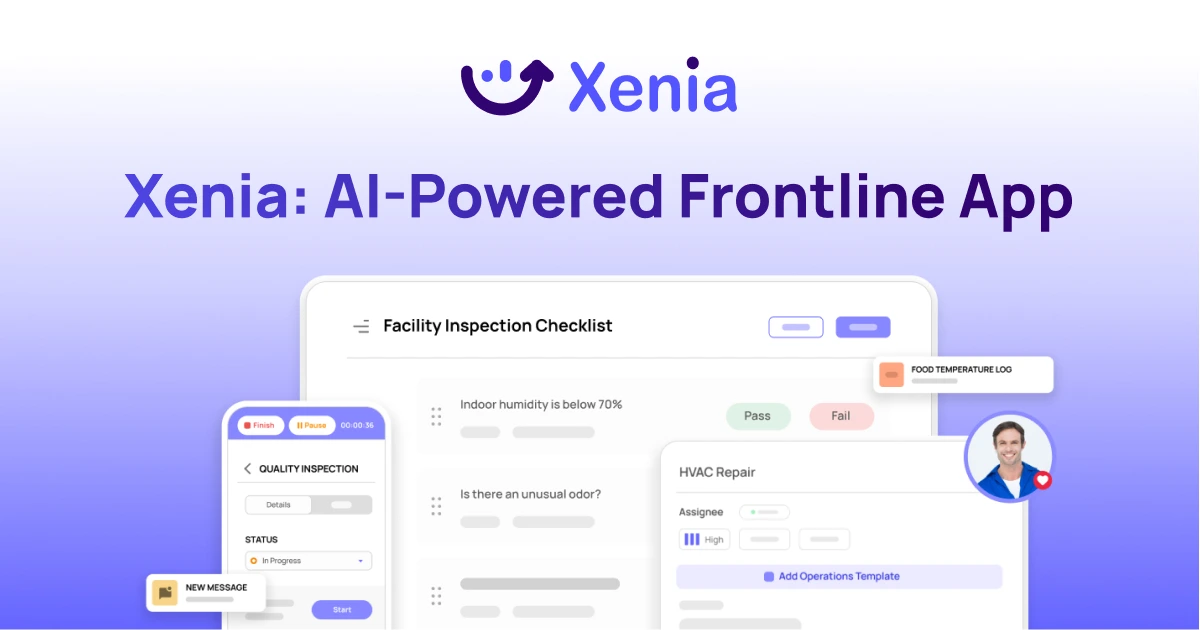
Why Multi-Location Operators Choose Xenia:
🤖 AI-Powered Operations, Create digital checklists instantly or convert paper forms with AI. Verify compliance automatically with photo analysis and get instant answers from your operational data.
✅ Daily Operations & Maintenance, Assign work across hundreds of locations in minutes. Report and route issues instantly. Schedule preventive maintenance to catch problems before downtime.
📊 Real-Time Visibility, Track completion, work orders, and performance across all locations through dashboards. Filter by site or asset to spot trends and take action.
Manage operations, maintenance, and compliance across all your locations from one platform

.svg)
.webp)
%201%20(1).webp)

.svg)
%201%20(2).webp)