
.webp)
Post Summary
Here's what happens at most retail brands.
Your merchandising team designs the perfect planogram. Marketing schedules the seasonal promotion. Operations sets the pricing strategy.
Everything looks great on paper.
Then you visit Store 47. The display? Wrong location. The signage? Never went up. Your premium products? Facing backward on the shelf.
Meanwhile, Store 52 executes everything perfectly. Store 47 struggles with basics.
This inconsistency is costing you sales. Every. Single. Day.
This is what we call the retail execution gap. It's the disconnect between what you plan at headquarters and what actually happens at the store level.
Here's the good news: You can fix it.
This guide will show you exactly how to close that gap using practical retail execution strategies, mobile verification, and real-time visibility across every location.
Let's dive in.
.svg)

Priced on per user or per location basis
Available on iOS, Android and Web


What Is Retail Execution?
Retail execution is the implementation of brand standards, promotional rollouts, and inventory management at the store level. Effective retail execution ensures that products are in the right place, at the right price, with the correct promotion, all verified through real-time reporting and visual documentation.
Think of it this way:
Strong retail execution means:
- Planograms actually match what's on the shelf
- Promotions launch on time across all locations
- Products are available when customers walk in to buy them
- Brand standards stay consistent from Store 1 to Store 150
- Problems get identified and fixed before they impact sales
Poor execution creates:
- The same brand looking completely different across locations
- Promotional investments not delivering expected returns
- Products technically "in stock" but customers can't find them on the shelf
Here's what makes the difference: systems.
Consumer goods retail execution requires verification, accountability, and real-time visibility. Not assumptions about what's happening at the store shelf.
Why Retail Execution Management Matters More in 2026
The truth is: If you're not prioritizing retail execution management right now, you're losing market share to competitors who are.
Here's why this matters more than ever:
**
Challenge, Impact on Your Business, Why It Matters Now
Promotional Complexity, Missing a promotional window by 2 days impacts ROI significantly, Brands run more frequent promotions targeting narrower segments
Shelf Competition, 6 inches of placement = difference between your product or competitor's, Your product competes with 15+ other brands in the same category
Labor Challenges, Inconsistent execution without clear systems, Store teams manage more with fewer experienced staff
**
Bottom line: The brands investing in retail execution software are gaining market share. The ones still using manual processes? They're falling behind.
Fast.
Common Retail Execution Process Challenges That Cost Sales
Let us walk you through the four most common execution problems.
Problem #1: Inconsistent In-Store Execution Across Locations
Corporate sends the same planogram to every store.
What happens:
- Store 23 executes it perfectly
- Store 71 interprets it differently
- Store 104 never implements it at all
Why this happens:
- Physical distance makes verification difficult
- Store teams face different constraints
- Communication gaps create inconsistency
The impact:
- Your brand looks different across markets
- Merchandising investments deliver uneven returns
- You don't know which stores need support
Problem #2: Delayed Problem Identification in Retail Execution Monitoring
Here's a real scenario:
A promotional display should launch on Friday. It doesn't go up until Monday. You discover this on Thursday when your regional manager happens to visit.
That's six days after the promotion started.
The problem: Manual verification cycles create information delays. By the time you identify problems, sales opportunities already passed.
Gone.
Problem #3: Limited Visibility Into Execution Quality
Your team completes the internal store audit checklist. They mark "planogram executed" on the audit form.
Sounds good, right?
But here's the question: What does "executed" actually mean?
**
What You Think Happened, What Actually Happened
Exact planogram match, Minor variances throughout
All specified SKUs in place, Substituted similar products
Perfect brand standards, Approximate implementation
**
Without visual documentation, you can't tell the difference between excellent execution and approximate implementation.
Problem #4: No Connection Between Execution and Sales Performance
Store 52 consistently outperforms Store 47 in your product category.
Similarities:
- Same demographics
- Similar traffic patterns
- Same general setup
The question: What's different?
Without execution data connected to sales results, you can't identify what drives these performance differences.
4 Retail Execution Strategies That Actually Work
These are the retail execution strategies that actually move the needle.
Strategy #1: Mobile Inspections With Photo Verification
Traditional paper audits rely on subjective assessments.
Someone writes "looks good" and that's it.
Mobile inspections with AI-powered photo verification? Completely different game.
Here's how it works:
Store teams or field reps use mobile devices to complete inspection checklists
- Each critical item requires a photo before they can mark it complete
- No photo? Can't check the box
- The system captures exactly what's happening at the shelf level
Regional managers review photos remotely
They can also leave comments directly on issues, and request re-uploads instantly, all in one platform.
The real advantage? You verify merchandising at 100% of stores every week instead of the 10-15 locations your team can physically visit. AI flags problems automatically. Managers review exceptions only, not every photo.
Result: 15-20 hours saved per week on manual review. Better resource allocation, visit stores that need coaching, not random sampling.
Strategy #2: Clear Task Assignment for Retail Execution Services
Effective retail execution strategy assigns clear ownership for every single activity.
Key questions to answer:
- Who sets the promotional display?
- When does it need to be complete?
- Who verifies it?
- Who fixes issues if they come up?
Digital task assignment in retail:
**
Role, Assigned Tasks
Store Managers, Promotional setup tasks
Department Leads, Planogram compliance tasks
Field Reps, Competitive intelligence audits
District Managers, Photo documentation review
**
Every team member sees their specific responsibilities.
Nothing falls through the cracks.
Strategy #3: Side-by-Side Image Comparison for Retail Execution Insights
Traditional planogram verification requires field reps to manually compare shelf reality against planogram standards.
It's time-consuming and inconsistent.
Side-by-side image comparison works differently:
Step 1: Store teams photograph shelf sets using their mobile devices
Step 2: The image appears right next to the reference planogram image
Step 3: Photo markup tools let you:
- Circle discrepancies
- Draw arrows pointing to specific issues
- Add feedback directly on the images
Result: Crystal-clear visual direction showing exactly what needs correction.
No confusion. No ambiguity.
Strategy #4: Real-Time Corrective Actions
When mobile inspections identify execution issues, manual follow-up creates delays.
Automated corrective action workflow:
Issue Identified → Task Created → Manager Assigned → Deadline Set → Photo Verification → Resolution Tracked
How it works:
- System identifies a planogram variance during morning inspection
- Automatically creates a corrective action task
- Assigns it to the department manager
- Sets a resolution deadline based on issue severity
- Manager receives task with photo showing what needs to be corrected
- They fix it and document completion with follow-up photo
- System tracks resolution time
District leadership sees which issues get resolved quickly and which locations need additional support.
All without manual tracking spreadsheets.
Building Your Retail Execution Strategy: Implementation Guide
Want to implement this? Here's your step-by-step plan.
Step 1: Start With One High-Impact Category
Don't try to overhaul your entire retail execution process simultaneously.
That's a recipe for failure.
Focus on one category with the highest improvement potential:
- Your highest-revenue product line
- A category with poor execution track record
- A new product launch requiring precise execution
- A promotional program with significant trade spend
Prove the concept. Build your internal success story. Then expand to additional categories.
Step 2: Run a Pilot Program
Select pilot locations strategically:
**
Selection Criteria, Why It Matters
Mix of high and average performers, See impact across performance levels
Geographic diversity, Test in different markets
Different retail formats, Ensure solution works everywhere
Experienced managers, Get constructive feedback
**
What to do during pilot:
- Test your workflows
- Refine your processes
- Identify training needs
- Document measurable results
Metrics to track:
- Compliance score improvements
- Problem resolution time reduction
- Field team efficiency gains
Step 3: Build Your Inspection Template Library
Set teams up for success with pre-configured content.
Create templates for:
Daily Execution:
Weekly Verification:
- Planogram compliance checks
- Promotional display maintenance
- Inventory availability audits
Monthly Assessments:
- Brand standard audits
- Competitive intelligence capture
- Seasonal campaign verification
Make the system immediately useful from day one.
Field reps shouldn't have to build inspection forms from scratch.
Step 4: Train Field Teams Before Store Rollout
Your field team becomes expert users before you deploy to all stores.
Field rep training should cover:
- Complete platform functionality
- How to conduct photo-verified inspections
- How to use side-by-side image comparison effectively
- How to create clear corrective actions from images
- How to analyze execution data
- How to identify and share best practices
Field reps provide on-the-ground support when store teams have questions.
Their expertise drives store-level adoption success.
Step 5: Connect Execution Data to Sales Performance
This is where you prove ROI.
Link execution scores to sales analytics:
**
Analysis Question,What It Reveals,Action You Take
Do higher planogram compliance scores drive category sales,Correlation between execution and revenue,Prioritize compliance in high value categories
Which promotional execution elements impact lift most,What execution details matter most,Focus field team on high impact elements
How quickly do execution improvements translate to revenue gains,Timeline for ROI realization,Set realistic expectations with leadership
Which stores show strong execution but poor sales,Other issues beyond execution,Investigate additional factors
**
This analysis proves execution program ROI and identifies which execution activities deserve investment priority.
Retail Execution Reporting: Metrics That Matter
Focus on these metrics:
Execution Metrics
**
Metric,What It Measures
Planogram Compliance Rate,Percentage of planogram elements executed correctly
Promotional Setup On Time Rate,Percentage of promotions launched by target date
Brand Standard Score,Average across cleanliness signage display maintenance
Photo Verification Rate,Percentage of required inspections with complete photos
Corrective Action Resolution Time,Average hours between issue identification and resolution
**
Business Impact Metrics
**
Metric,What It Reveals,How to Use It
Category Sales Velocity,Sales per week per store in audited categories,Correlate with execution scores
Promotional Lift,Sales increase during promotional periods,Measure execution impact on promotions
Out of Stock Rate,Percentage of inspections where key SKUs are unavailable,Identify inventory execution gaps
Shelf Space Share,Your brands shelf allocation vs category total,Track competitive position
**
Here's the truth: Focus on outcomes, not just activity.
Completing 500 inspections matters less than the compliance improvements and sales impact that those inspections enable.
How Xenia Improves Retail Execution Management
Most brands manage execution across multiple disconnected systems.
The typical mess:
- Task management platform
- Mobile inspection software
- Photo documentation tool
- Separate compliance tracking
- Different analytics dashboards
Each additional system creates complexity. Multiple logins. Different interfaces. Data that doesn't connect automatically.
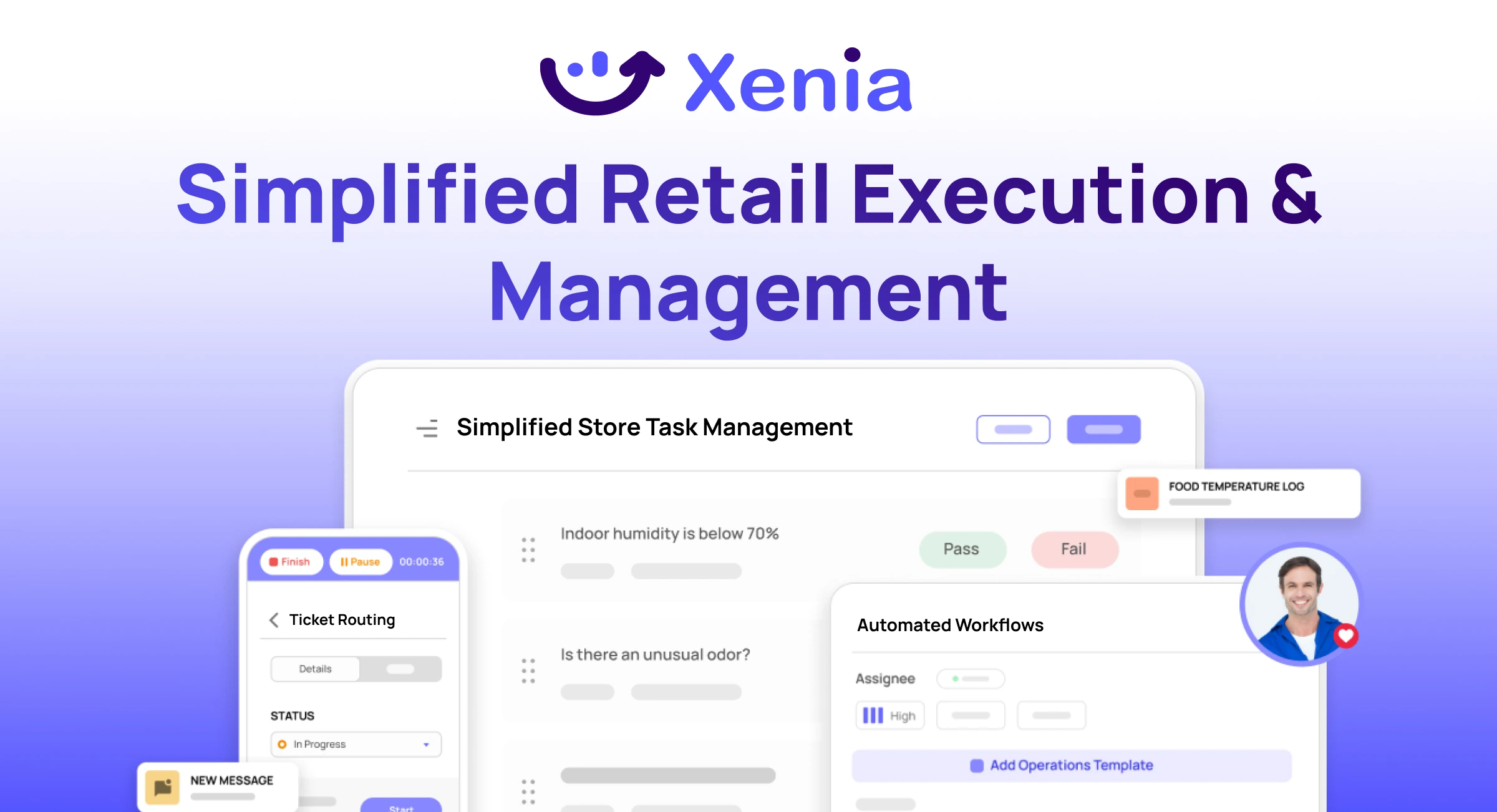
Xenia combines task management, mobile inspections, and execution monitoring into a single retail execution management software.

Here's what unified integration delivers:
**
Function, How It Works in Xenia, Why It Matters
Task Assignment, Assign to teams and individuals with clear ownership and deadlines, Everyone knows their responsibilities
Mobile Inspections, Conduct inspections from any device with photo requirements, Verify execution anywhere & anytime
Image Verification, Side-by-side reference image comparison with photo markup tools, Objective compliance assessment
Create Tasks From Images, Generate corrective actions directly from inspection photos, Faster problem resolution
Corrective Actions, Flow automatically from failed inspection steps with clear ownership, No issues fall through cracks
Live Progress Tracking, Real-time dashboards showing execution status across all locations, Instant visibility into execution
Template Library, Thousands of ready-to-use retail operations templates, Launch faster with proven frameworks
**
Store teams complete execution tasks in one interface. Field managers monitor compliance across all locations from one dashboard.
Every capability works together in your complete execution program.
FAQs
What are the most effective retail execution strategies for consumer goods brands?
Three things: clear standards, mobile verification, and automated accountability.
Define what good execution looks like with reference images. Require photo verification for every inspection. Automate corrective actions so issues get assigned immediately.
Track compliance scores to spot patterns and optimize performance.
How do I improve in-store execution and compliance across 100+ locations?
Focus on exception-based monitoring. Deploy resources to stores that need support.
Use side-by-side image comparison for planogram verification. Implement role-based task assignment for clear ownership.
Track execution scorecards to identify what works and what doesn't.
What is the role of real-time reporting in modern retail execution management?
Real-time reporting makes you proactive instead of reactive.
You spot problems immediately. Field teams see which stores need support. Leadership connects execution to sales instantly.
Fix execution gaps before they impact revenue.
How can image verification improve retail execution and shelf-health monitoring?
Image verification eliminates guesswork.
Store teams photograph the current execution next to reference images. Field managers mark discrepancies directly on photos.
You track compliance based on documented evidence, not opinions. Either it matches, or it doesn't.
Conclusion
Look for platforms that connect your retail execution process instead of adding more disconnected tools.
When task management, mobile inspections, and image verification work together in one system, your teams spend less time managing systems and more time executing standards.
Xenia combines these capabilities in a single retail execution software.
Want to see how it works? Book a demo.
Frequently Asked Questions
Got a question? Find our FAQs here. If your question hasn't been answered here, contact us.

Looks like there's no data available in our FAQ section at the moment.

A Modern, AI-Powered Platform Built for Retail Operations
Xenia brings store operations, merchandising, audits, and loss prevention into one mobile-first platform. Store teams execute daily work consistently, maintain brand standards, and resolve issues faster, while regional and corporate leadership get real-time visibility across all locations.
Why Retail Operators Choose Xenia:
🤖 AI-Powered Merchandising, Verify planograms, displays, and brand standards automatically with AI photo analysis. Build digital checklists instantly or convert existing merchandising guides.
🏬 Operations & Loss Prevention, Assign opening procedures, store walks, and resets across locations. Track theft, cash discrepancies, and security incidents with evidence and approval workflows.
📊 Real-Time Visibility, Compare audit scores and task completion across stores. Identify top and underperforming locations. Export reports for leadership reviews.
One platform for operations, merchandising compliance, and loss prevention across all locations.

.svg)
.webp)
%201%20(1).webp)

.svg)
%201%20(2).webp)