
.webp)
Post Summary
A district manager overseeing 12 restaurant locations spends 4 hours every Sunday reviewing next week's schedules.
Cross-referencing labor budgets, availability, historical sales, and compliance windows. And still gets it wrong on Thursday night when a rush hits a location that was scheduled for light coverage.
The data to build a better schedule existed. The time and system to use it did not.
AI scheduling is not a futuristic concept. Operations leaders at mid-to-large multi-unit businesses are evaluating it right now. This article explains what it actually does, in operational terms that matter for leaders managing frontline hourly workforces.
.webp)
.svg)

Priced on per user or per location basis
Available on iOS, Android and Web


What AI scheduling actually is in Frontline Operations
AI scheduling is the use of machine learning and data analysis to automate and improve how employee schedules are built, adjusted, and optimized.
It is not a single feature. It is a layer of intelligence applied to the scheduling process.
Here is the critical distinction most vendors blur:
**
Scheduling approach, How it works, Does it improve over time?
Manual scheduling, Manager builds schedule from memory and habit, No
Rule-based automation, System applies fixed rules (if X then Y), No
AI scheduling, System learns from historical data and improves forecasts, Yes
**
AI scheduling gets smarter. Rule-based automation just runs faster. That difference matters enormously at scale.
Three capabilities define AI scheduling in practice.
Pattern recognition from historical data
AI scheduling systems analyze historical sales, traffic, and labor data to find patterns that humans miss.
Which shifts are consistently underserved. Which locations spike at specific times. Which day-of-week combinations reliably produce overtime. This is the foundation. A system that cannot learn from the past cannot predict the future.
Demand forecasting
The most commercially mature AI scheduling capability. The system uses historical patterns plus external signals like weather and local events to predict how busy each location will be for each shift window.
The schedule is built against that forecast, not against last week's headcount. This is the difference between a schedule that reflects actual expected demand and one that just copies the past.
Constraint optimization
AI scheduling simultaneously balances multiple competing constraints:
- Employee availability and role qualifications
- Labor budget targets by location
- Overtime thresholds and compliance rules
- Predictive scheduling notice windows
A human scheduler balancing all of this manually for 12 locations needs hours. The system does it in seconds. And it applies every constraint at once, not sequentially.
How AI employee scheduling works: step by step
How does it actually work? Five stages, described operationally, no technical jargon.
Stage 1: data ingestion
The system pulls in data from multiple sources:
- Historical sales by location and day-part
- Employee availability and approved time-off requests
- Overtime accumulation by employee
- Labor budget targets by location
- Compliance rules by jurisdiction
The quality of the output depends entirely on the quality of this input. Operators with clean HRIS and scheduling data get meaningfully better AI outputs than those starting with gaps. This is the most important thing to know before buying any AI scheduling tool.
Stage 2: demand forecast generation
The system analyzes historical patterns and generates a demand forecast by location, shift window, and role type.
How many servers does Location 7 need on Friday at 6pm? The AI calculates from actual performance data. Not the manager's intuition. Not last week's schedule copy. External feeds like weather APIs and local event calendars can sharpen the forecast further.
Stage 3: auto-fill against constraints
The system assigns available employees to shifts based on the demand forecast, subject to all loaded constraints simultaneously.
Role requirements, availability windows, overtime limits, labor budget caps. All applied at once. The result: a draft schedule that already satisfies most constraints. The manager reviews exceptions rather than building from scratch.
Stage 4: exception flagging for manager review
AI scheduling does not replace manager judgment. It focuses it.
Shifts the system could not fill cleanly are flagged for human review. Employees approaching overtime are highlighted. Compliance risks are surfaced. The manager spends time making decisions, not entering data. That is the operational shift that matters.
Stage 5: continuous learning
After each schedule period, the system compares predicted demand against actual demand. It updates its forecasting model accordingly.
A system running for six months at a location is meaningfully more accurate than one in its first week. This is the core advantage of AI over rule-based automation. It improves without being reprogrammed.
The AI scheduling process at a glance:
**
Stage, What happens, Who does it
Data ingestion, Historical sales-availability-compliance rules pulled in, System
Demand forecast, Predicts staffing need by location and shift window, System
Auto-fill, Assigns employees against all constraints simultaneously, System
Exception flagging, Surfaces gaps-overtime risks-compliance issues, System flags-manager decides
Continuous learning, Compares forecast vs actual-updates model, System
**
What AI scheduling changes for multi-unit operators
Three specific operational shifts at the district manager and VP level. These are not generic efficiency claims. They are the changes that show up in the P&L.
Scheduling moves from reactive to proactive
Without AI, scheduling is reactive. Managers build next week's schedule based on last week's pattern and fix coverage failures on the fly.
With AI, scheduling is proactive. The system sees that next Thursday is forecasted 40% busier than the prior week and flags it for additional coverage before the schedule publishes. The gap is prevented rather than recovered from.
That is a fundamentally different position to be in at 7 pm on a Thursday night.
Labor cost visibility moves to the front of the process
In manual scheduling, labor cost as a percentage of sales is a retroactive metric. It shows up after payroll closes.
In AI-assisted scheduling, the system calculates projected labor cost as each shift is built. A manager about to publish a schedule that will put two locations over their labor budget target sees that signal before publishing. Not two weeks later in a variance report.
Real-time reporting that surfaces labor data during the scheduling process, rather than after payroll closes, is the operational change that matters most for above-store leaders.
Compliance risk is managed by the system, not the manager
For multi-unit operators with locations across multiple states, managing different overtime rules, break requirements, and predictive scheduling notice windows manually is nearly impossible at scale.
AI scheduling systems apply jurisdiction-specific compliance rules automatically as constraints. Schedules that would violate California's daily overtime rules or Seattle's predictive scheduling notice requirements do not get generated without a flag.
The compliance burden shifts from manager awareness to system enforcement. That is a real change for any operator running locations in multiple states.
For operations leaders managing schedules across locations, understanding how to collect and use employee availability data is essential. Our employee availability guide covers how to structure availability collection so AI systems have clean constraint data to work with.
Where AI scheduling has limits
This section is what separates thought leadership from marketing copy. Three genuine limitations, written plainly. Any vendor who cannot answer these questions directly is worth being skeptical of.
AI scheduling requires clean input data
A demand forecasting model is only as good as the historical data it learns from. Operations with inconsistent time tracking or data in spreadsheets will not see the same results as those with clean, centralized, consistently structured data.
The first phase of any AI scheduling implementation is often a data quality project. Operators who skip this step get AI-shaped noise, not AI-driven insights.
It cannot account for context the data does not capture
A new competitor opening nearby. A popular manager leaving. A product launch driving unusual traffic. These signals do not show up in historical data automatically.
AI scheduling systems surface data-driven recommendations. They do not know what the manager knows from being on the ground. Human judgment remains essential for decisions that require context the data does not capture. The two work together, not in competition.
Adoption depends on manager behavior as much as technology
If managers override every AI recommendation without reviewing the logic, the system never improves. If employees do not trust the system to generate fair schedules, adoption stalls.
Successful AI scheduling implementations invest as much in training and change management as in the technology itself. The tool is only half the implementation.
Where AI scheduling delivers vs where it has limits:
**
Area, AI scheduling delivers, AI scheduling has limits
Demand prediction, Pattern-based forecasts from historical data, Cannot account for new context data does not capture
Constraint management, Simultaneous balancing across all rules, Only as good as the rules loaded into the system
Labor cost visibility, Real-time projected cost as schedule is built, Requires clean data inputs to be accurate
Compliance enforcement, Jurisdiction-specific rules applied automatically, Manual updates needed if laws change
Manager role, Frees time from data entry to decision-making, Requires manager buy-in to work properly
**
What to look for in an AI scheduling tool
Five evaluation criteria for operations leaders actively assessing options.
Does it learn from your data or apply generic rules?
The distinction between true AI and rule-based automation. A system that applies fixed rules is not AI. A system that learns from your specific location's historical patterns and improves its forecasts over time is AI.
Ask vendors directly: how is the demand forecast model trained and updated?
How does it handle multi-jurisdiction compliance?
For operators with locations in multiple states, this is non-negotiable. The system must apply different rules by location. Verify whether it automatically updates when state or local laws change or whether that requires manual maintenance.
What does the manager interface actually look like?
If the scheduling interface requires heavy training to use, adoption will be low. The manager-facing view should:
- Surface exceptions clearly
- Show projected labor cost in real time
- Make overrides easy with a clear audit trail
Test the interface with the actual managers who will use it before committing.
How does it integrate with existing HR and payroll systems?
A scheduling tool that does not connect to the HRIS and payroll system creates a new data entry burden rather than eliminating one. Confirm integration depth: bidirectional, handles employee lifecycle events automatically.
What happens when the AI gets it wrong?
The question most operators forget to ask. What is the escalation and correction process when a forecasted demand turns out to be significantly off? How are manager corrections fed back into the model?
A good AI scheduling system has a clear answer. A vague one is a warning sign.
Related resources
- Workforce Scheduling Guide
- Employee Scheduling Guide
- Employee Availability Guide
- Predictive Scheduling Laws
- Overtime Laws Explained
Conclusion
The four hours the district manager spends rebuilding schedules every Sunday are not a management problem. They are a data problem.
The information needed to build a better schedule existed across sales reports, availability records, and labor budgets. AI scheduling turns that dispersed data into a draft schedule that already accounts for demand, compliance, and cost. The manager spends 20 minutes on exceptions rather than four hours on construction.
For multi-unit operators, the ROI goes beyond time saved. It is coverage gaps prevented, overtime caught before it is worked, and compliance risks managed by the system rather than by institutional memory.
Use Xenia's multi-unit operations platform to bring AI-assisted scheduling, real-time labor visibility, and workforce optimization together across every location. See how Xenia works.
Frequently Asked Questions
Got a question? Find our FAQs here. If your question hasn't been answered here, contact us.
What is the difference between AI scheduling and predictive scheduling laws?

Two different things. Predictive scheduling laws require advance notice and pay premiums for last-minute changes. AI scheduling is a technology. A good tool treats those legal requirements as compliance constraints built into the scheduling process.
Can employees see their AI-generated schedule?
Managers review and publish the schedule. Once published, employees get it on mobile and can request swaps or flag conflicts through the same system.
Does AI scheduling work with high employee turnover?
Yes. The demand forecast runs on location-level sales data, so turnover does not affect it. What does get affected is shift matching. New employee availability and qualifications need to be loaded in promptly as people join.
How is AI scheduling different from a regular scheduling tool?
A regular scheduling tool lets managers build schedules digitally. AI scheduling analyzes patterns, forecasts demand, and auto-fills shifts. If a manager still assigns every shift manually, it is a digital tool, not AI.
How long does AI scheduling take to implement?
Four to twelve weeks, depending on data readiness. Clean HRIS data means faster setup. Spreadsheet-based operations typically spend the first month on data cleanup. A single-location pilot can go live in two to three weeks.

A Modern, AI-Powered Platform Built Specifically for Frontline Operations
Xenia brings daily operations, maintenance, audits, and compliance into one mobile-first platform. Frontline teams execute work consistently across locations while leadership gets real-time visibility.
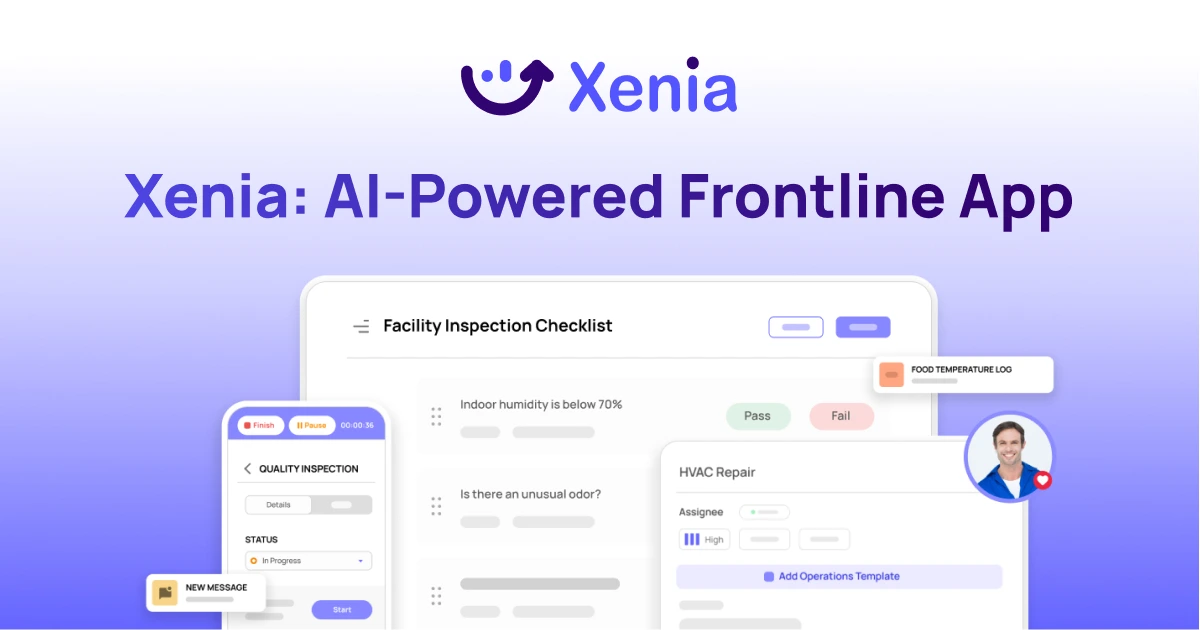
Why Multi-Location Operators Choose Xenia:
🤖 AI-Powered Operations, Create digital checklists instantly or convert paper forms with AI. Verify compliance automatically with photo analysis and get instant answers from your operational data.
✅ Daily Operations & Maintenance, Assign work across hundreds of locations in minutes. Report and route issues instantly. Schedule preventive maintenance to catch problems before downtime.
📊 Real-Time Visibility, Track completion, work orders, and performance across all locations through dashboards. Filter by site or asset to spot trends and take action.
Manage operations, maintenance, and compliance across all your locations from one platform

.svg)
.webp)
%201%20(1).webp)

.svg)
%201%20(2).webp)