
.webp)
Post Summary
A VP of HR at a multi-unit operator has 2,000 hourly employees across 80 locations. Turnover is running at 60% annually. Three new locations are opening in Q3. A labor law change in two of their markets takes effect in 90 days. And corporate is asking HR to reduce headcount costs by 8% without impacting service levels.
Every one of those is a workforce planning problem. Not an HR administration problem.
Here is the difference. HR administration reacts to workforce events as they happen. HR planning builds the system that anticipates them. For organizations with large hourly workforces, the gap between the two is where labor costs run over, compliance exposure accumulates, and growth plans stall.
.webp)
.svg)

Priced on per user or per location basis
Available on iOS, Android and Web


What is human resource planning?
Human resource planning is the process of aligning workforce supply with business demand.
Right people. Right skills. Right locations. Right cost. Right time.
Most operators can describe it. Very few can deliver it. For multi-unit operators, that means planning at the location level, not just the company level.
How the three workforce layers differ:
**
Layer, What it covers, Time horizon
HR administration, Day-to-day workforce events: hiring-scheduling-payroll, Weekly / monthly
Workforce management, Execution of labor plans across locations, Monthly / quarterly
HR planning, Aligning workforce supply with future business demand, Quarterly / annual
**
HR planning is the strategic layer above both. For the enterprise-level view, see enterprise workforce management.
The importance of HRP for workforce-heavy organizations
The importance of HRP becomes clearest when the workforce is large, hourly, and distributed across multiple locations.
Turnover is a planning variable, not an exception
In many hourly frontline industries, annual turnover rates of 50-100% are normal. Workforce planning must account for continuous replacement hiring as a baseline, not as a deviation from plan.
A VP of HR who plans for stable headcount in a 70%-turnover environment is planning for a workforce that does not exist.
Headcount requirements vary by location as much as by company
A 50-location retail operation may need very different staffing ratios at a high-volume urban location versus a suburban store. HR planning that operates at the company level without location-level granularity misallocates resources. Every time.
Compliance exposure scales with every new location and every new market
Each market the organization enters may bring new labor law requirements:
- Minimum wage thresholds
- Predictive scheduling mandates
- Break requirements
- Overtime rules
For multi-state operators, compliance is a planning input. Not an afterthought.
Growth plans create workforce demand ahead of revenue
New location openings require trained staff before the location generates revenue. The hiring, onboarding, and training cycle for hourly frontline workers, typically 2-8 weeks, must be built into growth planning timelines.
Operators who start hiring when the lease is signed are already behind.
The process of HRP: 7 steps explained
The process of HRP runs in seven interdependent steps. Each one builds on the last.
Step 1: know your current workforce
Get an accurate picture of the present before anything else.
How many people. What roles. Which locations. What skills. For most multi-unit operators, that data lives in three different systems and a filing cabinet.
No visibility into the present means no plan for the future.
- When done well: Leadership pulls headcount by location, role, and skill level in minutes.
- When missing: Planning starts from guesses. Plans fall apart on day one.
Step 2: forecast what you will need
Based on revenue targets, location openings, and seasonal patterns: what roles are needed, where, and in what quantities?
For multi-unit operators, this is a location-by-location exercise. Not a company-level headcount number. Use frontline reporting that gives operations leaders location-level labor data to build an accurate forecast.
- When done well: New location openings have a staffing plan with hire dates and training timelines ready 90 days out.
- When missing: New locations open understaffed and the first 30 days are a crisis.
Step 3: identify the gap between supply and demand
The workforce gap is the difference between what the organization has today and what it will need at a defined future point.
The gap has two dimensions:
**
Dimension, What it measures
Quantity gap, How many people are missing at each location
Quality gap, What skills and certifications are missing by role
**
For multi-unit operators, this analysis must be done at the location level. A company-level surplus in one market may coexist with a shortage in another. Operating at the aggregate level hides the real problem.
- When done well: Leadership sees locations at risk of understaffing 60 days before the risk materializes.
- When missing: The gap is discovered when service fails.
Step 4: develop the workforce plan
The workforce plan is the bridge from current state to desired state. The hiring, training, redeployment, and attrition management actions needed to close the gap.
Replacement hiring is a continuous process, not a project. The plan should include:
- Role-specific hiring targets by location
- Training pipeline capacity
- Internal promotion pipelines
- Contingency staffing: seasonal hires, on-call pools
When done well: Hiring managers at each location have a monthly hiring target and know which roles are priority.
When missing: Hiring is reactive and perpetually behind.
Step 5: execute recruitment and onboarding
The plan is only as good as the pipeline that feeds it.
Recruitment must be localized. The sourcing channels that work in one market may not work in another. Onboarding must be standardized. A new hire anywhere should receive the same foundational training regardless of which manager handles their first week.
That consistency is what separates operators with stable teams from those always catching up. HR workflows that connect onboarding across locations deliver that consistency without requiring each manager to build it from scratch.
- When done well: New hires in every market complete a consistent onboarding process and are fully productive within a defined window.
- When missing: Onboarding quality varies by location and manager. Early turnover rates reflect it.
Step 6: develop and retain existing talent
Hiring to replace turnover is the most expensive workforce strategy. Developing and retaining existing employees is the most cost-efficient. Most operators get this backwards.
Retention is a location-level problem. The same organization can have 30% turnover at one location and 90% at another. Retention planning must identify what is driving attrition at each location and address it there, not at the company level.
Development planning must include a clear path from frontline role to supervisory role. Use employee accountability systems that create visibility into individual performance and development progress across all locations.
- When done well: Internal promotion rates are tracked and career paths are visible to frontline employees from day one.
- When missing: The best employees leave for competitors who offer a clearer path forward.
Step 7: monitor, measure, and adjust
HR planning is not a once-a-year exercise. Conditions change fast.
A location opens. A labor law changes. A competitor raises wages. A key manager leaves.
Review the plan on a regular cadence:
- Monthly for tactical adjustments
- Quarterly for strategic realignment
The metrics that matter most are location-level:
**
Metric, Why it matters
Turnover rate by location, Identifies retention problems before they compound
Time-to-fill by role and market, Flags sourcing gaps early
Labor cost as % of revenue by location, Connects workforce decisions to financial outcomes
Compliance incident rate, Tracks exposure before it becomes liability
**
- When done well: Deviations from plan are visible early enough to course-correct before they become financial or operational problems.
- When missing: The plan becomes a document reviewed once a year and ignored the rest of the time.
What makes HR planning fail in practice
Most HR planning fails for one of three reasons. They are predictable. And they are fixable.
Planning at the company level instead of the location level
A company-level workforce plan misses the location-specific demand, supply, and compliance variables that drive actual outcomes. Multi-unit operators need a planning framework that aggregates from the location up. Not one that distributes from corporate down.
The two approaches produce fundamentally different plans. One reflects reality. The other reflects an average.
Treating turnover as abnormal instead of planning for it
In high-turnover industries, a workforce plan that assumes stable headcount is wrong before it is published. Building turnover rates into the baseline, as a planning input rather than a problem to be solved, produces plans that are achievable rather than aspirational.
The operators who get this right stop trying to solve turnover with the workforce plan. They plan around it.
No feedback loop between the plan and operational reality
A workforce plan reviewed once a year is a document, not a management tool.
The plan must stay connected to operational data: labor cost, turnover, time-to-fill, and compliance incidents. Without that connection, the plan drifts from reality in weeks.
Related resources
- Workforce Scheduling Guide
- Workforce Management Best Practices
- Predictive Scheduling Laws
- Overtime Laws Explained
Conclusion
Replacing a frontline employee costs 40% of their annual salary. Most multi-unit operators replace a large chunk of their workforce every year. The math compounds fast. Most of it is avoidable.
The seven steps in this article are a cycle, not a project. Analyze, forecast, gap, plan, execute, develop, measure. Then start again.
Organizations that run this cycle stop being surprised by their labor cost line. Organizations that skip steps keep paying for the same problems every quarter.
HR workflows that connect planning, onboarding, and execution across locations turn the plan into something the organization can actually run against. See how Xenia works to bring workforce planning and frontline execution together in one place.
Frequently Asked Questions
Got a question? Find our FAQs here. If your question hasn't been answered here, contact us.
What is workforce gap analysis?

Comparing current workforce supply against future demand to identify where shortages will occur. The output is a location-level view of which roles will be understaffed, by how many, and by when. It is step 3 of the HR planning process.
How does HR planning connect to the labor budget?
Directly. The workforce plan determines how many people are hired, at what roles, and at what hours. Those decisions drive the labor cost line. Treat labor budget targets as a constraint in the plan from the start, not a check at the end.
Who owns HR planning in a multi-unit operation?
The VP of HR owns the strategy. District and area managers own execution at the location level. The gap between those two layers is where HR planning most commonly breaks down.
What is the difference between HR planning and workforce planning?
Workforce planning covers headcount, coverage, and labor cost. HR planning is broader. It adds talent development, retention, succession planning, and compliance. Workforce planning is a component of HR planning, not a replacement for it.

A Modern, AI-Powered Platform Built Specifically for Frontline Operations
Xenia brings daily operations, maintenance, audits, and compliance into one mobile-first platform. Frontline teams execute work consistently across locations while leadership gets real-time visibility.
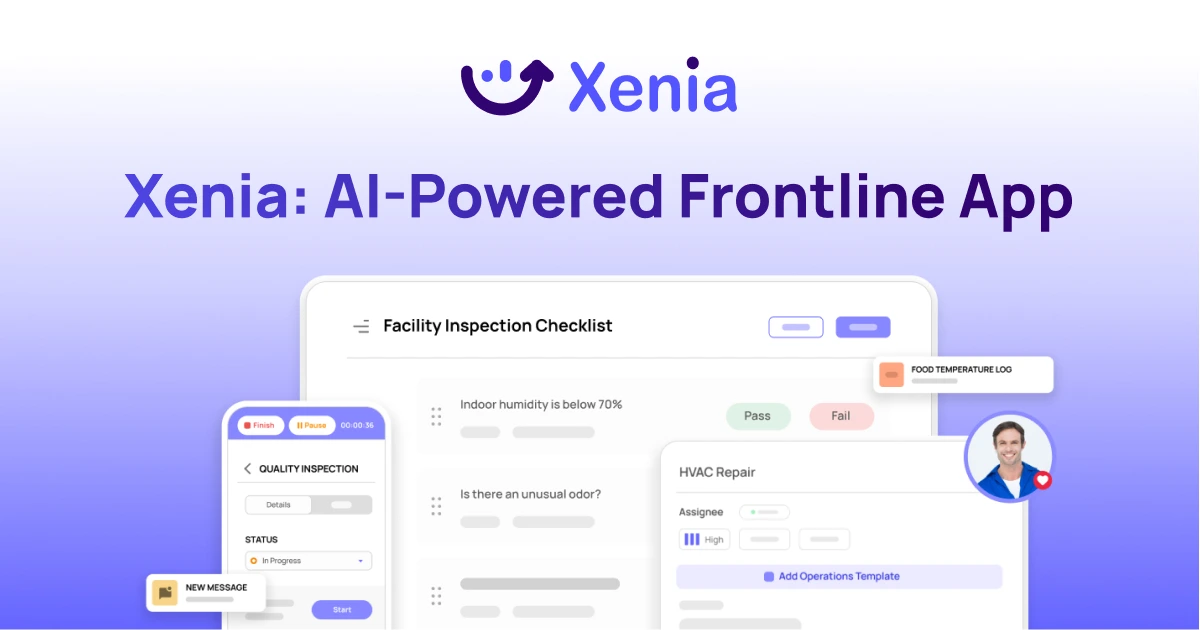
Why Multi-Location Operators Choose Xenia:
🤖 AI-Powered Operations, Create digital checklists instantly or convert paper forms with AI. Verify compliance automatically with photo analysis and get instant answers from your operational data.
✅ Daily Operations & Maintenance, Assign work across hundreds of locations in minutes. Report and route issues instantly. Schedule preventive maintenance to catch problems before downtime.
📊 Real-Time Visibility, Track completion, work orders, and performance across all locations through dashboards. Filter by site or asset to spot trends and take action.
Manage operations, maintenance, and compliance across all your locations from one platform

.svg)
.webp)
%201%20(1).webp)

.svg)
%201%20(2).webp)