
.webp)
Post Summary
Your labor costs are climbing. Your customers want more. Your store managers are drowning in paperwork.
Sound familiar?
Here's the truth: The retailers winning right now aren't working harder. They're working smarter with digital platforms that actually make sense.
This guide shows you exactly how to execute retail digital transformation that puts money back in your pocket.
.png)
.svg)

Priced on per user or per location basis
Available on iOS, Android and Web


What Is Retail Digital Transformation?
Let's cut through the buzzwords.
Retail digital transformation means replacing your paper checklists and manual processes with modern technology. We're talking AI, IoT, and mobile-first operations that change how your stores actually run.
In 2026, it's all about "Frontline Enablement." That's a fancy way of saying: give your store managers the tools they need to do their jobs without losing their minds.
Think about it this way.
Your store managers should see operational data instantly. Tasks should flow automatically. Problems should get caught before your customers notice them.
The gap between digital leaders and everyone else? It's getting bigger every day.
Retailers with connected operations make decisions faster. They execute more consistently. They adapt while competitors are still waiting for last week's spreadsheet to load.
Why Retail Digital Transformation Matters Right Now
Three things are forcing retailers to go digital in 2026.
Labor markets are competitive.
The solution isn't just hiring more people. Wages jumped 20% since 2020. Every efficiency gain you make multiplies across every single location you operate.
That's huge.
The data gap creates opportunity.
Your corporate team makes decisions based on last week's reports. But store conditions change every hour. Close that gap and you gain a competitive advantage.
Retailers with real-time data respond while competitors are still compiling reports.
Customers expect consistency everywhere.
Every store experience shapes your entire brand. Shoppers expect the same product availability, the same cleanliness, and the same service quality at every single location.
Manual processes can't deliver that.
Digital transformation in retail isn't about following trends. It's about building systems that make consistency automatic instead of accidental.
The 3 Pillars of Retail Digital Transformation in 2026
1. Frontline Enablement (Where Digital Transformation Actually Happens)
Here's what separates successful digital transformation from failed attempts.
The winners invest in digital systems that reach every level. Corporate gets connected tools. Store managers get connected tools. Everyone works from the same platform.
That's the winning approach.
Real digital transformation means your frontline teams use the same connected systems as your executives.
Here's what that looks like:
Your store manager opens one mobile app. Everything they need is right there. Opening procedures. Merchandising tasks. Safety checks.. All tracked with clear completion criteria.
Assigns it to the right person. Sets a deadline. Tracks when it's fixed.
No phone calls. No emails. No chasing people down.
The system handles it.
This is what digital transformation should feel like. Technology that makes life easier, not more complicated.
2. Real-Time Operational Visibility
Traditional retail reporting relies on historical data.
Store managers submit end-of-day reports. District managers compile data. Regional leaders review everything days later.
Digital transformation analytics transforms this approach.
Your district leaders see task completion across all stores as it happens. Not yesterday. Not last week. Right now.
Compliance rates drop at specific locations? You see it immediately. Equipment issues pop up across multiple stores? You spot the pattern before it becomes a crisis.
You solve problems while they're small instead of reacting to disasters.
That's the difference.
3. Procurement and Supply Chain Integration
Traditional procurement processes need optimization.
Store managers' email inventory needs. Procurement teams compile requests. Orders flow through separate systems.
There's an opportunity to streamline this.
Connected procurement changes everything.
Store inventory runs low? The system triggers procurement workflows automatically. Equipment needs parts? Supply chain teams get notifications with exact specifications.
Multiple stores need the same thing? Procurement sees aggregated demand in real time. Better price management? Fewer emergency shipments that cost 3x more than planned orders.
This isn't just about ordering efficiency. It's about connecting operational needs to procurement decisions instantly.
What Are the Top Digital Transformation Trends in the Retail Sector for 2026?
1. AI-Powered Operational Intelligence
AI moved from "cool experiment" to "daily use" in 2026.
Planogram compliance verification:
Store teams photograph displays with their phones. AI compares images to your corporate standards automatically. It tells you exactly which products are in the wrong spots.
You verify merchandising across all locations instead of just the stores your district managers can physically visit.
Predictive equipment maintenance:
AI analyzes performance data across all your locations. Runtime metrics in HVAC. Usage patterns that scream "this is about to break."
The system predicts which stores need service in the coming weeks. You schedule preventive maintenance during slow hours instead of dealing with failures during rush hour.
Automated operational summaries:
Your district leaders used to spend hours reviewing completion logs and audit results.
AI summarizes it automatically. It surfaces what actually matters. Which stores need support. Which tasks consistently take too long. Where training gaps exist.
Your leaders make strategic decisions instead of compiling spreadsheets.
2. Mobile-First Operations Architecture
Store managers don't work at desks.
They're on the sales floor. Helping customers. Leading teams.
So why are we still designing systems for desktop computers?
Mobile-first design changes this.
Everything store managers need lives in their phone. Task management. Photo documentation. Communication with district leadership. Performance analytics.
No more logging into desktop computers to finish administrative work.
Offline capability:
Internet goes down. Life continues. Mobile platforms work offline. Tasks get completed. Photos get captured. Data syncs when connectivity returns.
Role-based mobile experiences:
Store managers see their workload. District managers see portfolio analytics. Corporate teams access strategic dashboards.
Same platform. Different views for different roles.
Mobile-first architecture puts digital systems where retail work actually happens: on the sales floor.
3. Unified Communication Platforms
Store managers text their DMs. DMs email regional leaders. Regional teams call corporate. Information gets lost somewhere in between.
Questions sit in email for days. Updates disappear in group texts. Store teams can't find answers when they need them.
2026 brings communication directly into operations platforms.
Task-based messaging: Conversations happen where work happens. Need to discuss a corrective action? The entire conversation lives with that task. No digging through emails.
Instant updates: Corporate changes a procedure. Every store gets notified immediately. Everyone works from the same playbook.
Knowledge sharing: Store 47 solves a tough merchandising problem. Store 52 sees that solution instantly. Best practices spread across all locations automatically.
Less time on phones: Managers spend fewer hours in calls and email chains. More time helping customers and leading teams.
Communication happens inside your operations platform. Teams stop switching between apps to find information.
What Are the Measurable Benefits of Digital Transformation in Retail for Multi-Site Operations?
Let's talk real numbers.
**
Benefit Area, Before Digital Transformation, After Digital Transformation, Measurable Impact
Execution consistency across all locations, Each store operates independently and task completion varies with inconsistent brand standards, Standardized platform procedures with photo verification and analytics identifying struggling locations, Higher task completion rates improved brand compliance and faster issue resolution
Manager productivity improvements, Hours spent weekly on admin work manual tracking and phone coordination, Automated tracking reporting and contextual in app communication, Weekly hours shifted from paperwork to customer service and team development
Maintenance cost optimization, Equipment runs until failure with emergency repairs during business hours, IoT monitoring and predictive analytics enable scheduled maintenance, Lower emergency repair costs reduced downtime and longer equipment lifespan
Inventory shrink reduction, Manual monitoring causes documentation gaps and audit failures, Continuous temperature monitoring with automated corrective alerts, Meaningful reduction in food spoilage losses
Decision speed and quality, Decisions rely on outdated data and infrequent store visits, Real time analytics surface trends across locations instantly, Decision cycles reduced from weeks to days with faster strategy adjustment
**
How to Build Your Retail Digital Strategy: Implementation Roadmap
Phase 1: Assessment and Pilot Setup (Weeks 1-4)
Map your current operational challenges and identify where digital transformation delivers the highest impact.
Critical questions to answer:
Execution consistency: What percentage of stores complete critical tasks reliably? Where does compliance falter across locations?
Operational visibility: How quickly do corporate teams identify and respond to store-level issues? What's the current lag between problem occurrence and resolution?
Resource efficiency: Where do managers spend time on administrative work versus customer service? What processes consume disproportionate time relative to value?
Maintenance costs: What percentage of equipment service is emergency response versus preventive maintenance? How much do emergency repairs cost annually?
Rank opportunities by impact and implementation complexity. Focus on high-impact, moderate-difficulty opportunities first.
Select pilot locations strategically:
- Mix of performance levels (high, average, below-average)
- Experienced managers who provide constructive feedback
- Different store formats if operating multiple concepts
- Geographic diversity if relevant to operations
Configure systems before launch:
- Build complete task library with standard operating procedures
- Create daily, weekly, monthly recurring workflows
- Establish safety audit templates
- Configure alert thresholds for monitoring systems
- Set up role-based access for different user types
Build business case with projected ROI. Calculate current costs of inefficiency. Estimate improvement potential based on operational data.
Phase 2: Pilot Program (Weeks 5-10)
Test your digital transformation approach in 3-5 stores before company-wide deployment. Run the pilot for 30-45 days to gather meaningful performance data.
Measure baseline metrics before activation:
- Current task completion rates by location
- Time managers spend on administrative work daily
- Equipment maintenance costs and emergency service frequency
- Compliance audit scores across pilot stores
- Inventory shrink and spoilage rates
During the pilot:
- Monitor adoption metrics daily
- Collect qualitative feedback from store managers weekly
- Track system usage patterns and feature adoption
- Document friction points and user questions
- Measure improvements against baseline metrics
Focus on both quantitative results and user experience. The best platform won't deliver value if frontline teams don't adopt it.
Phase 3: Optimization and Expansion Prep (Weeks 11-12)
Analyze pilot results before rolling out to remaining locations.
What worked well? Which features drove highest adoption? What processes saw greatest improvement? Which workflows became second nature quickly?
What created friction? Where did users struggle? What caused confusion? Which workflows need simplification before broader rollout?
What surprised you? Which unexpected benefits emerged? What challenges didn't you anticipate during planning?
Refine your approach based on learnings:
- Adjust task templates based on actual completion times
- Modify alert thresholds based on pilot data
- Simplify workflows that caused user confusion
- Enhance training materials addressing common questions
- Update configuration based on real usage patterns
Build internal success stories with specific data from pilot stores. Document improvement percentages. Capture manager testimonials about time savings and easier workflows. Prepare case study for company-wide communication.
Phase 4: Company-Wide Deployment (Weeks 13-20)
Deploy in waves rather than simultaneously to all locations. Staged rollout allows you to maintain quality support and catch issues before they scale.
Wave 1 (Weeks 13-15): Roll out to 25-35% of remaining stores. Focus on locations with managers similar to successful pilot participants.
Wave 2 (Weeks 16-18): Expand to another 30-40% of stores. Include more challenging locations but provide additional support resources.
Wave 3 (Weeks 19-20): Complete deployment to final stores.
For each wave:
- Train district managers first so they can support store teams effectively
- Conduct focused training for store managers (2-4 hours typically sufficient)
- Provide extra support during first two weeks post-launch
- Monitor adoption metrics daily during initial rollout period
- Share success stories and best practices from previous waves
Communication matters during rollout. Explain why this benefits store teams specifically. Show how it reduces their administrative burden rather than adding work.
Phase 5: Advanced Feature Integration (Weeks 21-28)
Layer additional capabilities after core platform adoption stabilizes. Don't overwhelm teams with advanced features during initial deployment.
Week 21-22: Activate AI-powered photo verification for planogram compliance and brand standards.
Week 23-24: Deploy predictive analytics for equipment maintenance forecasting.
Week 25-26: Integrate HRIS system for schedule-aware task assignment and labor optimization.
Week 27-28: Implement AI operational summaries for district and regional leadership teams.
Each integration builds on previous success. Teams master core functionality before adopting advanced capabilities. This approach maintains high adoption rates throughout the transformation.
Phase 6: Continuous Optimization (Ongoing)
Digital transformation is continuous evolution, not one-time implementation. Plan for ongoing refinement based on operational data.
Monthly performance reviews:
- Analyze task completion metrics across all locations
- Identify stores exceeding expectations and those needing additional support
- Review workflows showing consistent friction or unusually long completion times
- Update task templates based on actual operational patterns
- Recognize high-performing teams and share their approaches
Quarterly strategic reviews:
- Assess overall ROI against initial business case projections
- Identify new opportunities for digital integration
- Review and optimize alert thresholds based on accumulated data
- Plan next phase of capability expansion
- Update training materials based on new user patterns
Continuous training program:
- Onboard new managers using refined training materials
- Provide refresher training for existing users quarterly
- Train teams on new features as they launch
- Develop power users at each location who become internal champions
- Create peer-to-peer learning opportunities across locations
Best practice documentation:
- Surface innovative approaches from high-performing stores
- Document process improvements worth scaling
- Share operational insights across organization through regular communications
- Build library of proven workflows other locations can adopt
Successful retailers treat their digital operations platform as a living system that evolves with their business needs rather than static software that stays unchanged after implementation.
How Xenia Enables Retail Digital Transformation
Here's the problem with most digital transformation attempts.
You end up managing multiple separate systems:
- Task management platform
- Equipment maintenance tracking
- Temperature monitoring system
- Safety audit software
- Analytics and reporting tools
- Photo verification applications
- Communication platforms
Each system requires a separate login. Different interface. Data that doesn't connect.
There's a better approach.
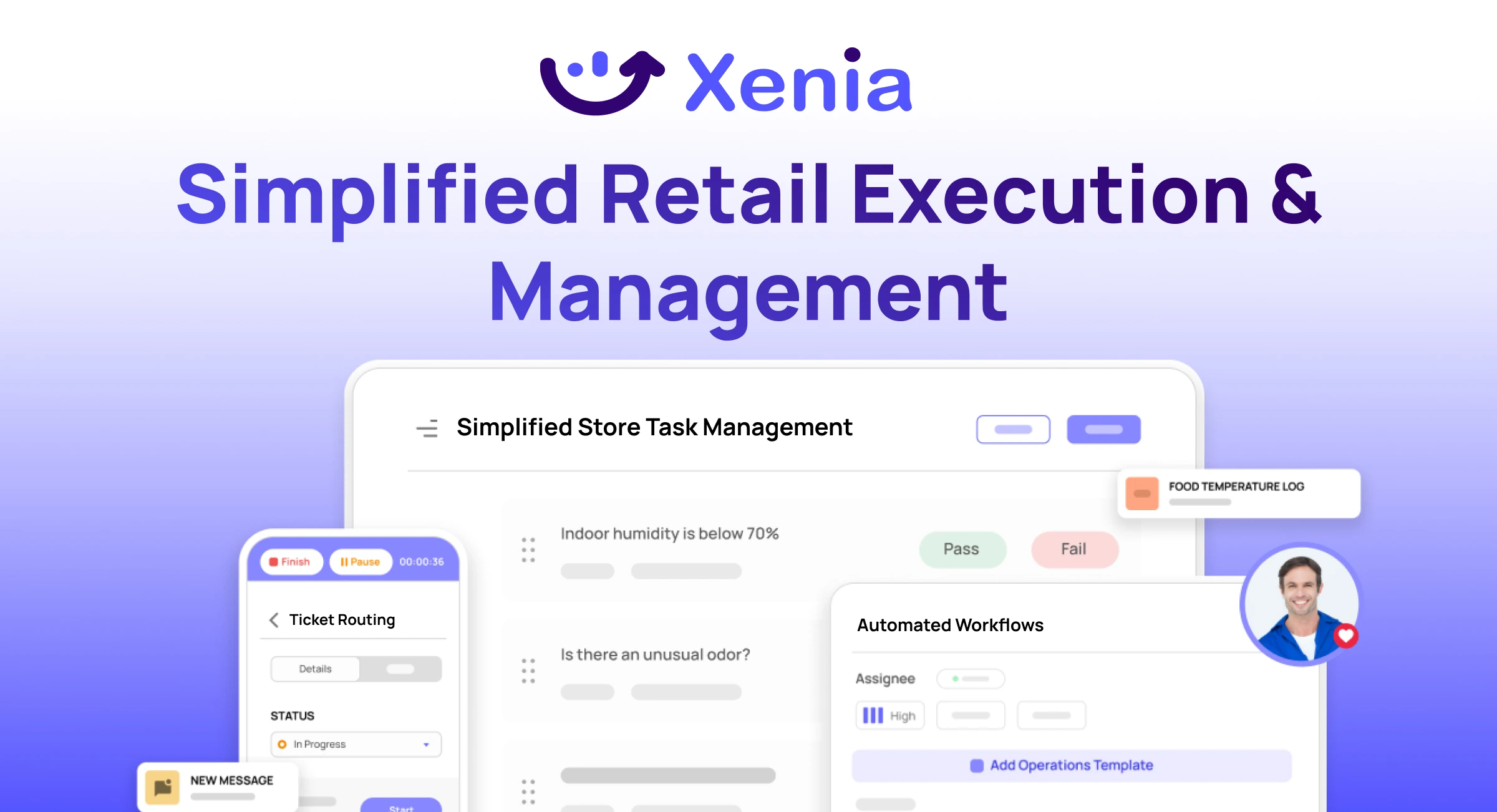
Xenia combines operations, maintenance, and safety into one platform built specifically for multi-location retail.

Here's what unified integration delivers:
AI-powered verification: Photo analysis for planogram compliance integrated directly into daily workflows. Store managers don't switch systems.
Automated corrective actions: AI-detected opportunities create tasks automatically in the same system managing all work.
Real-time operational visibility: District and regional leaders see complete portfolio performance in unified dashboards. Task completion. status..
Predictive analytics: AI analyzes complete operational datasets because all functions exist in one platform. Maintenance patterns. Task completion trends. Performance optimization opportunities.
HRIS integration: Tasks get assigned to team members actually scheduled that day. Labor analytics connect directly to operational data.
Store managers work from one mobile interface. District leaders access unified visibility. Corporate teams make decisions from connected data instead of isolated reports.
FAQs
How long does retail digital transformation take to show ROI?
Timeline depends on your starting point. Retailers focusing on high-impact areas first typically see measurable ROI within several months. Full transformation spans 12-18 months but delivers value throughout.
What are the biggest barriers to successful digital transformation in retail?
Change management beats technology every time. Starting too broad creates change fatigue. Disconnected systems increase complexity instead of reducing it. Success requires clear communication, gradual rollout with early wins, and sustained leadership commitment.
Can small retailers with 10-20 stores benefit from digital transformation?
Absolutely. Digital transformation delivers value at any scale. Smaller retailers often see faster ROI because implementation is simpler. The principles remain identical: replace manual processes with connected digital systems.
How does retail digital transformation differ from retail technology implementation?
Technology implementation adds new tools to existing processes. Digital transformation fundamentally changes how work gets done. New POS system? That's implementation. Connecting store operations to supply chain through automated workflows? That's transformation.
What skills do retail teams need for successful digital transformation?
Digital literacy, not technical expertise. Store managers need comfort using mobile apps, not programming knowledge. District leaders need ability to read dashboard analytics, not data science training. Most modern platforms require minimal technical skill.
Conclusion
Retail digital transformation creates competitive advantage.
The gap widens every quarter. Retailers with real-time visibility make faster decisions. Digital platforms deliver consistency that manual processes can't match. Connected systems optimize resources and maximize budget efficiency.
Start with one high-impact area. Prove it works with real numbers. Expand based on demonstrated ROI.
Look for platforms that integrate functions instead of adding complexity.
Xenia combines operations, maintenance, and safety in one platform built specifically for multi-location retail. Your managers access everything through one mobile interface. You gain portfolio-level visibility without juggling separate tools.
Want to see how it works for your operation? Book a demo.
Frequently Asked Questions
Got a question? Find our FAQs here. If your question hasn't been answered here, contact us.

Looks like there's no data available in our FAQ section at the moment.

A Modern, AI-Powered Platform Built for Retail Operations
Xenia brings store operations, merchandising, audits, and loss prevention into one mobile-first platform. Store teams execute daily work consistently, maintain brand standards, and resolve issues faster, while regional and corporate leadership get real-time visibility across all locations.
Why Retail Operators Choose Xenia:
🤖 AI-Powered Merchandising, Verify planograms, displays, and brand standards automatically with AI photo analysis. Build digital checklists instantly or convert existing merchandising guides.
🏬 Operations & Loss Prevention, Assign opening procedures, store walks, and resets across locations. Track theft, cash discrepancies, and security incidents with evidence and approval workflows.
📊 Real-Time Visibility, Compare audit scores and task completion across stores. Identify top and underperforming locations. Export reports for leadership reviews.
One platform for operations, merchandising compliance, and loss prevention across all locations.

.svg)
.webp)
%201%20(1).webp)

.svg)
%201%20(2).webp)