
.webp)
Post Summary
A customer reports a foodborne illness. Your insurance carrier asks for the shift records from the day in question. Your GM says the handoff happened verbally, the way it always does. There's nothing written down.
That's not a staffing problem. That's a liability gap. And in a food safety incident investigation, the absence of a restaurant shift handoff record is treated the same as the absence of compliance. If it isn't documented, it didn't happen.
Most shift handoffs in independent and multi-unit restaurants are still verbal. One GM briefs the next, covers the open items, mentions the cooler that's been running warm, and walks out. The incoming shift inherits a kitchen full of assumptions and no written record of what was handed to them.
This article is about why that creates compliance and liability exposure, what a complete digital shift record actually contains, and how to build a system that protects your operation when something goes wrong.
.webp)
.svg)

Priced on per user or per location basis
Available on iOS, Android and Web


Recommended resources
- Health inspections vs. internal audits: closing the compliance gap
- How multi-unit restaurant groups are replacing paper monthly ops reviews
- How closed-loop corrective actions work in multi-unit restaurants
Why do verbal shift handoffs create compliance and liability gaps?
The verbal handoff feels efficient. Two GMs, five minutes, everything covered. The outgoing shift tells the incoming shift what they need to know, and everyone moves on.
The problem is that nothing in that conversation creates a record.
Unresolved issues don't surface across shifts. When the handoff is verbal, open issues travel only as far as the conversation. If the outgoing GM mentions the walk-in door seal is loose and the incoming GM forgets to follow up, that issue disappears.
There's no written record that it was raised, no status attached to it, and no way for the next shift to know it was ever flagged. By the time the issue becomes a health inspector citation, there's no documentation showing when it was first identified or what was done about it.
Food safety SOP completion is assumed, not verified. A verbal handoff tells the incoming shift that the closing checklist was done. It doesn't show a timestamped record of what was completed, who completed it, or whether the critical food safety items were done to standard.
The restaurant SOP template sitting on a clipboard in the back office isn't a compliance record. It's a piece of paper that may or may not have been filled out accurately under the pressure of a closing shift.
There's no documentation for a health inspector or incident investigation. When a health inspector asks for your shift log documentation from the last 30 days, a verbal handoff system produces nothing.
When an incident investigation asks what the outgoing shift communicated to the incoming shift about a known equipment issue, a verbal system has no answer. The absence of a digital shift record doesn't just create compliance risk. In a legal or regulatory context, it creates presumed liability.
One owner at a ten-location full-service restaurant group described their inspection log situation plainly: when asked whether weekly inspection logs existed digitally, the answer was that they didn't exist at all.
That's not unusual. It's the default for most restaurant groups that haven't built a formal shift handover template process.
What to do about it
Replace the verbal handoff with a required digital shift log that has mandatory fields, a completion timestamp, and a carry-forward mechanism for unresolved issues. The shift close doesn't complete until the required fields are submitted. The incoming shift opens to a documented list of what was handed to them.
Xenia's digital shift log enforces this structure at every close, across every location, without requiring anyone to manage it manually.
What does a complete restaurant shift handoff record actually contain?
Most operators who decide to formalize their shift handoff process start with a simple checklist. Task completed: yes or no. That's better than nothing. It's not a compliance record.
A complete digital shift record has four layers.
Line check results with photo evidence on failures. The line check is the foundation of the shift handoff. Every station, every temperature, every critical food safety item completed before the shift closes and documented with the results.
When a temperature reading is out of spec, the record requires a photo before the shift can move on. That photo is timestamped, attached to the shift log, and visible to the incoming GM before they start. This is what line check compliance looks like when it's connected to the shift record rather than living in a separate tool.
Food safety SOP completion per station, timestamped. Each station's closing SOP is completed as a required field in the shift log, not as a separate paper form. Hot holding temperatures, cooling log completion, surface sanitation, and proper storage labeling.
Each item is tied to the shift close record with a timestamp showing when it was completed and by whom. The restaurant manager daily log becomes a verified compliance record, not a self-reported summary.
Unresolved issues carried forward with status. Any item flagged during the shift and not resolved before close is automatically carried forward to the incoming shift's open issue list. The incoming GM doesn't inherit a kitchen full of assumptions.
They open a documented list of what's unresolved, when it was first flagged, and what status it's currently in. Nothing disappears between shifts.
Equipment status with open work orders visible to the incoming shift. Any equipment issue that generated a work order during the outgoing shift is visible in the incoming shift's dashboard.
The incoming GM knows before they start whether the cooler ticket is still open, whether the maintenance vendor has been notified, and whether any food safety protocols need to be adjusted in the meantime.
Here's what the two approaches look like side by side:
**
Verbal shift handoff, Digital shift record
Outgoing GM tells incoming what they remember, Required fields completed before shift close
Open issues travel only as far as the conversation, Unresolved issues auto-carried to incoming shift
No photo evidence on food safety failures, Photo required on out-of-spec items before close
SOP completion self-reported, SOP completion timestamped per station
Equipment issues communicated informally, Open work orders visible in incoming shift dashboard
No record for health inspector or investigation, Full log exportable on demand
**
What to do about it
Move from a yes/no checklist to a structured digital shift log with four required layers: line check results with photo evidence, food safety SOP completion per station, unresolved issue carry-forward, and equipment status. Each layer should be a required field, not an optional addition.
Xenia's shift log enforces all four layers at close, so the compliance record is complete by default rather than by memory.
How does food safety SOP enforcement connect to the shift handoff?
Most restaurant SOP templates treat food safety compliance as a separate process from shift handoff. The closing checklist is one document. The food safety log is another. The shift handoff is a conversation. None of them are connected.
That separation is where enforcement breaks down.
Required photo on temperature out-of-spec readings. When a temperature reading during the closing line check falls outside the safe range, the shift log should require a photo before the checklist item can be marked complete. Not a note. A photo with a timestamp.
This is the difference between a closing checklist that documents what someone said the temperature was and a shift record that shows what it actually was. That distinction matters to a health inspector, and it matters in a liability investigation.
Cooling log completion tied to the shift close checklist. The cooling log is a required food safety SOP in any operation handling cooked proteins. When it exists as a separate paper form, completion is inconsistent and verification is impossible.
When it's embedded as a required field in the shift close checklist, the shift doesn't close until it's done. The restaurant opening and closing checklist stops being a best-practice document and becomes an enforcement mechanism.
SOP item failure triggers an immediate corrective action prompt. When a critical food safety SOP item is marked non-compliant on the shift log, the system should immediately prompt a corrective action. Not a note for the next manager to deal with.
An assigned task, with a deadline, logged against the shift record.
Operators who have made the switch describe the difference clearly. Running paper audits means walking a store with a clipboard and hoping the notes are enough. A digital shift record with required photo capture means the evidence exists the moment the check is done, attached to the record automatically, without anyone having to remember to document it later.
What to do about it
Embed your food safety SOPs directly into the shift close checklist as required fields, not optional additions. Make photo capture mandatory on any temperature or sanitation item that falls out of spec. Connect SOP failures to an automatic corrective action prompt so the finding and the fix are in the same record.
Xenia enforces all three at the shift level, so food safety SOP completion is verified rather than assumed at every close.
What does multi-location shift log visibility give the ops team?
For a single-location operator, a digital shift log is a compliance tool. For a multi-unit group, it's an operational intelligence layer.
Completion rate dashboard across all locations. The ops director can see which locations are submitting shift logs on time, which are skipping steps, and which have open issues that haven't been resolved across multiple shifts. That visibility doesn't require a site visit or a phone call. It's available in the dashboard before the morning standup.
Escalation alert if the shift close is not submitted by the required window. When a shift close log isn't submitted within the expected time window, the platform sends an automatic alert to the GM and the district manager.
The missed submission doesn't go unnoticed. It becomes a documented gap in the compliance record that prompts an immediate response, not a pattern that's discovered three weeks later during a monthly review. For how this connects to the broader ops review cadence, how multi-unit restaurant groups are replacing paper monthly ops reviews covers the reporting layer above it.
Trend view of recurring issues by location and shift. When the same issue appears in the shift log at the same location across multiple shifts, the trend is visible in the dashboard. A cooler that keeps getting flagged on closing but never generates a resolved work order is a pattern that shows up in the data weeks before it becomes a health inspection citation.
What to do about it
Set a required submission window for every shift close at every location. Make missed submissions an automatic escalation, not a manual follow-up. Review recurring issue trends by location weekly, not monthly.
Xenia's multi-location shift log dashboard gives ops directors this visibility in real time, without a single phone call or manual report.
What does consistent shift documentation make possible across a restaurant group?
When every location submits a complete digital shift record at every shift close, four things change.
Health inspector asks for records and they're available in 30 seconds. The full shift log history, including line check results, food safety SOP completion, photo evidence, and corrective actions, is exportable from one place. The health inspector gets a complete documented record, not a collection of paper forms from a binder that may or may not be current.
Incident investigation has a documented trail. When a food safety incident is traced back to a specific shift, the digital record shows exactly what was completed, by whom, at what time, with photo evidence on the critical items. The absence of documentation is replaced by a verified compliance record.
GMs held to a consistent standard regardless of location. The shift close checklist is the same at every location. The required fields are the same. The photo capture requirements are the same. A GM at location twelve is held to the same standard as a GM at location one, and the compliance record reflects that consistently.
The incoming shift inherits documented open issues, not assumptions. Every unresolved item from the outgoing shift appears in the incoming shift's open issue list with its current status. The incoming GM knows what they're walking into before they start, and the record shows they were informed.
How does Xenia build the shift handoff record that protects your operation?
A verbal handoff leaves no record. A paper checklist creates a record that can't be verified, exported, or connected to a corrective action. Neither protects your operation when something goes wrong.
Xenia is built to create the shift record that does.
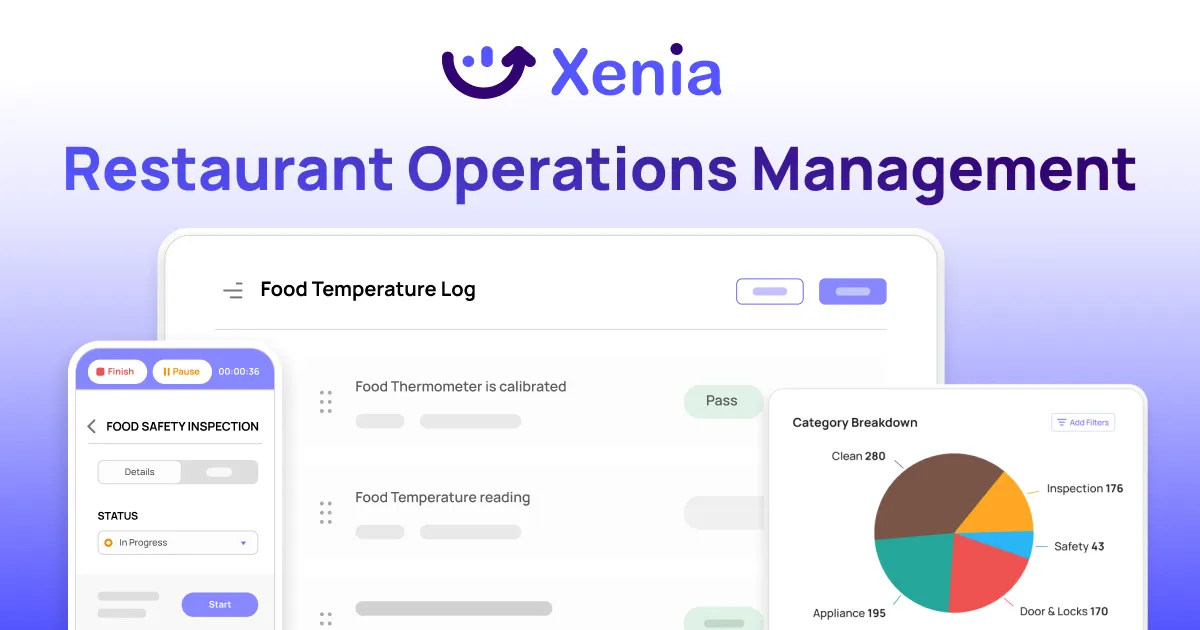
Every shift close produces a timestamped, verified digital record. In Xenia, every shift close requires completion of a structured digital log with mandatory fields. The shift doesn't close until the required items are submitted. The record exists by default, timestamped and attached to the location's compliance history.
Photo evidence required on every critical food safety item. Any food safety SOP item that falls out of spec requires a photo before the checklist can proceed. The photo is timestamped and attached to the shift record. The difference between a self-reported checklist and a verified compliance record is the photo.
Unresolved issues follow the shift, automatically. Any item flagged during the outgoing shift that isn't resolved before close is automatically surfaced in the incoming shift's open issue list, with its current status and how long it's been open. Nothing disappears between shifts.
GMs can verify completion from anywhere, in real time. The ops director and district manager see shift log completion status across every location in real time. A missed submission triggers an automatic escalation alert before the gap becomes a compliance pattern.
Every failed checklist item creates a corrective action automatically. When a critical item fails on the shift log, a corrective task is created automatically, assigned to the right person, and given a deadline. The finding and the fix are in the same record from the moment the failure is logged.
Full shift log history exportable on demand. The complete shift log history, including line check results, SOP completion, photo evidence, and corrective actions, is exportable from one place in a format that satisfies a health inspector, a franchisor, or a legal inquiry.
SOP adherence visible by location, not just assumed. Xenia tracks SOP completion rates by location and by shift, so the ops director can see which locations are consistently hitting food safety SOP standards and which are skipping steps before a health inspection confirms it.
New shift inherits unknown issues, open issues surfaced at shift open. The incoming shift opens to a documented list of every unresolved issue from the outgoing shift, with status, age, and assigned corrective action. The incoming GM is informed from the moment they start.
The operational problem is an undocumented shift handoff. But the business problem is what happens when something goes wrong and there's no record to show.
A foodborne illness claim with no shift documentation is a liability with no defense. A health inspection request with no shift logs is a compliance gap with no explanation. A franchisor audit with inconsistent shift records across locations is a brand standards failure with no accountability trail.
When every shift close produces a verified, timestamped, photo-backed compliance record, those risks don't just become manageable. They stop being risks at all. The record shows what happened, who was responsible, and what was done about it. That's not damage control. That's an operation that runs clean, holds up to scrutiny, and gives ownership, franchisors, and regulators nothing to question.
See how Xenia builds your shift record.
Conclusion
Verbal handoffs work until something goes wrong. When an incident gets traced back to a shift, when an inspector asks for 30 days of records, when a franchisor requests documented SOP completion, the verbal system has nothing to show.
The digital shift record creates the compliance trail that proves your operation was running to standard on the day in question.
Xenia builds that record at every shift close, across every location.
Book a demo and see how Xenia turns every shift close into a compliance record.
Frequently Asked Questions
Got a question? Find our FAQs here. If your question hasn't been answered here, contact us.
How does multi-location shift log visibility help ops directors?

It gives them a real-time view of shift log completion rates across every location without a site visit or phone call. Missed submissions trigger automatic escalation alerts. Recurring issues across multiple shifts at the same location show up as trends before they become health inspection citations.
What happens to unresolved issues in a digital shift handoff system?
They're automatically carried forward to the incoming shift's open issue list with current status and how long they've been open. The incoming GM sees every unresolved item before they start. Nothing disappears between shifts.
How does food safety SOP enforcement connect to the shift handoff?
When food safety SOPs are embedded as required fields in the shift close checklist, completion is verified rather than assumed. Photo capture on out-of-spec items creates evidence. SOP failures trigger automatic corrective actions. The shift handover template becomes a compliance enforcement mechanism, not just a communication tool.
How does shift handoff documentation reduce liability?
By creating a timestamped, photo-backed record of what was completed, who completed it, and what was communicated to the incoming shift. In a foodborne illness claim or regulatory investigation, that record shows that documented compliance processes were in place. The absence of documentation is treated as the absence of compliance in most legal contexts.
What should a restaurant shift handoff log include?
Line check results with photo evidence on failures, food safety SOP completion per station with timestamps, unresolved issues carried forward with status, open work orders visible to the incoming shift, and a completion timestamp. A yes/no checklist is not a shift handoff log. A verified digital record is.
What is a restaurant shift handoff?
The process of transferring kitchen and front-of-house responsibility from one shift to the next. In most restaurants it happens verbally. In a compliance-focused operation it happens through a structured digital log documenting open issues, food safety SOP completion, line check results, and equipment status.


A Modern, AI-Powered Platform Built for Restaurant Operations
Xenia brings kitchen operations, food safety, audits, and team communication into one mobile-first platform. Restaurant teams execute daily work consistently, maintain compliance, and resolve issues faster, while leadership gets real-time visibility across all locations.
.webp)
Why Restaurant Operators Choose Xenia:
🤖 AI-Powered Operations, Convert paper logs instantly and verify food presentation and kitchen cleanliness automatically. Get instant answers about food safety trends without building reports.
🍽️ Food Safety & Compliance, Track line checks and temperature logs with automated alerts. Trigger corrective actions when readings exceed safe ranges. Maintain audit-ready records for health inspections.
📊 Multi-Location Control, Monitor food safety compliance and task completion across regions. Benchmark locations to identify training needs. Export reports for operational reviews.
One platform for kitchen operations, food safety, and compliance across all locations.

.svg)
.webp)
%201%20(1).webp)

.svg)
%201%20(2).webp)