
.png)
Post Summary
You manage 12 locations. Maybe 30. Maybe 50.
You have a schedule posted for every single one of them.
But scheduled and actually happening are two different things. A shift starts short-staffed. A food safety log gets skipped. A new hire starts with zero training because nobody set it up. You find out when a district manager visits. Or when an auditor does.
That gap between what's planned and what actually gets done is a workforce management problem. And it gets worse with every location you add.
Do a quick self-check before going further:
- Do shift coverage problems reach you after they've already hit the floor?
- Do tasks get assigned but nobody confirms they were done?
- Is compliance documentation inconsistent across locations?
- Does your visibility depend on a manager telling you what happened?
- Are you running scheduling, tasks, and communication in separate tools?
Two or more yes answers means you have real gaps. This article breaks down what workforce management is, what it covers, and what it takes to get it right.
.webp)
.svg)

Priced on per user or per location basis
Available on iOS, Android and Web


What is workforce management? (And what does WFM mean?)
Workforce management (WFM) means getting the right people in the right place, doing the right work, at the right time. And being able to see that it actually happened.
In a corporate office, WFM mostly means scheduling and payroll. In a restaurant, retail store, or c-store, it means something more. It's the difference between a location that runs the same way every day and one that depends entirely on whoever showed up that morning.
Three things worth clearing up before going deeper.
WFM is not the same as HR
Most operators confuse these two. They're related but they solve different problems.
**
Aspect, HR Management, Workforce Management
What it manages, The employment relationship, What happens during the shift
Core tools, ADP-Gusto-Workday, Scheduling-task management-ops platforms
The question it answers, Who works here?, Are they doing what they're supposed to?
Focus, Hiring-payroll-benefits, Execution-compliance-visibility
**
Your HRIS records that someone was hired. WFM makes sure they know what to do on day one, and every day after.
WFM is not call center software
Type "workforce management software" into Google and half the results are about contact centers. Call forecasting. Agent utilization. Queue management.
That's a completely different world. For restaurants, retail, convenience stores, and hospitality operators, WFM is about what's happening on the floor. Not call queues.
WFM is not just scheduling
This is the most common mistake. A schedule shows who's working. It doesn't show if they did the opening checklist, logged temperatures, or finished their training.
Scheduling gets people to show up. WFM makes sure they do their jobs.
The core components of WFM
WFM isn't a single feature. It's a system of connected processes. Here's what it actually covers in a real frontline operation.
Scheduling and shift coverage
WFM starts with scheduling. Who's working, when, and where. But it does more. It checks who's coming in, finds coverage when someone calls out, and makes sure every location has enough people before shifts start.
Task assignment and accountability
A task with no owner is a task that doesn't get done. Full stop.
WFM assigns the right tasks to the right roles, sets completion windows, and creates a record that the work actually happened. Not just that it was assigned.
Compliance tracking and documentation
Food safety logs. Inspection checklists. Training records. Policy sign-offs. Every frontline industry has compliance requirements and every one of them has real consequences when they're missed.
WFM adds compliance into daily workflows. Deadlines, reminders, escalation paths. When something gets missed, the system flags it. Nobody has to remember to check.
Training and onboarding integration
Frontline turnover is high. New people start every week in most operations. WFM connects role assignment to training delivery so the right modules go to the right person automatically. The manager doesn't have to think about it.
For a complete breakdown of what new hires need on day one and beyond, see our employee onboarding checklist that shows how to structure onboarding workflows that don't depend on manager memory.
Team communication and policy rollout
When a policy changes, someone at corporate usually sends an email. WFM makes sure that update actually reaches the floor, gets acknowledged, and gets documented. There's a meaningful difference between "we sent it" and "they confirmed it."
Our guide on frontline employee communication shows how to make sure corporate messages actually reach your floor staff and get acted on.
Reporting and visibility
A district manager covering 15 locations can't physically be everywhere. WFM gives them a live view: what's complete, what's overdue, and where the problems are. No phone calls to store managers. No waiting for someone to compile a report.
HRIS integration
WFM works best when it talks to your existing HR system. A new hire gets added to the HRIS and their role, tasks, and training automatically sync. A role change updates access and responsibilities without anyone touching it manually.
Platforms like Xenia integrate directly with Workday, ADP, and Paycom so workforce data and operational execution stay connected across the full employee lifecycle.
**
WFM Component, What breaks without it
Scheduling, Short-staffed shifts-last-minute scrambles
Task assignment, Work that falls through the cracks daily
Compliance tracking, Missed documentation-failed audits
Training integration, New hires working without required certifications
Communication, Policy updates that never reach the floor
Reporting, Problems you only hear about after they've escalated
HRIS integration, Manual data entry-access errors-provisioning delays
**
WFM in multi-location operations vs single-site
Here's the honest truth about multi-location management: the complexity doesn't scale linearly. It multiplies.
What works at one location stops working at ten
At one location, a great manager can hold everything together. They know every team member. They walk the floor. They notice when something's off.
Give that manager a second location and they can't be in two places. Give them ten and the whole operation depends on trusting that every location manager is running things the same way. Most of the time, they're not.
District managers are flying blind
Most district managers don't get data. They get summaries. Store managers tell them what they want them to hear. Real problems stay buried until they become expensive ones.
WFM changes that. Completion rates by location. Compliance gaps by site. Task backlogs by team. The picture comes from the system, not from a phone call.
Same process everywhere, without losing flexibility
Corporate needs every location to follow the same standards. Location managers need room to handle what's specific to their site, different footprints, different staff levels, different local requirements.
Role-based workflows and conditional logic solve this. The core process is identical across every location. What changes is how it gets delivered based on what's relevant for that specific site.
If you manage retail stores, our retail operations management guide shows how to keep the same standards at every location while handling each store's unique needs.
Accountability that doesn't require micromanagement
The goal isn't surveillance. The goal is building a system where the right things happen by default and exceptions surface on their own.
Checklist not completed? The manager gets a notification. Compliance deadline passed? It escalates automatically. No one has to remember to follow up.
See how enterprise workforce management works when you're operating at scale across dozens of locations.
Why WFM matters for frontline industries
Every vertical has its own version of this problem. Here's what's actually at stake in each one.
Restaurants: shift coverage and food safety compliance
A missed shift affects every table in that section. A missed temperature log can cost you a health inspection.
And here's something worth saying plainly: the cost of a failed health inspection is orders of magnitude higher than the cost of the system that prevents it. We're talking fines, mandatory closures, and reputation damage that takes months to repair.
WFM for restaurants means real-time shift coverage, task completion tracking for opening and closing procedures, and food safety documentation that logs itself. No one has to compile records after the fact.
For restaurant operators specifically, our restaurant staff training topics guide shows which training modules should be part of your role-based WFM workflows so every new hire gets the right certifications automatically.
Retail: task execution and seasonal spikes
The gap between what corporate sends and what actually happens on the store floor is where retail execution falls apart. Planogram changes that didn't get done. Promotional setups that missed the deadline. Loss prevention steps that got skipped.
Seasonal spikes make it worse. Temporary staff join fast, turnover accelerates, and the margin for error gets smaller. WFM ensures every new hire gets role-specific tasks and training from day one so volume doesn't turn into chaos.
To see what complete daily retail execution looks like, our daily store checklist breaks down the tasks that need to happen consistently across every retail location.
Convenience stores: small teams, serious compliance burden
C-stores are genuinely underestimated when it comes to compliance complexity. One or two people on a shift. Food safety logs, fuel system checks, age verification, cash handling procedures. All of it falling on a tiny team with no backup.
WFM builds those requirements into daily workflows so they happen automatically, every time, with documentation ready for when an inspector walks in.
Hospitality: coordination across departments
A hotel isn't one operation. It's five running at the same time. Housekeeping, maintenance, front desk, food and beverage, security. Different teams, different managers, different priorities.
WFM connects them. A room inspection triggers a maintenance request. A guest complaint generates a corrective action. The property operates as one system instead of five teams leaving notes for each other.
Common WFM challenges
These are the problems that come up over and over when workforce management isn't working.
Having a schedule isn't the same as having visibility
This one trips up a lot of operators. They have a scheduling tool and they think that counts as workforce management. It doesn't.
A schedule tells you who's supposed to show up. It tells you nothing about whether the work got done. If you can't see task completion, compliance status, and shift activity in real time, you have a schedule. You don't have WFM.
Running too many tools creates blind spots
Most multi-location operators run scheduling in one tool, tasks in another, and compliance in a spreadsheet. None of them talk to each other.
So nobody has a single view of what's happening. A district manager logs into multiple systems, pulls data manually, and tries to piece it together. That's hours gone before the real work starts.
One platform fixes this. Not for convenience. For clarity. Xenia replaces the fragmented stack with a single place where scheduling, tasks, compliance, and communication all live together.
Turnover breaks manual processes every time
When someone key walks out, the institutional knowledge walks out with them. The new person doesn't know the routine. The manager is too slammed to retrain properly. Standards slip.
Role-based WFM is the fix. Tasks and workflows attach to roles, not people. When someone new steps into that role, the full process is already waiting for them. Turnover stops being an operational crisis.
For a structured approach to onboarding that survives turnover, our workforce management best practices guide shows how to build role-based processes that don't depend on individual manager knowledge.
No paper trail when things go wrong
When a health inspector shows up, when an incident happens, when someone files a complaint, the question is always the same: can you prove what happened?
In a manual system? Usually not. Verbal confirmations leave no record. Paper checklists disappear. Spreadsheets have no timestamps.
WFM logs everything. Every task completed. Every sign-off collected. Every escalation triggered. Pull a report and the record is there.
What to look for in WFM software
Plenty of tools call themselves workforce management software. Not all of them are built for frontline operations. Here's what to actually evaluate.
**
Feature, What good looks like, Why it matters
Mobile-first design, Built for phones from the ground up, Your team is on the floor-not at a desk
Role-based workflows, Tasks tied to roles-not individuals, Process survives turnover without breaking
Real-time visibility, Live completion data across all locations, Problems surface before they escalate
HRIS integration, Native sync with Workday-ADP-UKG-7shifts, No duplicate entry-no access gaps
Compliance documentation, Timestamped records for every action, Audit-ready at any moment
Location-level reporting, Site-by-site data-not just aggregates, Averages hide your worst-performing locations
**
One test worth doing before you sign anything: pull out your phone and try to complete a daily checklist in the platform. If it's clunky, slow, or takes too many taps, your deskless workers won't use it consistently. Mobile usability isn't a nice-to-have for frontline teams. It's the whole thing.
Related Resources
- Employee Onboarding Checklist
- Workforce Management Best Practices
- Frontline Employee Communication Strategies
- Daily Store Checklist
- Retail Operations Management
- Restaurant Staff Training Topics
- Digital Checklists Guide
Conclusion
Workforce management isn't an HR concept. It's an operations one.
The gap between scheduled and actually happening is where multi-location businesses win or lose every day. Missed tasks, incomplete compliance records, coverage problems nobody caught in time. Those aren't people failures. They're process failures.
The operators getting this right aren't hiring more managers. They're building systems where the right things happen by default and problems surface before they get expensive.
That's what good WFM delivers.
See how Xenia helps multi-location teams connect scheduling, task execution, compliance, and communication in one platform. Schedule a demo.
Frequently Asked Questions
Got a question? Find our FAQs here. If your question hasn't been answered here, contact us.
How is WFM different from a tool like Asana or Monday?

Those tools are built for office teams on defined projects. WFM is built for recurring daily work across physical locations. Shift accountability, compliance tracking, and location-level visibility are things general project tools were never designed for.
Is there a minimum number of locations where WFM makes sense?
Two. The moment you can't be at every location every day, you have a visibility problem. Even small multi-location operators recover the cost quickly through reduced manual follow-up alone.
What happens to workflows when a manager leaves?
Nothing breaks. Workflows attach to roles, not people. A new manager stepping into that role inherits everything automatically. No manual handover needed.
Does WFM work for franchise operations?
Yes. Franchisors use it to push standard processes to every location while franchisees keep visibility into their own data. Brand standards stay consistent across the board.
How long does WFM implementation take?
Most operations are up and running in 30 to 90 days. The technology is rarely the bottleneck. Mapping your current processes before building them into the platform takes the most time.

A Modern, AI-Powered Platform Built Specifically for Frontline Operations
Xenia brings daily operations, maintenance, audits, and compliance into one mobile-first platform. Frontline teams execute work consistently across locations while leadership gets real-time visibility.
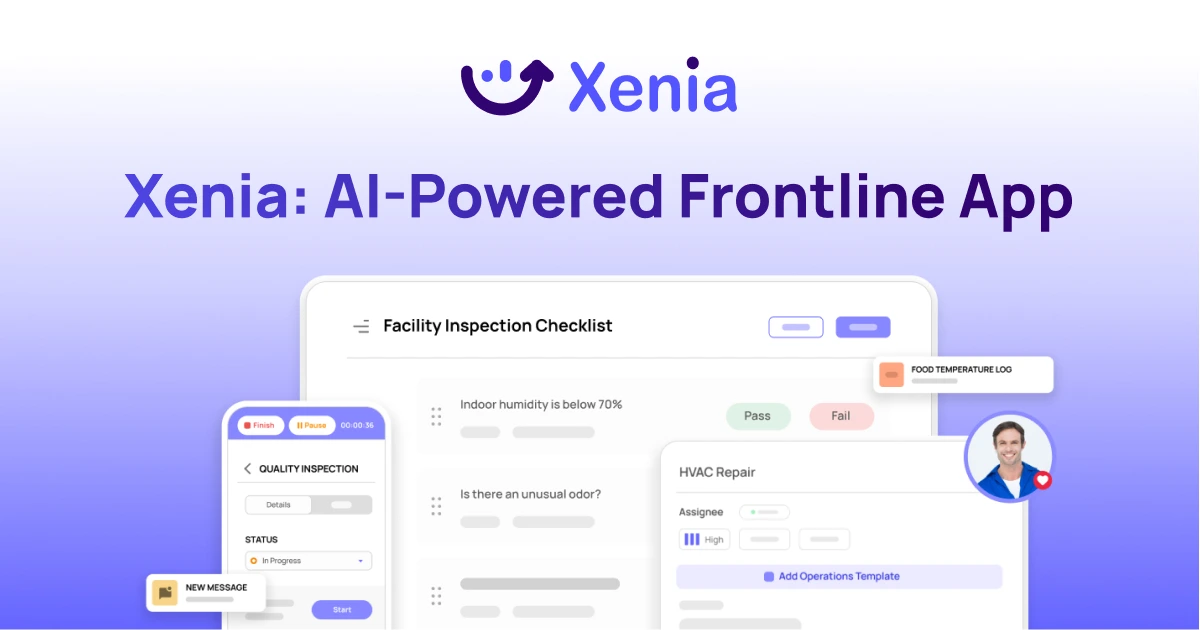
Why Multi-Location Operators Choose Xenia:
🤖 AI-Powered Operations, Create digital checklists instantly or convert paper forms with AI. Verify compliance automatically with photo analysis and get instant answers from your operational data.
✅ Daily Operations & Maintenance, Assign work across hundreds of locations in minutes. Report and route issues instantly. Schedule preventive maintenance to catch problems before downtime.
📊 Real-Time Visibility, Track completion, work orders, and performance across all locations through dashboards. Filter by site or asset to spot trends and take action.
Manage operations, maintenance, and compliance across all your locations from one platform

.svg)
.webp)
%201%20(1).webp)

.svg)
%201%20(2).webp)