
Post Summary
Your warehouse supervisor doesn't check email. Your retail associates can't access Slack during shifts. Your facilities team doesn't sit at desks. And your restaurant crew changes every six months.
But you still need to communicate with them. Policy updates. Safety alerts. Task assignments. Operational changes.
So where does this information go? Personal WhatsApp groups. Printed memos that disappear. Verbal announcements, half the team misses. Or it just doesn't get communicated at all.
This is the deskless disconnect. And it's breaking your operations.
Frontline employee communication isn't about feel-good engagement initiatives. It's about getting operational information to the right people at the right time so work actually gets done.
.svg)

Priced on per user or per location basis
Available on iOS, Android and Web


8 Strategies for Effective Frontline Employee Communication
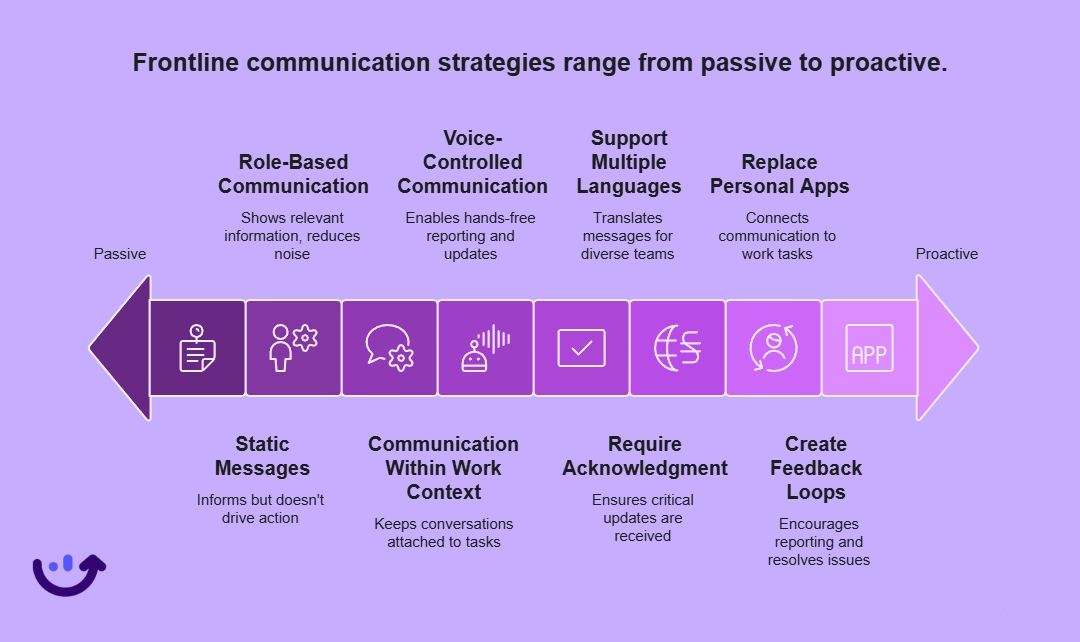
Strategy 1: Replace Static Messages With Actionable Communication
Here's the shift that changes everything. Stop sending information. Start creating action.
Old way: "Remember to complete the opening checklist."
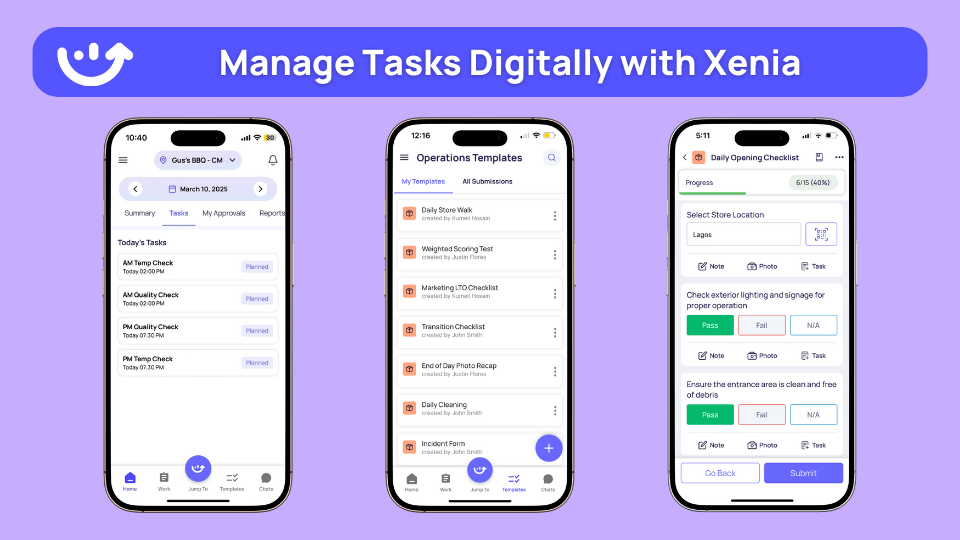
New way: Push notification links directly to the digital checklist. Worker completes it on their phone. System tracks completion automatically. The manager sees it in real-time.
The message doesn't just inform. It makes the work happen.
How Actionable Communication Works
Modern frontline communication and collaboration software connects every message to a workflow. When you announce a task, the system creates that task, assigns it to the right people, tracks completion, and documents everything.
Corporate sends a safety policy update. Instead of an email everyone ignores, the system pushes an announcement to every frontline device. The policy document is attached right there. Workers can't dismiss it without acknowledging it.
Tracking shows who read it and when. Managers whose teams haven't acknowledged get automatic reminders.
The communication becomes a workflow. Not just a message hoping someone acts on it.
This is what effective communication for frontline workers looks like. And it's why strategies that rely on email and memos fail.
Strategy 2: Implement Role-Based Communication to Cut Through Noise
Your frontline workers get bombarded with irrelevant information. Corporate updates meant for executives. Policy changes for other departments. Messages about locations they don't work at.
Important information gets buried. They miss what actually matters.
How Role-Based Access Reduces Noise
Smart frontline worker communication strategies show people only what's relevant to their specific role, location, and department.
Store associates see their location's operations, company policies affecting them, and training for their role. They don't see corporate financials, manager HR policies, or updates for other departments.
District managers see their region's performance, corporate operations updates, and escalations from their locations. They don't get buried in store-level detail from districts they don't manage.
Advanced communication platforms handle this automatically through role-based access controls. You send one message. The system figures out who needs to see it based on organizational hierarchy. No manual distribution lists. No spray-and-pray hoping the right people see it.
This is critical for effective communication for frontline workers. When every message matters to them personally, they actually pay attention.
Strategy 3: Enable Communication Within Work Context
Communication and task management shouldn't be separate systems. When someone reports a problem that needs fixing, the conversation about fixing it should happen right there with the problem.
Task-Based Communication That Preserves Context
A facilities worker logs a broken HVAC unit. They snap a photo. Create a work order.
In systems built for frontline communication, all conversation about that specific issue happens inside that work order. The facilities manager asks clarifying questions right there. The technician who shows up adds repair notes and photos to the same thread. Additional people get pulled in through @mentions. The manager approves completion with a final comment.
Every single conversation about that HVAC unit lives permanently with the work order. No hunting through email threads. No asking "what happened with that thing last week." Complete context in one place.
This is what modern platforms solve. The message, the task, the photos, and the resolution exist together. Forever. Searchable.
Why Context Matters for Frontline Teams
Think about what normally happens. Someone reports a problem. The conversation scatters across email, text messages, verbal handoffs, and notes in five different places. When you need to know what actually happened, good luck.
Keeping communication attached to work solves this. The frontline worker who reported it can see updates. The manager approving it has full context. The next person who encounters the same issue can see how it was solved before.
This solves one of the biggest challenges in frontline communication—information getting lost when it's scattered across disconnected systems.
Strategy 4: Deploy Voice-Controlled Communication for Hands-Free Work
Frontline workers often can't type. Their hands are full. They're wearing gloves. They're operating equipment. They're helping customers.
But they still need to report issues. Update status. Ask questions. Log observations.
Voice-to-Text for Frontline Operations
Voice-controlled frontline communication lets workers speak instead of type. The system transcribes. Communication happens without stopping work.
Real-world applications:
Facilities tech inspecting equipment spots a problem. Instead of stopping to type a report, they use voice-to-text while still examining the unit. Full details logged instantly.
Warehouse workers moving inventory notice damage. Voice command creates the incident report without setting down products or removing gloves.
Retail associate helping a customer spot an out-of-stock item. Quick voice note updates inventory and creates a restock task without leaving the customer.
Kitchen staff notices equipment acting weird during rush. Voice log documents it for the next shift without stopping food prep.
Why Voice Changes Communication Strategies
Issues get reported immediately instead of forgotten by shift end. Managers get real-time updates instead of delayed information. Documentation happens without disrupting workflow.
Modern voice recognition works even in noisy environments. Systems filter background noise and focus on the speaker.
This transforms frontline internal communication from "when I have time to type" to "right now while I'm looking at it."
Strategy 5: Require Acknowledgment for Critical Updates
Safety procedures. Policy changes. Compliance requirements. Equipment recalls.
You need proof that people actually got this information. Not hope. Proof.
Mandatory Acknowledgment Systems
Modern communication platforms designed for frontline operations require action before dismissal. The message appears on the device. You can't swipe it away without confirming you read it.
The system tracks who received it, who opened it, who acknowledged it, and who ignored it.
Managers see real-time dashboards showing compliance across their teams. Non-responders get automatic reminders. You have documented proof for audits.
When regulators ask, "how do you know workers got this safety training?" you show timestamps. Digital signatures. Complete audit trails.
Not "we sent an email." Actual proof of delivery and acknowledgment.
This solves the accountability gap that kills most frontline communication programs. You finally know what actually reached your team.
Strategy 6: Support Multiple Languages for Diverse Teams
Your frontline workforce speaks different languages. Many employees have English as a second or third language.
Language barriers create real operational risks. Misunderstood safety procedures. Missed policy updates. Incorrectly executed tasks.
Multi-Language Communication
Effective frontline worker communication strategies include automatic translation. The corporation sends a message in English. Workers see it in Spanish, Vietnamese, Tagalog, or whatever language they prefer.
Acknowledgment tracking works regardless of language. Training completion gets documented the same way.
This capability needs to be built into how the system works. Not machine translation bolted on afterward.
Visual Communication Overcomes Language Barriers
Sometimes pictures communicate better than words in any language.
Photo-based SOPs showing correct procedures. Video demonstrations of tasks. Before-and-after images for quality standards. Annotated photos highlighting specifics.
A worker who struggles with written instructions can watch a video and execute perfectly.
This is why effective communication for frontline workers always includes rich media support. Not just text.
Strategy 7: Create Feedback Loops That Actually Close
Frontline workers see problems the corporate world never knows about. Equipment issues. Customer complaints. Process improvements. Safety hazards.
But they have no channel to share it. Or they report something, and nothing happens. So they stop trying.
Structured Upward Communication
Successful frontline communication includes built-in channels for feedback:
- Issue reporting where workers flag problems with photos. Automatically routed to the right people. Tracked until resolved.
- Suggestion programs where improvements get documented and reviewed with actual feedback to the person who submitted them.
- Safety reporting where hazards get logged immediately with photo documentation and automatic corrective actions.
These aren't suggestion boxes that nobody checks. They're operational systems with accountability.
Why Closing the Loop Matters
A worker reports an equipment issue with a photo. The system creates a work order automatically. Updates go back to the reporter via push notifications. Resolution gets documented. The reporter sees the outcome.
This creates trust. People communicate more when communication creates actual change.
This addresses a fundamental challenge in frontline communication—making workers feel heard instead of ignored.
Strategy 8: Replace Personal Apps With Purpose-Built Platforms
Your team uses WhatsApp for work communication. Or personal texts. Or Facebook Messenger.
This works until it doesn't. No compliance records. Lost knowledge when people leave. Security vulnerabilities. Zero accountability.
Why Personal Apps Create Problems
Work communication mixed with personal messages. Company information on unsecured platforms. No control over data. No audit trails.
When someone leaves, their WhatsApp history leaves with them. Operational knowledge disappears.
You can't produce records for audits. You have no proof that people received critical safety information. Professional boundaries blur when work invades personal messaging apps.
What Makes Teams Actually Switch
The official system needs to be genuinely better than WhatsApp. Not just "more professional."
It needs to work as smoothly as consumer messaging. Push notifications that arrive reliably. Functions offline. Requires zero training. Integrates with actual work.
Look for platforms that provide team messaging but connect it to tasks, work orders, checklists, and documentation. Communication should happen where work happens.
Choosing the Right Frontline Communication Platform
When evaluating platforms for frontline employee communication, prioritize these capabilities:
- Mobile-first design that works as well as consumer apps. If it's clunky on phones, frontline workers won't use it.
- Actionable messaging that links communication to tasks and workflows. Information without action is noise.
- Role-based access that shows people only relevant information. Reduce noise so important messages don't get buried.
- Acknowledgment tracking that proves delivery for critical updates. Compliance requires documentation, not assumptions.
- Multi-language support built into the platform architecture. Your diverse workforce needs communication in their language.
- Voice capabilities for hands-free reporting and updates. Frontline work often prevents typing.
- Integration with operations so communication doesn't live separately from task management and documentation.
Platforms like Xenia consolidate these capabilities specifically for frontline operations. But regardless of which system you choose, these features separate tools that work from tools that fail.
The goal isn't finding communication software. It's finding a platform that makes frontline work clearer, easier, and more accountable.
Frequently Asked Questions
How do you improve communication for frontline workers?
Start by linking messages to actual tasks so people can act immediately. Filter by role so workers only see what matters to them. Put conversations inside work orders so context stays together. Add voice-to-text for hands-free updates. Track who actually read critical updates. Support the languages your team speaks. Build feedback channels that close the loop. And get people off WhatsApp onto platforms built for work.
What are the challenges of frontline communication?
The basics are tough. Workers don't sit at desks checking email. Messages just inform without driving action. You can't prove who read what. People get buried in irrelevant info. Language barriers cause confusion. Communication lives in different systems from tasks. Nobody has time during busy shifts to read paragraphs. And WhatsApp creates compliance headaches.
Why is frontline employee communication important for retention?
When communication works, people know what's expected and have what they need to succeed. They feel heard when you respond to feedback. They see growth through clear training paths. And operations run smoothly instead of chaotically. Bad communication makes people feel ignored. Good communication makes them feel valued. That shows up in your turnover numbers.
How do I stop employees from using personal WhatsApp groups for work communication?
Give them something that works as well as WhatsApp but actually helps them do their jobs. That means mobile-first, reliable notifications, works offline, needs zero training, and connects to their daily work. If your official tool adds friction, they'll stay on WhatsApp. If it makes work easier, they'll switch naturally.
How can I ensure frontline workers actually read and acknowledge important policy updates?
Use a system that won't let them dismiss messages without acknowledging. Push updates straight to their phones. Attach the actual document right there. Track who opened it and when. Auto-remind people who ignore it. Give managers dashboards showing who's compliant. Keep records for audits. Email and printed memos can't do any of this.
What are the best ways to communicate with non-native English speakers on the frontline?
Let people read messages in their own language through automatic translation. Use photos and videos for procedures instead of walls of text. Enable voice commands in their language. Keep written instructions simple and clear. Actually check that people understood. A video showing the steps beats text instructions in any language.
How do I measure the impact of internal communication on frontline employee retention?
Track who actually reads critical messages. See how fast you respond to frontline feedback. Ask people leaving about communication in exit interviews. Compare turnover at locations with good communication versus those with bad. Measure how quickly new hires get productive. Look for patterns between communication engagement and people leaving. Then calculate what you save in hiring costs versus what the system costs.
Conclusion
The deskless disconnect isn't inevitable. It's what happens when you use office tools for frontline work.
When you implement communication systems actually built for frontline reality, mobile-first, action-oriented, role-based, voice-enabled, multilingual, integrated with workflows, communication becomes infrastructure. Not an afterthought.
Your teams get information when they need it. Messages drive action. Updates get acknowledged. Feedback flows up. Work happens with clarity instead of confusion.
This is how multi-site operations scale without losing control.
Xenia's frontline communication platform was built specifically for deskless teams, combining announcements, task-based chat, acknowledgment tracking, and voice-to-text in one system that your frontline actually uses.
See how it works for operations teams managing distributed locations.
Frequently Asked Questions
Got a question? Find our FAQs here. If your question hasn't been answered here, contact us.

Looks like there's no data available in our FAQ section at the moment.

A Modern, AI-Powered Platform Built Specifically for Frontline Operations
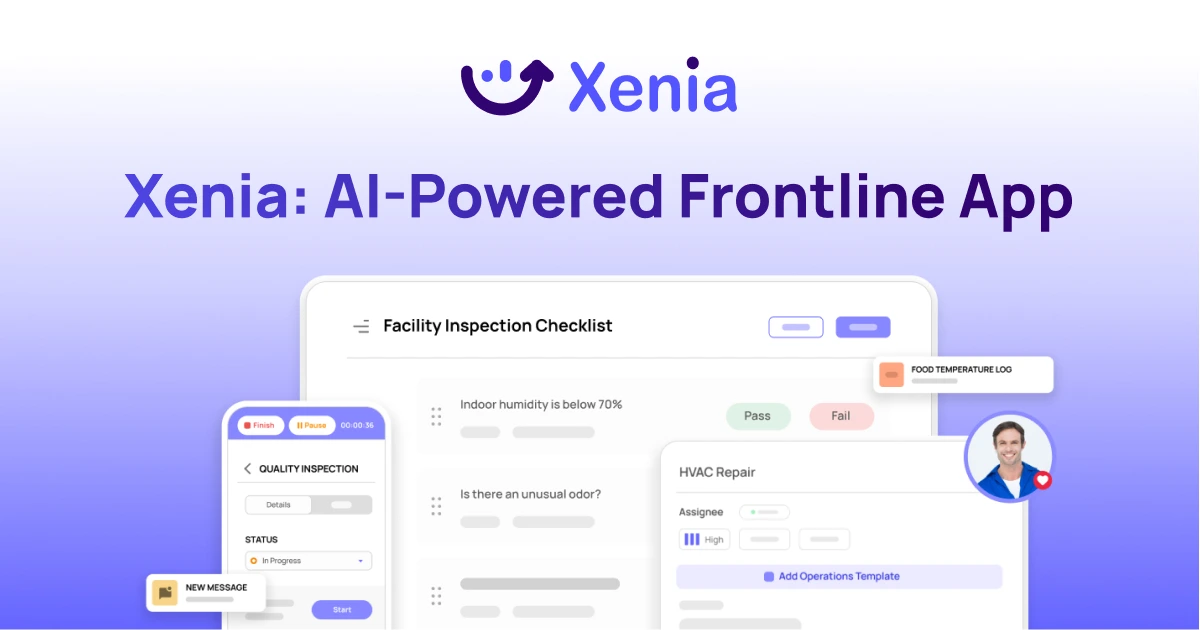
Xenia brings daily operations, maintenance, audits, and compliance into one mobile-first platform. Frontline teams execute work consistently across locations while leadership gets real-time visibility.
Why Multi-Location Operators Choose Xenia:
🤖 AI-Powered Operations, Create digital checklists instantly or convert paper forms with AI. Verify compliance automatically with photo analysis and get instant answers from your operational data.
✅ Daily Operations & Maintenance, Assign work across hundreds of locations in minutes. Report and route issues instantly. Schedule preventive maintenance to catch problems before downtime.
📊 Real-Time Visibility, Track completion, work orders, and performance across all locations through dashboards. Filter by site or asset to spot trends and take action.
Manage operations, maintenance, and compliance across all your locations from one platform

.svg)
.webp)
%201%20(1).webp)

.svg)
%201%20(2).webp)