
.webp)
Post Summary
You open location four. Within three weeks, location two starts slipping.
The GM there used to call you directly when something went wrong. Now you're harder to reach. The closing checklist that everyone followed because you checked it personally is being skipped on Tuesdays. A prep temp was out of range on Thursday. Nobody flagged it because there was no system to flag it to. There was just you.
That's the moment most restaurant operators realize that scaling a restaurant business is not the same as opening more locations. The systems that worked at two locations weren't really systems. They were you, showing up.
This article maps the staged failure sequence for growing restaurant groups. What breaks at 3 to 7 locations, what breaks at 8 to 20, and what breaks at 20 to 50 plus. Not general advice about hiring well or building culture. A specific diagnostic of which operational systems fail at which growth threshold, and what to build before each one.
.webp)
.svg)

Priced on per user or per location basis
Available on iOS, Android and Web


Recommended resources
- Operational excellence across locations
- Complete operational audit guide for growing businesses
- The best restaurant audit and inspection software for multi-unit operators
- Free restaurant SOP template for multi-location groups
Why do restaurant operators not see the scaling breakpoint coming?
The honest answer is that informal systems are invisible until they fail.
At one or two locations, the owner is the standard. They know every GM personally. They walk the floor most days. When something is off, they notice it and say something. The closing checklist gets done because the owner checks it. The prep temps stay in range because the owner asked about them last week. The communication is clear because it goes directly from the owner to the team.
None of this is documented. None of it is a system. It works because one person with very high standards is physically present most of the time.
Then the group opens location three. The owner splits time between three stores instead of two. Location 2 gets a little less attention. Things that used to get caught don't get caught. The GM at location two starts making small decisions independently because there's nobody to ask. Some of those decisions are fine. Some aren't.
By the time the owner opens location four, location two has been running on informal workarounds for six months. Nobody noticed because the owner wasn't there often enough to notice, and there was no system to notice for them.
Each new location doesn't just add operational complexity. It inherits the workarounds from the previous one. By location five, the group is running five variations of a process that was never formally documented in the first place.
This is where restaurant expansion goes wrong. Not at the new location. At the ones that were already open.
What breaks first at 3 to 7 locations?
Three things fail in sequence at this stage, usually in this order.
1. Checklist consistency
At two locations, the owner built the checklists, and the team followed them because the owner checked. At five locations, each GM has quietly modified their version. One added steps. Another removed the temperature log because it was "redundant." A third is using a checklist from eight months ago because nobody sent them the updated one.
The result is five locations running five different versions of a restaurant operations checklist that was supposed to be the same at every store. When something goes wrong, there's no way to know whether the process failed or whether the location was running the wrong process entirely.
2. Communication degradation
At two locations, the owner sends one message and everyone gets it. At five, the message goes from owner to GM to shift lead to team member. At every handoff, something changes. Context gets dropped. The urgency changes. By the time the message reaches the person who needs to act on it, it looks different from what was sent.
This is how a simple policy update becomes a compliance gap three weeks later. Not because anyone ignored it. Because the communication chain at five locations is long enough to distort anything that passes through it.
3. Ops review with no standard format and no trend data
At two locations, the owner reviews performance informally during their regular visits. At five, they're asking GMs for updates and getting five different formats back. One sends a summary email. One sends a spreadsheet. One calls. The owner is now spending time reconciling formats instead of acting on information.
There's no trend data because there's no standard format. Nobody can say whether location three is improving or declining because the data from last month looks nothing like the data from this month.
Here's what informal systems look like at two locations versus what's actually needed at ten:
**
Informal systems at 2 locations, Minimum required at 10 locations
Owner-as-standard-personal presence, Documented SOPs-standardized templates
Verbal instructions passed down, Written communications with read receipts
Ad hoc checklists modified per location, Unified checklist platform-one version per template
Owner catches issues during visits, Compliance dashboard visible without physical presence
Follow-up by memory or text message, Structured corrective action workflow with deadlines
Performance reviews by feel, Scored ops review with trend data across locations
**
What to do before you hit this stage
Write down every process that currently lives in the owner's head before the third location opens. Not a lengthy manual. A standardized checklist for each key workflow, opening, closing, line check, shift handoff, that every location runs the same way.
Set up a documented communication channel where policy updates reach every location with confirmation they were read. Not WhatsApp. Not a group text. A platform where every message has a delivery record.
Xenia's standardized checklist library means one template update reaches every location simultaneously. Broadcast communications with mandatory read receipts means every policy change is confirmed delivered. The owner stops being the communication layer before the third location makes that impossible.
What breaks next at 8 to 20 locations?
The first stage breaks consistency. The second stage breaks visibility and accountability.
1. Audit trail with no unified compliance view
At eight to twenty locations, a VP of Ops or regional director is making decisions about where to spend time and which locations need intervention. Without a unified compliance view, those decisions are based on gut feel, recent visits, and whatever the DM remembered to mention in the last call.
The audit trail for each location exists somewhere. It's in a spreadsheet, a printed form, a shared folder, or an email thread. But nobody is looking at all of them systematically, which means the VP is flying blind on which locations are trending toward a compliance problem before the health department shows up to confirm it.
2. Corrective actions flagged and forgotten
At this stage, internal audits are happening. Issues are being identified. But the corrective action workflow is broken. A GM flags a prep area issue on the internal audit. It gets noted. Three weeks later the same item fails again. Nobody followed up because there was no system to follow up. The finding and the fix were never connected.
This is where multi-unit restaurant management stops being about operations and starts being about documentation. The operator isn't failing to run good restaurants. They're failing to prove it when asked.
3. DM territory too large for physical visits alone
A district manager overseeing ten locations physically visits each one roughly once every two to three weeks. Everything that happens between visits is invisible without a digital ops layer. The DM is making territory-level decisions based on a fraction of the actual operational picture.
What to do before you hit this stage
Before you reach ten locations, two things need to be in place.
A unified audit and checklist platform where every location runs the same checklist version, every audit produces a comparable score, and every corrective action is tracked to resolution. For what this looks like in practice, operational excellence across locations covers the full framework.
A closed-loop corrective action workflow where a failed checklist item automatically creates a task, assigns it to the right person, sets a deadline, and requires photo evidence to close. Without this, the audit trail exists but the accountability layer doesn't. For a closer look, how closed-loop corrective actions work in multi-unit restaurants covers the mechanics.
Xenia's compliance dashboard gives the VP of Ops visibility across every location's audit scores and open corrective actions in one view, without opening a single file or making a single call.
What breaks at 20 to 50 plus locations?
The third stage breaks reporting, vendor accountability, and compliance documentation at a scale where the consequences are significantly larger.
1. Reporting becomes a full-day project
At twenty plus locations, pulling a weekly ops report requires someone to open twenty files, extract the relevant data, and build a summary. That process takes hours. By the time the report is ready, it's already out of date. The VP is spending half their week compiling information instead of acting on it.
This is where restaurant franchise operations and large multi-location groups start hiring dedicated ops analysts just to maintain the reporting function. That's a headcount cost that a unified digital ops layer eliminates.
2. Vendor accountability is unverifiable at scale
Maintenance work, deep cleaning, equipment servicing, pest control. At five locations, the owner knows the vendors personally and can verify the work informally. At thirty locations, off-hours vendor work is essentially unverifiable without a digital record. The invoice arrives. The work may or may not have been completed. There's no photo evidence, no timestamp, no record in the compliance system.
Operational audit for growing businesses covers how the audit framework needs to expand at this stage to include vendor accountability.
3. Compliance documentation impossible to produce on demand
A franchisor audit, a regulatory investigation, or a legal inquiry asks for compliance documentation across thirty locations for the past twelve months. What the operator can actually produce is a collection of documents in inconsistent formats, stored in different places, with no unified record connecting audits, corrective actions, and inspection outcomes.
At this scale, the absence of a compliance documentation system isn't a minor inconvenience. It's a legal and financial exposure.
What to do before you hit this stage
The compliance dashboard and corrective action workflow need to be fully operational across every location before you reach twenty stores. Not piloted at two. Running everywhere.
Auto-aggregated reporting needs to replace manual compilation. A digital vendor accountability layer needs to be in place so off-hours work is verifiable without a site visit. Compliance documentation needs to be exportable on demand in a format that satisfies a franchisor, a regulator, or a lawyer.
Xenia's trend reporting auto-aggregates location data across the full portfolio. Inspection-ready documentation is exportable from one place. The reporting problem that consumes half a VP's week at this stage is solved before it becomes a staffing decision.
What do operators building for 50 to 500 plus locations need?
At this scale, the infrastructure isn't just about fixing what's broken. It's about building a system that doesn't require the ops team to grow at the same rate as the location count.
The failure points at 50 plus locations are extensions of what broke earlier, but the stakes are proportionally larger. A compliance gap at thirty locations is a serious problem. At one hundred and fifty, it's a regulatory pattern, a franchise liability, and a reputational risk simultaneously.
What operators at this stage need is a single platform that replaces the informal systems, the spreadsheet exports, the manual compilations, and the phone calls that have been accumulating since location three. Not a better version of what already exists. A unified foundation that the entire ops organization runs on.
That's the problem Xenia is built to solve at scale.
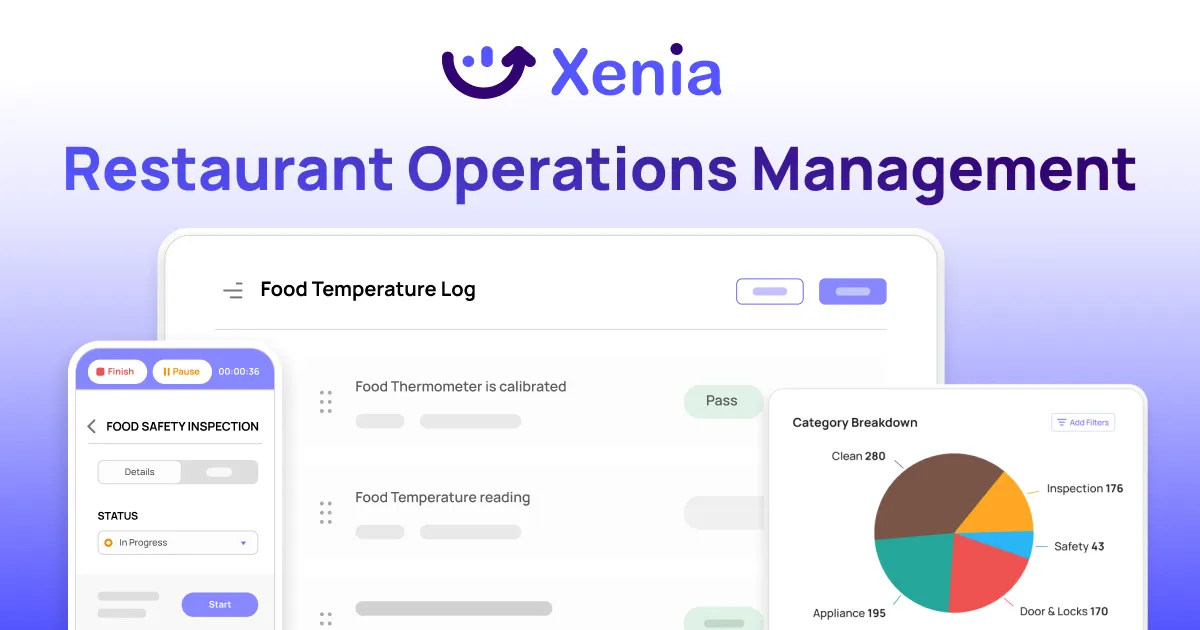
Standardized checklists pushed to every location at once. One template update reaches every store simultaneously. No version drift across fifty or five hundred locations. The restaurant standardization problem is solved at the platform level, not the management level.
Compliance dashboard across all locations, one login. The VP of Ops sees every location's checklist completion rate, audit scores, and open corrective actions in one view. The visibility that used to require physical presence or manual compilation now exists in real time.
Corrective action auto-workflow, flagged, assigned, and closed with proof. When any checklist item is marked non-compliant, a corrective task is created automatically, assigned to the right person, given a deadline, and closed with photo evidence. Nothing gets flagged and forgotten at location forty-seven the same way it did at location three.
Location-level visibility without physical presence. A DM overseeing twenty locations sees their full territory in one dashboard. A VP overseeing one hundred sees the portfolio. The operational picture doesn't depend on who visited which store last week.
Trend reporting showing which locations are drifting, in real time. Checklist completion rates, audit scores, and corrective action closure rates tracked over time across every location. The drift is visible before it becomes a crisis.
Communication with read receipts, no WhatsApp, no guessing. Policy updates, SOP changes, and operational announcements reach every location with confirmation that they were read. The communication degradation that breaks at five locations doesn't exist at five hundred.
DM territory view with location scores across their portfolio. Each district manager sees their territory's performance data. Area managers see their district. The VP sees everything. Role-based access means every stakeholder sees the right slice of the operational picture.
Inspection-ready compliance documentation on demand. When a franchisor, regulator, or insurer requests compliance history, it's exportable from one place. The documentation problem that becomes a legal exposure at thirty locations is solved before it reaches that point.
Scales from 3 locations to 500 with no per-user pricing penalty. Location-based pricing means every person at every store is covered. Headcount growth doesn't create a cost spike in the restaurant management software budget.
Book a demo to see how Xenia gives growing restaurant groups the operational foundation to scale.
Conclusion
The failure sequence is predictable. Checklist consistency breaks at 3 to 7 locations. Audit trails and corrective action loops break at 8 to 20. Reporting and compliance documentation break at 20 to 50 plus.
The operators who scale without breaking things build the next stage's infrastructure before the current stage forces it. Xenia gives growing restaurant groups the checklists, compliance dashboard, and corrective action workflows to do exactly that.
Book a demo to see how Xenia gives growing restaurant groups the operational foundation to scale.
Frequently Asked Questions
Got a question? Find our FAQs here. If your question hasn't been answered here, contact us.
How do corrective action workflows prevent operational drift at scale?

By connecting the finding to the fix inside the same system. A flagged issue creates a task automatically, gets assigned, given a deadline, and closed with evidence. Without that workflow, findings get noted and forgotten.
What is the difference between restaurant franchise operations and independent multi-unit growth?
Franchise operations come with mandated systems and compliance requirements built into the agreement. Independent growth requires the operator to build those systems from scratch. The failure sequence is the same but franchise operators usually hit each breakpoint with more infrastructure already in place.
What does a compliance dashboard do for a growing restaurant group?
It gives the VP of Ops visibility across every location's checklist completion, audit scores, and open corrective actions without a physical visit or a manual report. It replaces the daily phone calls and weekly compilation tasks that consume ops leadership time at scale.
What is the owner-as-standard problem in multi-location restaurant management?
It's when the owner's physical presence is the only thing enforcing standards. It works at two locations. At four or five, they can't be everywhere and nothing has been built to replace what they used to catch. Standards drift because the standard was a person, not a system.
When should a restaurant group move off informal systems?
Before location three, not after. By the time the owner notices something is wrong, multiple locations are already running on workarounds. Build documented SOPs and a standardized checklist platform before the third location opens.
What systems break first when scaling a restaurant business?
Checklist consistency breaks first, then communication, then ops review. All three happen between location three and location seven. Each location starts running its own version of a process that was never formally documented, and nobody notices until the drift is already built in.


A Modern, AI-Powered Platform Built for Restaurant Operations
Xenia brings kitchen operations, food safety, audits, and team communication into one mobile-first platform. Restaurant teams execute daily work consistently, maintain compliance, and resolve issues faster, while leadership gets real-time visibility across all locations.
.webp)
Why Restaurant Operators Choose Xenia:
🤖 AI-Powered Operations, Convert paper logs instantly and verify food presentation and kitchen cleanliness automatically. Get instant answers about food safety trends without building reports.
🍽️ Food Safety & Compliance, Track line checks and temperature logs with automated alerts. Trigger corrective actions when readings exceed safe ranges. Maintain audit-ready records for health inspections.
📊 Multi-Location Control, Monitor food safety compliance and task completion across regions. Benchmark locations to identify training needs. Export reports for operational reviews.
One platform for kitchen operations, food safety, and compliance across all locations.

.svg)
.webp)
%201%20(1).webp)

.svg)
%201%20(2).webp)