
.webp)
Post Summary
You're running three brands under one franchise group. Each has its own audit template. Each has its own scoring rubric. Each franchisor expects brand-specific compliance documentation enforced their way.
You want one system.
That tension is the franchise compliance problem nobody in the industry talks about directly.
Multi-location platforms are built for operators running one brand across many stores. They're not built for operators running many brands across many stores, each with its own audit requirements, its own permission structure, and its own franchisor expecting a report that looks nothing like the other two.
This article is about that specific problem. Why single-brand platforms break under multi-brand pressure, how QSR franchise groups build brand separation with group-level visibility, and what a mature multi-brand operations system actually looks like.
.webp)
.svg)

Priced on per user or per location basis
Available on iOS, Android and Web


Recommended resources
- Scaling restaurant operations from 5 to 50 locations and more
- The best restaurant audit and inspection software for multi-unit operators
- How closed-loop corrective actions work in multi-unit restaurants
Why do multi-brand operations break single-brand platforms?
Most restaurant franchise operations software is built around one assumption: every location in your portfolio runs the same brand. The checklist template is the same. The audit rubric is the same. The compliance score means the same thing at every store.
That assumption breaks the moment you operate more than one brand.
Franchisors require brand-specific audit templates. Each franchisor agreement specifies what gets audited and how. Those requirements differ across brands and aren't interchangeable.
A platform that gives you one audit template library for your entire group either forces you to mix brand-specific requirements into a single template or create workarounds that make the data impossible to compare cleanly.
A single compliance score hides brand-level failures. When your group dashboard shows a compliance score of 84%, that number is meaningless without knowing which brands are pulling it up and which are pulling it down.
A Brand A location scoring 95% and a Brand B location scoring 60% average out to a number that looks acceptable. The Brand B failure is invisible until the franchisor visit confirms it.
Vendor routing differs by brand. Each brand typically has its own approved vendor list for equipment categories. The same piece of equipment at two different brand locations may require two different service providers under two different agreements.
A platform with a single work order routing system either ignores those distinctions or forces your ops team to route manually every time.
These aren't edge cases. They're the core operational reality of running a multi-brand QSR franchise group, and most franchise compliance software isn't designed to handle them.
What to do about it
The fix isn't running separate platforms per brand. That trades one problem for another. The structure that works is brand-level audit template separation inside a single platform, with vendor routing rules configured per brand, and a group-level compliance dashboard that shows brand-level scores before rolling them up. Each problem above has a direct architectural answer.
Xenia is built around exactly that structure.
How do QSR franchise groups build brand separation with group-level visibility?
The structure that works is brand-level separation inside a single platform with a group-level rollup on top. Here's what that looks like in practice.
Brand-level audit templates with no cross-contamination. Each brand has its own audit template library, scoped to that brand's franchisor requirements. Each location runs the audit template scoped to its brand's franchisor requirements, not a combined template shared across the group.
Neither template is visible to the other brand's staff, and the results feed into separate brand-level compliance records before rolling up to the group dashboard.
Permission walls between brands. In Xenia, this separation is enforced through location attributes. Every location is tagged with its brand, concept, and region when it's set up. Templates, checklists, and audit records are then built with conditional visibility rules tied to those tags.
A GM at a Brand A location sees Brand A workflows automatically because their location's attribute determines what surfaces, not because an admin manually restricted their access. The separation is built into the data structure from the moment a location is tagged.
For context on what franchisors are required to disclose and enforce at the brand level, the FTC's franchise disclosure rule provides the regulatory foundation most franchise agreements are built around. The permission structure needs to enforce that separation at the role level, not rely on people not clicking the wrong thing.
DM visit templates configured per brand. A district manager overseeing locations across two brands needs a different visit template for each. The questions, the scoring rubric, and the required documentation are brand-specific. A platform that gives the DM one generic visit template forces them to mentally filter what applies to which brand on every visit.
Here's what the two approaches look like side by side:
**
Single mixed platform view, Brand-separated dashboard with group rollup
One audit template for all brands, Separate audit template per brand-franchisor-aligned
Combined compliance score masks brand failures, Brand-level score visible alongside group rollup
Work orders routed manually per brand, Vendor routing rules configured per brand automatically
DM uses one generic visit template, DM visit template configured per brand
Brand A staff can access Brand B data, Permission walls enforce brand-level data separation
Franchisor report compiled manually, Brand compliance report exportable directly from platform
**
Where does franchise compliance management break down across multiple brands?
Even with the right structure in mind, three specific failure points show up when you try to solve multi-brand operations with a platform that wasn't designed for it.
Shared checklist templates flatten your brand differences. When your platform has one checklist template library for the entire group, you have to decide how to handle the fact that Brand A's opening checklist has 14 items and Brand B's has 22, with nine that overlap and thirteen that don't.
The usual solution is a combined template that tries to cover both. The result is a checklist that's technically wrong for both brands and satisfies neither franchisor.
Cross-brand compliance averages mask your individual brand failures. A group-level dashboard showing one compliance number for your entire portfolio is measuring the wrong thing.
Franchise compliance management at a multi-brand group requires brand-level visibility first, group rollup second. When the average looks fine, the individual brand failure stays invisible until it shows up on a franchisor scorecard.
Training completion tracking per brand is invisible. Each brand has its own certified training requirements for new hires. A platform that tracks completion at the group level without brand-level separation can't tell you whether each brand's locations are hitting that brand's specific requirements.
A platform that tracks training completion at the group level without brand-level separation can't tell you whether your Brand B locations are hitting Brand B's training requirements. You find out when the franchisor audit flags it.
One operations manager at a 36-store chain described the core problem clearly: when they asked every location to send their checklist, every single one came back different, even though every manager said they were using the standard one. No two were in the same format.
That's not a people problem. That's what happens when brand-specific workflows are managed without brand-level separation.
What to do about it
Stop trying to solve multi-brand compliance with a single shared template. The fix is architectural. Each brand gets its own template library, scoped through location attributes so the right workflows surface at the right stores automatically. Training completion is tracked at the brand level because each location's tag determines which training requirements apply to it.
Xenia handles this through conditional visibility and location attributes, not manual configuration. When a location is tagged with its brand, every template, checklist, and training module tied to that brand surfaces automatically at that location. Your ops team doesn't manage the separation. The platform enforces it through the attribute layer.
What does multi-brand standardization actually look like operationally?
The goal is to standardize what can be standardized across brands while preserving what has to stay brand-specific.
Common workflows across all brands
Daily operations, work order creation, inter-team communications, and facilities management can be standardized across your entire group. The format for submitting a maintenance request doesn't need to change by brand. These are operational functions where standardization saves time without creating any franchisor compliance risk.
Brand-specific workflows that must stay separated
Audit templates, scoring rubrics, training completion tracking, corrective action documentation, and franchisor report formats must stay brand-specific. These are the areas where franchisor requirements are explicit and non-negotiable. Flattening them into a shared format to make the group dashboard cleaner creates compliance risk with the franchisor, not operational efficiency for the group.
The permission layer that makes it work
Xenia enforces this through location attributes and conditional template visibility. Each location carries tags for its brand, region, and concept. Every checklist, audit template, and compliance record is built with visibility conditions tied to those tags.
The right workflows surface at the right location automatically. A DM with a cross-brand territory sees brand-appropriate templates for each location they oversee because the template knows which location it's being run at. Group leadership sees the full portfolio because their role has no attribute restriction. Nobody configures this manually per user. It runs through the attribute and permission layer.
What does a mature multi-brand franchise operations system make possible?
When brand separation and group visibility are both in place, 3 things change for your franchise group.
Franchisor reports generated from live data, not spreadsheets. Each brand's compliance report is built from the same data that feeds the group dashboard. When a field consultant asks for your last quarter's audit history, it's exportable directly from the platform in the format you expect. You're not spending two days building a spreadsheet before every franchisor visit.
Brand-specific compliance trends visible to your DM. A district manager overseeing six locations across two brands can see how each brand's locations are performing against brand-specific standards, not a combined average that obscures the picture. When a location is trending down on a brand-specific compliance category, the DM sees it in their brand-filtered view before the franchisor visit surfaces it.
New brand onboarded in days, not months. When the platform is built for brand separation from the start, adding a third or fourth brand means configuring a new brand-level template library and permission structure, not rebuilding the entire system. The infrastructure is already designed to handle it.
One director of ops at a twenty-location QSR franchise group described the reality of running without a unified system: living in one app for one brand, then another app for the next, then another, with no single view of what was happening across the portfolio. That's the problem a mature multi-brand franchise operations platform solves directly.
How does Xenia support multi-brand QSR franchise operations?
Most franchise compliance software is built for multi-location operations. Xenia is built for multi-location operations AND multi-brand operations. The distinction matters because running multiple locations under one brand and running multiple brands under one group are different problems, and the architecture required to solve them is different.
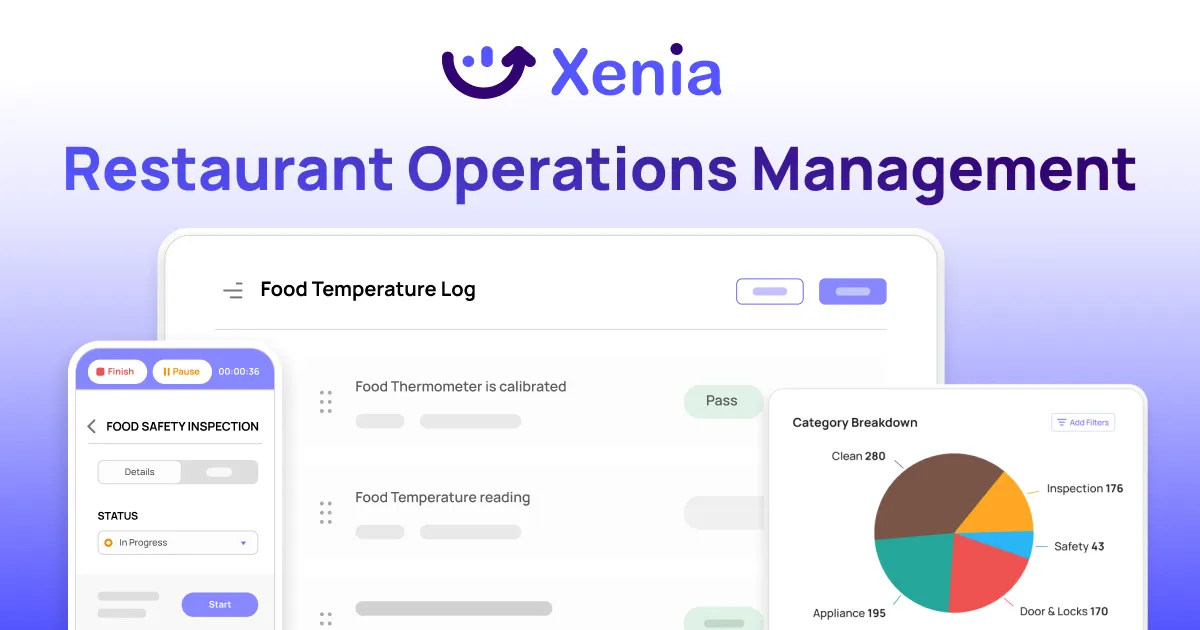
Brand-level audit template separation with no cross-contamination. Xenia's audit templates are built with location attribute tags that scope them to specific brands. When a location opens an audit, the platform surfaces the template tied to that location's brand tag automatically. No manual selection. No risk of running the wrong brand's rubric at the wrong store. The conditional visibility layer handles it at the template level.
Compliance dashboard filterable by brand, region, or location. Xenia's location hierarchy and permissions structure means group leadership sees the full portfolio while each level of the organization sees only what's relevant to them.
Filter by brand and you see brand-level compliance scores. Filter by region and you see regional performance within each brand. The right data at every level, without hiding the detail underneath.
Work order routing rules configured per brand and equipment type. Maintenance requests at each location route to the correct vendor automatically based on the brand and equipment category. The routing rules are configured once at setup. After that, every work order reaches the right vendor without your ops team making a manual decision on each one.
Brand-separated training modules under one login. Each brand's training completions are tracked against that brand's specific requirements. One login for your ops team, brand-level separation in the data.
Role-based access with brand-level permission gates. Access in Xenia is governed by location attributes, not manual permission lists. Every user's role is tied to the locations they're assigned to, and every location carries its brand tag.
What a user sees is determined by which locations they're assigned and what those locations are tagged as. A store-level GM sees one location's data. A DM sees their territory. Group leadership sees everything. The permission model scales as you add locations and brands without anyone rebuilding the access structure.
DM visit templates configured per brand. The visit template at each location is configured for that location's brand standards. One platform, brand-appropriate templates for every visit.
AI-powered operational summaries per brand. Instead of manually compiling a compliance narrative before a franchisor visit, Xenia generates an AI-powered summary of what's performing, what's flagging, and what needs attention at the brand level.
The summary is ready before anyone asks for it, which means your ops team stops spending two days assembling a report and starts walking into franchisor visits with the story already written.
Exportable brand compliance reports for franchisor requirements. When a franchisor requests compliance documentation, the brand-level report is exportable directly from Xenia in a format that satisfies the franchisor's request. No manual compilation. No spreadsheet assembly before the visit.
Scales across brands as you add them. Adding a new brand means configuring a new brand-level template library inside Xenia. Xenia's AI Template Agent accelerates that process by converting existing brand documents, PDFs, spreadsheets, or paper forms into structured Xenia templates automatically. Onboarding a new brand takes days, not months, because you're not building the template library from scratch.
The operational problem is fragmented brand compliance across a platform that wasn't built for it. But the business problem is bigger. Every hour your ops team spends manually routing work orders, compiling franchisor reports, and reconciling brand-specific checklists that were never properly separated is an hour not spent on growth.
Every franchisor visit where you can't produce clean brand-level documentation on demand is a relationship risk, not just an ops inconvenience.
When brand separation is built into the architecture, that stops. Franchisor relationships become straightforward because the documentation is always ready. New brands get onboarded without rebuilding the system. And your ops team runs one platform instead of four, which means they actually use it.
That's the real outcome. Not a better compliance tool. A franchise group that can add brands, satisfy franchisors, and scale without compliance becoming the bottleneck.
See how Xenia handles multi-brand franchise operations.
Conclusion
Running multiple brands under one group only stays manageable if the platform underneath is built for it. One shared template, one combined score, one routing system across all brands creates franchisor compliance risk at every stage of growth.
The operators who do this well run one platform with brand-level separation built into the architecture. Franchisor requirements met per brand. Group performance visible across all of them. New brands added without rebuilding anything.
Xenia is built for exactly that.
Book a demo with your brand structure in mind and see how Xenia handles multi-brand franchise operations.
Frequently Asked Questions
Got a question? Find our FAQs here. If your question hasn't been answered here, contact us.
How long does it take to onboard a new brand onto a multi-brand franchise operations platform?

On a platform built for brand separation from the start, days. On a platform retrofitted for multi-brand use, months. The difference is whether multi-brand architecture was designed in from the beginning or added later.
What workflows can be standardized across brands and what must stay brand-specific?
Daily ops, work orders, communications, and facilities management can be standardized. Audit templates, scoring rubrics, training tracking, corrective action documentation, and franchisor reports must stay brand-specific. Flattening brand-specific workflows into a shared format creates franchisor compliance risk, not efficiency.
How should a multi-brand franchise group structure its compliance dashboard?
Brand-level scores first, group rollup second. A single combined number hides which brands are performing and which aren't. Filter by brand, by region, and by location so you can see brand-specific compliance trends without losing the group-level view.
What is brand-level audit separation and why does it matter?
Each brand in your group has its own audit template, compliance scoring, and documentation format scoped to that brand's franchisor requirements. It matters because franchisors audit against their own standards, not a group average. Without separation, you can't produce the brand-specific report each franchisor expects.
Why do single-brand platforms fail multi-brand franchise operators?
They assume every location runs the same audit template and scoring rubric. A multi-brand group has different franchisor requirements per brand. Flatten those into one shared template and you create compliance risk with every franchisor while hiding brand-level failures in a combined average.
What is franchise compliance in a multi-brand QSR group?
Meeting each franchisor's specific audit, training, and documentation requirements across every brand in your portfolio, while maintaining a unified view of group-level performance. The challenge is that each franchisor has different standards, and most platforms flatten those differences instead of separating them.


A Modern, AI-Powered Platform Built for Restaurant Operations
Xenia brings kitchen operations, food safety, audits, and team communication into one mobile-first platform. Restaurant teams execute daily work consistently, maintain compliance, and resolve issues faster, while leadership gets real-time visibility across all locations.
.webp)
Why Restaurant Operators Choose Xenia:
🤖 AI-Powered Operations, Convert paper logs instantly and verify food presentation and kitchen cleanliness automatically. Get instant answers about food safety trends without building reports.
🍽️ Food Safety & Compliance, Track line checks and temperature logs with automated alerts. Trigger corrective actions when readings exceed safe ranges. Maintain audit-ready records for health inspections.
📊 Multi-Location Control, Monitor food safety compliance and task completion across regions. Benchmark locations to identify training needs. Export reports for operational reviews.
One platform for kitchen operations, food safety, and compliance across all locations.

.svg)
.webp)
%201%20(1).webp)

.svg)
%201%20(2).webp)