
Post Summary
Your location passed the last audit. Your team knows the standards.
But three locations down, the same product looks different. The same process runs differently. And nobody flagged it.
That is a quality control testing problem.
QC testing is not just for factories or labs. It is for any business where consistency matters. And as a multi-unit operator, you know
consistency is everything.
One location doing things right is good. Every location doing things right, on every shift, every day, is the real goal. That gap between one and every is exactly where quality control testing lives.
This guide covers what quality control testing is, why it matters, the main methods, how to build a process that works, and how multi-unit operators use it to keep standards consistent across every location.
.svg)

Priced on per user or per location basis
Available on iOS, Android and Web


Related Resources
- Quality control checklist templates for operations teams
- Quality control inspection software: what to look for
- QA inspection guide for multi-unit operators
- Quality audit software: how to pick the right one
What is quality control testing?
Quality control testing is the process of checking your products, services, or processes against a set standard to make sure everything meets the expected level of quality.
Here is a simple way to think about it.
You set a standard for how something should look, work, or be done. Quality control testing is the regular check that confirms it is actually happening that way.
It applies to a finished product on a shelf. A meal coming out of a kitchen. A store display. A customer interaction. A piece of equipment. Any time you check whether something meets a defined standard, that is quality control testing.
The goal is straightforward. Find problems before they reach the customer. Before they turn into complaints. Before they turn into something harder to fix.
What is the purpose of quality control testing?
The purpose of quality control testing is simple. Catch problems early. Keep standards consistent. Protect the customer experience.
Here is what it does for your operation:
**
Purpose, What it means in practice
Catch defects early, Find issues at the source before they reach customers
Keep standards consistent, Every location and every shift meets the same bar
Reduce waste and rework, Fix problems before they get bigger
Build customer trust, Consistent quality keeps customers coming back
Support compliance, Documented QC checks create an audit trail for inspections
Identify training gaps, Repeated failures show where coaching is needed
**
Without quality control testing you react to problems after they happen. With it, you catch them before they do.
Quality control vs quality assurance: what is the difference?
These two get confused a lot. Here is the simple version.
Quality assurance is about building the right process. It is the planning, the standards, and the procedures you put in place before work starts.
Quality control testing is about checking whether the process is working. It happens during or after the work.
**
Aspect, Quality Assurance, Quality Control Testing
Focus, Process, Output
When it happens, Before and during, During and after
Goal, Prevent defects, Detect defects
Example, Writing a food prep SOP, Checking a dish against the SOP
Who does it, Management-operations leaders, Staff-managers-auditors
**
You need both. Quality assurance sets the bar. Quality control testing checks whether you are hitting it.
Types of quality control testing
There is no single way to do quality control testing. The right method depends on what you are testing and why.
Here are the main types operators use:
Inspection-based testing
A manager or auditor physically checks a product, process, or location against a standard. This is the most common type in frontline operations.
A manager walking the floor before service. A district manager doing a site visit. A food safety check during health inspection prep. All of these are inspection-based QC testing.
Checklist-based testing
A structured checklist verifies that every step in a process was completed correctly. This is standard in restaurant line checks, retail opening and closing procedures, and food safety audits.
Checklists make quality control testing repeatable. They remove guesswork from the process entirely.
Photo verification
Staff or managers take photos to document that something meets the visual standard. A plated dish photographed next to a reference image. A store display photographed after setup.
Photo-based QC testing creates a visual record anyone in the organization can review remotely.
Automated and sensor-based testing
IoT sensors and connected devices monitor conditions continuously without needing a human check. Temperature sensors in walk-in coolers are the most common example.
The sensor checks temperature every few minutes and sends an alert if something goes out of range. This type of quality control testing runs around the clock.
Scored audits
Auditors score each checklist item based on how important it is. Critical failures score more heavily than minor ones. This gives a more accurate picture of overall quality than a simple pass or fail check.
Weighted scoring audits are common in franchise compliance and brand standards reviews.
Quality control testing methods: which one to use
**
Method, Best for, How it works
Physical inspection, Food quality-product presentation-store appearance, Visual or hands-on check against a defined standard
Digital checklist, Daily operations-opening and closing-food safety, Step-by-step verification with timestamped records
Photo verification, Visual standards-plating-displays-merchandising, Photo compared against a reference image
Sensor monitoring, Temperature-equipment-environmental conditions, Automated alerts when readings go out of range
Weighted scoring audit, Brand standards-franchise compliance-district visits, Scores assigned by importance-generates overall QC rating
Corrective action tracking, Any failed QC check, Assigns a fix-tracks completion-documents outcome
**
The most effective quality control testing programs use more than one method. Daily checklists catch routine issues. Scored audits catch bigger ones. Sensor monitoring catches what humans miss overnight.
What makes a good quality control testing process?
A lot of businesses have quality standards written down somewhere. Far fewer have a QC testing process that runs consistently. Here is what separates the two.
Defined standards come first
You cannot test against a standard that does not exist or is not written down. Every quality control check needs a clear definition of what pass and fail look like. Vague standards produce inconsistent results every single time.
Testing must be scheduled, not random
Quality control checks that only happen when someone remembers are not a process. They are a habit that breaks under pressure. Scheduled QC testing at defined intervals is what keeps standards consistent across shifts and locations.
Every check needs a record
A QC check with no documentation is just an opinion. Timestamped records, photos, scores, and corrective actions create the paper trail that proves quality control testing is actually happening. This matters for health inspections, franchise audits, and internal reviews.
Failed checks need corrective actions
Finding a problem and noting it is only half the job. A good QC testing process assigns a corrective action to a specific person, gives it a deadline, and tracks whether it got done.
Data needs to surface patterns
If the same quality control check fails repeatedly at the same location or on the same shift, that is a signal. It might be a training problem. It might be an equipment issue. Individual failed checks are events. Repeated failed checks are patterns. A good process captures both.
For more on building structured audit processes, see quality audit software and quality control inspection software.
Quality control testing in restaurants
In a restaurant, quality control testing touches almost every part of the operation.
Food quality is the most visible area. Does the dish look right? Is the portion correct? Does it match the recipe? These are quality control checks.
Line checks before service are a structured form of QC testing. Managers check temperatures, taste dishes, and verify presentation before the first order comes in. This is product quality control testing happening in real time.
Food safety is the second layer. Temperature checks on hot and cold holding food are quality control testing. So are sanitizer concentration checks, allergen protocol verifications, and HACCP critical control point reviews. These checks are not just about quality. They are about keeping guests safe.
See related reading on food quality checks and food safety standards for restaurants.
Brand standards are the third layer. Does every location plate the signature dish the same way? Is the dining room set up correctly before guests arrive? Do open and close procedures happen completely every time?
These are all quality control checks. In multi-unit operations they need to happen consistently across every location, not just the ones a district manager visited last week.
For restaurant-specific resources, see restaurant inspection app, restaurant audit report, and quality control checklist templates.
Quality control testing in retail
In retail, quality control testing focuses on three main areas.
Store presentation
Does the planogram match the standard? Is the display set up correctly for the current promotion? Is the pricing accurate? Visual merchandising quality checks directly affect how customers see the brand.
Inventory accuracy
Cycle counts, receiving verification, and stock level checks are all quality control testing for inventory. Getting this wrong leads to out-of-stocks, shrinkage, and unhappy customers.
Operational compliance
Are opening and closing procedures being completed fully? Are safety checks happening on schedule? Is the team following brand standards on every shift? These are process-level QC checks that only become visible when something goes wrong.
For retail-specific resources, see retail audit guide and QA inspection.
Common quality control testing mistakes operators make
Most QC programs fail not because the standards are wrong but because execution breaks down. These are the patterns that show up most often.
Checking equipment instead of output
A manager looks at the steam table dial instead of measuring the actual food temperature. A store walk looks at the surface instead of checking against the checklist. Equipment readings and visual impressions are not quality control testing. Measuring the actual output against the actual standard is.
Not documenting failed checks
A failed check that gets fixed on the spot but never recorded creates a blind spot. Six months later when the same issue comes back, there is no history to show it is a pattern. Every failed check needs a record even if the corrective action was immediate.
No corrective action tracking
Writing "needs improvement" on a checklist and moving on is not a corrective action. A real corrective action has an owner, a deadline, and a completion record. Without that the same failures repeat.
Inconsistent check frequency
Checking quality three times a week at some locations and once a week at others produces uneven data and uneven standards. Consistent frequency across all locations is what makes quality control testing useful at scale.
How to build a quality control testing process for multiple locations
One location is a checklist problem. Ten or fifty locations is a systems problem.
Here is what a scalable quality control testing process looks like:
Step 1: Define your quality standards
Write down exactly what pass and fail look like for every critical process. Without clear standards, QC testing produces inconsistent results.
Step 2: Build your QC checklists
Turn your standards into structured checklists. Each item should be specific enough that two different people checking the same thing reach the same result. "Kitchen is clean" is too vague. "All prep surfaces wiped down and sanitized before service" is specific.
Step 3: Schedule the checks
Define who checks what, how often, and when. Daily checks for high-risk items. Weekly or monthly checks for lower-frequency items. Put the schedule in writing and make it part of the role.
Step 4: Record every check
Use a system that timestamps records and ties them to the person who did the check. Paper logs work but create gaps at scale.
Step 5: Assign corrective actions for every failure
When a quality control check fails, assign a specific corrective action to a specific person with a deadline. Track whether it was completed.
Step 6: Review the data regularly
Look at QC check results by location, by shift, and by item. Patterns in the data show you where to focus training and resources.
For templates to get started, see quality control checklist templates and best quality control checklist apps.
Quality control testing tools for frontline operations
The right tool makes QC testing consistent and scalable. Here is what to look for:
**
Tool type, What it does, Best for
Digital checklist app, Structured QC checks with timestamps and photo requirements, Daily operational checks across all locations
Weighted audit software, Scores QC checks by importance-generates overall ratings, Brand standards audits-franchise compliance reviews
IoT sensors, Continuous automated monitoring of temperature and equipment, Walk-in coolers-freezers-critical equipment
Corrective action tracking, Assigns-tracks and closes failed QC items, Any failed check requiring follow-up
Multi-location dashboard, Shows QC compliance rates by location-shift and item, District managers overseeing multiple locations
Photo verification, Documents visual standards with side-by-side comparison, Plating-displays-merchandising-store setup
**
For more on selecting the right tools, see quality control inspection software, best quality control software, and quality management system.
How Xenia Supports Quality Control Testing Across Your Locations
Quality control testing at one location is manageable. At ten or fifty locations it becomes a visibility and consistency problem.
Xenia is an operations execution system built for multi-unit operators.
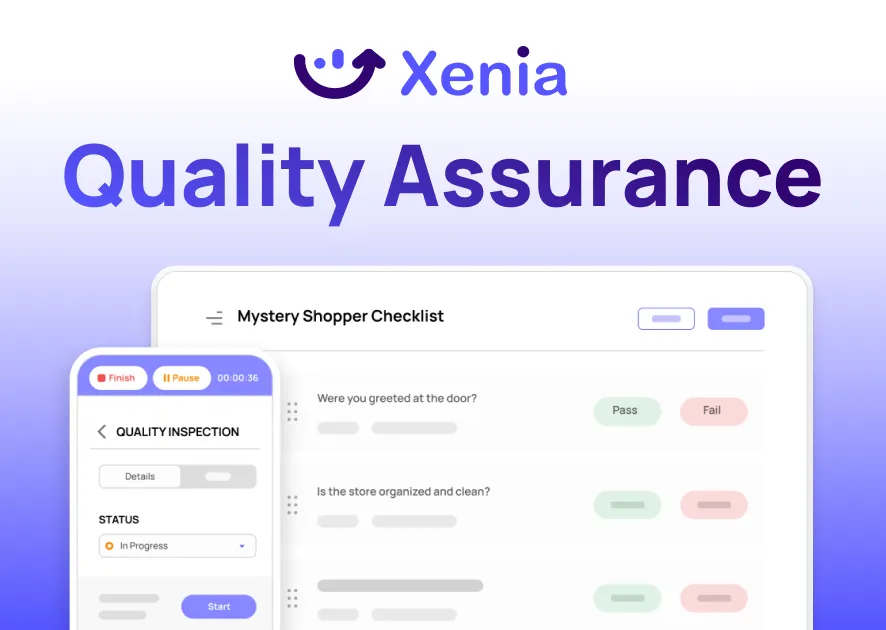
Digital checklists replace paper logs and every QC check is timestamped and tied to the person who completed it.
Weighted audit scoring assigns more importance to critical items so your overall QC score reflects real operational risk.
Photo verification lets staff document visual standards from their phone so managers can review remotely without being on-site.
When a check fails, Xenia automatically creates a corrective action task, assigns it to the right person, sets a deadline, and tracks completion.
District managers get full visibility across all locations through Xenia's analytics dashboards showing QC compliance by location, by shift, and by check type.
Start with quality control checklist templates or explore quality control inspection software.
Conclusion
Quality control testing comes down to three things. Set a standard. Check against it. Fix what does not meet it.
The hard part is doing that consistently across every location, every shift, every day.
If your QC checks still live on paper and your corrective actions depend on someone remembering to follow up, there is a better way. Xenia gives your team digital checklists, weighted audit scoring, photo verification, automated corrective action workflows, and multi-location dashboards so nothing slips through.
Book a demo and see how it works.
Frequently Asked Questions
Got a question? Find our FAQs here. If your question hasn't been answered here, contact us.
What happens when a quality control check fails?

It triggers a corrective action. Assign the fix to a specific person with a deadline and track whether it was completed. A failed check with no corrective action record means nothing was done about it.
How often should quality control testing happen?
It depends on the risk level. High-risk items like food temperatures need checking multiple times per shift. Brand standards and store presentation checks might happen daily or weekly. Equipment checks follow maintenance cycles.
What are the main quality control testing methods?
Physical inspections, digital checklists, photo verification, sensor-based monitoring, and scored audits. Most effective QC programs use a mix depending on what is being checked.
What is the difference between quality control and quality assurance?
Quality assurance designs the right process before work starts. Quality control testing checks whether that process is working during and after. You need both.
What is the purpose of quality control testing?
To find problems early so they can be fixed before they affect the customer. It also keeps standards consistent, reduces waste, supports compliance, and shows where training is needed.
What is quality control testing?
It is the process of checking whether a product, process, or service meets a defined standard. The goal is to catch problems before they reach the customer and keep quality consistent across locations and shifts.


A Modern, AI-Powered Platform Built Specifically for Frontline Operations
Xenia brings daily operations, maintenance, audits, and compliance into one mobile-first platform. Frontline teams execute work consistently across locations while leadership gets real-time visibility.
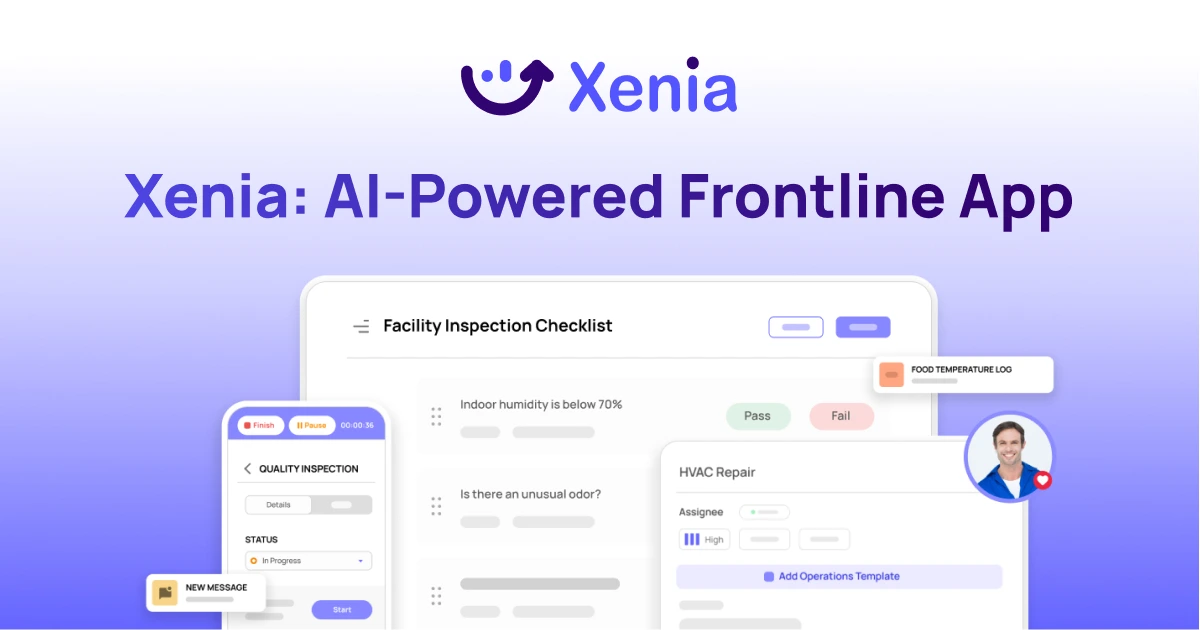
Why Multi-Location Operators Choose Xenia:
🤖 AI-Powered Operations, Create digital checklists instantly or convert paper forms with AI. Verify compliance automatically with photo analysis and get instant answers from your operational data.
✅ Daily Operations & Maintenance, Assign work across hundreds of locations in minutes. Report and route issues instantly. Schedule preventive maintenance to catch problems before downtime.
📊 Real-Time Visibility, Track completion, work orders, and performance across all locations through dashboards. Filter by site or asset to spot trends and take action.
Manage operations, maintenance, and compliance across all your locations from one platform

.svg)
.webp)
%201%20(1).webp)

.svg)
%201%20(2).webp)