
Post Summary
At location 8, the spreadsheet stops working. Nobody decides that. It just happens. One manager starts a notebook because the shared sheet got too messy. Another texts photos because nobody built anything better. By location 20, managers are passing notes between shifts instead of running them.
This is not a discipline problem. It's not even a training problem. It's what happens when compliance management software doesn't exist yet, and you're trying to hold 20 locations to one standard with tools built for one.
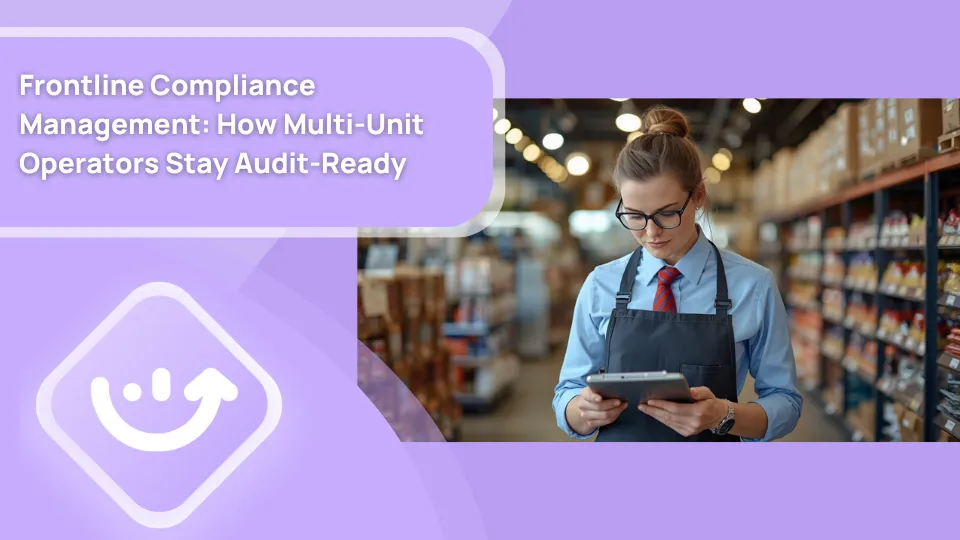
Quick answer: Frontline compliance management is the coordinated system that handles task assignment, completion tracking, evidence collection, exception escalation, and location-level reporting across every site in a multi-unit operation.
It replaces the patchwork of email, spreadsheets, and manager walkthroughs that works fine at 3 locations and falls apart somewhere between location 8 and location 15.
A real system has four parts: a task routing layer, an evidence layer, an exception escalation path, and a visibility layer for ops leaders. Below, we break down each part, why fragmented tools hit a ceiling as you scale, and how to evaluate a compliance platform once you're ready to fix this for good.
.svg)

Priced on per user or per location basis
Available on iOS, Android and Web


What is frontline compliance management?
Frontline compliance management is the system, not the spreadsheet, that makes sure every location does what it's supposed to do, proves it did it, and flags it when it didn't. It covers task routing, evidence collection, exception escalation, and reporting, tied together so nobody has to chase any of it by hand.
People mix this up with audit software a lot. An audit is a periodic check. Someone walks the location, scores it, moves on. Compliance management is everything that happens between those checks. It's the daily temperature log, the opening checklist, the photo proof the walk-in got cleaned, the alert that fires when someone skips a step.
An audit tells you how you did last quarter. Compliance management tells you what's happening today, across every site, in real time. If you want the deeper breakdown, our piece on restaurant line checks versus compliance audits draws that line in more detail.
It's also different from generic task management. Task management doesn't care if a task has a regulatory obligation attached to it. Compliance management does. Skip a to-do and nothing happens. Skip a food safety check and you've got a health department problem waiting to surface. That weight is what separates operational compliance management from regular task tracking.
The 4 components of a frontline compliance system
Strip away the branding and every working compliance system does the same four things.
**
Component, What it does, Why it matters
Task routing layer, Sends the right task to the right role at the right location on schedule, Removes the manager from the job of remembering and assigning everything by hand
Evidence layer, Captures photo verification-digital sign-offs and temperature logs, Proves the task got done-not just that someone checked a box
Exception escalation, Routes missed tasks or failed checks to the right person automatically, Stops small problems from sitting unnoticed until an audit finds them
Visibility layer, Shows completion rates-exception trends and compliance scores by location, Gives ops leaders a real compliance dashboard instead of a guess
**
None of these are "more meetings" or "stricter managers." They're rules and routing. A system either has all four working together or it has gaps, and gaps are where compliance problems live.
The compliance ceiling: why manual systems break at scale
There's a point where email, spreadsheets, and manager walkthroughs stop working as a compliance system. Most operators hit it somewhere between location 8 and location 15. We call it the compliance ceiling, and it's structural, not a people issue.
The tools that worked at 3 locations weren't built to coordinate 20. We've written more on what this risk of paper-based operations actually costs you, and why so many ops teams default to a Google Sheets restaurant audit long after it's stopped being safe.
Three warning signs show up right before you hit the compliance ceiling.
**
Warning sign, What's actually happening
Managers spend over 2 hours a day on compliance follow-up, They're doing the routing and chasing the system should be doing
Audit prep turns into a dedicated scramble week, Evidence isn't captured daily-so someone has to reconstruct it
The gap between your best and worst locations keeps widening, New locations inherit none of the consistency the old ones built up
**
Here's the math that makes this real. One missed task per location per day, times 20 locations, times 365 days, comes out to 7,300 untracked compliance events a year. Zero visibility into any of them. A structural blind spot.
Operators who've lived through this describe the same gap over and over. No single platform coordinates task assignment, completion, escalation, and reporting across multiple locations at once. Everything lives in a different tool, and someone has to manually stitch it together. That stitching job is the first thing that breaks when you scale.
What a working compliance management system looks like
Picture a 20-location restaurant group that's already past the ceiling. At the opening manager's location, the system has already assigned the right tasks for that site and flagged which ones need proof before they can be marked done.
The district manager sees a dashboard ranking all 20 locations by completion rate and flagged items, with no calls required. The VP of Ops sees a weekly rollup of exception trends across the whole portfolio, with corrective actions already assigned and time-stamped.
That's what audit-ready actually means. No scramble. No pre-audit all-nighter pulling photos off someone's phone. Location-level proof sits there, ready, whenever someone asks for it.
Corrective action history is documented with dates attached, not reconstructed from memory the night before an inspector shows up. It's also the difference between real compliance and what some operators call pencil whipping, checking a box without actually doing the work. A system with a real evidence layer and audit trail makes that nearly impossible to get away with.
The real shift is moving from reactive compliance to embedded compliance. Reactive means you find out about problems when the auditor walks in. Embedded means the problem surfaces and gets flagged before that ever happens, because the system is watching every day, not once a quarter. Audit readiness stops being a project and becomes a side effect of how the location runs.
How to choose a compliance platform for multi-unit operations
Most software in this category gets built for enterprise legal and finance teams managing GRC frameworks. None of that maps cleanly to a 30-location retail or restaurant brand. Here's what actually matters for frontline ops.
**
Evaluate for, Skip if it offers
Mobile-first task execution for deskless staff, A desktop-only interface managers can't use on the floor
Built-in photo evidence capture, Audit-only functionality with no daily task tracking
Location hierarchy with role-based routing, A flat structure that treats every site the same
Exception alerts that fire without manager polling, Dashboards that require someone to log in and check manually
Integration across your ops platform-not a point solution, A tool built for financial or legal compliance-repackaged for ops
**
A multi-unit compliance software worth paying for handles all five. If a vendor can only check two or three boxes, you're buying a point solution, and point solutions are exactly what got you to the compliance ceiling in the first place.
If you want to go deeper on vendor evaluation, our multi-location audit software buyer's guide and our breakdown of compliance audit software options cover what to look for in more detail.
Food safety is its own layer worth a closer look, and our food safety compliance software guide walks through it. When you're ready to put vendors side by side, our guide on questions to ask before buying a restaurant operations platform gives you the full list to bring into demos.
Conclusion
You're not going to fix this with a better spreadsheet template or a stricter manager. The compliance ceiling is structural, and it shows up the same way for every operator who scales past 8 to 15 locations. The fix isn't more effort. It's a system that routes tasks, captures evidence, escalates exceptions, and reports on all of it without anyone having to chase it down.
That's exactly what Xenia is built for. Checklists and SOPs handle the daily routing, audits and inspections capture the evidence, and corrective action tracking closes the loop automatically. One platform, every location, always audit-ready.
See it in action. Book a demo.
Frequently Asked Questions
Got a question? Find our FAQs here. If your question hasn't been answered here, contact us.
Can a task management tool replace a compliance management system?

No. Task management tools don't attach regulatory or brand-standard weight to a task, and they don't typically include photo evidence, exception escalation, or location-level compliance scoring. They handle the "what" but not the "prove it" or the "what happens when it's missed."
How many locations do I need before compliance management software is worth it?
Most operators feel the strain somewhere between 8 and 15 locations, when manual tracking starts producing visible gaps. If your managers are spending more than 2 hours a day on compliance follow-up, you're already past the point where a spreadsheet makes sense.
What is the difference between compliance management software and audit software?
Audit software handles the periodic check, usually quarterly or monthly. Compliance management software handles everything between audits: daily task routing, evidence collection, and exception escalation. Most operators need both, but compliance management is the layer that actually prevents audit surprises.


A Modern, AI-Powered Platform Built Specifically for Frontline Operations
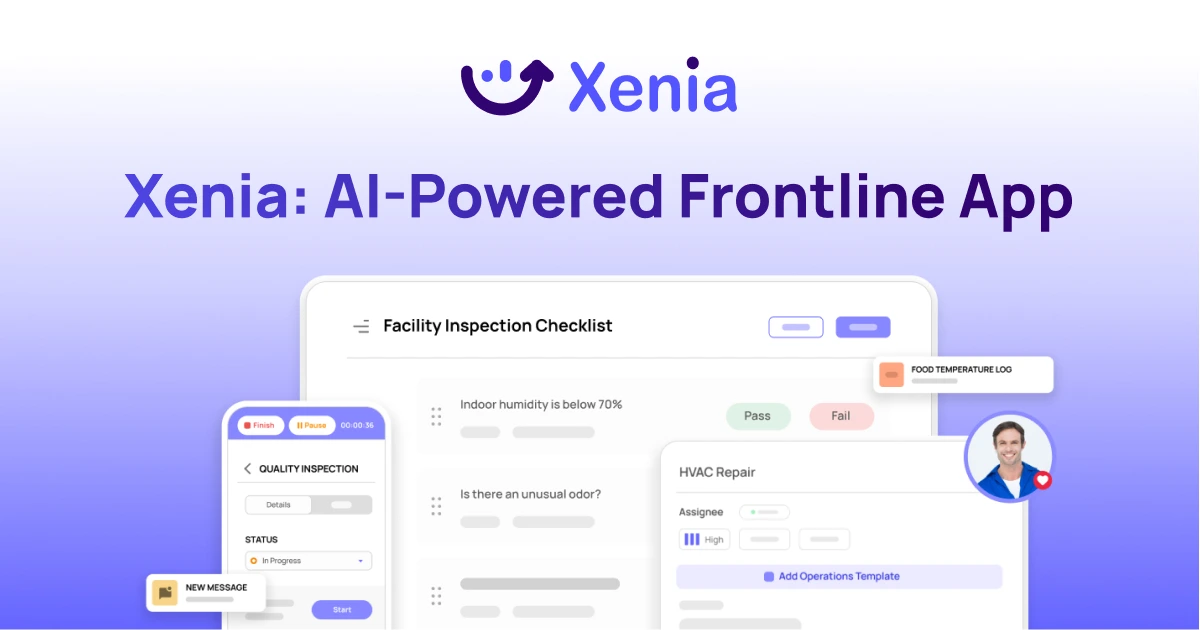
Xenia brings daily operations, maintenance, audits, and compliance into one mobile-first platform. Frontline teams execute work consistently across locations while leadership gets real-time visibility.
Why Multi-Location Operators Choose Xenia:
🤖 AI-Powered Operations, Create digital checklists instantly or convert paper forms with AI. Verify compliance automatically with photo analysis and get instant answers from your operational data.
✅ Daily Operations & Maintenance, Assign work across hundreds of locations in minutes. Report and route issues instantly. Schedule preventive maintenance to catch problems before downtime.
📊 Real-Time Visibility, Track completion, work orders, and performance across all locations through dashboards. Filter by site or asset to spot trends and take action.
Manage operations, maintenance, and compliance across all your locations from one platform

.svg)
.webp)
%201%20(1).webp)

.svg)
%201%20(2).webp)