
.webp)
Post Summary
Most operations teams track their inventory carefully.
Food costs. Product stock. Raw materials. All monitored closely.
But there is another category that keeps operations running every single day and almost never gets the same attention.
MRO supplies.
When MRO is managed well, nobody notices. Equipment stays running. Repairs happen fast. When it is managed poorly, the consequences show up quickly. Unexpected downtime. Emergency purchases. Maintenance delays that were entirely avoidable.
This guide covers everything you need to know about MRO.
.svg)

Priced on per user or per location basis
Available on iOS, Android and Web


What Is MRO? MRO Definition and MRO Full Form
MRO stands for maintenance, repair, and operations.
In simple terms, it covers all the supplies, tools, and materials used to maintain equipment, repair facilities, and keep day-to-day operations running. Not the products you sell. Not the raw materials you use to make them. Everything else that keeps your operation functional behind the scenes.
MRO full form broken down:
- Maintenance: supplies used for scheduled upkeep of equipment and facilities
- Repair: parts and materials used to fix equipment when it breaks
- Operations: consumables and supplies used in the day-to-day running of the business
MRO meaning in practice: anything your team uses to keep things running that does not end up in the product itself.
MRO items show up in every frontline industry. Restaurants, retail stores, convenience stores, and hotels all rely on MRO supplies every single day.
MRO vs Direct Materials: Understanding the Difference
This is where most teams get confused.
Direct materials go directly into the product or service you sell. A restaurant's direct materials are food ingredients. A retailer's direct materials are the products on the shelves. They get tracked closely because they tie directly to revenue.
MRO supplies are different. They do not go into the product. They support the operation that produces or delivers it.
A replacement HVAC filter. A cleaning chemical. A set of replacement belts for a fryer. None of these end up in what you sell. But without them you cannot operate.
**
Aspect, Direct Materials, MRO Supplies
Purpose, Goes into the product, Supports the operation
Tracked as, Cost of goods sold, Indirect operating expense
Examples, Food ingredients-retail products, Spare parts-cleaning supplies-tools
Visibility, High-closely monitored, Low-often overlooked
Impact when missing, Cannot produce or sell, Operations slow or stop
**
Both matter. But MRO supplies are the ones that get overlooked until something stops working.
Types of MRO Supplies: Categories and Examples
MRO products cover a wide range of items. Here is how the main MRO categories break down.
**
MRO Category, What It Includes, Frontline Examples
Spare parts and components, Replacement parts for machinery, HVAC belts-compressors-heating elements
MRO consumables, Items used up during maintenance, Cleaning chemicals-lubricants-filters
Tools and equipment, Hand tools-power tools-testing equipment, Wrenches-multimeters-drill sets
Safety supplies, PPE and safety equipment, Gloves-safety glasses-first aid kits
Facility maintenance supplies, Materials for building upkeep, Light bulbs-caulk-plumbing fittings
Janitorial and cleaning supplies, Cleaning and sanitation items, Mops-sanitizing wipes-trash bags
Office and administrative supplies, Back-office operational items, Labels-printer ink-paper
**
Every one of these MRO goods and categories shows up across restaurants, retail, and convenience stores daily. The challenge is not knowing what MRO items are. It is tracking and managing them consistently across every location.
Why MRO Management Is Often Neglected and What It Costs
MRO inventory gets neglected for one simple reason.
It is invisible until something goes wrong.
Direct materials get tracked because they tie directly to revenue. MRO supplies do not. They sit in storage rooms and maintenance closets across every location. Nobody tracks how much is being used. Nobody knows when stock is running low. Nobody notices until a technician needs a part that is not there.
Here is what poor MRO management actually costs:
Unplanned downtime. A technician arrives to fix equipment and does not have the right part. One missing MRO item turns a thirty-minute repair into a two-day wait for an emergency order.
Emergency purchasing. When MRO stock runs out unexpectedly teams resort to emergency purchases at premium prices. No time to compare vendors. No opportunity to negotiate.
Excess inventory. Without visibility into what is being used teams over-order to avoid stockouts. Supplies pile up in storage rooms. Money sits tied up in inventory that nobody is using.
Maintenance delays. When the right MRO supplies are not available, preventative maintenance gets pushed back. Pushed-back maintenance leads to equipment failures that cost three to five times more to fix than planned servicing.
No spend visibility. Without a centralized system MRO spend is scattered across locations and vendor invoices. Nobody knows how much is actually being spent. And without that visibility there is no way to reduce it.
MRO Inventory Management Best Practices for Frontline Businesses
Managing MRO inventory well does not require a complex system. It requires consistency and visibility.
Here is what works:
Centralize your MRO catalog. Start with a complete list of every MRO item used across your locations. Part numbers, descriptions, preferred vendors, reorder points, and current stock levels. One catalog that everyone works from.
Set reorder points for critical items. Every MRO item that would cause downtime if it ran out needs a defined reorder point. When stock drops below that level a purchase request triggers automatically. No more discovering stockouts when a technician needs a part.
Categorize by criticality. Spare parts for critical equipment need tighter inventory controls than office supplies. Not all MRO items deserve the same attention. Prioritize accordingly.
Track consumption by location. Knowing total MRO spend is useful. Knowing which locations are consuming the most and why is far more useful. Track at location level to identify patterns and inefficiencies.
Standardize across locations. When every location uses different brands and suppliers for the same MRO items purchasing becomes fragmented and expensive. Standardize where possible to consolidate spend.
Audit regularly. MRO inventory has a habit of disappearing without anyone noticing. Regular audits keep stock levels accurate and prevent surprise stockouts.
MRO Tracking Within a CMMS: How It Works in Practice
MRO inventory does not exist in isolation. It is directly connected to your maintenance program.
Every time a preventative maintenance task is completed, MRO supplies get consumed. Filters get replaced. Lubricants get applied. Belts get swapped. Without a system connecting maintenance activity to inventory consumption you have no way of knowing what is being used or when to reorder.
A CMMS, which stands for computerized maintenance management system, is where MRO maintenance and preventative maintenance programs come together in one system.
Here is how it works:
- A work order is created for a preventative maintenance task
- The CMMS identifies the MRO items required for that task
- The technician completes the work order and logs parts and consumables used
- The system updates inventory levels automatically
- When stock drops below the reorder point a purchase request triggers
The result is a closed loop. Maintenance drives consumption. Consumption drives purchasing. Purchasing keeps stock levels where they need to be for the next maintenance cycle.
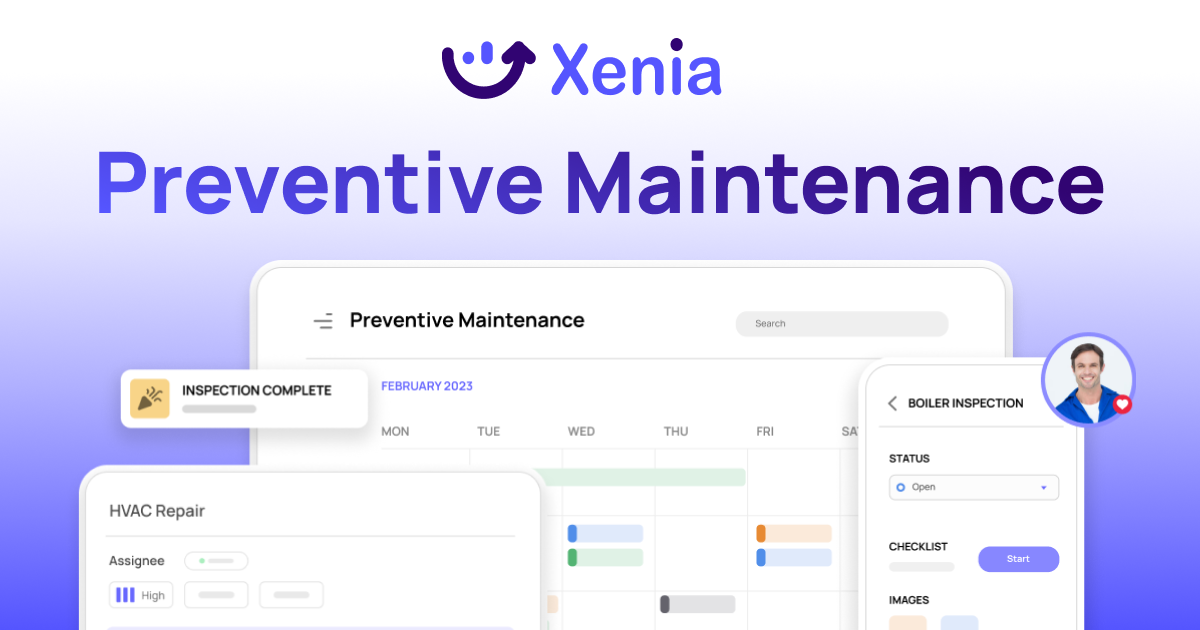
Xenia's CMMS connects MRO tracking directly to your preventative maintenance program. Work orders include the parts and supplies needed for each task. Technicians log consumption when they close the work order. Managers see inventory levels and MRO spend across every location from one dashboard.
No spreadsheets. No separate inventory system. No surprises when a technician shows up and the part they need is not there.
Reducing MRO Spend Through Better Planning and Preventative Maintenance
Most operations teams try to reduce MRO spend by negotiating better vendor prices.
That helps. But it is not where the biggest savings come from.
The biggest driver of excess MRO spend is reactive maintenance. When equipment fails unexpectedly teams need parts fast. They pay premium prices. They over-order to avoid being caught short again. And they repeat the cycle every time something breaks.
Preventative maintenance breaks that cycle.
Planned parts consumption. When maintenance is scheduled in advance you know exactly which MRO items will be needed and when. Order ahead. Consolidate purchases. Negotiate better pricing.
Fewer emergency repairs. Preventative maintenance reduces equipment failures. Fewer failures mean fewer emergency orders at premium prices.
Longer equipment life. Equipment that is properly maintained lasts longer. Fewer major component replacements. Lower overall MRO costs.
Better vendor relationships. When you know what you need and when you need it you can negotiate volume pricing. Reactive purchasing eliminates that leverage entirely.
The connection is direct. Better preventative maintenance means better MRO supply chain management. Better MRO supply chain management means lower costs and fewer surprises across every location.
Conclusion
MRO supplies are not glamorous.
But they are what keeps your equipment running, your facilities operational, and your frontline teams able to do their jobs every day.
Poor MRO management leads to unplanned downtime, emergency purchases, and maintenance delays that cost far more than a proper system ever would.
The fix is not complicated. Centralize your MRO catalog. Set reorder points. Connect MRO tracking to your maintenance program. Shift from reactive to preventative maintenance so you know what you need before you need it.
Xenia connects MRO tracking directly to your preventative maintenance program.
Work orders, parts consumption, inventory levels, and spend visibility across every location from one platform.
Book a demo and see how Xenia helps multi-location operations teams manage MRO inventory and maintenance in one place.
Frequently Asked Questions
Got a question? Find our FAQs here. If your question hasn't been answered here, contact us.
How can I reduce MRO waste or overstock?

Track consumption trends, standardize parts across locations, and only order what you need based on usage patterns. Regular audits help prevent excess stock from piling up.
How often should MRO inventory be audited?
At a minimum, quarterly audits are recommended. High-use or critical parts may need monthly checks. The goal is to prevent stockouts before they impact operations.
Can small businesses benefit from MRO tracking, or is it only for large operations?
Every business that uses equipment or facilities benefits from tracking MRO. Even small operations save time and money by avoiding emergency purchases and maintenance delays.
How do I know which MRO items are most critical for my business?
Critical MRO items are those that, if missing, would stop operations or delay repairs. Look at equipment downtime risk, cost of failure, and frequency of use to prioritize what to track closely.

A Modern, AI-Powered Platform Built for Facility Operations
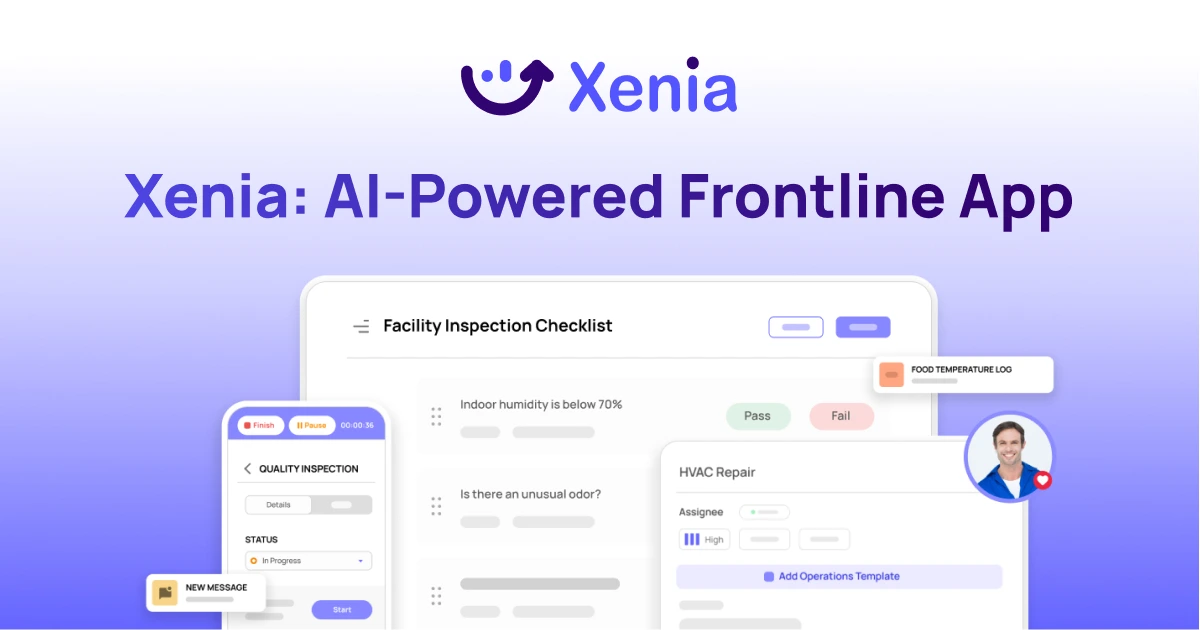
Xenia connects maintenance, safety, inspections, and daily operations into one mobile-first platform. Facility teams respond faster, prevent downtime, and maintain compliance, while leadership tracks performance across all buildings in real time.
Why Facility Managers Choose Xenia:
🤖 AI-Powered Inspections, Verify safety equipment and compliance automatically with AI photo analysis. Surface critical maintenance issues instantly with AI-powered summaries.
🛠️ Work Orders & Maintenance, Report issues via mobile or QR codes. Route requests to teams or vendors. Schedule preventive maintenance for HVAC, elevators, and emergency systems to reduce downtime.
📊 Safety & Visibility, Deploy fire safety and hazard inspection workflows. Monitor work order resolution times and asset health across all facilities.
Manage work orders, maintenance, and safety inspections across all facilities from one platform.

.svg)
.webp)
%201%20(1).webp)

.svg)
%201%20(2).webp)