

Summary
What is multi-location work order management?
Multi-location work order management is the operational discipline that turns ticket intake, routing, dispatch, and closure into one repeatable process across every store in a multi-unit restaurant chain. A work order is the digital record of a single equipment or facility problem, from the line cook flagging "fryer 2 won't hold temp" to the closing manager logging a walk-in door seal that won't shut. Preventive maintenance, or PM, is the scheduled service that keeps that fryer or walk-in from breaking in the first place. The severity level on a ticket is the operator's first decision: P1 means a menu category is down or food safety is at risk, P2 means degraded but operating, P3 means cosmetic or deferred.
The operational problem this discipline solves is volume. A 50-unit chain generates between 1,500 and 3,500 tickets a year once PM is layered on top of reactive work. 86 Repairs' incident data shows cold-side equipment (walk-in coolers, ice machines, prep tables, reach-ins) accounts for 31.88% of all service incidents at an average $765.50 per incident (86 Repairs data via Retail & Restaurant Facility Business). Single-site tools collapse under that volume because they cannot route by region, scope visibility to a DM, or roll up cost across a brand.
Restaurant work order software earns its place when it answers four questions in one screen: which stores have open P1s right now, which tickets are aging past SLA, which assets are racking up repeat repairs, and which DMs are running over R&M budget. Anything that cannot answer those four questions is still a glorified text thread.
Workflow diagram, store-level submission to regional rollup
The workflow that closes a multi-location ticket runs through nine steps. Each step exists because the previous step at single-site scale was the one that broke when the chain crossed 25 units.
- Submission at the store. A line cook spots a fryer holding low or a walk-in trending warm. They scan the QR code stuck on the asset (no app, no login) or open Xenia on the store tablet. The form opens pre-populated with the asset ID, store address, and equipment category. Xenia supports anonymous QR submission, so any staff member or third-party vendor can file a ticket without a user seat (Xenia work order requests).
- Severity classification. The submitter picks low, medium, or high. A walk-in trending warm is high because the FDA Food Code requires Time/Temperature Control for Safety foods to stay at or below 41 degrees F in cold storage (FDA Food Code 2022, Chapter 3). A cosmetic dent on a menu board is low.
- Photo and description. Required at submission so the assigned tech does not show up blind. A photo of the fryer thermostat reading beats a paragraph of free text.
- Auto-route to the right tech. A high-severity walk-in ticket in Tampa routes to the regional refrigeration vendor for that district, not a Phoenix tech. A fryer ticket routes to the certified hood and fryer vendor. Drive-thru AV routes to the signage partner.
- DM notification. The district manager covering that store gets a push and an email. They do not see other DMs' tickets, only their 8 to 15 stores.
- Vendor accepts and sets ETA. Internal tech, external vendor, or hybrid. The status flow moves from Submitted to Triaged to Assigned to In Progress.
- Resolution capture. Tech logs the fix with a photo, parts used, and labor hours. Cost gets attached to the ticket.
- Verification. The store GM verifies the asset is back in service. Status moves to Verified, then Closed.
- Asset history append. The closed ticket writes to the asset record. Store 47, Fryer 2, now has its fourth thermostat ticket in 60 days, which is the cue for a capex decision instead of another repair.
Anchor the workflow on the sibling pattern in our dispatch-to-resolution work order workflow guide, then layer the multi-unit routing on top.
QR-code submission is the entry point that makes this whole flow possible at the line cook layer. Kitchen manager scans QR on a broken fryer, the work request auto-routes to maintenance with the photo attached. That is the difference between a ticket that gets filed and a ticket that gets filed on time. For the deeper mechanics of no-login submission across staff and third-party vendors, see our walkthrough on QR code work requests for no-login submission at multi-site operations.
How does Xenia's multi-location flow differ from a full CMMS?
A full CMMS like Limble or MaintainX is built around the maintenance technician. Xenia is built around the frontline submitter and the district manager. Both have a place in a 50 to 500 unit restaurant stack. The honest comparison is below.
| Capability | Xenia | Limble or MaintainX (full CMMS) |
|---|---|---|
| Frontline submission UX | QR code with no login, mobile-first form, photo required, pre-populated asset and store fields | Mobile submission supported, but designed around an authenticated technician seat |
| District manager scoping | DM sees only their 8 to 15 stores by default, with one-tap rollup to region | Permissioning is asset-tree-based, not org-chart-based, often needs custom config |
| Parts inventory depth | Light, attach parts cost and description at close | Deep, full SKU catalog, reorder thresholds, vendor PO integration |
| PM cadence by asset class | Yes, on schedule and meter-based | Yes, plus meter-based and condition-based with sensor inputs |
| Vendor invoice automation | Cost capture at close | Three-way match, vendor PO, invoice reconciliation |
| Pricing model | Flat per location, $99 to $199 per store per month (Xenia pricing) | Per-user, MaintainX runs free Basic, $16 Essential, $49 Premium per user per month (MaintainX vs Limble) |
| All-in-one with daily ops and audits | Yes, same app as opening checklists and audits | No, work-order-only |
Xenia wins on no-login submission, frontline UX, DM scoping, and the all-in-one stack that puts work orders next to daily checklists. The full CMMS still leads on parts inventory depth and vendor invoice automation, which matters most when a corporate facilities team owns a dedicated parts crib. A growing pattern in 50 to 300 unit chains is to run both intentionally, the CMMS as the asset-of-record system for the facilities team, and Xenia as the frontline submission and DM rollup layer. The line cook files in the app she already uses for the line check, and the facilities tech keeps her parts catalog where she wants it. For a direct head-to-head on this stack pattern, see our Xenia vs. Limble honest comparison for multi-unit operators.
.svg)

Priced on per user or per location basis
Available on iOS, Android and Web


How to set up multi-location work orders in Xenia
The setup runs in five steps. Plan for two weeks of configuration before you flip on submission for the full chain.
- Build the location hierarchy first. Corporate at the top, then Region (East, Central, West), then District (one node per DM), then Store. Inside each store, set up departments (kitchen, FOH, drive-thru, restrooms) and tag the assets that live in each. Xenia's location hierarchy and permissions is the multi-unit anchor that makes scoped visibility work. DMs see only their district, regionals see their region, corporate sees the whole portfolio. One account, multiple scopes, no over-visibility, no data silos.
- Define asset classes and the routing pool for each. Fryer routes to the certified hood and fryer vendor. Walk-in routes to refrigeration. Drive-thru AV routes to the signage partner. HVAC routes to the rooftop partner. List the vendor or internal tech for each region.
- Print and place QR codes on every asset. Fryer 1, Fryer 2, Walk-in A, Hot-hold, Ice machine, Drive-thru OCB. Anonymous submission means a back-of-house dishwasher can scan and file without a seat.
- Set severity defaults by asset class. Walk-in temp drift defaults to high (food safety). Fryer thermostat defaults to high (kills a menu category). Menu board cosmetic defaults to low. Operators can override at submission.
- Build the Monday morning dashboard. Configure custom dashboards for the DM view (open P1s, aging buckets, PM compliance, R&M YTD vs. budget) and the corporate view (brand-wide rollup with drill-down). Xenia's dashboards surface what is coming up as a problem, flagged items, open corrective actions, high-risk locations, not just completion metrics, so the DM sees where the next failure is forming before it lands.
Pair the work order rollout with a maintenance cadence calendar so PM does not slide. Our walkthrough on preventive maintenance cadence by asset class lays out the quarterly hood, monthly fryer boil-out, and weekly walk-in coil cycles that keep reactive volume down.
Where do operators see results?
Operators see results in three places: ticket time-to-resolution drops, DM windshield time gets redirected, and asset capex decisions get cleaner. Bacari Restaurants, an 8-unit Los Angeles concept, consolidated multi-channel R&M requests onto Xenia and completed over 150 work orders in 30 days while standardizing daily checklists, food-quality assessments, and training across every location (Xenia customer story, Bacari Restaurants). The value was eliminating fragmented chat threads and call lists, then getting work orders, food safety, and store comms into one app.
The Monday morning workflow is where the discipline shows up. A DM covering 15 locations cannot drive to every site every week. The dashboard replaces windshield time. The DM opens Xenia and reads, in order, P1 and P2 tickets still open from the weekend, aging buckets at 48 hours, 7 days, and 14 days, PM compliance for the scheduled hood, fryer, and walk-in cycles, asset-history flags (Store 47, Fryer 2 has had three thermostat tickets in 60 days), and the R&M cost rollup against monthly budget. Any store running over 120 percent of plan gets a call before lunch.
The closure-tracking layer is what turns work orders into a real metric, not a ticket count. Our companion piece on maintenance ticket systems with closure tracking covers the verification step that separates a ticket marked "closed" from an asset actually back in service. Pair that with prioritization rules, see work order prioritization by severity level and SLA, and the queue stops choking when ticket volume crosses 100 stores.
The food safety hook is the reason any of this matters at the P1 level. A walk-in cooler drifting above 41 degrees F is not just a revenue event. It is a health code event, and the work order trail becomes the documentation the inspector pulls. Our walk-in cooler temperature log guide for manual vs. automated logging covers the temp evidence side that pairs with the work order side. For the broader operations stack across the chain, see the restaurant task management hub and the work order management Collection hub for sibling guides on dispatch, vendor access, and PM cadence.
Frequently Asked Questions
Got a question? Find our FAQs here. If your question hasn't been answered here, contact us.
What does multi-location work order management look like for a 200-unit restaurant chain?

How does Xenia route a fryer ticket at one store to the right area tech?
Can DMs see only their district's tickets while corporate sees the whole portfolio?
What's the rollup view a regional VP looks at on Monday?
How does Xenia handle ticket volume across 100+ stores without choking the queue?
Where does Limble fit alongside Xenia for restaurant operators who already use a CMMS?

A Modern, AI-Powered Platform Built for Facility Operations
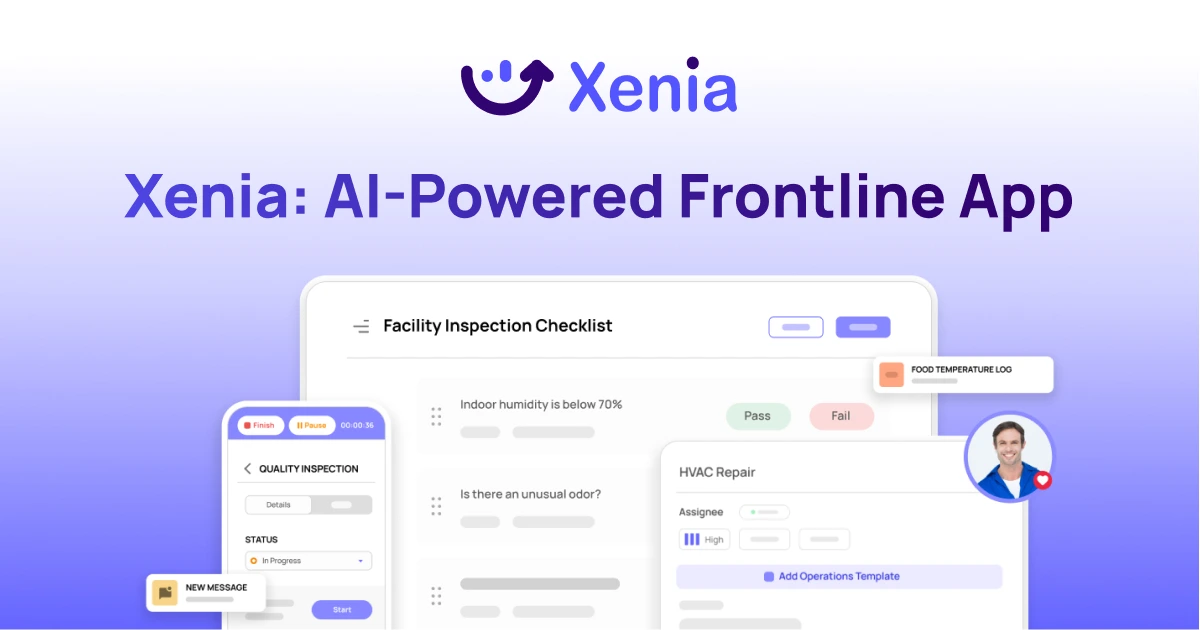
Xenia connects maintenance, safety, inspections, and daily operations into one mobile-first platform. Facility teams respond faster, prevent downtime, and maintain compliance, while leadership tracks performance across all buildings in real time.
Why Facility Managers Choose Xenia:
🤖 AI-Powered Inspections, Verify safety equipment and compliance automatically with AI photo analysis. Surface critical maintenance issues instantly with AI-powered summaries.
🛠️ Work Orders & Maintenance, Report issues via mobile or QR codes. Route requests to teams or vendors. Schedule preventive maintenance for HVAC, elevators, and emergency systems to reduce downtime.
📊 Safety & Visibility, Deploy fire safety and hazard inspection workflows. Monitor work order resolution times and asset health across all facilities.
Manage work orders, maintenance, and safety inspections across all facilities from one platform.

.svg)
.webp)
%201%20(1).webp)

.svg)
%201%20(2).webp)


