
.webp)
Post Summary
Your restaurant's success comes down to execution.
You can have the best food in town and a gorgeous space. If your team can't execute consistently, none of it matters.
Most training programs cover fluff like "be nice to guests." That's not training.
Real training teaches specific skills that drive results. Better guest experiences. Lower food costs. Smoother shifts.
Here are 10 training topics for restaurant staff that actually make a difference.
.webp)
.svg)

Priced on per user or per location basis
Available on iOS, Android and Web


Why Restaurant Training Actually Matters
Here's what happens without training: New hires take 4-6 weeks to get up to speed. Service quality is all over the place. Your managers answer the same questions constantly.
With structured training, new team members contribute meaningfully within days. Service stays consistent. Your team solves problems independently.
Training transforms your procedures into actual team capabilities.
10 Essential Restaurant Training Topics
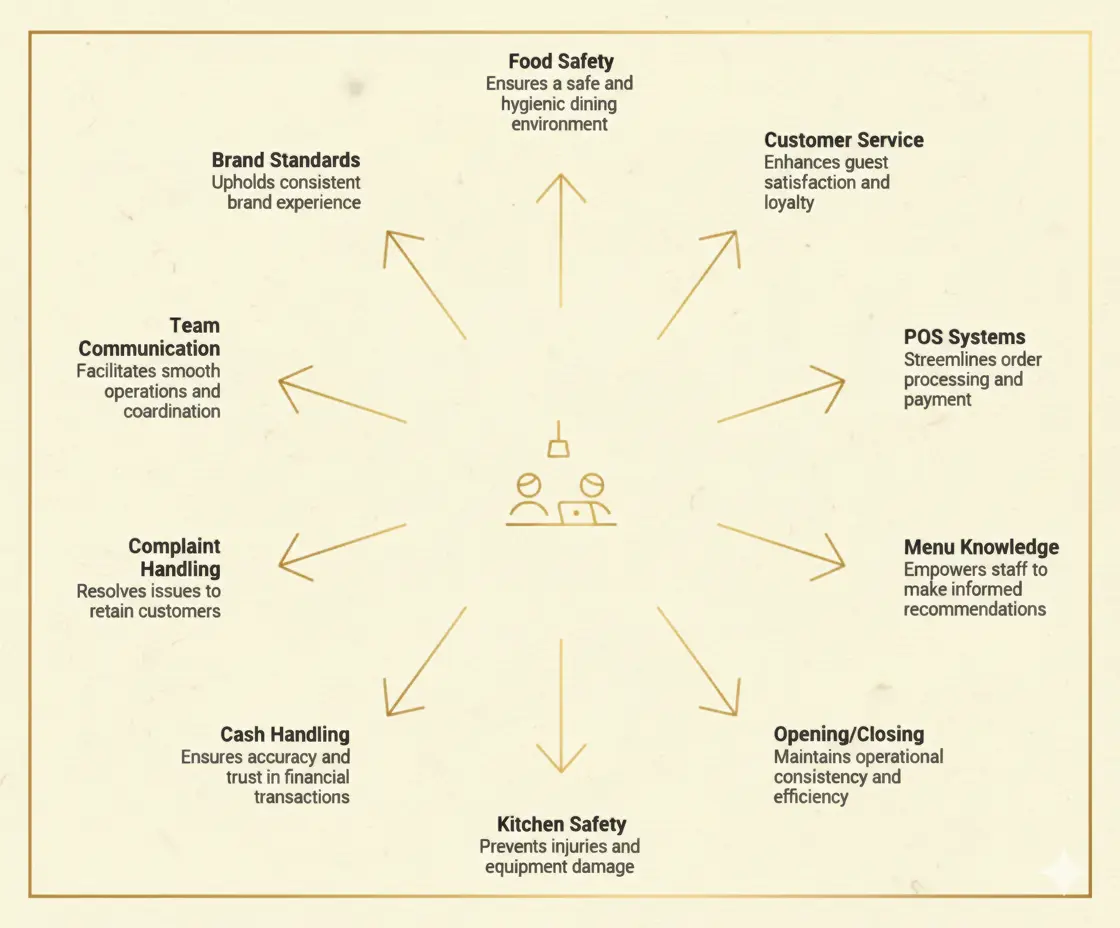
1. Food Safety & Hygiene Standards
Food safety violations can shut you down. Every team member needs solid food safety knowledge.
One foodborne illness outbreak costs more than you'll spend on training all year. Beyond legal compliance, proper food safety protects your reputation.
Key areas to cover:
- Proper handwashing technique and timing
- Temperature danger zone (41°F-135°F)
- Cross-contamination prevention
- Allergen awareness and handling
- Personal hygiene standards
- When to stay home sick
How to train: Show them in the actual kitchen. Have team members practice handwashing, using thermometers, and proper storage. Use photo examples of correct vs. incorrect execution.
Digital food safety management systems make compliance automatic instead of relying on manual logs that get skipped during rush hours.
For complete protocols, check out food safety training for employees.
2. Customer Service Excellence
Happy guests come back. It's that simple.
Good service can be taught. The difference between a returning guest and a one-time visitor? How your team made them feel.
Key areas to cover:
- Greeting standards (timing, warmth, eye contact)
- Reading guest cues (rushed vs. leisurely)
- Menu guidance without being pushy
- Handling special requests
- What to do when mistakes happen
- Creating memorable moments
How to train: Role-play common scenarios. Have your best servers demonstrate excellent service. Film training sessions so people can see themselves and improve.
Focus on specific behaviors. "Be friendly" means nothing. Define what friendly actually looks like in your restaurant. Check out our guide on restaurant customer service training.
3. POS Systems & Technology
Technology confusion slows service and creates errors.
When servers fumble with your POS system, guests wait longer, and mistakes happen that cost you money.
Key areas to cover:
- Order entry for common items and modifications
- Splitting checks and separate payments
- Applying discounts correctly
- Processing different payment types
- Sending orders to kitchen displays
- Running end-of-shift reports
How to train: Use test mode for practice before real transactions. Create common order scenarios. Have new team members shadow experienced staff during actual service.
Don't assume technology is intuitive. What's obvious to you is brand new to them.
Read: Restaurant managers’s guide to POS system training
4. Menu Knowledge & Upselling
Your team can't sell what they don't understand.
Servers with deep menu knowledge drive higher check averages and provide better recommendations. Knowledge builds confidence. Confidence drives sales.
Key areas to cover:
- Ingredients and preparation for every dish
- Portion sizes and presentation
- Allergen information
- Taste profiles for accurate recommendations
- Wine and beverage pairings
- Natural upselling opportunities
How to train: Menu tastings for all staff. You can't describe dishes you've never tried. Quiz team members regularly. Reward those who demonstrate deep knowledge.
Update training immediately when menu changes.
Check out the 8 ways to strategize menu learning
5. Opening & Closing Procedures
How shifts start and end determines your operational consistency.
Proper opening means you're ready when first guests arrive. Thorough closing prevents food waste and chaotic next-day starts.
Opening essentials:
- Equipment startup sequence
- Temperature checks and documentation
- Station setup and prep verification
- Dining room setup and cleanliness
Closing essentials:
- Food storage and labeling
- Equipment cleaning and shutdown
- Cash handling and deposits
- Prep for next shift
How to train: Create detailed checklists for each role. Have trainees complete procedures with checklist in hand. Then verify execution quality.
Reference restaurant standard operating procedures for detailed execution steps.
6. Kitchen Safety & Equipment Operation
Kitchen injuries are preventable. Equipment damage is expensive.
Workers' comp claims and equipment repairs stem from inadequate safety training. Prevention costs less than dealing with consequences.
Key areas to cover:
- Knife handling and cutting techniques
- Proper lifting to prevent back injuries
- Burn prevention around hot equipment
- Slip and fall prevention
- Equipment operation procedures
- Fire extinguisher location and use
How to train: Demonstrate proper techniques before allowing independent work. Never assume someone knows how to use equipment safely. Verify competency through supervised practice. Share kitchen equipment training guide with your team.
7. Cash Handling & Payment Processing
Money mistakes damage trust and create accounting nightmares.
Cash variances and credit card errors trace back to inadequate training. When it comes to handling money, accuracy is everything.
Key areas to cover:
- Opening cash drawer and verification
- Making accurate change
- Processing credit card payments correctly
- Handling large bills
- Cash drop procedures and timing
- Closing and reconciliation
How to train: Practice with real currency in controlled settings. Have trainees count starting banks, process mock transactions, and complete closing procedures. Verify accuracy before allowing real transactions.
Reference restaurant cash handling procedures for detailed protocols.
8. Handling Complaints
Not every interaction goes smoothly. How your team handles complaints determines whether disappointed guests become loyal customers or negative reviews.
Most team members avoid conflict without training. They freeze up or get defensive.
Key areas to cover:
- Active listening
- Sincere apologies
- Offering fixes instead of excuses
- When to involve a manager
- Staying calm under pressure
How to train: Role-play common difficult scenarios. Practice responses until they feel natural. Teach specific phrases that work. Debrief real situations as learning opportunities.
Confidence comes from preparation. Read our comprehensive guide on restaurant customer complaint handling training.
9. Team Communication & Coordination
Service breaks down when communication fails.
Kitchen running behind? Front of house needs to know. Table has severe allergy? Kitchen needs clear communication.
Key areas to cover:
- Shift handoff procedures
- Using communication systems properly
- Kitchen-to-server protocols
- Manager notification requirements
- Pre-shift meeting participation
How to train: Demonstrate effective communication during actual service. Point out examples of great communication. Create standard protocols everyone follows.
Consistency matters more than perfection.
10. Brand Standards & Consistency
Your brand is what guests experience every visit.
Multi-location restaurants succeed through consistency. Guests expect the same experience whether they visit Monday or Saturday, Location A or Location B.
Key areas to cover:
- Uniform and appearance standards
- Greeting scripts and service language
- Plating and presentation requirements
- Atmosphere expectations
How to train: Use photos and videos showing your brand standards in action. Have team members practice until execution matches expectations.
Reference brand guidelines regularly.
Conclusion
Restaurant training determines everything. How well your team executes food safety. Guest satisfaction. Operational consistency. Revenue per guest.
Start with these 10 essential topics. Build a structured plan that delivers content over 3-4 weeks. Connect training to daily execution.
The restaurants winning today don't just document training. They implement it through systems that make procedures accessible during shifts and track compliance automatically.
Xenia helps multi-unit restaurants deliver consistent training across all locations. Your team accesses current procedures during shifts through mobile devices. You verify training got applied without constant supervision.
Want to see how systematic training works? Book a demo of Xenia's training and operations platform.
Frequently Asked Questions
Got a question? Find our FAQs here. If your question hasn't been answered here, contact us.
How do you measure if restaurant training is working?

Look at whether your team can actually do their jobs correctly. Check guest satisfaction scores and sales numbers. Monitor if food safety logs are being completed. Count how many mistakes happen during shifts. Track how long employees stay with you.
What should restaurant staff meetings cover?
Keep meetings short, from 10 to 15 minutes max. Talk about today's specials, share what guests are saying, do a quick training refresher on one topic, mention current promotions, and cover any safety updates. Focus on one thing deeply instead of rushing through five things.
How long should restaurant employee training take?
Effective training spans 3-4 weeks. Week 1 covers foundations (food safety, POS, menu). Week 2 builds core skills (service, procedures, cash handling). Week 3 develops advanced capabilities (upselling, conflict resolution). Week 4 focuses on refinement and verification.
What are the most important training topics for restaurant staff?
Start with food safety and customer service. These directly impact guest safety and satisfaction. Then add POS operation, menu knowledge, and opening/closing procedures.

A Modern, AI-Powered Platform Built for Restaurant Operations
Xenia brings kitchen operations, food safety, audits, and team communication into one mobile-first platform. Restaurant teams execute daily work consistently, maintain compliance, and resolve issues faster, while leadership gets real-time visibility across all locations.
.webp)
Why Restaurant Operators Choose Xenia:
🤖 AI-Powered Operations, Convert paper logs instantly and verify food presentation and kitchen cleanliness automatically. Get instant answers about food safety trends without building reports.
🍽️ Food Safety & Compliance, Track line checks and temperature logs with automated alerts. Trigger corrective actions when readings exceed safe ranges. Maintain audit-ready records for health inspections.
📊 Multi-Location Control, Monitor food safety compliance and task completion across regions. Benchmark locations to identify training needs. Export reports for operational reviews.
One platform for kitchen operations, food safety, and compliance across all locations.

.svg)
.webp)
%201%20(1).webp)

.svg)
%201%20(2).webp)