
Post Summary
For any food business, food safety is a core operational responsibility. The relevant question for leadership teams is why food safety is important beyond regulatory compliance, particularly in complex operating environments.
Food safety programs help reduce variability between locations, limit disruptions, and lower the risk of foodborne illness, spoilage, and unnecessary food waste.
According to the World Health Organization, effective food safety systems protect approximately 600 million people each year from foodborne illness. These systems also support standardized processes and stronger operational control.
Understanding why food safety is important in daily operations comes down to execution.
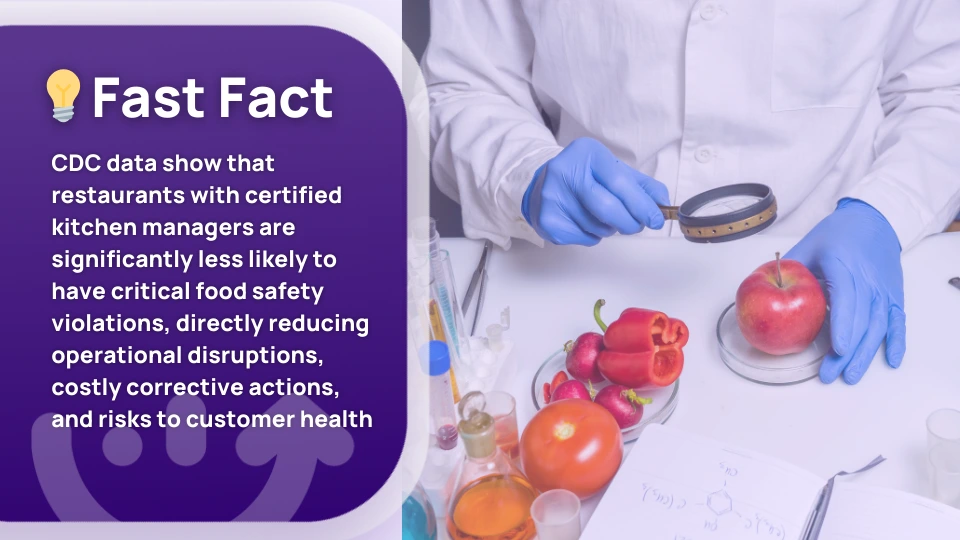
Clear procedures and consistent documentation help prevent incidents and reduce spoilage. Unit-level accountability improves inventory handling and helps maintain customer trust, especially when supported by structured food safety training for employees.
Organizations with established food safety programs experience fewer interruptions and more predictable operations. Over time, this supports steady growth and consistent performance.
This guide explains why food safety matters for food businesses and how it functions as an operational discipline rather than just a compliance task.
.svg)

Priced on per user or per location basis
Available on iOS, Android and Web


What Is Food Safety?
Food safety is about keeping food safe to prepare, store, and serve so customers are protected from illness.
For multi-unit operators, it's something more. It's the operational discipline that signals you are ready to scale.
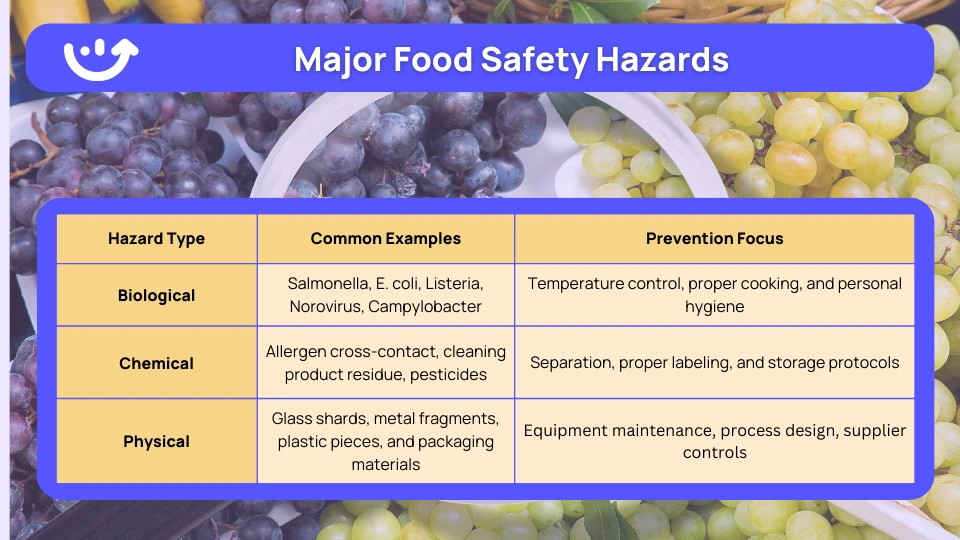
The Three Categories You Need to Control
Every successful food safety program addresses three types of hazards:
What Makes Multi-Unit Operations Different
Single-location operators can personally oversee every shift. Multi-unit operators need systems that create consistency without your physical presence.
This requires three core capabilities:
- Compliance - Meeting FDA, USDA, and local requirements across all locations
- Consistency - Ensuring Location #1 and Location #50 follow identical standards
- Accountability - Documenting procedures with verifiable proof
The operators who master these capabilities unlock growth opportunities others can not access. Institutional buyers, franchise investors, and private equity firms all look for documented operational excellence. Your food safety systems become proof that you can scale reliably.
For most multi-unit operators, these capabilities cannot be sustained with paper logs, spreadsheets, or disconnected tools. As location counts grow, food safety requires systems that standardize execution, automate documentation, and provide visibility across every site, especially during food safety audits.
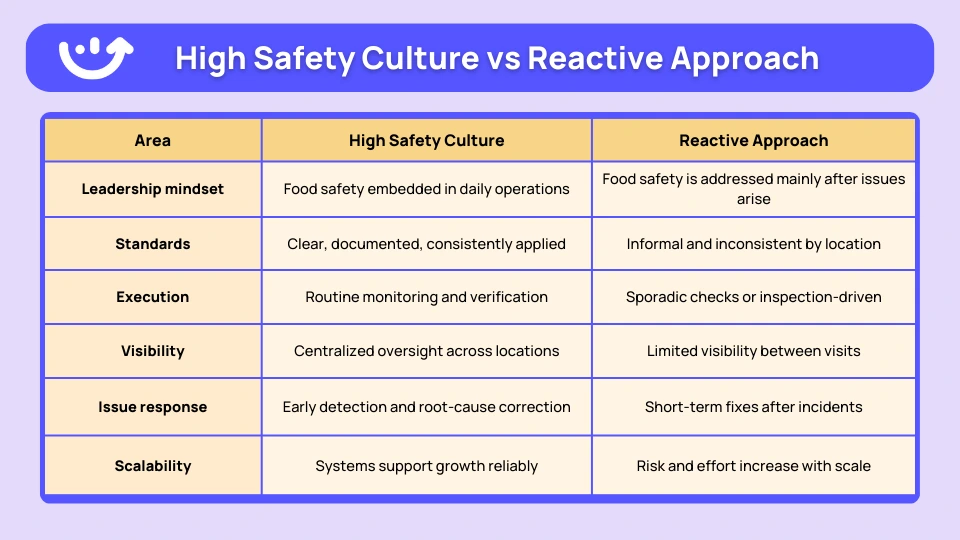
Comparative Table: High Safety Culture vs Reactive Approach
Why Is Food Safety Important? (The Business Opportunity)
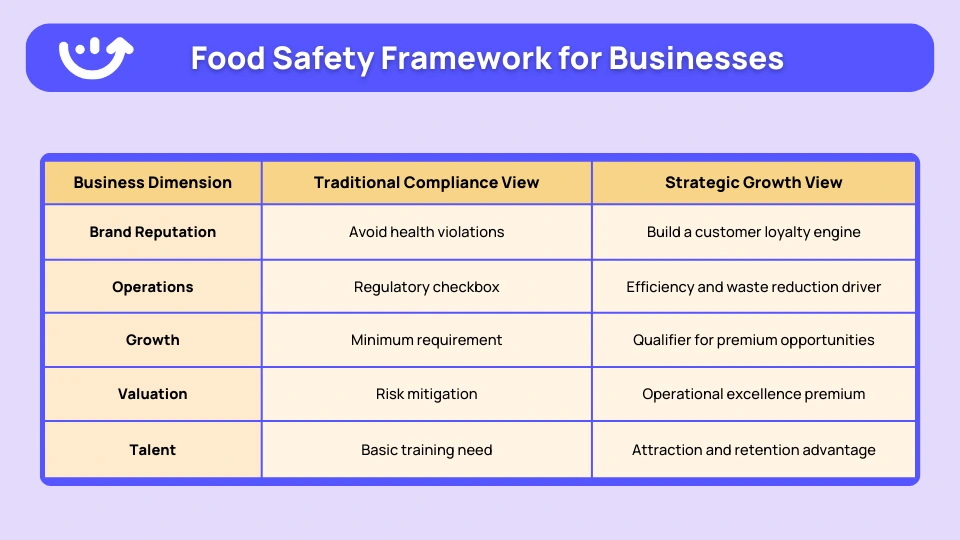
The best multi-unit operators don't just "do food safety." They leverage it strategically to build competitive advantages.
Here is the framework:
Building Brand Value That Compounds
78% of diners check online reviews before choosing a restaurant. Food safety excellence shows up in those reviews.
When customers consistently experience great food in clean, well-managed environments, they become vocal advocates.
Great food safety → Confident customers → Positive reviews → More traffic → Higher revenue
Organizations with strong food safety cultures see this compound effect accelerate over time.
Operational Efficiency That Scales
Proper food safety systems reduce operational costs.
Manual food safety processes consume 8 to 12 hours per week per location. Digital systems automate 80% of that work. Across a 50-location brand, that's over $300,000 annually redirected to customer service.
Additional benefits:
- Reduced waste from spoilage (15 to 30% improvement)
- Faster training for new employees, especially when supported by modern food safety training software
- Predictive maintenance prevents emergency repairs
- Better inventory control through improved rotation and visibility reduces expired product and over-ordering
Food safety platforms unify temperature monitoring, inspections, corrective actions, and reporting within a single system to reduce administrative overhead and improve accuracy.
Most operators see positive ROI within 6 to 12 months.
Growth Opportunities You Can't Access Otherwise
Strong food safety programs open doors:
- Institutional buyers (hospitals, universities, corporate campuses) require documented food safety maturity for contracts
- Franchise expansion accelerates when you demonstrate proven operational systems
- Private equity buyers pay premium valuations for brands with documented operational excellence
- Quality talent prefers well-run organizations
Why Is Food Safety and Hygiene Important When Preparing Food?
This is where your systems meet reality on the line. Excellent food safety during preparation creates consistency that customers notice and appreciate.
The Four Critical Control Points
1. Cross Contamination Prevention
Effective prevention is about process design:
- Color-coded cutting boards for different food types
- Designated prep areas for raw and cooked foods
- Strategic handwashing station placement
- Digital checklists prompting hygiene steps at the right moments
2. Temperature Control Excellence
The most measurable aspect of food safety:
Food Type Minimum Internal Temperature
Poultry, stuffed meats, reheated leftovers 165°F
Ground meats, eggs held for service 155°F
Whole cuts of beef, pork, seafood 145°F
Hot holding Above 135°F
Cold holding Below 41°F
3. Personal Hygiene Standards
- Handwashing stations are placed where staff move between tasks
- Clear visual reminders at key decision points
- Stay home policies that do not penalize sick staff financially
- Photo verification for coaching effectiveness
4. Smart Time Management
Digital time tracking eliminates mental load during busy periods. Systems remind staff when time limits approach for foods in the danger zone.
The pattern: Design systems that make excellence easier than shortcuts.
The Importance of Food Safety
Let us break down the specific advantages of systematic food safety management.
Customer Loyalty and Lifetime Value
Health inspections directly influence where customers choose to eat and whether they return. When guests see clean facilities and strong inspection results, they are more likely to trust the restaurant, come back again, and recommend it to others.
Operational Efficiency
Food safety automation platforms eliminate 8 to 12 hours of manual work per location weekly, $300,000+ annually for a 50-location brand.
- Reduced waste: Better monitoring cuts spoilage and food waste by 15 to 30%
- Faster training: New hires learn the job faster
- Predictive maintenance: Catch equipment issues early
- Better scheduling: Understand actual task completion times
Access to Premium Opportunities
- Institutional contracts provide stable revenue and higher margins
- Franchise growth accelerates with proven systems
- Strategic partnerships seek well-operated brands
- Better positioning for acquisition or investment
Premium Valuations
For buyers, operational discipline affects value. Well-documented food safety systems reduce perceived risk and support higher valuations.
Talent Attraction and Retention
People want to work for businesses that train them well and give them good tools. A good reputation makes hiring easier.
How to Ensure Food Safety Compliance with Xenia
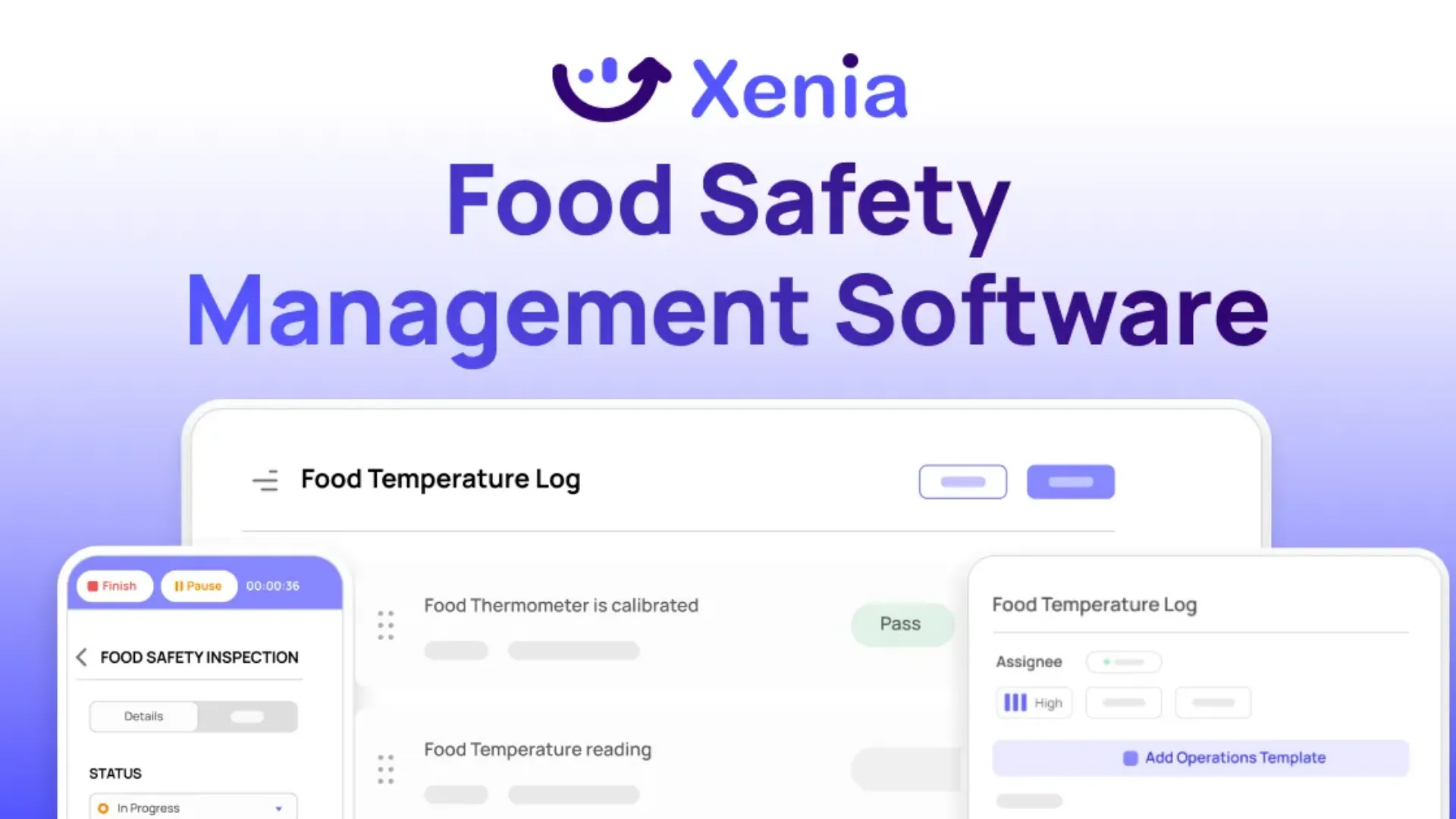
Keeping food safety standards consistent across multiple locations takes more than written rules. Teams need clear guidance, simple tools, and visibility into what’s happening day to day.
Xenia helps operators digitize food safety SOPs. Tasks like line checks, cleaning routines, and safety verifications are built into regular shifts so staff know what needs to be done and when.
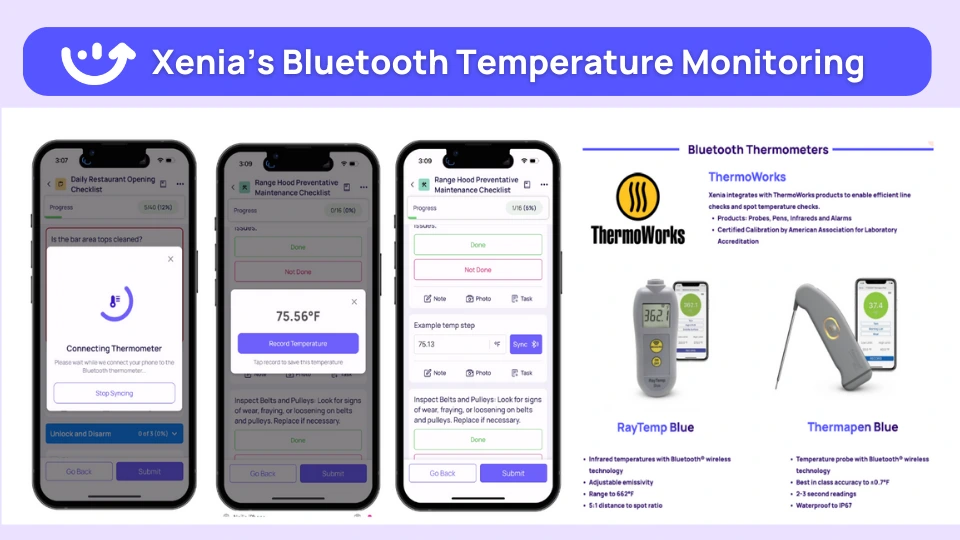
Temperature monitoring supports one of the most common risk areas in food safety and one of the leading causes of foodborne illness. Automated logs and alerts make it easier for teams to catch issues early and take action before food quality is affected.
When problems do occur, follow-up actions are easy to assign, track, and document. Everything is recorded in one place, which helps during inspections and audits without extra paperwork.
For operators managing multiple sites, having one view of compliance activity across locations makes it easier to spot patterns, support teams, and stay prepared for inspections without adding complexity to daily operations.
FAQs
How does food safety affect a business’s bottom line?
Food safety affects a business’s bottom line through cost control and risk reduction.
Consistent systems help reduce waste, limit equipment-related issues, and decrease manual administrative work. They also lower the likelihood of disruptive events such as recalls, legal claims, or insurance increases.
Over time, steady execution supports repeat business and more predictable financial performance.
What are the four benefits of food safety?
The four key benefits of food safety are operational consistency, cost efficiency, growth readiness, and risk reduction.
Standardized procedures reduce variation across locations and lower waste and labor costs. They also support expansion and institutional requirements while reducing the risk of disruptive incidents.
Why is food safety important in the food industry?
Food safety is important because it protects public health and keeps operations reliable. The food industry handles large volumes daily, so failures have a bigger impact.
Strong food safety systems control hazards and help teams work consistently across locations and suppliers.
Why is food safety important for brand reputation?
Food safety is important for brand reputation because customer trust depends on consistent, safe experiences.
Strong food safety practices reduce incidents, support positive inspection results, and limit negative exposure. For multi-location brands, one food safety issue can affect the whole business, which is why consistency matters.
Why is food safety important for restaurants and food businesses?
Food safety matters because it keeps daily operations running smoothly, builds customer trust, and meets regulatory requirements. Good systems help teams work consistently, keep customers safe, and reduce risk as the business grows.
Conclusion
Food safety has evolved from a compliance requirement to a competitive advantage.
The operators who recognize this shift first are building market positions that become increasingly defensible over time.
Systematic food safety management drives customer loyalty, operational efficiency, reduced food waste, growth access, and talent attraction. These benefits compound as organizations scale.
Modern food safety management systems, such as platforms that unify monitoring, documentation, and corrective action, make enterprise-grade execution accessible to mid-market operators.
Xenia is one example of how multi-unit operators are operationalizing food safety at scale.
The best time to build these capabilities was five years ago. The second-best time is now.
Frequently Asked Questions
Got a question? Find our FAQs here. If your question hasn't been answered here, contact us.

Looks like there's no data available in our FAQ section at the moment.

A Modern, AI-Powered Platform Built Specifically for Frontline Operations
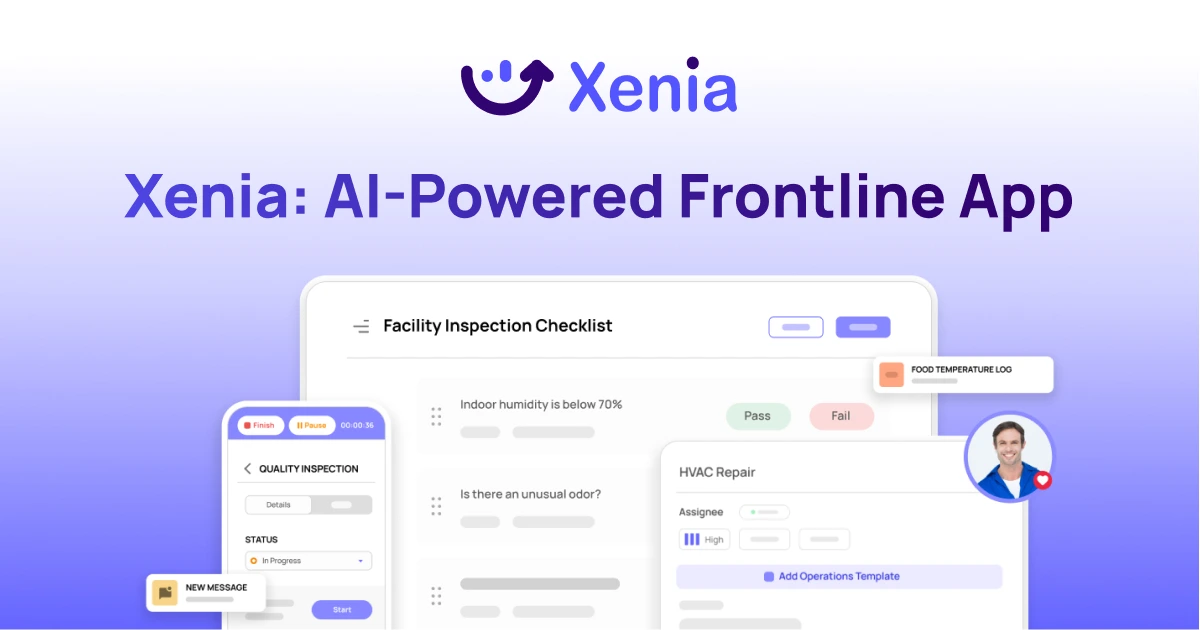
Xenia brings daily operations, maintenance, audits, and compliance into one mobile-first platform. Frontline teams execute work consistently across locations while leadership gets real-time visibility.
Why Multi-Location Operators Choose Xenia:
🤖 AI-Powered Operations, Create digital checklists instantly or convert paper forms with AI. Verify compliance automatically with photo analysis and get instant answers from your operational data.
✅ Daily Operations & Maintenance, Assign work across hundreds of locations in minutes. Report and route issues instantly. Schedule preventive maintenance to catch problems before downtime.
📊 Real-Time Visibility, Track completion, work orders, and performance across all locations through dashboards. Filter by site or asset to spot trends and take action.
Manage operations, maintenance, and compliance across all your locations from one platform

.svg)
.webp)
%201%20(1).webp)

.svg)
%201%20(2).webp)