
Post Summary
Every Monday starts the same way for a multi-unit operations manager. Pull last week's audit scores from Zenput. Switch to a shared Google Sheet for task follow-ups. Check a Slack thread from the overnight manager at location 34. Only then does any real picture of the weekend across 80 locations start to form.
By 9 AM, an hour is already gone and not a single problem is solved.
This is the coordination tax. And it's not a technology problem. It's an ops architecture problem.
Most multi-unit operators didn't set out to build a fragmented restaurant tech stack. They bought the best audit tool available. Then the best task management tool. Then started using Slack because everyone already had it.
Each decision made sense at the time. The problem is what it adds up to: data scattered across five systems, reports that require manual assembly, and a team that stays so busy moving information that little time is left to act on it.
This article gives you a framework to audit what you're actually running, calculate what the fragmentation is costing you, and migrate to a unified restaurant management platform without triggering a revolt from the field teams who've spent years building habits around the old stack.
.svg)

Priced on per user or per location basis
Available on iOS, Android and Web


Why the best-of-breed era is ending for multi-unit ops
The argument for legacy software used to be solid. Specialized tools do one thing better than any platform can. Buy the best audit tool, the best task tool, the best communication tool, and integrate them.
That worked when integrations were easy, and APIs were reliable. Neither is true in frontline operations.
Here's what actually happens. Your audit tool flags a food safety issue. Someone has to notice the flag, copy the details, and manually create a follow-up task in a different system. Someone else has to check the task system to find out whether the issue got resolved.
A regional manager wants to know the compliance trend across 30 locations for the last quarter. That requires a data export, a manual merge, and an hour of spreadsheet work before the answer exists.
Three costs compound with every location you add.
Integration maintenance. APIs break. Vendors push updates that change how data gets passed between systems. Someone on your team owns the fix every time. At 20 locations, that's an annoyance. At 80 locations, it's a part-time job nobody officially has. The risks of paper-based and disconnected operations compound the same way — silently, until the damage is already done.
Reconciliation overhead. Every meaningful ops report requires pulling from two or three systems and connecting the dots manually. The report tells you what happened last week. By the time it's ready, you're already behind on this week.
Training surface. A new general manager joins your chain and has to learn five different logins across five different tools before they can do their job. Your onboarding takes longer than it should, and your frontline teams never quite hit the adoption rate you need.
At a small location count, fragmentation is annoying. Past a certain scale, it becomes operationally dangerous. Cross-location trend detection becomes nearly impossible when the data lives in disconnected systems that don't talk to each other in real time.
5 warning signs your ops stack is holding you back
Before you can make the case for consolidation, you need to diagnose how bad the fragmentation actually is. These five signals tell you the coordination tax has gotten out of hand.
Your managers log in to three or more tools before noon, and at least one of them is a spreadsheet. Every additional login is friction, and friction compounds at scale.
Your weekly ops report requires manual data pulls from more than two sources. If producing your Monday report takes more than 30 minutes of data assembly, your frontline reporting layer is broken.
Follow-up tasks from audits live in email threads, not inside the audit system. An audit flag that generates an email chain has no accountability trail, no due date enforcement, and no visibility for anyone outside the chain. This is exactly the gap that dedicated audits and inspections software closes.
You can't answer "What is our compliance rate across all locations right now?" without waiting for a report to be compiled. Real-time cross-location visibility is the minimum bar for a functional restaurant management platform. If the answer requires a data pull, you don't have visibility. You have lagging indicators.
Onboarding a new location requires configuring access to four or more separate platforms. Every new location is a configuration project instead of a simple activation. That's a signal your platform stack hasn't scaled with your operation. Operators who are scaling their restaurant group hit this wall fast.
How to audit your current ops tech stack
Before you can consolidate, you need to know exactly what you're running and what each tool is actually costing you. This is a four-step process.
Step 1: Map every tool to a workflow category.
Build a simple table. Four columns: Tool, Workflow it owns, Who uses it, and Where the data goes after. Fill it out for every platform your ops team touches, including spreadsheets and Slack.
**
Tool, Workflow, Who uses it, Where data goes after
Google Sheets, Reporting-task tracking, HQ ops team, Nowhere structured
Slack, Task follow-up-comms, GMs-regional managers, Nowhere tracked
Email, Corrective action follow-up, Everyone, Untrackable
**
Step 2: Identify overlap and integration gaps.
Flag any workflow that requires data from two or more tools to get a complete picture. Every flag is a manual process that someone on your team owns, whether they know it or not.
Step 3: Calculate the hidden cost of coordination.
How many manager-hours per week does your team spend moving data between systems, reconciling reports, or re-entering information that already exists somewhere else? Multiply by location count, then by the blended hourly cost of a regional manager. For most 50 to 150 location operators, the annual coordination tax runs between $200,000 and $500,000.
Step 4: Identify the consolidation candidates.
Which tools could you retire if one operations management system covered their combined workflow? Most operators find they're paying for three to five tools that a single platform would replace, plus carrying the integration overhead on top of the licensing cost.
The platform consolidation decision framework
Not every fragmented tool is a consolidation candidate. Consolidate if the tool's workflow is upstream of decisions that need cross-location data, and if the integration cost now exceeds the specialization benefit.
A dedicated inventory system with deep supplier integrations probably stays. Your audit tool, task management system, and frontline communication platform almost certainly consolidate. These three categories generate the most cross-system data movement and the most reconciliation overhead.
When you're evaluating a unified platform, these are the five questions that actually matter.
Coverage. Does it replace your audit tool, task management, and frontline communication in one login? Partial coverage means you still maintain integrations.
Configurability. Can your team configure it to your SOPs without months of professional services? A platform that requires a consultant to set up a checklist is not a frontline tool. Look for something with a proper checklists and SOPs module your team can own.
Reporting layer. Does it produce cross-location trend data natively, or does every report still require a data export? Native reporting is the whole point of consolidation.
Location hierarchy. Does it model your real org structure, brand, region, district, location, or is it flat? Check whether the platform supports location hierarchy and permissions that match your actual org structure before you commit.
Mobile-first for frontline. If your GMs won't use it on their phone in a walk-in cooler, adoption will crater within 60 days.
For a broader look at what's available in the restaurant operations software space, the best restaurant automation software guide covers the category in detail. If you're currently running Jolt or evaluating Jolt alternatives, that's worth reviewing before you finalize your evaluation criteria.
How to replace legacy tools without a revolt
The main failure mode in platform consolidation is announcing the change to the field before the migration plan is ready. Field teams hear "new software" and translate it as "more work, same pay, different passwords."
Building the internal ROI case
Before you take this to leadership, quantify three things.
The coordination tax. Manager-hours per week multiplied by location count multiplied by hourly cost. Show this as an annual figure. It's usually the largest and most defensible part of the ROI case. If your team is spending time on manual restaurant reporting every week, that number adds up faster than most leadership teams expect.
The error cost. How many compliance issues were caught late because the data lived in a disconnected system? Even one health inspection violation or brand standards failure that slipped through because nobody could see the cross-location trend belongs in this calculation.
The licensing consolidation. Add up what you're paying for every tool in the current stack. Replacing three tools with one platform usually costs less in licensing, even before you count the integration maintenance you stop paying for.
Frame the consolidation as headcount-neutral. You're not adding cost. You're eliminating tool licensing, reducing IT support burden, and recovering manager time that currently goes to moving data instead of managing people.
A phased migration that actually works
Phase 1: Pilot at 3 to 5 locations. Run the new platform in parallel with legacy tools. Do not shut off old tools until GMs at the pilot locations confirm the new platform covers their full workflow. Gaps discovered in pilot are easy to fix. Gaps discovered after full rollout cause revolts.
Phase 2: Champion expansion across 20% of locations. Promote pilot GMs to internal champions. Let them lead peer-to-peer training rather than top-down mandates. A regional manager hearing "this actually works" from a peer GM carries ten times the weight of a corporate deck. The frontline operations platform rollout and adoption guide covers the controlled pilot methodology in full if you want the detailed framework.
Phase 3: Full rollout with a hard legacy sunset date. Set a date when old tools go dark. Give clear migration support and a helpdesk for edge cases. As long as the old tool is accessible, people will keep using it.
Managing vendor contracts and data migration
Review your existing contracts for auto-renewal clauses before you sign a new platform deal. Most ops tools have 30 to 90 day termination windows. Missing a renewal date and paying another year of licensing on a tool you're replacing is an avoidable mistake.
Export historical audit data and digital checklists before migration. Historical compliance records are often not easily portable between systems, and losing them creates a gap in your audit trail. Assign one internal migration owner who is accountable for vendor communication, data transfer, and the go/no-go decision on legacy sunset.
What unified ops platform adoption looks like at scale
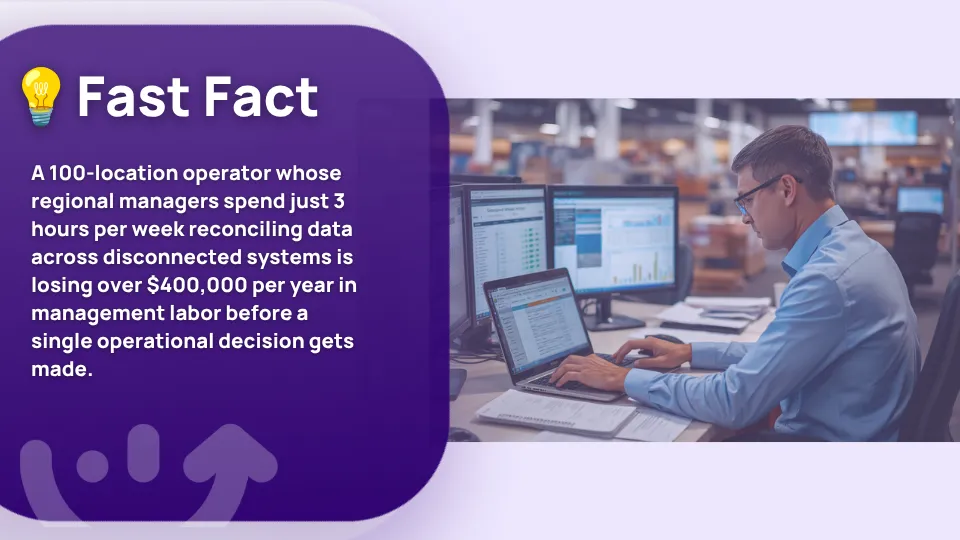
Before consolidation, a regional manager at a 60-location chain spends three hours every Monday reconciling audit data, task follow-up statuses, and location scorecards pulled from three different systems. By the time the picture is assembled, it's Monday afternoon, and the week's issues are already compounding.
After consolidation on a platform like Xenia's multi-unit operations hub, the same regional manager opens one dashboard at 8 AM. Every location's compliance status, open tasks, and flagged exceptions are in a single view. Issues that need attention surface automatically.
The real ROI signal isn't the dashboard. It's what happens downstream. When a food safety flag from an audit automatically generates a corrective action task assigned to the GM with a due date, without a human manually moving data between systems, you've closed the loop that fragmented stacks can never close.
The issue gets flagged, assigned, tracked, and resolved inside one system. Nothing falls into an email thread. Nothing waits for a Monday morning reconciliation.
That's the difference between a fragmented ops stack and a genuine operations execution system.
How Xenia helps
Xenia replaces the fragmented audit, task, checklist, and communication stack with a single platform built for how multi-unit operators actually work.
The multi-unit operations hub gives HQ real-time visibility across every location without waiting for a report to be assembled. Audits and inspections replace iAuditor, Zenput, Jolt, or whatever your current audit tool is, with weighted scoring, photo evidence, and corrective actions that live inside the same system as the audit.
Task management closes the loop between audit flags and follow-up accountability. Frontline communication replaces the Slack threads and email chains that currently carry your ops follow-ups with no accountability trail. And frontline reporting gives your operations leaders a single dashboard view of every location's performance without a single manual data pull.
For the regional manager who used to spend three hours every Monday merging spreadsheets, the analytical agent answers questions like "which locations have the highest incident rates" in plain language, no data export required.
Four tools. One login. One data layer.
Book a demo to see how it works for your location count and org structure.
.webp)
Conclusion
The coordination tax of a fragmented ops stack compounds every time you open a new location. Every new GM learns five logins. Every new report requires another manual pull. Every compliance flag waits for a human to move it between systems before anyone acts on it.
Consolidation is not a technology decision. It's an operational efficiency decision with a measurable ROI, a clear migration path, and a defensible business case that most ops leaders can build in an afternoon once they've run the numbers.
See how Xenia replaces the fragmented stack with a single platform for multi-unit restaurant and retail operations.
Frequently Asked Questions
Got a question? Find our FAQs here. If your question hasn't been answered here, contact us.
How do I get field teams to actually adopt the new platform?

GM-to-GM peer training from a pilot location champion lands better than any corporate communication about the new system. Make the rollout feel like something happening with the field, not to them. And set a firm shutdown date for the old tools. Ambiguity keeps people hedging and running both systems indefinitely.
What happens to historical compliance data when you migrate?
Export everything before you switch. Most platforms accept CSV imports for historical audit records and checklist templates. The records you most need to preserve are audit history, corrective action logs, and any compliance documentation that could be relevant in a regulatory review.
How long does a full platform migration take?
For a 50 to 150 location operator with active change management, plan 60 to 90 days from pilot kick-off to full legacy sunset. That timeline assumes a 3 to 5 location pilot, a 20% champion expansion phase, and a hard sunset date. Operators who skip the pilot and go chain-wide immediately typically take longer because they spend the back half fixing problems a pilot would have caught.
Does consolidating mean giving up best-in-class features?
For most frontline ops workflows, the marginal feature advantage of a specialized tool isn't worth the integration overhead it creates. The exception is highly specialized tools where data accuracy is mission-critical, like a dedicated inventory system. For audits, tasks, checklists, and frontline communication, the integrated platform almost always wins on total value even if it's not the best-in-class option on any single feature.


A Modern, AI-Powered Platform Built Specifically for Frontline Operations
Xenia brings daily operations, maintenance, audits, and compliance into one mobile-first platform. Frontline teams execute work consistently across locations while leadership gets real-time visibility.
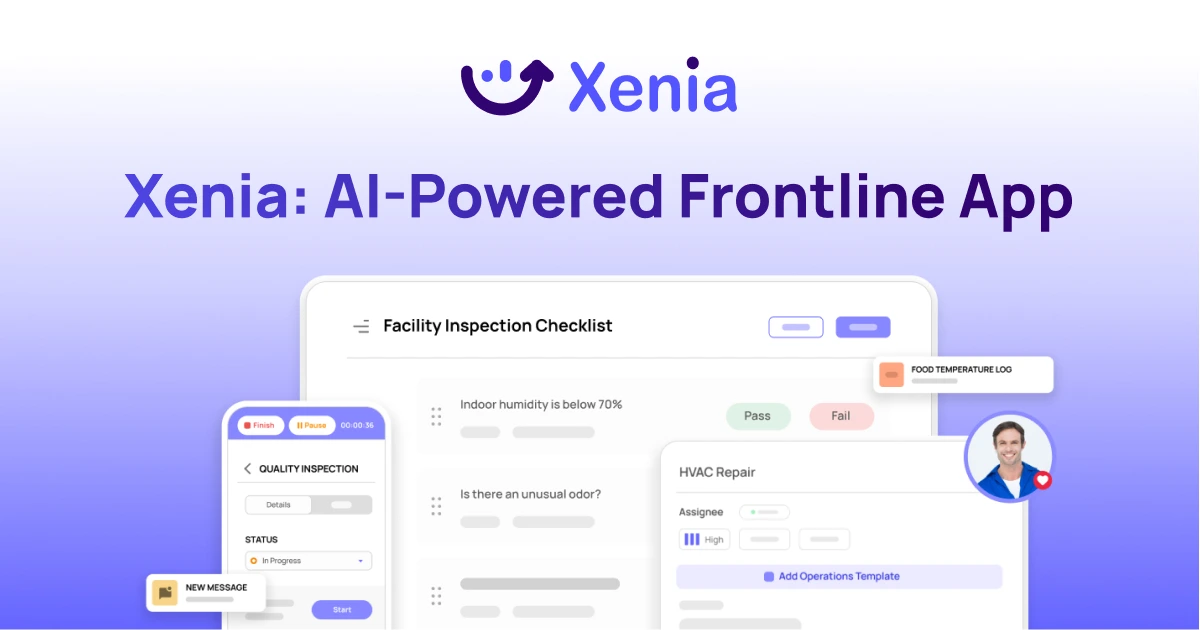
Why Multi-Location Operators Choose Xenia:
🤖 AI-Powered Operations, Create digital checklists instantly or convert paper forms with AI. Verify compliance automatically with photo analysis and get instant answers from your operational data.
✅ Daily Operations & Maintenance, Assign work across hundreds of locations in minutes. Report and route issues instantly. Schedule preventive maintenance to catch problems before downtime.
📊 Real-Time Visibility, Track completion, work orders, and performance across all locations through dashboards. Filter by site or asset to spot trends and take action.
Manage operations, maintenance, and compliance across all your locations from one platform

.svg)
.webp)
%201%20(1).webp)

.svg)
%201%20(2).webp)