
Post Summary
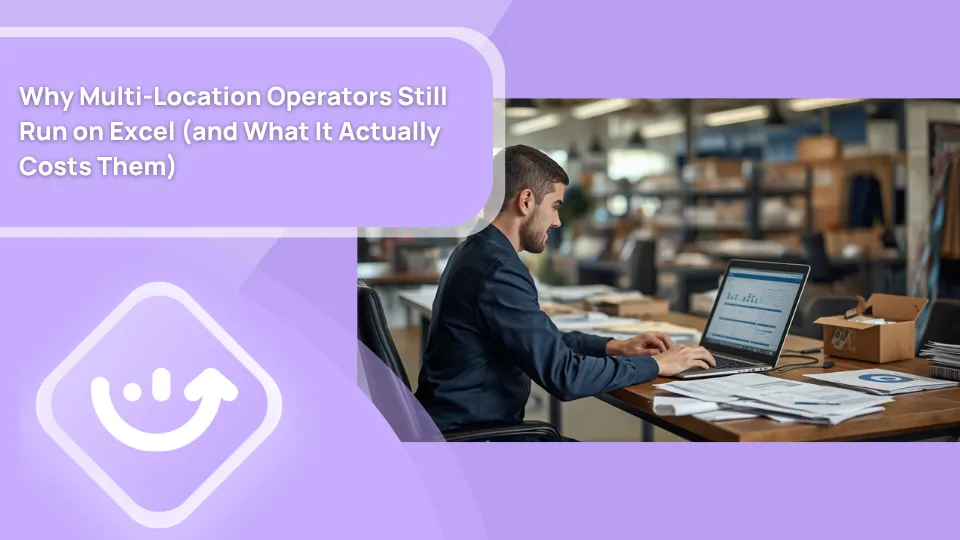
You're running 30, 50, maybe 100 locations. Your revenue is in millions. And somewhere right now, a store manager is updating a shared Google Sheet that three other people are also editing at the same time.
That's not a small-business problem. That's a multi-location operations problem. And it's more common than most ops leaders want to admit.
Excel has survived in operations for one simple reason. Nobody has put a real price tag on what it costs. It's free to use. Everyone knows it. And it's just painful enough to keep people busy but not broken enough to force a change.
This article does something most listicles about operations management tools skip entirely. It shows you the real cost of staying on spreadsheets. It gives you a self-assessment to see how exposed your operation is right now. And it walks you through a practical 90-day plan to start moving off Excel without burning your ops team out.
.svg)

Priced on per user or per location basis
Available on iOS, Android and Web


Related resources
- Restaurant Operations Management: A Complete Guide for Multi-Unit Operators
- How to Build Digital Checklists That Actually Get Completed
- Multi-Unit Operations Execution: What It Actually Takes
- Operations Execution System: What It Is and Why It Matters
Why Excel persists in multi-location operations
Nobody chose Excel as their long-term operations management system. It just happened.
You open your first few locations and build a spreadsheet for opening checklists. It works. You add more locations and duplicate the sheet. A manager adds a column. Someone else changes the format. Now you have 12 versions of the same file and nobody knows which one is current.
That's the trap. And it sticks around for a few predictable reasons.
It looks free. There's no line item in the budget for "Excel." No invoice, no renewal email. That makes it invisible as a cost, even when it's burning real money in labor hours every single week.
Everyone already knows it. Training a 50-location team on a new platform is a project. Training them on a spreadsheet they've used for five years is not. The path of least resistance wins every time.
It's flexible in the worst way. You can jam any process into a spreadsheet. That flexibility is exactly why spreadsheets accumulate everything and clean up nothing.
Nobody has done the math. This is the real reason Excel stays. Ops leaders know it's painful. They don't know the dollar figure. And without a dollar figure, there's no business case to take to leadership. This is also why the risks of paper-based and spreadsheet-driven operations are so easy to ignore until something goes wrong at scale.
The 5 hidden costs of running operations on Excel
Most operators think of Excel as a zero-cost tool. The costs are there. They're just buried in your team's hours, your data lag, and your compliance exposure.
1. Version-control chaos
Which file is the real one?
When 30 locations are all working from their own copy of an operations checklist, you don't have a system. You have 30 different systems that all happen to look like the same spreadsheet.
Managers create local versions. Regional directors create their own master files. Someone at HQ maintains a "final" version that's two weeks out of date. When a problem surfaces, your first task isn't fixing it. It's figuring out which version of the data you're looking at.
A single operations issue that should take 20 minutes to diagnose can eat half a day when your data lives in 30 different files. This version-control breakdown is one of the most consistent pain points for any operator scaling a restaurant group past the point where informal systems hold up.
2. Data lag at headquarters
When you run on spreadsheets, HQ sees yesterday's operations. Sometimes last week's.
Every decision you make about staffing, compliance, or store performance is based on data that's already stale. Your daily operations are moving in real time. Your visibility into them isn't.
By the time you see that a location is behind on a critical compliance task, the window to fix it before an audit may already be closed. Good restaurant reporting requires live data, not end-of-day file transfers. If your reporting layer depends on someone emailing you a spreadsheet, you don't have a reporting system. You have a hope system.
3. No accountability trail
Who completed the opening checklist at location 17 last Tuesday?
If your answer is "I'd have to ask the manager," that's an accountability gap. And it's a liability in any audit or health inspection scenario.
A checkbox on a spreadsheet doesn't tell you who checked it, when they checked it, or what the store actually looked like at that moment. It just tells you someone clicked a cell. That's not an accountability system. That's a record that someone touched the file. For teams managing employee accountability across dozens of locations, that gap becomes a serious operational risk fast.
4. The manual aggregation tax
Someone on your team is spending real hours every week doing nothing but copying numbers from location spreadsheets into a master report.
This is the hidden labor cost most ops leaders underestimate. Run the math yourself:
**
Locations, Hours per location per week, Total weekly hours, Annual labor cost (at $30/hr)
10, 0.5 hrs, 5 hrs, $7800
30, 0.5 hrs, 15 hrs, $23400
50, 0.5 hrs, 25 hrs, $39000
100, 0.5 hrs, 50 hrs, $78000
**
That's not software cost. That's salary going to someone manually moving data from one spreadsheet to another. Every week. With zero strategic value added.
5. Audit and compliance risk
Health inspectors don't want to hear "it's in the shared drive somewhere."
When your compliance records live in spreadsheets, producing them during an inspection requires someone to stop what they're doing, find the right file, figure out if it's current, and manually compile a report. That process has a real failure rate.
For multi-location operations, that failure rate isn't just inconvenient. It can mean violations, fines, or temporary closures. The data silos created by fragmented spreadsheets directly increase your regulatory exposure across every location in your portfolio.
The Excel-to-platform migration readiness test
Before you build a business case for new operations management tools, you need to know how exposed you actually are. Answer these five questions honestly.
**
Question, Yes, No
Can you pull a compliance report for any location in under 60 seconds?, - , -
Do you know right now which locations completed today's opening checklist?, - , -
If a health inspector walked in tomorrow-could every location produce records instantly?, - , -
Does your HQ team spend more than 5 hours per week aggregating spreadsheets?, - , -
Have you ever made a decision based on data that turned out to be a week old?, - , -
**
Score: Three or more "no" answers means Excel isn't a free tool. It's an expensive liability wearing a familiar face.
This is also the language you take to leadership. Not "we need a platform." But "here are five operational risks we cannot answer for right now, and here is what each one is costing us in labor hours and compliance exposure."
What good looks like: operations management beyond spreadsheets
Good operations management doesn't mean more complexity. It means your team knows exactly what's happening at every location without sending a single email asking for updates.
Here's what that looks like in practice when you move to a purpose-built multi-unit operations platform:
Real-time location-level visibility. You open a dashboard. You see which locations completed their morning checklist. You see which ones didn't. Platforms like Xenia build this in as the default view, not an upgrade.
Automated checklist completion with timestamps. When a task gets done, the system logs who did it and when. Not a checkbox in a cell. An actual record with a name, a time, and in many cases a photo attached. This is the foundation of audit-ready checklists and SOPs that hold up under real scrutiny.
Audit-ready compliance records. When an inspector shows up, your team isn't scrambling. The records are already there, already organized, already timestamped. You can pull them in under 60 seconds.
Exception-based management. Instead of reviewing 50 locations' worth of data, your system flags the ones that need attention. You spend your time on actual problems, not on scanning rows looking for them.
Single source of truth for ops data. Every location, every checklist, every temperature log, every corrective action lives in one place. No version control issues. No aggregation tax. No guessing about which file is current. This is the same dashboard view Xenia's HQ users rely on day to day.
Here's a quick comparison of what the before and after looks like day-to-day:
**
Scenario, Running on Excel, Running on an ops platform
Pulling today's checklist status, Email 30 managers and wait, Open dashboard-see it instantly
Preparing for a health inspection, Scramble to compile records, Pull report in under 60 seconds
Catching a compliance gap, Find out after the fact, Get a flag in real time
Weekly ops aggregation, 5–15 hrs of manual work per week, Automated and always current
Accountability for a missed task, Ask the manager who was on shift, Timestamped record with name attached
**
For a deeper look at the full ops framework, the restaurant operations management guide covers how multi-unit operators structure everything from daily line checks to corrective action workflows. If you're thinking about how to improve restaurant operations specifically at scale, that's worth reading alongside this one.
The first 90 days off Excel: a practical migration playbook
The biggest mistake operators make when they decide to move off spreadsheets is trying to replace everything at once. That's how migration projects die. One workflow. Prove it. Then expand.
Weeks 1 to 2: Pick one high-pain workflow
Opening checklists are the best place to start. Every location runs them. Everyone knows what they're supposed to look like. The pain points show up immediately: inconsistent completion, no accountability, no real-time visibility at HQ.
Don't touch temperature logs, inventory counts, or line checks yet. One workflow. That's it.
Weeks 3 to 4: Pilot at 3 to 5 locations
Pick a mix. One high-performing location, one struggling, one in the middle. Run the new system alongside your existing spreadsheet if you need to. Measure three things at the end of the pilot:
- Time to complete the checklist
- Completion rate across the pilot locations
- Time your HQ team spent aggregating that workflow's data
Write those numbers down before you start. You'll need them when you present to leadership.
Weeks 5 to 8: Roll to all locations for that one workflow only
Once the pilot data confirms the approach works, expand to your full location portfolio for that single workflow. This is where you collect the before-and-after numbers that make your ROI case concrete. The frontline reporting layer becomes critical here because this is when you stop guessing and start showing leadership actual data, not projections.
Weeks 9 to 12: Add a second workflow
Temperature logs or daily line checks are the natural next move. By this point, your team has the muscle memory for the new system, and your leadership has seen the pilot results. Adding a second workflow is far easier than the first.
Then present the 90-day results to leadership. At that point, you're not asking for budget approval. You're reporting on results that already happened.
For operators thinking about broader task management structure and how audits and inspections fit in, both are natural second and third steps after opening checklists are locked in.
The checklist foundation matters too. The digital checklists guide covers how to build audit-ready checklists that frontline teams will actually complete, not just technically acknowledge.
Common migration mistakes that stall the rollout
Most migrations that fail don't fail because the platform was wrong. They fail because the rollout approach was wrong.
Watch for these.
Trying to rebuild every Excel column in the new system. Your spreadsheets have accumulated years of fields that nobody uses anymore. A migration is a chance to start clean, not to import your technical debt into a new platform. This is one of the most consistent findings in any multi-unit operations execution review.
Going chain-wide on day one. If something breaks at 50 locations simultaneously, you don't have a test. You have a crisis. Pilot first. Always.
Choosing a tool built for office workers. A lot of operations management tools are built for people who sit at desks. If your frontline team can't use it on a phone in a walk-in cooler, adoption will crater within 30 days. This is the most common mistake in multi-location operations technology decisions. The right platform should work for deskless frontline teams, not just the people at HQ reviewing data.
Not measuring the before state. If you can't show what things looked like before the migration, you can't prove ROI after. Document your baseline before you touch anything.
Underestimating change management. The platform is the easy part. Getting 200 store managers to change their daily habits is the hard part. Plan for it with as much rigor as you plan the technical rollout. For teams that have tried previous rollouts that didn't stick, the frontline operations platform rollout and adoption guide goes deep on what actually drives lasting adoption at the location level.
Once the migration is done, the operational excellence for restaurants guide is a useful next step in thinking beyond the spreadsheet problem and toward a repeatable ops system.
Get started with Xenia
Xenia is built for frontline operations teams at multi-location restaurant, retail, and convenience store chains. Where Excel forces your HQ team to wait for data, Xenia gives them a live view of every location's task completion, checklist status, and compliance records in a single dashboard.
Migrating off spreadsheets doesn't mean starting from a blank page. Xenia's AI Template Agent converts your existing checklists, SOPs, and paper-based forms into digital workflows in minutes, so you're not rebuilding years of process documentation by hand. That alone removes the biggest reason migrations stall before they start.
Connectivity isn't a blocker either. Offline capability means a manager in a walk-in cooler or a back room with no signal can still complete a checklist. The app syncs the moment connection returns, so HQ never loses visibility just because one location's WiFi is down.
The multi-unit operations module replaces fragmented spreadsheets with a single source of truth across your entire location portfolio. This is what kills version-control chaos: there's one current file, not twelve copies with three different managers convinced theirs is the master.
The frontline reporting module turns that data into audit-ready records without manual aggregation, closing the data lag gap that leaves HQ making decisions on last week's numbers instead of this morning's.
Audits and inspections lets your compliance team run, track, and close out audits across every location without touching a single spreadsheet, so when a health inspector walks in, the records are already there instead of scattered across a shared drive.
And the employee accountability module gives HQ a timestamped record of who did what, at which location, and when. No more "I'd have to ask the manager."
This is also why a 90-day rollout doesn't have to be a leap of faith. Run a pilot at 3 to 5 locations on one workflow, measure completion time and HQ aggregation hours, then expand once the data backs it up. Most teams use that pilot window to build the exact business case leadership asked for, before ever going chain-wide.
Your team stops chasing files. Regional managers start spending time on the locations that actually need attention. And HQ stops making decisions on data from last week.
G2: 4.9/5 | Capterra: 4.9/5
See how it works with a quick demo.
.webp)
Conclusion
Excel isn't free. It's hiding its costs inside your team's hours, your compliance gaps, and the decisions you're making on data that's already a week old.
The operators who move fastest off spreadsheets aren't the ones with the biggest budgets. They're the ones who ran the math, started with one workflow, and proved the ROI before asking for sign-off on a full rollout.
Book a demo to see how Xenia replaces the spreadsheet layer with real-time visibility across every location.
Frequently Asked Questions
Got a question? Find our FAQs here. If your question hasn't been answered here, contact us.
How do I build a business case for replacing Excel?

Start with the aggregation tax. Count the hours your HQ team spends each week copying data from location spreadsheets into a master report. Multiply by your labor rate. That number alone is usually enough to justify a platform. Then add compliance exposure and data lag on top, and you have a case that's hard to argue with.
What should I look for in an operations platform for frontline teams?
The most important thing most operators miss: it has to work on a phone in a walk-in cooler. A lot of platforms are built for people who sit at desks. If your frontline team can't complete a task in under 30 seconds on mobile, adoption will drop within a month regardless of how good the dashboard looks at HQ.
How long does it take to migrate off spreadsheets?
If you start with one workflow and pilot it at three to five locations before going chain-wide, most operators see meaningful results within 90 days. The migration itself isn't the hard part. Getting 50 or 100 store managers to change their daily habits is. That's where most rollouts either win or fall apart.
Why do multi-location businesses still use Excel for operations?
Mostly inertia. It's free, everyone knows it, and nobody has put a dollar figure on what staying on it actually costs. The moment you run the aggregation math, the conversation with leadership changes. Until then, the pain is real but invisible.
What are operations management tools?
Software platforms that replace your location spreadsheets with a live dashboard. Instead of waiting for a manager to email you a file, you see task completion, compliance status, and exceptions across every location in real time.
For multi-location restaurant, retail, and c-store operators, that typically means checklist management, temperature monitoring, audit tracking, and frontline reporting all in one place.


A Modern, AI-Powered Platform Built Specifically for Frontline Operations
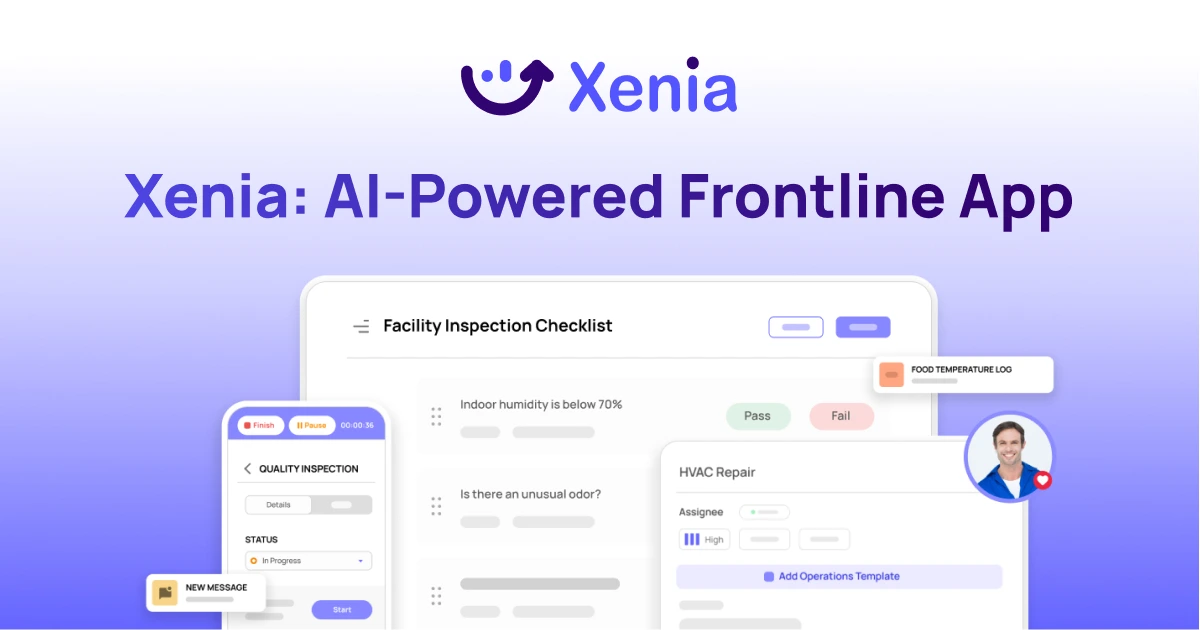
Xenia brings daily operations, maintenance, audits, and compliance into one mobile-first platform. Frontline teams execute work consistently across locations while leadership gets real-time visibility.
Why Multi-Location Operators Choose Xenia:
🤖 AI-Powered Operations, Create digital checklists instantly or convert paper forms with AI. Verify compliance automatically with photo analysis and get instant answers from your operational data.
✅ Daily Operations & Maintenance, Assign work across hundreds of locations in minutes. Report and route issues instantly. Schedule preventive maintenance to catch problems before downtime.
📊 Real-Time Visibility, Track completion, work orders, and performance across all locations through dashboards. Filter by site or asset to spot trends and take action.
Manage operations, maintenance, and compliance across all your locations from one platform

.svg)
.webp)
%201%20(1).webp)

.svg)
%201%20(2).webp)