
.webp)
Post Summary
A job posting says "flexible schedule." A retail worker reads that and thinks it means they get to pick their shifts. The hiring manager means the schedule changes based on store traffic and they need someone who can deal with it.
Both of those things are happening at the same time. Same phrase. Two opposite meanings.
For office workers, this is annoying. For hourly frontline workers who can't work from home, who need to arrange childcare around their shifts, and who depend on steady hours to pay rent, it matters a lot more.
This article is written for frontline hourly workers. Not remote work. Not office jobs. What flexible scheduling actually looks like when you have to show up in person, cover specific shifts, and work within labor compliance rules.
For a broader overview of shift structures, see the guide to types of work shifts.
.webp)
.svg)

Priced on per user or per location basis
Available on iOS, Android and Web


What is a flexible schedule?
A flexible schedule lets employees work different hours, days, or shifts instead of the same pattern every week.
For office workers, that usually means picking when you start and end your day. For hourly frontline workers, it means something different. And that difference matters.
Flexible schedule meaning for hourly workers
For hourly frontline employees, a flexible schedule typically means one of three things:
- You can tell your manager when you're available to work
- Your schedule changes week to week based on how busy the store is, sometimes with almost no warning
- You can swap shifts with coworkers after the schedule comes out
The third option is real flexibility. The second one gets called flexibility, but it's really just unpredictability. Those aren't the same thing when you're trying to arrange childcare or work a second job.
Flexible schedule vs fixed schedule
A fixed schedule gives the employee the same shifts on the same days every week. A flexible schedule varies the days, the hours, or both.
Here is something worth knowing. For hourly frontline workers, a fixed schedule often provides more practical life-planning ability than a variable flexible one, even if the fixed schedule includes evenings and weekends. Predictability has real value that most job postings undercount.
**
Aspect, Fixed schedule, Flexible schedule
Shift pattern, Same days and hours every week, Varies by week or by request
Predictability, High, Depends on who controls the variation
Life planning, Easy to plan around, Hard if changes come late
Employee input, Low, Can be high if structured correctly
Operator benefit, Consistent coverage, Can match staffing to demand
**
Types of flexible schedules for frontline hourly teams
Most people search "flexible work schedule examples" and get a list written for office workers. Here are the six formats that actually exist in frontline jobs, what each one is, where it works, and where it doesn't.
Flex windows
You work a core shift but can start and end at different times within a range. For example, start anytime between 7am and 9am and work 8 hours.
This works for back-office jobs where it doesn't matter when you start. It doesn't work for customer-facing roles. A kitchen that opens at 6am can't wait for a cook who wants to start at 8am.
Works when your start time doesn't leave gaps in coverage.
Self-scheduling
You pick your own shifts from a list of open slots. Used in healthcare and hospitality.
This is real flexibility. You control your schedule and the store still gets coverage. Without a system that shows open shifts and checks who's qualified, self-scheduling turns into a free-for-all. Nobody takes the bad shifts.
Works when you have enough people willing to fill all the shifts. For tools that track scheduling accountability across locations, see employee accountability.
Fails when nobody wants early mornings, weekends, or holidays.
Shift swapping
You trade shifts with coworkers after the schedule comes out. Manager has to approve it.
This is the most common type of flexibility in frontline jobs. It doesn't change the schedule. It lets you fix conflicts yourself. When it's done right, fewer people call out sick.
Works when swaps are written down and approved quickly. Fails when people make verbal agreements and both think the other person is working.
Part-time and variable hours
You work less than full-time, and your hours change week to week based on how busy things are. Common in retail and restaurants for students, parents, and people with second jobs.
Part-time works for people who can't do full-time. The problem is when hours jump around without warning. You can't pay rent when you work 30 hours one week and 12 the next. Random hours make people quit.
On-call scheduling
You're asked to be available on short notice, sometimes same-day. You might get called in or you might not.
This is flexibility for the employer, not the worker. Some cities and states regulate this under predictive scheduling laws. For businesses with genuinely unpredictable rushes, it serves a purpose. For workers who need to arrange childcare or transportation, it creates real problems. Both things are true at the same time.
Split shifts
You work two separate blocks in the same day. For example, 7am to 11am, then 5pm to 9pm, with hours off in between.
Common in restaurants where it's busy at lunch and dinner but slow in the afternoon. This works well for the business. For workers, the unpaid gap is hard to use if you have a long commute. You can't really go home, but you're not getting paid either.
Flexible schedule types at a glance:
**
Type, Employee control, Operator benefit, Main risk
Flex windows, Moderate, Back-office flexibility, Not viable for fixed-coverage roles
Self-scheduling, High, Employees fill slots voluntarily, Unpopular shifts go unfilled
Shift swapping, Moderate, Reduces no-shows, Informal swaps with no documentation
Part-time variable, Low to moderate, Staffing matches demand, Income instability drives turnover
On-call, Low, Covers unpredictable demand, Creates hardship for employees
Split shifts, Low, Peak-period coverage efficiency, Long unpaid gaps and commute burden
**
Does flexible scheduling actually work for frontline hourly operations?
This is the honest question most articles skip. The answer is: it depends entirely on which kind of flexibility you are offering.
Where flexibility has real value for frontline teams
Self-scheduling and shift swapping, when properly structured, improve employee satisfaction and reduce no-shows without creating coverage gaps. Part-time variable scheduling works well for workforce segments who genuinely need it.
The retention effect is real. Employees who feel they have some meaningful control over their schedule are measurably more likely to stay. That is one of the most controllable retention levers available to frontline operators. It does not require a pay increase to deliver.
Where "flexibility" creates problems for hourly workers
On-call scheduling and last-minute variable scheduling create income unpredictability. That drives turnover, which is the opposite of what most operators are trying to achieve.
When "flexible" means the employer changes the schedule with less than 72 hours notice, employees cannot plan their lives. They cannot arrange childcare, confirm transportation, or commit to a second job. The workers who tolerate that uncertainty tend to be the ones with the fewest other options. That is not a stable workforce.
In cities and states with predictive scheduling laws including Seattle, Chicago, San Francisco, New York City, and Oregon, last-minute schedule changes trigger premium pay obligations. What looks like scheduling flexibility can quickly become a compliance cost that nobody planned for. For a full overview of what those laws require, see the workforce scheduling guide.
The work-life integration reality for shift workers
Work-life integration for frontline workers doesn't mean working from a coffee shop. It means knowing your schedule early enough to plan your life.
For hourly employees, predictability matters most. If you know your schedule two weeks ahead, you can arrange childcare and figure out rides. If you find out on Thursday what you're working next week, you can't.
Benefits of flexible scheduling for operations leaders
Some of these benefits move the needle more than others. The last two are the ones that actually show up in retention numbers.
Improved coverage during variable demand windows
Part-time and variable hour schedules let operators match staffing to actual demand without carrying full-time headcount across every shift. Peak periods get more coverage. Slow periods run leaner. This is the core scheduling efficiency argument for flexible arrangements and it is a real one. It only works if the variable hours are genuinely driven by demand and not just by the manager's convenience that week.
Reduced absenteeism when employees have schedule input
When employees submit availability and have documented shift swap options, unexpected absences go down. An employee who cannot make a shift has a structured path to resolve it rather than just not showing up.
The alternative is no flexibility, no swap mechanism, and no process. That produces higher no-show rates because employees have no other option when something comes up.
Access to a wider labor pool
Offering part-time and flexible schedules lets you hire people who can't work fixed full-time hours. In tight labor markets, this helps you recruit without spending extra money.
Retention improvement in high-turnover environments
This is the one that actually moves the needle.
Schedule-related dissatisfaction is consistently among the top reasons hourly frontline workers leave. Giving employees meaningful input through self-scheduling, shift preferences, or documented swap processes directly addresses one of the most controllable retention drivers available. Operators who take this seriously tend to see the results within a quarter.
How to implement flexible scheduling in a multi-location operation
Step 1: define what "flexible" means at each location
Before announcing anything, decide which form of flexibility you are actually offering. Shift swapping, self-scheduling, flex windows, and part-time variable hours are four very different things.
"We offer flexible scheduling" means something different to every manager. Standardize the definition across all locations so employees at every site experience the same policy. Inconsistency between locations on something this visible destroys trust fast.
Step 2: build compliance rules into the process
Shift swaps need manager approval to verify the replacing employee is qualified for the role. Self-scheduling needs guardrails to ensure minimum coverage thresholds are met at every shift window. On-call scheduling needs review against predictive scheduling requirements in any regulated market you operate in.
Flexibility that bypasses compliance generates fines. The structure is not optional.
Step 3: document every swap and schedule change
An employee-initiated swap that is not documented creates a no-show with no accountability trail. Every schedule change, regardless of who initiated it, needs a written record. Who requested it. Who approved it. What the resulting schedule is.
Use HR workflows to create a consistent documentation process that works the same way across every location, not just the sites where the manager happens to be organized.
Step 4: publish schedules early regardless of flexibility type
Whatever flexibility model is in place, the base schedule should be published at least seven days in advance. Flexibility layered on top of an early-published schedule works well. Flexibility used as a justification for publishing schedules late is not a benefit. It is a structural problem.
Implementation checklist:
**
Step, What to do, Why it matters
1, Define the specific flexibility model at each location, Prevents manager-by-manager inconsistency
2, Build compliance rules into swap and scheduling process, Avoids fines in regulated markets
3, Document every schedule change with a written record, Creates accountability and prevents no-shows
4, Publish the base schedule at least 7 days in advance, Gives employees time to plan their lives
**
Related resources
- Types of Work Shifts
- Workforce Scheduling Guide
- Employee Scheduling Guide
- Shift Swap Policy Guide
- Predictive Scheduling Laws
- Employee Accountability Software
Conclusion
The word "flexible" in a job posting means different things to different people.
For frontline workers: before you accept a role, ask what the flexibility actually looks like. Can you swap shifts? Can you submit your availability? Does the schedule change every week without warning? Those answers matter more than the word itself.
For operators: a flexible schedule is only a benefit when there is a system behind it. Documented swaps, early publishing, and coverage guardrails are what make it work. Without that structure, it is just a schedule that changes whenever the business needs it to.
Employees who have a real say in when they work stay longer. That is the whole point.
See how Xenia works for scheduling and HR workflows across frontline hourly teams.
Frequently Asked Questions
Got a question? Find our FAQs here. If your question hasn't been answered here, contact us.
Does flexible scheduling reduce employee turnover?

When it's real and structured, yes. Workers who actually get a say in their schedule stay longer. When "flexible" just means last-minute changes with no input from you, people leave faster.
Can hourly employees have flexible schedules?
Yes, through shift swapping, self-scheduling, and part-time work. The flexibility looks different from office jobs because frontline roles need coverage and have compliance rules.
What is the difference between a flexible and a fixed schedule?
A fixed schedule gives you the same shifts on the same days every week. A flexible schedule changes the days, hours, or both. For hourly workers, a fixed schedule is often easier to plan around, even if you work evenings and weekends.
What does "flexible schedule" mean in a job posting?
It can mean two things. Either you get some say in when you work, or the schedule changes based on what the business needs. Before you take the job, ask: Do my hours change every week? Can I tell you when I'm available? Can I swap shifts with coworkers?
What are examples of flexible work schedules?
The main types are flex windows, self-scheduling, shift swapping, part-time variable hours, on-call scheduling, and split shifts. Each one works differently depending on the job and how much coverage you need.

A Modern, AI-Powered Platform Built Specifically for Frontline Operations
Xenia brings daily operations, maintenance, audits, and compliance into one mobile-first platform. Frontline teams execute work consistently across locations while leadership gets real-time visibility.
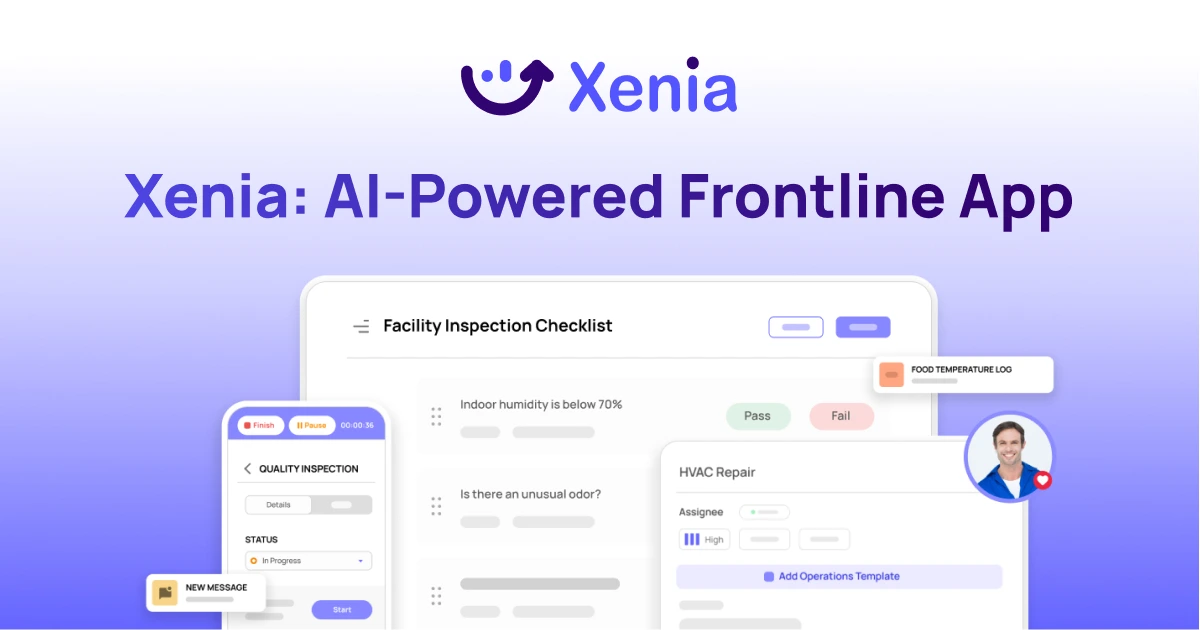
Why Multi-Location Operators Choose Xenia:
🤖 AI-Powered Operations, Create digital checklists instantly or convert paper forms with AI. Verify compliance automatically with photo analysis and get instant answers from your operational data.
✅ Daily Operations & Maintenance, Assign work across hundreds of locations in minutes. Report and route issues instantly. Schedule preventive maintenance to catch problems before downtime.
📊 Real-Time Visibility, Track completion, work orders, and performance across all locations through dashboards. Filter by site or asset to spot trends and take action.
Manage operations, maintenance, and compliance across all your locations from one platform

.svg)
.webp)
%201%20(1).webp)

.svg)
%201%20(2).webp)