

.webp)
Post Summary
A job applicant sees "fixed schedule" in a posting and wonders what that actually means for their daily life. Will it be the same shifts every week? Can the employer change it? What happens if their availability shifts?
Or an employee finds out their schedule is switching from fixed to rotating and wants to know whether that is even allowed without their input.
Both questions deserve a straight answer.
This article covers what a fixed schedule actually is in the frontline hourly context, the real advantages and limitations for both employees and managers, how it compares to the other scheduling structures operators use, and what your rights are when an employer wants to change it.
.webp)
.svg)

Priced on per user or per location basis
Available on iOS, Android and Web


What is a fixed schedule?
A fixed schedule is a recurring work schedule where the employee works the same days and the same hours every week. There is no rotation. There is no variation. The schedule repeats identically until it is formally changed.
The classic office example is Monday through Friday, 9am to 5pm. In frontline operations it looks different. Tuesday through Saturday, 7am to 3pm. Wednesday through Sunday, 2pm to 10pm. The specific days and hours vary. What stays the same is that they repeat week after week without changing.
Fixed schedule meaning in frontline operations
In restaurants, retail, and convenience stores, a fixed schedule assigns specific recurring shifts to specific employees.
The fixed opener works the same morning shift every week. The fixed closer always works evenings. The schedule is predictable for both the employee and the manager. That predictability matters practically, employees can plan their lives around a schedule that does not change without warning.
For an hourly worker arranging childcare, catching a bus, or holding a second job, knowing exactly when they work three weeks from now has real value. Most scheduling structures do not offer that.
Fixed schedule vs set schedule
"Fixed schedule" and "set schedule" mean exactly the same thing. Both describe recurring, consistent shifts that repeat week after week.
"Set schedule" appears more often in job postings. "Fixed schedule" is more common in HR and operations contexts. If you see either phrase, the meaning is the same: the days and hours do not change from week to week.
Pros of a fixed schedule for frontline operations
Predictability that supports employee retention
Employees who know their schedule weeks in advance can arrange childcare, transportation, and personal commitments.
Schedule unpredictability is one of the top reasons hourly frontline workers quit. A fixed schedule removes one of the easiest causes to fix. It doesn't cost more money. You just commit to a consistent structure and stick with it.
Reduced manager time spent on weekly scheduling
A fixed schedule, once built, runs itself. The manager's weekly job becomes managing exceptions, covering call-outs and processing time-off requests, instead of building a schedule from scratch every week.
In multi-location operations where managers oversee large teams, this saved time adds up over the year. That time goes somewhere more useful.
Consistent coverage patterns that are easy to audit
When the same employees work the same shifts every week, coverage gaps are easy to spot. A gap means someone called out or a position is empty, not normal schedule changes.
District managers reviewing location schedules spot problems faster when the baseline is fixed. That's nearly impossible when every week's schedule looks different.
Stronger shift-specific performance and accountability
When the same employee works the same shift week after week, they learn the specific demands of that window. The morning rush patterns. The closing procedures. The lunch peak flow. That knowledge builds over time.
People get better at their shift with fixed scheduling because they're not relearning it from scratch every week.
Compliance simplicity in regulated markets
In jurisdictions with predictive scheduling laws, a fixed schedule is the lowest-risk scheduling structure. It is already published in advance, rarely changes, and generates no last-minute change premiums.
For multi-state operators managing compliance across multiple markets, fixed scheduling reduces the administrative burden significantly.
Fixed schedule advantages at a glance:
**
Advantage, Who benefits, Why it matters
Predictability, Employee, Enables life planning around work
Reduced scheduling overhead, Manager, Frees time for other operational tasks
Easy coverage auditing, District manager, Anomalies surface immediately
Shift-specific competency, Employee and operation, Familiarity builds performance over time
Compliance simplicity, HR and legal, Lowest exposure to scheduling law violations
**
Cons of a fixed schedule for frontline operations
Fixed schedules have real limitations and understanding them is what separates operators who make them work from operators who wonder why turnover is still high.
Reduced staffing flexibility during variable demand
If a fixed schedule assigns four employees to Tuesday lunch every week but demand spikes unpredictably, the fixed schedule cannot flex to add coverage without additional shift offers or call-ins.
Operations with highly variable demand patterns may find fixed schedules create systematic over and understaffing at predictable intervals. The schedule stays consistent. Customer volume does not always cooperate.
Harder to accommodate employee availability changes
When an employee's availability changes, a class schedule, a family commitment, a second job, a fixed schedule requires a formal schedule change rather than a simple availability update.
In high-turnover environments where availability shifts frequently, fixed schedules require more active maintenance than variable ones. That maintenance cost is real, even if it is not always tracked.
Employee schedule fatigue on undesirable fixed shifts
An employee permanently fixed to the overnight shift or every weekend closing position accumulates fatigue and resentment. That drives turnover.
Fixed schedules that permanently concentrate undesirable shifts on the same employees are a retention risk, not a retention advantage. The predictability benefit disappears when what is predictable is consistently hard on the employee's personal life.
Less useful for part-time or genuinely variable-hour employees
Fixed schedules work best for employees with stable, full or near-full-time hours. For part-time employees with genuinely variable availability, students, parents with changing childcare schedules, a fixed schedule may not reflect what they can actually commit to.
A schedule that looks stable on paper but generates frequent conflicts is not a fixed schedule in practice. It is a recurring scheduling problem dressed up as consistency.
Fixed schedule limitations at a glance:
**
Limitation, Who it affects, What to do about it
Low staffing flexibility, Operations with variable demand, Build a part-time float pool for demand spikes
Harder to update, HR and managers, Create a formal process for availability change requests
Shift fatigue on undesirable windows, Employees on overnight or weekend-only shifts, Rotate undesirable shifts on a defined timeline
Poor fit for variable-hour part-timers, Part-time employees, Use flexible or variable scheduling for this segment
**
Fixed schedule vs flexible schedule vs rotating schedule
Three scheduling structures. Each has a legitimate use case. Here is a direct comparison so you can decide which one fits your operation.
**
Aspect, Fixed schedule, Flexible schedule, Rotating schedule
Consistency, Same shifts every week, Varies by week or employee choice, Shifts rotate on a set pattern
Employee predictability, High, Variable, Moderate to low
Coverage flexibility, Low, Moderate, High
Compliance simplicity, High, Moderate, Moderate
Best for, Stable roles-retention-focused operations, Variable demand-part-time workforce, 24/7 operations-fair shift distribution
**
When to choose a fixed schedule
Operations with stable, predictable demand patterns. Roles with consistent shift requirements week to week. Workforces where retention is a priority and schedule unpredictability is a known driver of departures. Compliance-sensitive markets where schedule change premiums are a real cost.
If your operation runs roughly the same staffing pattern every week and your biggest scheduling challenge is keeping good people, a fixed schedule is the right structure.
When a flexible schedule makes more sense
Operations with variable demand or a workforce that includes students, parents, and workers with frequently changing availability. When giving employees input into their schedule improves retention more than consistency does.
For a detailed look at how that works in frontline operations, see the flexible schedule guide.
When a rotating schedule makes more sense
24/7 operations that need to distribute overnight and weekend shifts fairly across the team. When a fixed schedule would permanently concentrate undesirable shifts on the same employees. When the operation has enough staffing depth to make rotation viable without leaving coverage gaps.
Can your employer change your fixed schedule?
Many employees searching this topic want to know their rights when their employer announces a schedule change. Here is a direct answer.
The at-will baseline
In most US states, employers can change employee schedules with reasonable notice as part of their operational authority. At-will employment means the employer can change work conditions, including schedules, as long as the change is not discriminatory or in violation of a written contract.
A fixed schedule that was verbally promised but not contractually documented is generally not legally binding. The employer can change it with reasonable notice.
When predictive scheduling laws apply
In jurisdictions with predictive scheduling laws including Seattle, Chicago, San Francisco, New York City, and Oregon, employers must post schedules a set number of days in advance and pay premium predictability pay for last-minute changes.
A schedule change made inside the required notice window triggers a financial obligation in these markets. Multi-state operators need to know which of their locations are in regulated jurisdictions before changing posted schedules.
What "reasonable notice" means in practice
Outside predictive scheduling jurisdictions, reasonable notice is not legally defined. It is a practical standard. Most employers give one to two weeks notice for schedule changes.
Changes made same-day or with less than 48 hours notice are generally considered unreasonable even where not legally restricted. They generate the disengagement and turnover that makes the schedule change counterproductive in the first place.
Employer schedule change rules at a glance:
**
Situation, Can they change it?, What applies
At-will state-no written contract, Yes-with reasonable notice, No specific legal requirement on notice period
Predictive scheduling jurisdiction, Yes but with cost, Premium pay owed for changes inside notice window
Written employment contract, Depends on contract terms, Contract language governs
Verbal promise only, Generally yes, Verbal promises are typically not legally binding
**
How to implement fixed schedules in a multi-location operation
Step 1: build fixed schedules against demand data, not habit
A fixed schedule built on last year's staffing pattern may under-cover a new peak window or over-cover a slow period. Before fixing any schedule, confirm the fixed shift windows match actual current demand by day-part at each location.
Building fixed schedules from habit rather than data is the most common reason fixed scheduling underperforms expectations.
Step 2: rotate undesirable fixed shifts on a defined timeline
No employee should be permanently fixed to the overnight shift or every weekend closing position. Build a formal rotation timeline, quarterly or semi-annually, for fixed schedules that include undesirable windows, and communicate it at the time of hire.
This is the step most operators miss. Predictability without fairness is still a retention risk. Employees know when they are permanently stuck with the bad shifts and they leave because of it.
Step 3: document the fixed schedule formally
A fixed schedule that lives only in the manager's head is not a fixed schedule. It is a preference that changes when the manager changes.
Document it. Give the employee a copy. Store it in their file. Use HR workflows to maintain schedule documentation consistently across all locations so fixed schedules are visible, enforceable, and transferable when managers turn over.
For operations leaders managing fixed schedules across frontline teams, understanding how to structure predictable scheduling systems while maintaining fairness is essential.
Our workforce scheduling guide covers how to build scheduling infrastructure that balances consistency with operational needs across multi-location operations.
Related resources
- Types of Work Shifts
- Flexible Schedule Guide
- Workforce Scheduling Guide
- Predictive Scheduling Laws
- Employee Scheduling Guide
Conclusion
A fixed schedule is one of the best ways to keep frontline workers from quitting. Most operators don't use it enough.
Employees who know their schedule weeks ahead show up more and stay longer.
The structure is simple. Build the schedule based on actual busy times, not what you did last year. Rotate the bad shifts on a set timeline and tell people about it when you hire them. Write the schedule down and give employees a copy.
When things change, update the schedule with proper notice. Last-minute changes make people quit. That's what fixed scheduling prevents.
See how Xenia works for scheduling and HR workflows across frontline operations.
Frequently Asked Questions
Got a question? Find our FAQs here. If your question hasn't been answered here, contact us.
What do you do when a location is short-staffed?

Cover gaps with voluntary extra shifts, a part-time float pool, or cross-trained staff. If the shortage is ongoing, formally update the schedule with proper notice. Pulling fixed schedule employees into unplanned shifts without notice erodes the trust that makes the whole structure work.
What fixed schedule is best for work-life balance?
The one that fits the employee's actual life, childcare pickup, transportation, school schedules. A schedule that sounds good but conflicts with real commitments will still cause problems. The most important thing is that it is consistent and known in advance.
What happens to pay when a fixed schedule changes last minute?
In most US states, nothing extra is owed. In cities with predictive scheduling laws, Seattle, Chicago, San Francisco, New York City, and Oregon, last-minute changes trigger premium pay on top of the normal wage. The amount and notice window vary by city.
Can employees at the same location have different fixed schedules?
Yes. Openers have one pattern. Closers have another. Part-time staff may have their own fixed window. Each employee's specific days and times stay the same week to week. They do not all have to match each other.
Does a fixed schedule mean the same hours every week?
Not always. A fixed schedule means the same days and shift times repeat every week. Total hours depend on whether those shifts are full-time or part-time. The pattern stays the same. The total hours may not.
How much notice is needed before changing a fixed schedule?
One to two weeks is the standard. In cities with predictive scheduling laws, the minimum is set by law. Outside those markets there is no legal requirement, but less than a week tends to cause no-shows and people looking for other jobs.

A Modern, AI-Powered Platform Built Specifically for Frontline Operations
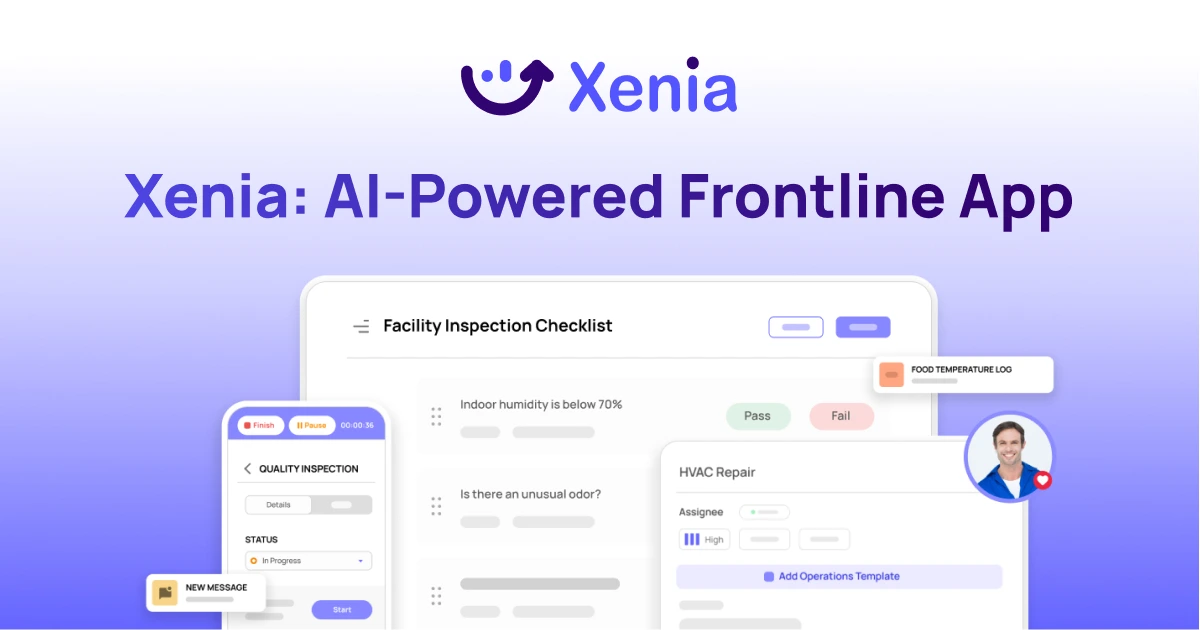
Xenia brings daily operations, maintenance, audits, and compliance into one mobile-first platform. Frontline teams execute work consistently across locations while leadership gets real-time visibility.
Why Multi-Location Operators Choose Xenia:
🤖 AI-Powered Operations, Create digital checklists instantly or convert paper forms with AI. Verify compliance automatically with photo analysis and get instant answers from your operational data.
✅ Daily Operations & Maintenance, Assign work across hundreds of locations in minutes. Report and route issues instantly. Schedule preventive maintenance to catch problems before downtime.
📊 Real-Time Visibility, Track completion, work orders, and performance across all locations through dashboards. Filter by site or asset to spot trends and take action.
Manage operations, maintenance, and compliance across all your locations from one platform

.svg)
.webp)
%201%20(1).webp)

.svg)
%201%20(2).webp)