

Post Summary
Key Differences Between a Server and a Waiter in a Restaurant
In modern U.S. restaurant operations, "server" and "waiter" describe the same job. "Server" is the gender-neutral professional title that most operators now use on schedules, job postings, and training manuals. "Waiter" and "waitress" are the older gender-marked terms for the same work. Waiter waitress training programs still carry those names because guests, job seekers, and federal job data still use them.
The federal occupational classification files the role under "Waiters and Waitresses." The U.S. Bureau of Labor Statistics counted 2,284,400 of these jobs in 2025, with median pay of $35,230 per year, or $16.94 per hour (BLS Occupational Outlook Handbook, Waiters and Waitresses). BLS lists the typical entry-level education as no formal credential and the required work experience as none. That is why the terms persist in search, and why a restaurant server role definition has to spell out what the job actually covers.
Where operators do draw a real line, it is by scope and station, not by title. In a fine dining room a captain owns the table and coordinates the section while a server or food runner executes. That is a role hierarchy question, and it is handled inside fine dining server training, not by swapping one word for another.
| Title | What it usually means on the schedule | Where you still see it |
|---|---|---|
| Server | The standard U.S. title for the person who takes the order and runs the table | Job postings, POS roles, training manuals, most chains |
| Waiter or waitress | The older gender-marked terms for the same job | Federal job data, older handbooks, guest vocabulary, search queries |
| Captain | Owns the table and coordinates the section in fine dining | Upscale rooms, banquet service, large-party service |
| Food runner | Delivers fired plates and verifies modifications at the pass | Higher-volume rooms and fine dining |
| Busser | Clears, resets, and pre-buses tables to protect turn time | Full-service rooms of every tier |

Here is why the title matters at all for a multi-unit group. The job description, the training checklist, and the wage record have to use one term consistently. Otherwise nobody at the support center can tell whether store 14's "waiter training" and store 22's "server onboarding" are the same program. That is the consistency problem this article solves, and it gets harder every year. The National Restaurant Association projects $1.55 trillion in restaurant and foodservice sales for 2026 and 15.8 million industry jobs, with nearly three in four operators planning to hire while expecting difficulty finding experienced staff (2026 State of the Restaurant Industry).


Priced on per user or per location basis
Available on iOS, Android and Web


Restaurant Waiter Waitress Training Training Essentials
Every server needs six things before they touch a table: a passing appearance check, controlled body language, timing standards they can hit, a stocked station, food-handling hygiene, and a clean handoff to the kitchen. Those are the essentials. The difference between advice and a training asset is whether each one has a standard a manager can score.
Professional Appearance and Dress Code
Run appearance as a pass or fail pre-shift check, not a paragraph in a handbook. Name the items so there is nothing to argue about: non-slip shoes, clean and pressed uniform, clean apron, hair restraint in place, trimmed nails, no exposed jewelry on the food-handling hand. Tie the standard to hygiene and safety rather than to looks. Non-slip shoes prevent a slip on a wet line. A hair restraint prevents a physical contaminant complaint. Grooming standards should match the room, so a fast-casual counter and a fine dining floor can carry different bars. What cannot differ is whether somebody checked, and whether the check is on the record for that shift.
Body Language Fundamentals
Body language is coachable once you attach it to a number. The standard to train is simple: acknowledge every guest who enters your section within 30 seconds, even when you cannot get to the table yet. Eye contact and a nod buy you four minutes of patience. Beyond that, train posture at the table, hands visible and off the back of chairs, and a full stop when taking an order instead of a walk-by. Train servers to read the table before speaking. A table with closed menus is ready. A table mid-conversation is not. New servers default to either hovering or hiding, and both come from not knowing what the cue is.
Time Management and Sense of Urgency
This is where service timing standards belong. Publish the numbers, hold servers to them, and measure them on the floor. The widely used full-service convention runs like this:
- Greet the table within 60 seconds of seating.
- Non-alcoholic beverages down within 3 minutes, cocktails within 5.
- Appetizers to the table within 8 to 10 minutes.
- Check back at two minutes or two bites after the entree lands.
- Pre-bus continuously, and never arrive at or leave a table empty-handed.
- Drop the check within 2 minutes of a declined dessert.
These are the common conventions used across full-service training programs (7shifts, How to Train Restaurant Servers, Restroworks, 7 Steps of Service). Set your own numbers before you publish them. A fine dining room and a QSR patio do not share a check-back window. The full sequence sits in the steps of service for restaurants.
Workspace Organization and Preparation
Turn station prep into a par list, not a reminder. Write down what is stocked, at what count, before the door opens: rolled silverware, ramekins, to-go containers, straws, check presenters, sanitizer buckets at the right concentration, POS paper. A server who runs out of rolled silverware at 7pm is not slow, they are under-prepped. Assign opening sidework, mid-shift sidework, and closing sidework by station so ownership is obvious at shift change. A written server sidework checklist removes the nightly argument about who was supposed to restock the bev station and makes the count auditable after close.
Basic Sanitation and Hygiene Requirements
Front-of-house hygiene is a regulatory exposure, not a grooming topic. Servers handle ice, garnish, bread, lemon wedges, and refills. The FDA Food Code requires the person in charge to demonstrate knowledge of foodborne disease prevention on request during an inspection, including the relationship between preventing foodborne disease and the personal hygiene of a food employee (Section 2-102.11, FDA Food Code 2022). Train handwashing timing, bare-hand contact rules, glove changes, ice scoop handling, and never carrying glassware by the rim. Train the illness reporting rule too. Pair this with allergy training for restaurants so the allergen handoff to the kitchen is part of the same lesson.
Teamwork and Communication
Service breaks at the handoffs, not in the middle of a task. Train the three that matter most: the FOH to BOH ticket handoff with modifications spoken back, the runner handoff where the plate gets verified against the ticket before it leaves the pass, and the shift-change note where the outgoing server hands over open tables, comps, and 86'd items. Give the team one place to log all three. Digital training and task platforms for restaurant staff let managers build interactive waiter training checklists so consistency does not depend on who is on shift.
A Step-by-Step Training Program for Waiters
Two weeks to solo, 30 days to certified. That is the practical answer for a full-service restaurant. Below is the full program in text, with what the trainee does in each phase and what has to be signed off before they move.
How long does waiter training take?
BLS classifies the role as requiring short-term on-the-job training, generally lasting from several days to a few weeks (BLS Occupational Outlook Handbook). Restaurant365 puts the practical new-hire window at one to two weeks, combining digital coursework with in-person shadowing (How to Train a Server). RestaurantOwner.com's framework runs two phases. The trainee follows and observes first. Then the trainee runs the section while the trainer follows silently and debriefs after each table, paired with a top performer for three to five shifts (The Fundamentals of an Effective Server Training Program). Volume, menu complexity, and prior experience move the dates. The gates should not move.
The 30-day waiter training program, phase by phase
| Phase | Timing | What the trainee does | Sign-off gate |
|---|---|---|---|
| Pre-day 1 | Before the first shift | Paperwork, schedule, handbook, buddy assigned | Handbook acknowledgment captured |
| Day 1 | Shift 1 | Tour, culture, safety, system access, uniform standard, no guest contact | Food handler card and alcohol training enrolled |
| Week 1 | Shifts 2 to 5 | Shadow a top performer, menu study, POS drills, steps of service observed | Menu quiz passed and POS accuracy drill passed |
| Week 2 | Shifts 6 to 10 | Runs a small section with the trainer following silently, debrief after every table | Trainer debrief signed, two to three table section run clean |
| Weeks 3 to 4 | Shifts 11 to 20 | Full section on a busy shift, cross-train one adjacent station, owns sidework | Alcohol certification in hand where required |
| Day 30 | Review | Scored certification check on safety, technical skill, guest handling, reliability | Scorecard passed, wage or section step |
| Days 60 to 90 | Ongoing | Cross-training, upsell coaching, can train one task for a new hire | 90-day review against guest feedback and check average |

Model the day-30 gate on a scorecard, not a conversation. Poached's restaurant onboarding framework scores each role from 1 to 5 across safety, technical skill, quality, communication, cost and revenue habits, and reliability, and requires a threshold score with no red flags before certification, backed by short micro-tests on critical tasks (Restaurant Onboarding: The First 30 Days). Build the shape, set your own numbers, and write the scorecard down before the first hire runs it. The same structure powers a repeatable restaurant server evaluation at 30, 60, and 90 days. The pre-day-1 and day-1 items belong on a standing restaurant employee onboarding checklist, and the week 1 register drill should ride along with your POS system training rollout.
The certification gates that are not optional
Alcohol service certification is the one gate a training program cannot quietly skip. Requirements are set state by state, and two of the largest markets are explicit.
| State | What it requires | Deadline from hire | Valid for |
|---|---|---|---|
| California | Responsible Beverage Service training plus the ABC exam for on-premises servers and their managers | Certified within 60 days of the first date of employment | 3 years |
| Texas | TABC seller-server certification, not mandated by state law but required for the license holder safe harbor defense | Sellers and immediate managers certified within 30 days of hire | 2 years |
Sources: California ABC Responsible Beverage Service Training Program and TABC Certification FAQs. California servers must also pass the ABC exam within 30 days of completing the training.
Read the Texas safe harbor language closely, because it is not a training requirement. It requires that the employer has written policies for responsible alcohol service and ensures each employee has read and understands them. That is an acknowledgment-evidence requirement. A program that cannot produce a per-employee record of who read the alcohol service policy and when does not get the license holder the protection. This is exactly the case for broadcasting a policy change and capturing acknowledgment with a signature. New alcohol service policy goes out, every server signs, and the compliance record sits in one place instead of a binder at store 22. Xenia handles that pattern as part of new hire SOP acknowledgment during onboarding, and the resulting record is the same audit trail and compliance evidence a health inspector or a license review will ask for.
Implementing a Structured Training Program with the Right Tools
The curriculum is rarely the problem. The completion record is. Picture a 40-unit group with a good server training program that lives as a PDF. Store 3's GM runs it in four shifts because they are short. Store 17's GM runs it in nine because the trainer is thorough. Store 22 skipped the menu quiz in August during a rush. Nobody at the support center learns any of this until a guest complaint or a health inspection surfaces it.
Turnover makes the gap compound. The quits rate in accommodation and food services ran 3.5 percent in July 2026 against 2.1 percent for total private employment (BLS Job Openings and Labor Turnover Survey, Table 4). This sector replaces people at roughly one and two-thirds the pace of the private economy. A 40-unit group re-runs the program constantly, and every re-run is another chance to drift. Tools like Xenia sit under the training program as the execution and evidence layer. Xenia is not a learning management system. It is where the program gets assigned, completed, proven, and corrected.
1. Creating a Standardized Training Checklist
Turn the day-1 to day-30 program above into a checklist template, not a document. Managers can build detailed training checklists where each phase is a set of items with due dates, photo-proof requirements, and a named owner. "Trained" then means the items are checked off with timestamps, not that the GM says so. Daily ops checklists with photo proof and completion tracking are already the habit that sticks in restaurants, because the completion percentage becomes the store's pulse. Attach the trainee's items to the same daily rhythm and the training stops being a separate project that competes with the shift.
2. Setting Measurable Performance Milestones
Tie milestones to the day-30 scorecard, not to vague impressions of upselling. The items are concrete: menu quiz passed, POS accuracy drill passed, trainer debrief signed, alcohol certification on file, first solo section run clean. Xenia's reporting and analytics roll those into a view a DM can act on. The useful view is not a completion percentage. It is which trainees are stalled at which gate, and which stores' programs are slipping before the guest feedback tells you. Dashboards should surface what is coming up as a problem, so you can see which locations are trending toward a service or food safety failure while there is still time.
3. Implementing Shadowing and Mentorship Systems
Shadowing works when the trainer is named on the record. Assign the trainee to a specific top performer for three to five shifts and log the per-shift debrief in the same place as the checklist. Two things change. First, the trainer's sign-off becomes auditable, so "she shadowed somebody" turns into "she shadowed Marisol on shifts 2 through 6, debriefed after every table, signed on the 6th." Second, the trainer gets credit and accountability at the same time. If a trainee fails the day-30 check, you can see who trained them and on which shifts, which usually points at the gap faster than any coaching conversation.
4. Conducting Interactive Role-Playing Exercises
Role-play is the only way to practice the situations a new server will face before they face them at a live table. Script three or four scenarios and run them in pre-shift: a wrong dish fired, an allergen question mid-order, a two-top that wants separate checks after the fact, and the upsell that fits the table. Use the written scenarios for handling customer complaints and restaurant upselling techniques as the source material. Servers submit photo or video evidence against the checklist item, and the manager reviews it and signs off. That is skill verification with media evidence, not a recording studio.
5. Integrating Real-time Coaching and Immediate Feedback
Coaching only counts when somebody wrote it down. A missed standard should become a corrective task with an owner and a date, not a hallway conversation nobody remembers by Friday. A check-back missed on three tables in a row becomes a task assigned to the shift lead, with a deadline and an escalation to the GM if it is not closed. Recognition works the same way in reverse. Log the good shift so the day-30 scorecard has evidence behind it. Bacari Restaurants uses Xenia to standardize checklists and operations across its locations, which is exactly this problem at group scale.
6. Mobile Access for Ongoing Reinforcement
Training that lives on a back-office desktop does not get used at 7:15pm. Servers need the wine pairing, the allergen matrix, and the table diagram on the phone in their apron. Put a QR code at the POS station that opens the training module without a login, and the refresher takes ten seconds instead of a trip to the office. That matters most for the details that change weekly: the special, the 86 list, the new well spirits, the seasonal menu swap. Reinforcement beats re-training. A server who can check the answer in five seconds stops guessing at the table.
Benefits of Digital Training Management with Xenia
Digital training management is worth it for one reason: it produces a per-location record that a paper binder cannot. The training content is not the differentiator. The proof is.
| Question a DM has to answer | Paper or PDF training binder | Digital training execution |
|---|---|---|
| How do you know the training actually happened | The GM says it did | Checklist items completed with timestamps and the trainer named |
| What proof survives a health inspection or a safe harbor question | A signature sheet in a filing cabinet | Per-employee acknowledgment record with date and signature |
| What happens when the program changes | Reprint, redistribute, and hope | Update the template once and push it to every location |
| What does a DM see across 40 units | Nothing until a complaint arrives | Which trainees are stalled and which stores are slipping |
| What happens when the trainer leaves | The program leaves with them | The steps and the record stay in the system |
Visual Training Through Detailed Photo and Video Guides
Text cannot teach a plate drop. Managers can record short video and photo guides for the techniques that are hard to describe: three-plate carry, correct table setup by service style, wine presentation, and clearing from the right. Servers watch the exact standard instead of reading a paragraph about it.
 Video training modules shorten the time from watching to doing.
The practical payoff is consistency across locations. When store 3 and store 17 watch the same 40-second clip for table setup, the DM stops arbitrating two versions of the standard on a store walk.
On-Demand Mobile Accessibility for Immediate Reinforcement
Servers review the critical steps between tables, not in a classroom. A QR code at the POS station opens the training module with no login, so a quick check on the daily special or a wine pairing happens before the server walks to the table rather than after the guest asks.
 Training material is available at the station, during the shift.
This is also how you keep a trained server current. Menu changes, LTOs, and new allergen procedures reach the floor the same day instead of waiting for the next pre-shift everyone happens to attend.
Digital Checklists and Task Management for Consistency
The training program from the section above ships as a checklist with due dates and required proof. Servers see today's items. Managers get confirmation the moment each one closes, with a timestamp and a photo where one is required.
 Structured daily training tasks assigned to the trainee.
Skoops achieved 100% scheduled task completion across two locations. That is the small-footprint version of the same mechanic that keeps a 40-unit rollout honest. For a larger group, the same pattern is how you manage training across multiple locations without a spreadsheet per region.
Customized Role-Specific Training Paths
A server, a captain, a food runner, and a busser should not receive the same checklist. Assign each seat its own path. Servers get upselling, guest interaction, and tableside presentation. Captains get large-party management, guest recovery, and wine service. Food runners get kitchen-to-table accuracy and modification verification. Bussers get pre-bus timing, reset standards, and glassware handling. Role-based assignment means nobody wastes a shift on content for a job they do not hold, and nobody skips the item that belongs to theirs. Newk's Eatery uses Xenia for audits and operations across 100+ locations, where role-scoped assignment is the only way the work stays sorted.
Real-time Skill Verification and Immediate Feedback
Verification is where training stops being a promise. Servers submit a photo or short video against a specific checklist item, such as a completed table setup, a correct wine pour, or a plated presentation. The manager reviews the submission, approves it or sends it back with a note, and the record stays attached to the item.
 Servers attach photo or video proof to the training item they completed.
Pair verification with a scheduled nudge so nothing stalls. A training reminder broadcast pushes the outstanding items to the right people before the 30-day review, and the wider frontline communication tools for multi-unit teams keep the follow-up in the same place as the record.
Conclusion
Run the program on dates and gates. Day 1 is orientation, safety, and system access with no guest contact. Week 1 is shadowing, menu certification, and POS drills. Week 2 is a supervised solo section with a debrief after every table. Day 30 is a scored certification check, with alcohol certification in hand wherever your state requires it. Publish the service timing standards, and set your own numbers rather than borrowing someone else's.
The thing that breaks at scale is not the curriculum. It is the completion record. Once you run more than a handful of locations, you need to know which server finished which gate, who signed off, and what proof exists when an inspector or a license review asks. Xenia turns that program into assigned checklists with timestamps, photo proof, acknowledgment capture, and corrective tasks across every unit. Book a demo and bring your current training checklist to it.
Frequently Asked Questions
Got a question? Find our FAQs here. If your question hasn't been answered here, contact us.
What should a new server be able to do after 30 days?

How do you train servers consistently across multiple restaurant locations?
Do servers need a certification to work in a restaurant?
What should be on a server training checklist?
What is the difference between a waiter and a server?
How long does it take to train a new waiter or waitress?

A Modern, AI-Powered Platform Built for Restaurant Operations
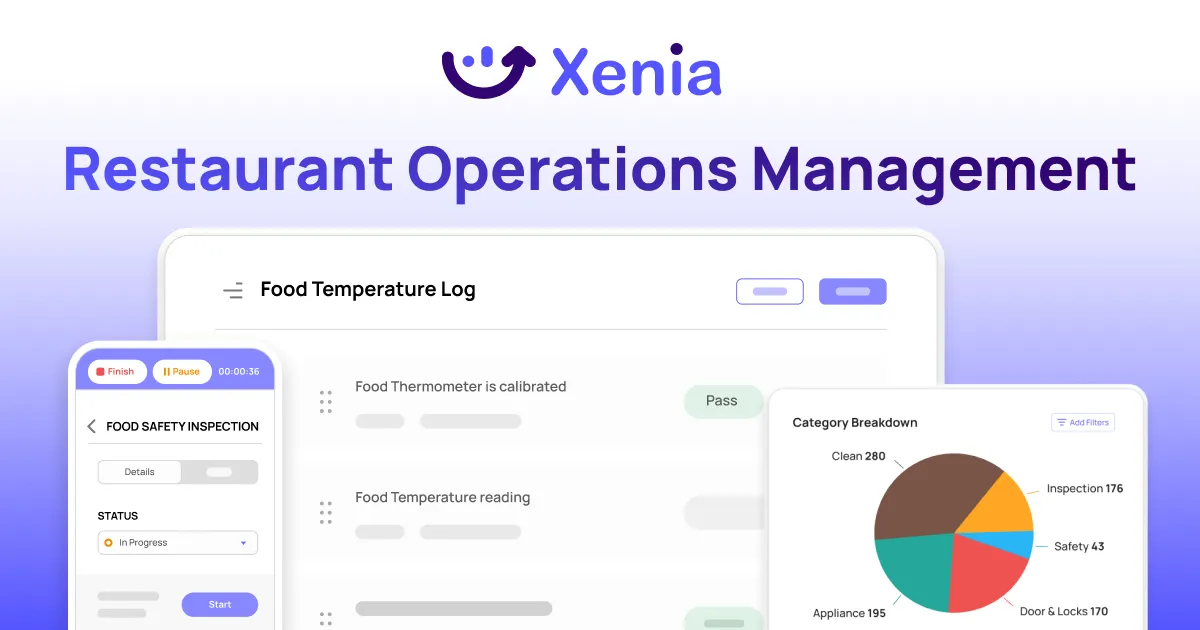
Xenia brings kitchen operations, food safety, audits, and team communication into one mobile-first platform. Restaurant teams execute daily work consistently, maintain compliance, and resolve issues faster, while leadership gets real-time visibility across all locations.
Why Restaurant Operators Choose Xenia:
🤖 AI-Powered Operations, Convert paper logs instantly and verify food presentation and kitchen cleanliness automatically. Get instant answers about food safety trends without building reports.
🍽️ Food Safety & Compliance, Track line checks and temperature logs with automated alerts. Trigger corrective actions when readings exceed safe ranges. Maintain audit-ready records for health inspections.
📊 Multi-Location Control, Monitor food safety compliance and task completion across regions. Benchmark locations to identify training needs. Export reports for operational reviews.
One platform for kitchen operations, food safety, and compliance across all locations.