

Post Summary
What Are the Steps of Service in a Restaurant?
Restaurant steps of service is the fixed sequence your front of house follows at every table, from the greeting to the table reset. Written down, with a target time attached to each step, it gives servers one correct answer for what comes next, and it gives managers something specific to observe, score and coach.

This guide covers the whole thing. The 7 steps of service most full-service restaurants run. The 5, 10 and 12-step versions, and which concept each one fits. The timing standard behind every step. A breakdown by role so hosts, bussers, runners and bartenders know their part. And a one-page printable checklist you can hand out at pre-shift.
The case for writing it down sits in the return visit. Toast survey data from April 2026 found that 43% of guests who stopped visiting a restaurant they once considered a regular spot pointed to gradual declines rather than one bad night, with a drop in service named by 15% of them. Those regulars carry more weight than their headcount suggests: Toast platform data from Q1 2026 shows roughly 7% of a restaurant's guest base can account for up to half of total order volume.
Service drifts quietly. The greeting slides from 60 seconds to three minutes during the Friday rush. The check-back stops happening on a short-staffed Tuesday. Nobody complains at the table. The guest just comes back less often.
A documented sequence of service, with a timing standard and a named owner on every step, is what makes that drift visible while you can still fix it. Start with the printable checklist, then work through the sequence below.


Priced on per user or per location basis
Available on iOS, Android and Web


The 7 Steps of Service, With Timing Standards
The seven-step model covers the full table journey in a full-service restaurant. Each step below carries a target time, an owner, and the thing a manager can check to know whether it actually happened.

The times are the conventions used across most full-service training programs. They are a starting point, not a rule. A fine dining room and a high-volume casual patio do not share a check-back window, so set your own numbers by concept before you publish them to your team.
| # | Step | Starts when | Target time | Owner | What a manager checks |
|---|---|---|---|---|---|
| 1 | The greeting | Guest is seated | Acknowledged within 30 seconds of entering, server at the table within 60 seconds of seating | Host, then server | Spot-check five tables a shift: time from seat to first server contact |
| 2 | The beverage order | Server reaches the table | Order taken on first contact, non-alcoholic drinks down within 3 minutes, cocktails within 5 | Server, bar | Bar ticket times in the POS, by daypart |
| 3 | The food order | Drinks hit the table | Order taken within 2 minutes, allergens confirmed and repeated back | Server | Modifier and allergen fields completed in the POS, void and remake rate |
| 4 | The check-back | Entrée lands | 2 minutes or 2 bites, whichever comes first | Server | Observed check-back rate during a floor walk |
| 5 | Clearing and pre-bussing | A guest finishes a course | Plates cleared within 2 minutes of the last guest at the table finishing | Server, busser | Table condition during a walk, plate counts at the dish pit |
| 6 | Dessert and coffee | Entrée plates are cleared | Offered within 2 minutes of clearing | Server | Dessert attachment rate per server in the POS |
| 7 | Payment and farewell | Guest declines dessert or asks for the check | Check within 2 minutes, payment processed within 3, table reset within 5 | Server, busser | Time from check request to card return, table turn time |
Step 1: The Greeting (within 60 seconds of seating)
The greeting is two handoffs, not one. The host acknowledges the guest within 30 seconds of the door, even if there is a wait and no table to offer. The server reaches the table within 60 seconds of seating, introduces themselves by name, and says who is looking after the table tonight.
What breaks it: a server who is mid-task at another table and decides the new party can wait. Train a verbal acknowledgement from across the section as the default, with the full greeting to follow.
Step 2: The Beverage Order (drinks down within 3 minutes)
Take the drink order on first contact. Recommend something specific rather than opening with an open question, because "can I start you with a drink?" produces water far more often than a named cocktail or a seasonal option does.
Non-alcoholic drinks should reach the table within 3 minutes, cocktails within 5. If the bar runs longer than that at peak, the number to fix is the bar, not the server.
Step 3: The Food Order (within 2 minutes of drinks)
Take the food order within about two minutes of delivering drinks. Three things happen here: allergens and dietary needs are asked about directly and read back, appetizers and sides are offered, and the order is entered with the right modifiers.
The allergen question is not optional and should not depend on the guest raising it first. Make it a line in the script, and make it part of what you audit. Training servers to upsell naturally belongs in this step too, once the accuracy part is solid.
Step 4: The Check-Back (2 minutes or 2 bites)
Return to the table two minutes after the entrée lands, or after the guests have taken a couple of bites. Ask a question that can be answered honestly, such as how the steak came out, rather than "is everything OK?"
This is the single highest-value step in the sequence, because it is the last moment a problem can be fixed before it becomes a review. Skipping it is also the easiest failure to hide, which is why it needs to be observed rather than assumed.
Step 5: Clearing and Pre-Bussing (within 2 minutes)
Clear plates and glassware as courses finish, within about two minutes of the last guest at the table putting their cutlery down. Clearing early, while someone is still eating, rushes the table. Clearing late leaves the guest sitting with a dirty plate.
Pre-bussing keeps the table workable and signals that the next course is coming. It is also the step most often dropped when a section is short, so assign it explicitly to the busser or runner rather than leaving it to whoever notices.
Step 6: Dessert and Coffee (offered within 2 minutes of clearing)
Offer dessert and coffee within two minutes of clearing entrées, while the table is still settled. Describe two items rather than handing over a menu in silence, and pair the suggestion with coffee or a digestif.
Servers skip this step when they are busy and when they assume the answer is no. Dessert attachment rate per server is visible in the POS, which makes this one of the easiest standards to coach with real numbers.
Step 7: Payment and Farewell (check within 2 minutes, table reset within 5)
Deliver the check within two minutes of a declined dessert or a request, process payment within three, and thank the guests by inviting them back specifically rather than generically. Reset the table within five minutes so the host can seat it.
The farewell is the last thing the guest remembers and the easiest to rush at the end of a long shift. The table reset is where service standards and floor capacity meet, which is why it belongs inside the sequence and not in a side process.
For the training detail behind each of these, see our guides to waiter and waitress training and fine dining server training.
Printable Steps of Service Checklist
Use the one-page steps of service checklist below. Print it for the pre-shift board, the server station and the host stand.
The checklist is the table below, formatted to fit a single page. Fill in your own target times in the blank column before you print it, because the numbers that matter are the ones your team is actually held to.
| Step | Standard | Our target time |
|---|---|---|
| Greet | Guest acknowledged at the door, server at the table and introduced |  |
| Drinks | Order taken on first contact, a specific recommendation made, drinks delivered |  |
| Food order | Allergens asked and read back, appetizers offered, order entered with modifiers |  |
| Deliver | Correct plate to the correct seat, dish named on the table |  |
| Check-back | Return after the first bites with a specific question, refill drinks |  |
| Pre-bus | Clear finished plates and glassware, keep the table workable |  |
| Dessert | Two items described, coffee offered |  |
| Check | Delivered promptly, payment processed, card or change returned |  |
| Farewell | Guests thanked by name where possible, invited back specifically |  |
| Reset | Table wiped, reset and marked available for the host |  |
For a longer onboarding document that covers menu knowledge, POS use and side work alongside the sequence, use the server training checklist in the template library.
5, 7, 10 and 12 Steps of Service: Which Model Fits Your Concept
There is no official number. Seven is the most common in casual and family dining, but the same guest journey gets split into 5, 10, 12 or 13 steps depending on how much of it a server owns and how closely the brand wants it audited.
Pick the model by how many distinct handoffs exist in your dining room. More handoffs need more steps, because every handoff is a place the sequence can break.
| Model | What it covers | Best fit | What it adds over 7 steps | Where it falls down |
|---|---|---|---|---|
| 5 steps | Greet, order, serve, check back, close out | QSR, fast casual, counter service, bars | Nothing. It strips the sequence to the touchpoints that exist without table service | No pre-bus, no dessert, no reset. Too coarse for a full-service floor |
| 7 steps | Greeting, beverage, food order, check-back, pre-bus, dessert, payment and farewell | Casual and family dining | The standard full-service table journey | Assumes host, busser and runner steps live in someone else's checklist |
| 10 steps | Adds seating and menu presentation, specials, and the table reset as named steps | Polished casual, upscale casual | Splits host duties out from server duties, so the handoff is owned | More steps to train, observe and score |
| 12 steps | Adds allergen confirmation, course pacing, wine service and a feedback ask at the farewell | Fine dining, multi-course, tasting menus | Covers the points a mystery shopper or brand standards audit grades | Overkill below that service level, and servers stop following a list they cannot remember |
Sequence of Service Means the Same Thing
Sequence of service and steps of service are used interchangeably. Hotel and European training programs tend to say sequence of service, North American restaurant groups tend to say steps of service. Both describe the same ordered set of guest touchpoints. If your brand standards document uses one term and your training deck uses the other, pick one and change the other, because two names for the same process is how a standard quietly becomes optional.
How to Choose and Then Stop Changing It
Run the model you pick for a full quarter before you revise it. Service standards only produce consistency when they outlast the people who wrote them, and a sequence that changes every few months trains the team to wait and see which version gets enforced.
If you operate several concepts, the honest answer is usually one core sequence with a documented variation per concept, not four unrelated standards. That keeps training portable when a manager moves between brands.
Steps of Service by Role
A sequence written only for servers leaves four roles guessing. The steps below split the same table journey by who owns what, which is the version worth posting at each station.
Host
- Acknowledge every guest within 30 seconds of the door, including when there is a wait
- Confirm the reservation, party size and any occasion or accessibility need
- Seat by rotation so no section gets double-sat, and tell the server the table is down
- Present menus, note anything the server needs to know, and quote an honest wait time
- Mark the table available in the system only once it is reset, not when it clears
Server
- Greet within 60 seconds of seating and introduce yourself by name
- Take the drink order on first contact with a specific recommendation
- Take the food order with allergens asked and read back
- Check back two minutes or two bites after the entrée lands
- Offer dessert and coffee within two minutes of clearing entrées
- Deliver the check, process payment, and invite the guests back
Busser
- Water the table within two minutes of seating and keep glasses topped up
- Pre-bus finished plates and glassware without being asked
- Crumb or wipe the table between courses where the concept calls for it
- Reset the table fully within five minutes of the guests leaving
- Tell the host the moment the table is ready
Food Runner
- Run food as it is called, with the full table delivered together
- Use seat numbers so nothing is auction-called at the table
- Name each dish as it lands and check nothing is missing from the ticket
- Carry condiments and extras with the food, not after it
- Flag anything that looks wrong to the kitchen before it reaches the guest
Bartender
- Hit the drink ticket times the floor is held to, and call out when the bar is backing up
- Greet bar guests within 30 seconds, because the bar is its own section
- Keep service well, garnishes and glassware stocked through the shift
- Follow the same allergen and alcohol service standards as the floor
Manager on Duty
- Run pre-shift with one service standard named as the focus for the shift
- Observe five tables against the sequence and record what you saw, not what you assume
- Fix the step that broke during the shift, not in next week's meeting
- Review ticket times, dessert attachment and check-back observations at close
Keeping all of this straight across shifts is a communication problem as much as a training one. Xenia's frontline communication tools keep role-specific standards and shift notes in the same app the team already uses to complete their work.
How to Train the Steps of Service So They Hold
A sequence posted in the break room changes nothing. What moves behavior is short, repeated reinforcement plus someone actually watching the floor.

Pre-shift, every shift. Name one step as the focus for that shift. One standard, five minutes, with the number attached. "Tonight we are hitting the two-minute check-back" beats a general reminder about hospitality.
Shadowing before solo tables. New servers follow a strong server for two shifts, then run a section with a trainer watching and signing off step by step. Certify on observed performance, not on a quiz score.
Role play the awkward ones. The steps that get skipped are the ones that feel uncomfortable: recommending a specific cocktail, asking about allergens, offering dessert. Rehearse those three in pairs until the words are automatic.
Short video over long documents. A 60-second clip of the check-back done correctly teaches more than a page describing it. Xenia's microlearning and document and records management features let you build short lessons and keep the current version of every standard in one place, so the team is never training off an old PDF.
Observe and record, do not assume. Five observed tables per shift, scored against the sequence, is enough to see a pattern within a week. Running those observations as a digital checklist or audit in Xenia means each one is timestamped, photo-backed where it helps, and comparable across shifts and managers.
Coach in the moment. When a step is missed, address it during the shift. A failed step logged in Xenia can trigger a corrective action with an owner and a due date, so the fix is tracked rather than mentioned and forgotten.
For the full onboarding sequence that sits around this, see our guide to restaurant server training.
Service Recovery: What to Do When the Sequence Breaks
Every service has tables where the standard sequence stops applying. Recovery is faster when servers already know the limits of what they can fix without finding a manager.

Set three things in writing: what a server can comp or remake on their own authority, when to escalate to the manager on duty, and what gets logged afterwards. Without the third one, you learn nothing from the recovery.
| Situation | What the server does | What gets logged |
|---|---|---|
| Food is late | Acknowledge it before the guest raises it, give a real time, offer something while they wait | Ticket time and the cause, so the kitchen sees the pattern |
| Wrong dish delivered | Apologize once, remove the plate, confirm the correct order with the kitchen and give a time | Whether it was an order-entry error or a kitchen error |
| Food quality issue | Remove it without debate, offer a replacement or an alternative, tell the kitchen immediately | The dish and the issue, for the next line check |
| Guest is unhappy with service | Listen without defending, name the fix, bring the manager if the guest wants one | What step of the sequence was missed |
| Long wait at the host stand | Quote honestly, update the guest at the halfway point | Quoted time versus actual time |
Two rules worth putting in the training: apologize once and then act, because repeated apologies read as excuses. And never explain the operational reason to the guest. "We are short a cook tonight" tells the guest their meal is not the restaurant's problem.
When recovery events are logged against the location rather than remembered by a manager, they become usable. A pattern of late tickets on Friday dinners at one location is an operations problem with a fix. The same pattern held only in one manager's memory is not.
Rolling Out Steps of Service Across 10+ Locations
One restaurant enforces its sequence by having a manager on the floor. Twenty restaurants cannot. At that point the standard only survives if it is documented once, distributed the same way everywhere, and verified on a schedule rather than when someone visits.

Write one standard, then document the variations. A single sequence with a named exception for the airport location beats twelve locally-written versions. Variations should be approved and written down, not improvised by whoever opened that store.
Put the sequence where the shift happens. A standard lives in the app the team opens at the start of a shift, not in a binder in the office or a PDF in someone's email. Checklists and SOPs in Xenia put the current version of the sequence on every phone, and updating it once pushes it to every location at the same moment.
Set an audit cadence and keep it. A service standards audit run monthly at every location, with the same questions and the same scoring, produces a comparable number. Run it as an audit or inspection with scored questions, photo evidence and automatic corrective actions, so a failed step creates an assigned task instead of a note.
Make a failure create work, not a report. The gap between knowing a location misses the check-back and fixing it is an owner and a due date. Corrective actions triggered from a failed audit item close that gap.
Look at the pattern, not the incident. Scores by location, by region and by step tell you whether a problem is a single manager or a training gap across the group. Multi-unit operations and frontline reporting in Xenia roll location-level results up so a director of operations can see which step is weakest across the portfolio before the quarterly review.
Benchmark locations against each other. The fastest way to fix a lagging store is often the practice already working at the strongest one. That comparison only exists when every location is scored the same way.
The operational test is simple. If a district manager can answer "which of my locations missed the check-back standard last month, and what was done about it" without making phone calls, the sequence is being managed. If they cannot, it is being hoped for.
Conclusion
The steps of service a restaurant writes down are worth less than the ones it checks. Three things turn the sequence from a poster into an operating standard:
- A number on every step. "Greet promptly" cannot be coached. "Server at the table within 60 seconds" can.
- An owner on every step. Host, server, busser, runner and bar each need their own version of the sequence, not a copy of the server's.
- A verification routine. Five observed tables a shift, one scored audit a month per location, and a corrective action when a step fails.
Start with the printable checklist above, set your own target times, and run the sequence unchanged for a quarter before you revise it.
Xenia gives multi-unit restaurant teams one place to do the last part: publish the current sequence to every location, run scored service audits with photo evidence, trigger corrective actions when a step fails, and compare results by location and region. See how it works for restaurant operations teams, or book a demo and we will walk through a service standards audit built on your own sequence.
Frequently Asked Questions
Got a question? Find our FAQs here. If your question hasn't been answered here, contact us.
How do you train staff on the steps of service?

How do you keep steps of service consistent across multiple locations?
Who is responsible for each step of service?
What is the difference between steps of service and sequence of service?
What are the 5, 10 and 12 steps of service?
What are the 7 steps of service in a restaurant?

A Modern, AI-Powered Platform Built for Restaurant Operations
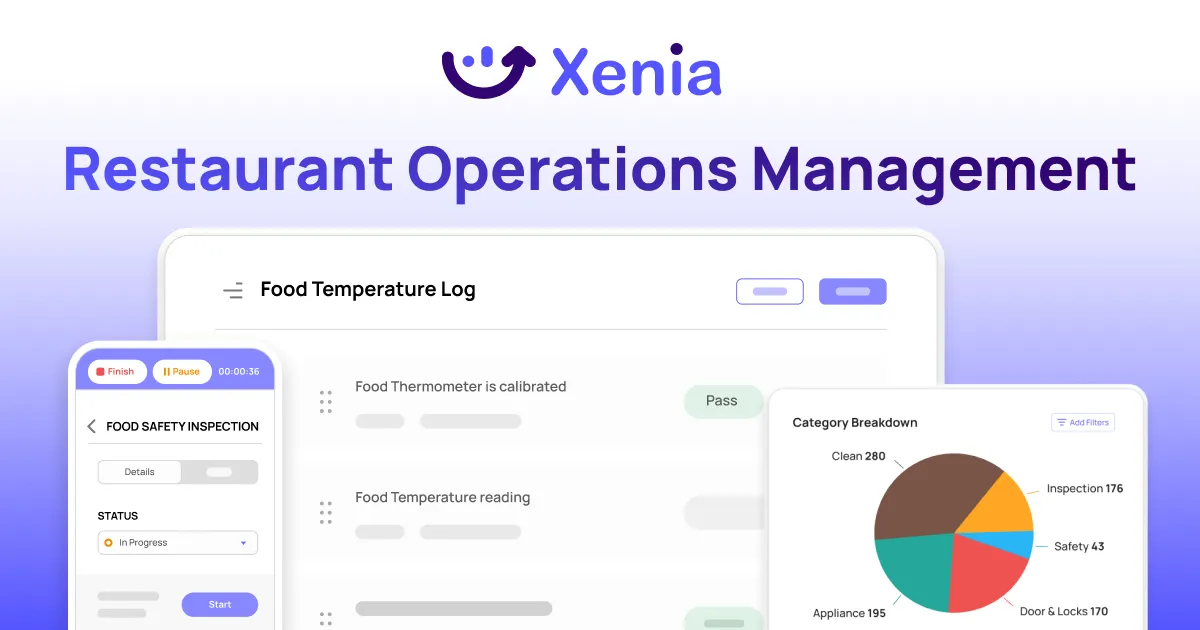
Xenia brings kitchen operations, food safety, audits, and team communication into one mobile-first platform. Restaurant teams execute daily work consistently, maintain compliance, and resolve issues faster, while leadership gets real-time visibility across all locations.
Why Restaurant Operators Choose Xenia:
🤖 AI-Powered Operations, Convert paper logs instantly and verify food presentation and kitchen cleanliness automatically. Get instant answers about food safety trends without building reports.
🍽️ Food Safety & Compliance, Track line checks and temperature logs with automated alerts. Trigger corrective actions when readings exceed safe ranges. Maintain audit-ready records for health inspections.
📊 Multi-Location Control, Monitor food safety compliance and task completion across regions. Benchmark locations to identify training needs. Export reports for operational reviews.
One platform for kitchen operations, food safety, and compliance across all locations.