
.png)
Post Summary
You run a restaurant. Food safety keeps you up at night.
One outbreak and everything's gone. Your business closes. Customers get sick. Lawsuits pile up. A HACCP plan prevents this.
Most managers think it's complicated. Too much paperwork. Too technical.
It's not.
Writing a HACCP plan is simple once you know the steps.
This guide shows you exactly how to write a HACCP plan for a restaurant with a real sample you can use.
.svg)

Priced on per user or per location basis
Available on iOS, Android and Web


What is HACCP in Food?
HACCP stands for Hazard Analysis and Critical Control Points.
Think of it like this. Instead of fixing problems after they happen, you stop them before they start.
You find where dangers could happen in your kitchen. You control those dangers. You write it all down.
The FDA created HACCP years ago. Now every health department uses it.
It's the gold standard for restaurant food safety.
Are HACCP Programs Mandatory for All Restaurants?
Yes. HACCP programs are mandatory for all restaurants and kitchen operations.
You definitely need one if you cure meats, smoke fish, vacuum seal food, make fresh juice, or sprout beans.
But even if you don't do these things, most health departments still require it. Please check with your local health department.
Here's why you want one anyway.
HACCP cuts foodborne illness risk by 90%. It creates consistent safety across all your shifts. Inspectors see you're serious about safety. Some insurance companies even give you discounts.
How to Write a HACCP Plan for a Restaurant: Step-by-Step
Here's the process. Step by step.
Step 1: Get Your Team Together
Don't do this alone. Grab your kitchen manager. They know food prep inside out.
Get your front-of-house manager. They understand service flow.
Find someone with food safety certification. They know the rules.
Include maintenance staff. They know your equipment.
Small restaurant? One person can do multiple jobs. That's fine.
Step 2: List Your Menu Items
Write down every dish that needs a HACCP plan for restaurant operations.
For each one, document the ingredients, how you store it, how you prep it, and who eats it.
Raw oysters have different risks than grilled steak. Know the difference.
Step 3: Map Your Process
Draw a simple flowchart.
Receiving → Storage → Prep → Cooking → Serving.
Add extra steps if you need them. Cooling. Reheating. Whatever your kitchen does.
Then walk through your kitchen during service. Watch what really happens.
Your flowchart and reality probably don't match. Update it.
Step 4: Find the Hazards
Go through every step. Look for three types of dangers.
Biological hazards are bacteria, viruses, and parasites. These are your biggest worries.
Chemical hazards are cleaning supplies and allergens. These can hurt people fast.
Physical hazards are glass, metal, and plastic. These cause injuries.
For each hazard, ask yourself: Could this happen? Could it hurt someone? Can we stop it here?
If yes to all three, you need a control.
Step 5: Pick Your Critical Control Points
Here's the key question.
Can you prevent, eliminate, or reduce the hazard at this step? If yes, it's a Critical Control Point.
Cooking is almost always a CCP. Heat kills bacteria.
Cold storage might not be a CCP if you're cooking later. The cooking step handles it.
Most restaurants have 3 to 7 CCPs. That's it.
If you identify 20, you're overdoing it.
Step 6: Set Your Limits
Get specific for each CCP.
Cooking temps from the FDA:
- Chicken and turkey: 165°F
- Ground beef and pork: 155°F
- Steaks and chops: 145°F
- Fish: 145°F
Cooling requirements:
- 135°F to 70°F in 2 hours
- 70°F to 41°F in 4 more hours
Cold holding: 41°F or below.
Hot holding: 135°F or above.
No guessing. Only exact numbers. Reference our temperature danger zone guide for safe temperature ranges.
Step 7: Monitor It
How do you know you hit those limits? Check it. Measure it. Write it down.
For cooking: Check every chicken breast with a thermometer. Line cook does this. Before every plate goes out.
For cooling: Check temps every hour. Write them on your cooling log.
For storage: Check walk-in temps twice a day.
Make it easy for your staff. Keep thermometers nearby. Make logs simple.
Temperature monitoring systems automate this process and eliminate manual errors.
Step 8: Plan for Problems
Things go wrong. Always.
What happens when chicken only hits 155°F?
Don't serve it. Keep cooking. Check again. Hits 165°F? Good. Still low? Trash it.
Write down what happened. Date. Time. What went wrong. What you did.
Then figure out why. Bad thermometer? Grill too cold? Train your staff better?
Fix the root cause.
Step 9: Verify It Works
Monitoring happens every day. Verification happens less often.
Calibrate thermometers once a month. Use ice water. Should read 32°F.
Review all your logs daily. Look for patterns.
Watch your staff weekly. Make sure they're doing it right.
Audit your whole system quarterly.
Step 10: Keep Records
Save everything.
Temperature logs for 6 months. Corrective actions for 6 months. Calibration records for a year. Training docs for a year after someone leaves.
Organize by month. Label clearly. "February 2026 - Temp Logs."
When an inspector asks for Tuesday's logs, you should find them in 30 seconds.
Sample HACCP Plan for Restaurant: Grilled Chicken Example
Here's a real example of a HACCP plan for restaurant kitchens. This food safety sample HACCP plan for restaurant operations shows exactly what yours should look like.
The Item: Fresh chicken breast seasoned with olive oil, salt, pepper, garlic. Grilled to order.
The Process: Receive chicken → Store at 41°F → Season → Grill → Serve hot.
The Hazard: Salmonella bacteria.
The CCP: Cooking.
The Limit: 165°F internal temp for 15 seconds.
The Monitoring: Line cook checks every chicken breast with a calibrated thermometer before serving.
The Fix: If it’s below 165°F, keep cooking until it reaches 165°F and check again. If it still doesn’t reach the right temperature after a reasonable time, discard it. Use it only as a last option.
The Verification: Manager watches during shifts. Reviews logs daily. Calibrates thermometer monthly.
The Records: Temperature log with date, time, temp, cook's initials.
Done. That's a complete example HACCP plan for restaurant use.
Copy this HACCP plan example for every item you serve.
Using a HACCP Plan Template for Restaurant Operations
Many restaurants start with a HACCP plan template for restaurant kitchens.
Templates give you the structure. But here's what matters.
Customize it. A generic template won't pass inspections. Your health inspector knows when you copied something without thinking.
Xenia offers customizable HACCP plan templates designed specifically for restaurants. They integrate with digital monitoring, so you're not starting from scratch.
When to Consider HACCP Consultancy
Sometimes you need professional HACCP consultancy.
Get expert help if you're doing complex stuff like smoking meats or curing fish. Get it if you're opening your first place. Get it if you failed an inspection.
HACCP consultancy typically costs $1,500 to $5,000.
Sounds expensive until you compare it to a $50,000 lawsuit.
But remember. Even with a consultant, you still run the plan daily.
How Xenia Simplifies HACCP Plan for Restaurant Compliance
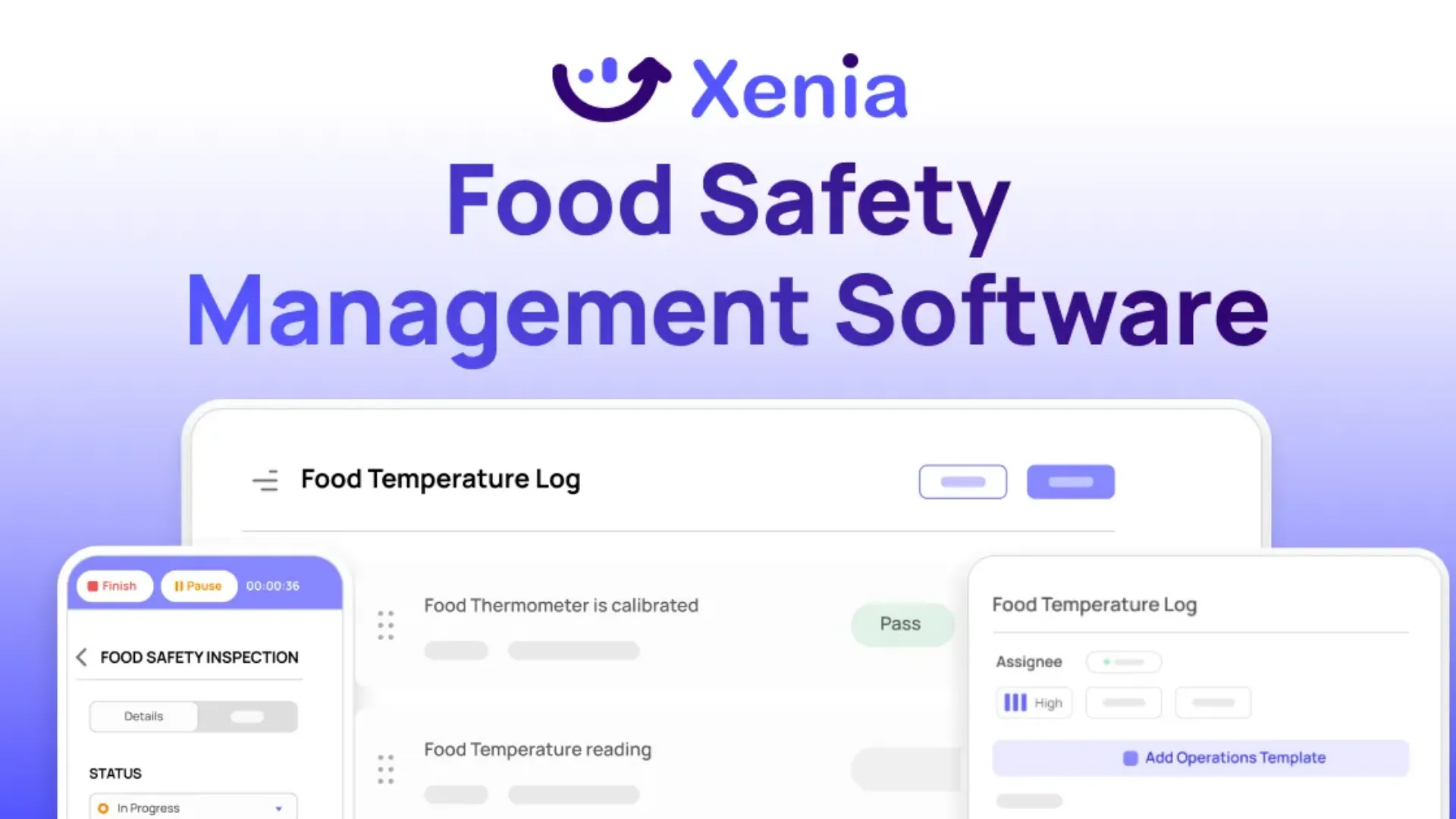
Xenia built a platform specifically for restaurant HACCP.
Bluetooth thermometers sync temps automatically. No writing. No errors. Everything timestamped.
Real-time alerts hit your phone when something goes wrong. Walk-in drops below 41°F? You know instantly.
Staff complete checklists on mobile devices during service. The system guides them through every step.
When violations happen, the system creates tasks automatically. Assigns them to the right manager. Tracks completion.
District managers see all locations on one dashboard. Spot problems before they become violations.
Health inspector shows up? Generate your complete HACCP report in 30 seconds.
Operators using Xenia cut documentation time in half. Schedule a demo to see it in action.
Conclusion
You know how to write a HACCP plan for a restaurant now.
Pick your high-risk menu items. Follow the steps. Train your team. Start monitoring.
Digital makes it easier. Less paperwork. Better compliance. Xenia gives you everything you need. One platform for all your HACCP.
Start free trial or get a demo.
Your customers deserve safe food. Your business deserves protection. Do it right.
Frequently Asked Questions
Got a question? Find our FAQs here. If your question hasn't been answered here, contact us.
What if I don't have a HACCP plan?

Health violations. Inspection failures. Fines from $500 to $5,000.
Temporary closure is losing thousands daily. Permanent license revocation for repeated violations.
Lawsuits when customers get sick. Settlements run $50,000 to $500,000.
One outbreak costs $75,000 in direct costs plus $2 million in reputation damage.
Where can I find a sample HACCP plan for restaurant use?
Scroll up to the "Sample HACCP Plan for Restaurant" section in this guide. You'll see a complete plan for grilled chicken. Every component filled out.
Copy that format for your menu items.
What are the most common CCPs in a restaurant HACCP plan?
Cooking. Heat kills bacteria.
Cooling. Prevents bacterial growth.
Cold holding. Keeps food too cold for bacteria.
Hot holding. Keeps food too hot for bacteria.
Most restaurants have 3 to 7 CCPs total.
Can I use a HACCP plan template for restaurant operations?
Yes. Start with a template. But customize it. Generic templates fail inspections. Your restaurant is unique. Your menu is different. Your equipment is different.
Xenia offers customizable templates built for restaurants.
What records do I keep for my HACCP plan for restaurant compliance?
Temperature logs for 6 to 12 months. Corrective action records for 6 to 12 months. Calibration records for a year. Training docs for employment duration plus one year.
Label everything clearly by month. Find any log in 30 seconds when inspectors ask.
How often should I update my HACCP plan?
Review every quarter minimum. Update immediately when you change your menu, equipment, or processes. Also update after any food safety incident.
What's the difference between a HACCP plan and a food safety plan?
HACCP focuses on critical control points. Where you can prevent, eliminate, or reduce hazards.
A food safety plan is bigger. It includes HACCP plus cleaning schedules, employee health policies, and allergen protocols. HACCP is one piece of your complete food safety system.

A Modern, AI-Powered Platform Built for Restaurant Operations
Xenia brings kitchen operations, food safety, audits, and team communication into one mobile-first platform. Restaurant teams execute daily work consistently, maintain compliance, and resolve issues faster, while leadership gets real-time visibility across all locations.
.webp)
Why Restaurant Operators Choose Xenia:
🤖 AI-Powered Operations, Convert paper logs instantly and verify food presentation and kitchen cleanliness automatically. Get instant answers about food safety trends without building reports.
🍽️ Food Safety & Compliance, Track line checks and temperature logs with automated alerts. Trigger corrective actions when readings exceed safe ranges. Maintain audit-ready records for health inspections.
📊 Multi-Location Control, Monitor food safety compliance and task completion across regions. Benchmark locations to identify training needs. Export reports for operational reviews.
One platform for kitchen operations, food safety, and compliance across all locations.

.svg)
.webp)
%201%20(1).webp)

.svg)
%201%20(2).webp)