

.webp)
Post Summary
You heard "9/80 schedule" in a job interview and nodded along. Now you are Googling it at home.
Or you are an HR manager trying to decide whether a compressed schedule is worth rolling out before the next all-hands meeting.
Either way, you need the same thing: a plain-English explanation of how this schedule works, what it actually costs your organization, and whether it makes sense for your team.
This article answers three questions in order. What a 9/80 schedule is and how the math works. Whether it creates overtime exposure and how to avoid it. And whether it is actually a realistic option for your workforce, which depends almost entirely on whether you are talking about salaried office staff or frontline hourly workers. Most articles skip that last part. This one does not.
For a broader overview of schedule types, see the guide to types of work shifts.
.webp)
.svg)

Priced on per user or per location basis
Available on iOS, Android and Web


What is a 9/80 work schedule?
A 9/80 schedule is a compressed work arrangement where employees work 80 hours over nine days instead of ten, and get one Friday off every two weeks.
The name is literally the structure. Nine days of work. Eighty hours total.
That is it. Everything else is just the mechanics.
The basic structure
Over a two-week pay period, employees work eight 9-hour days and one 8-hour day. The 8-hour day falls on the Friday before the alternating Friday off. That placement is not random. It is what keeps the overtime math clean, which we cover in the next section.
Here is what the two-week cycle looks like:
**
Week, Days worked, Hours per day, Weekly total
Week 1, Monday to Friday, 9 / 9 / 9 / 9 / 8, 44 hours
Week 2, Monday to Thursday, 9 / 9 / 9 / 9, 36 hours
Two-week total, 9 days, - , 80 hours
**
How the alternating Friday off works
The schedule rotates every two weeks. One week the employee works five days. The next week they work four and get Friday off.
Some companies give the entire team the same Friday off. Others stagger it, half the team off one Friday, the other half off the next, to keep coverage across both weeks. Both approaches work but they create different scheduling complexity. More on that in the challenges section.
Does a 9/80 schedule count as overtime?
This is the question most people come here to answer. The short version: under federal law, no, if you structure it correctly. Under some state laws, potentially yes, and on every 9-hour day.
Why the workweek definition matters
Under the federal Fair Labor Standards Act, overtime is calculated on a seven-day workweek basis, not a pay period basis. Most employers miss this detail and it is where the liability hides.
A 9/80 produces 44 hours in Week 1 and 36 hours in Week 2. If the workweek is defined incorrectly, Week 1 generates 4 hours of overtime every other cycle. That adds up fast across a large team.
The fix is straightforward. Define the FLSA workweek to start at the midpoint of the 8-hour Friday, typically Saturday. This splits that Friday's 8 hours evenly: 4 hours close out Workweek 1 and 4 hours open Workweek 2. Each workweek then contains exactly 40 hours. No overtime.
This is also why the 8-hour Friday is structurally non-negotiable. Change it to 9 hours and the boundary math breaks regardless of how you define the workweek.
For a full breakdown of federal and state overtime requirements, see overtime rules.
The state law exception
California is the biggest issue here. Several states require overtime for any hours worked beyond 8 in a single day, regardless of the weekly total.
In California, a 9-hour shift triggers 1 hour of daily overtime. Every day. Every cycle. For an employer with California locations, a 9/80 schedule is not a zero-cost benefit. It is a recurring labor cost built permanently into the schedule.
Multi-state employers need to assess this by location before rolling anything out. What is compliant and cost-neutral in Texas may be expensive in California.
How to structure the workweek to avoid federal overtime
Three things must happen before the schedule launches:
- Define the FLSA workweek to start on Saturday (or whichever day splits the 8-hour Friday into two equal 4-hour halves)
- Document that definition in writing before the schedule goes live
- Verify it is reflected correctly in your payroll system
An employer who skips these steps may be generating overtime liability every other week without knowing it. That is not a small error, it is a recurring payroll problem that compounds quietly.
The 9/80 schedule in practice: a two-week example
Here is how it looks for a real employee, call them Jordan, working at a corporate office.
Week 1 (FLSA workweek boundary starts Saturday):
**
Day, Hours worked, Running weekly total
Monday, 9 hours, 9
Tuesday, 9 hours, 18
Wednesday, 9 hours, 27
Thursday, 9 hours, 36
Friday, 8 hours, 44 (but only 40 in this workweek)
**
The FLSA workweek starts Saturday. So the first 4 hours of Friday close out Workweek 1 at exactly 40 hours. The second 4 hours open Workweek 2.
Week 2:
**
Day, Hours worked, Running weekly total
Monday, 9 hours, 13 (4 from Friday + 9)
Tuesday, 9 hours, 22
Wednesday, 9 hours, 31
Thursday, 9 hours, 40
Friday, Off, 40
**
Workweek 2 total: exactly 40 hours. Jordan gets Friday off with full pay. No overtime triggered.
This is why the 8-hour Friday is the structural anchor of the whole schedule. Remove it or change it to 9 hours and the compliance math falls apart.
Benefits of a 9/80 work schedule
Let me be direct here. The 9/80 has real benefits but they are not magic. They are specific and they apply to specific people.
A real three-day weekend every other week
The alternating Friday off is a full paid day. Not a half-day. Not a use-it-or-lose-it perk that disappears if you do not take it. A fully paid, completely free Friday every other week.
For employees who value predictable time off, this is meaningful. It is also a recruitment differentiator that does not cost the company a single extra dollar in payroll.
Fewer interruptions on the off Friday
For roles that involve strategic thinking, deep work, or reporting, a full Friday off every other week creates a natural uninterrupted window. For area managers and district managers at multi-unit organizations, it can serve as time for planning or site visits without the normal cadence of calls and messages.
This benefit is real for knowledge workers. It is essentially irrelevant for frontline staff who are scheduled by shift requirements rather than personal workflow.
Fewer commuting trips across the year
A 9/80 employee makes roughly 26 fewer commuting round trips per year than a standard 5-day employee. For someone with a long commute, that is genuine time and money back. For someone who works remotely, this benefit simply does not apply.
A retention lever that costs nothing extra
From an employer perspective, the 9/80 delivers a meaningful schedule benefit without increasing total paid hours. When structured correctly, it is a zero-cost benefit that gives employees something concrete to value. That is rare. Most retention levers cost money. This one does not.
Challenges and limitations of a 9/80 schedule
Here is where most articles get too optimistic. The 9/80 has real limitations and skipping them does not make them go away.
Coverage gaps on alternating Fridays
If the entire team takes the same Friday off, there is no coverage that day. Full stop.
Staggering the schedule, half the team off on opposite Fridays, solves the coverage problem but removes the social benefit of everyone being off together. It also adds scheduling complexity that needs to be managed every cycle. There is no perfect answer here. It is a genuine tradeoff.
Daily overtime exposure in California and similar states
As covered above, 9-hour days trigger daily overtime in California regardless of the weekly total. For multi-state employers, this creates a real cost inconsistency between markets. A policy that is neutral in most states may generate significant overtime expense in California locations.
This is not a corner case. It is a structural issue that must be assessed before the schedule launches.
Longer days increase fatigue risk in physical roles
For knowledge work, the difference between 8 and 9 hours is manageable. For physically demanding roles, kitchen work, retail floor, warehouse operations, that extra hour compounds fatigue. Accuracy and compliance tend to drop late in long shifts. This is not hypothetical. It is a real operational risk in environments where mistakes matter.
Client-facing coverage gaps need explicit management
In service businesses where clients or customers expect consistent Monday-to-Friday availability, an alternating Friday off creates a gap that must be explicitly addressed. Staggering solves it but requires clear communication protocols about who is available on which Friday.
9/80 schedule: benefits vs challenges at a glance:
**
Factor, Benefit, Challenge
Employee time off, Full paid Friday off every other week, Coverage gap if not staggered
Labor cost, No additional payroll cost when structured correctly, Daily overtime in CA and similar states
Fatigue, Manageable for knowledge work, Higher risk in physical frontline roles
Retention, Meaningful differentiator in hiring, Complex to administer across multiple sites
Coverage, Staggered schedules maintain coverage, Adds scheduling coordination every cycle
**
Is a 9/80 schedule right for your team? Frontline hourly vs corporate salaried
This is the question that matters most and most articles do not answer it honestly.
The 9/80 is not universally appropriate. It works well for some workforces and poorly for others. Here is a direct framework.
Where a 9/80 schedule works well
Corporate and office environments with salaried exempt employees doing knowledge work. Roles where output matters more than hours on site. Professional services, engineering, marketing, administrative functions, and management roles where the employee controls their own time within the 9-hour window.
It also works for back-office operations teams at multi-unit companies, corporate support staff, regional coordinators, HR, finance, even when the frontline staff at the same company are on a completely different schedule.
Field service roles where route planning can absorb a longer day are also a reasonable fit, depending on the territory.
Where a 9/80 schedule does not work well
Hourly non-exempt employees in California and similar states, the daily overtime cost makes it financially unattractive every single cycle, not occasionally.
Physical frontline roles in kitchens, retail floors, and warehouses, the 9-hour shift increases fatigue and compliance risk in environments where execution accuracy matters most.
Customer-facing roles with fixed business hours where coverage requirements cannot absorb an alternating Friday without staggering and where the staggering complexity outweighs the benefit.
The multi-unit operations nuance
For operators in restaurants, retail, convenience, and hospitality, the 9/80 is typically not a fit for frontline hourly staff. The daily overtime risk and physical fatigue concern both apply.
It may be a fit for area managers, district managers, and corporate support staff who are salaried exempt and doing knowledge work. These are two different workforce tiers that need two different scheduling systems.
Applying a single schedule structure across both tiers is the mistake operators make. Frontline staff need shift-based scheduling built around coverage requirements and labor cost management. Corporate and management staff need something different entirely.
Managing HR workflows separately for each tier is not optional at scale. It is the structure that makes both schedules work without creating compliance exposure on either side.
Suitability by workforce type:
**
Workforce type, 9/80 suitable?, Why
Salaried exempt office employees, Yes, Knowledge work-flexible 9-hour window
Corporate or back-office at multi-unit operator, Yes, Same profile as above
Hourly non-exempt in standard FLSA states, Possible, No daily overtime but fatigue risk in physical roles
Hourly non-exempt in California, No, Daily overtime every 9-hour shift
Frontline kitchen-retail or warehouse staff, No, Fatigue and compliance risk
Field service roles, Possibly, Depends on route and territory flexibility
**
How to implement a 9/80 schedule
Step 1: define the FLSA workweek correctly before launching
Set the workweek start to split the 8-hour Friday into two equal halves, typically Saturday. Document this in writing before the schedule launches.
This is the non-negotiable structural step. Get it wrong and you are generating overtime liability from day one, every other week, silently.
Step 2: verify state law requirements for every affected location
California, Alaska, Nevada, and other states with daily overtime requirements each need individual assessment. Multi-state employers may need to offer different schedule structures by state. Check current requirements at the time of implementation, these rules change.
Step 3: decide on staggered vs unified Fridays off
Staggered maintains coverage but reduces the social benefit. Unified maximizes the employee benefit but requires coverage planning for alternating Fridays. Make this decision based on business need before communicating to employees. Reversing it after announcement creates confusion and erodes trust in the policy.
Step 4: communicate the schedule in writing with a specific example
Employees need to know exactly which Fridays they have off, what their daily hours are, and how the two-week rotation works. A simple two-week calendar example in the launch communication prevents most of the confusion before it starts.
Step 5: monitor labor cost and compliance in the first 90 days
Track actual hours against expected hours per workweek. If any employee is consistently hitting more than 40 hours in either workweek, the schedule structure needs adjustment. Use HR workflows to set automated alerts for hours thresholds so deviations surface before the end of a pay period, not after.
Implementation checklist:
**
Step, What to do, Why it matters
1, Define FLSA workweek start date in writing, Prevents overtime liability from day one
2, Verify state law by location, California and similar states require separate assessment
3, Staggered vs unified decision made before launch, Affects coverage-employee experience and scheduling complexity
4, Written communication with two-week calendar example, Prevents employee confusion before it starts
5, 90-day labor cost monitoring with automated alerts, Catches structural errors before they compound
**
Related resources
- Types of Work Shifts
- Overtime Laws Explained
- 4x10 Work Schedule Guide
- Workforce Scheduling Guide
- Predictive Scheduling Laws
- HR Workflows
Conclusion
The 9/80 schedule has one compliance detail that catches employers off guard: the workweek definition.
Get it right and it is a zero-cost benefit that genuinely improves retention among salaried knowledge workers. Get it wrong and it generates overtime every other week quietly and indefinitely.
For frontline hourly teams in physical roles or daily-overtime states, it is the wrong tool. For corporate and management staff at multi-unit organizations, it is worth a serious look.
The starting point is knowing which workforce you are designing for. A schedule that works for your district managers may create daily overtime exposure for your store teams. Those are two different problems and they need two different solutions.
See how Xenia works for managing workforce scheduling and HR workflows across multi-unit operations.
Frequently Asked Questions
Got a question? Find our FAQs here. If your question hasn't been answered here, contact us.
Can a company switch to a 9/80 without asking employees?

In most states, yes, with reasonable advance notice. But if the change affects overtime pay or existing employment agreements, documented consent may be needed. In cities and states with predictive scheduling laws, advance notice requirements also apply. Worth checking with HR counsel before announcing anything.
Is a 9/80 schedule good for hourly workers?
Usually not. In California and similar states, the 9-hour days generate daily overtime every shift, which raises labor costs significantly. In states without daily overtime rules it is technically possible, but long shifts in physical roles increase fatigue and that is a real risk.
What is the difference between a 9/80 and a 4/10 schedule?
A 9/80 gives you one Friday off every two weeks. A 4/10 gives you every Friday off by working four 10-hour days each week. The 4/10 is simpler and gives you more three-day weekends. The 9/80 days are shorter on average.
Does a 9/80 schedule create overtime?
Under federal law, no, as long as the employer defines the workweek correctly. If the workweek starts on Saturday, each week lands at exactly 40 hours. In California and a few other states, the 9-hour days trigger 1 hour of daily overtime every shift, so the answer there is yes.

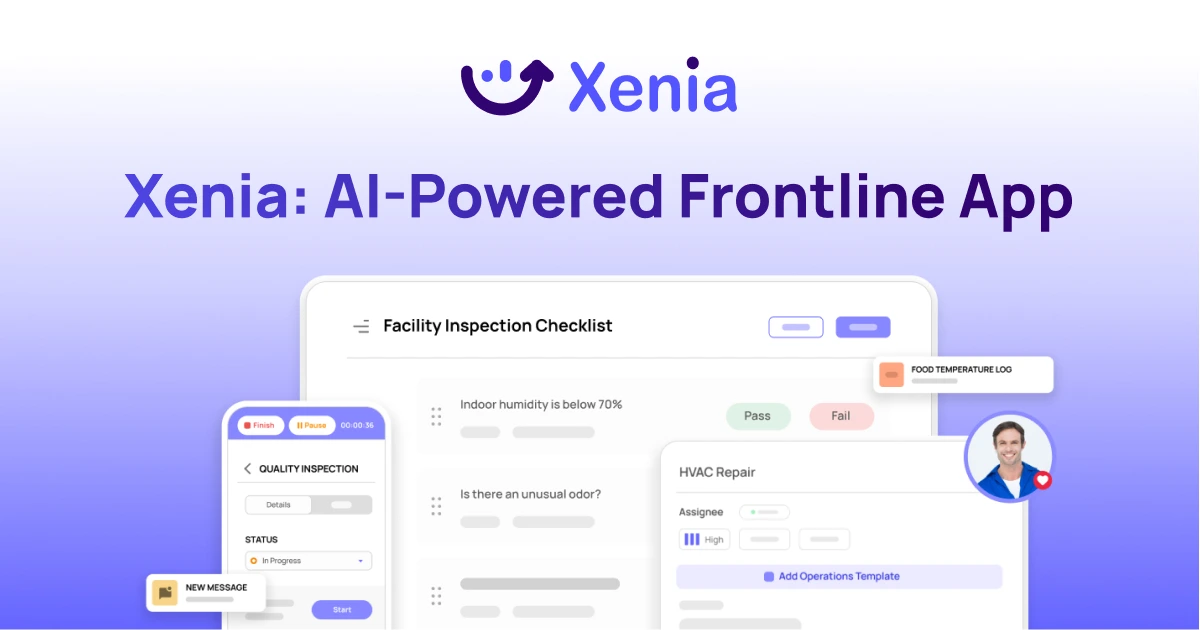
A Modern, AI-Powered Platform Built Specifically for Frontline Operations
Xenia brings daily operations, maintenance, audits, and compliance into one mobile-first platform. Frontline teams execute work consistently across locations while leadership gets real-time visibility.
Why Multi-Location Operators Choose Xenia:
🤖 AI-Powered Operations, Create digital checklists instantly or convert paper forms with AI. Verify compliance automatically with photo analysis and get instant answers from your operational data.
✅ Daily Operations & Maintenance, Assign work across hundreds of locations in minutes. Report and route issues instantly. Schedule preventive maintenance to catch problems before downtime.
📊 Real-Time Visibility, Track completion, work orders, and performance across all locations through dashboards. Filter by site or asset to spot trends and take action.
Manage operations, maintenance, and compliance across all your locations from one platform

.svg)
.webp)
%201%20(1).webp)

.svg)
%201%20(2).webp)