
Summary
What is a QSC audit?
A QSC audit is a structured operations inspection that scores a restaurant against the brand's own operating manual across Quality, Service, and Cleanliness.
The output is a weighted percentage (e.g., 87%), and the result feeds franchise compliance reviews, manager bonus plans, and expansion eligibility. The format originated at McDonald's under Ray Kroc in the 1950s as the operating motto every franchisee had to pledge to uphold.
The underlying problem the QSC framework solves is brand consistency at scale. A 200-unit franchise can't trust each store to interpret "good operations" on its own.
The QSC audit gives the brand a single rubric, repeated across every location, that a DM can run in 45 minutes and a corporate auditor can run in two hours. The scores tell the brand which units are on standard, which are drifting, and where the next operations problem is forming.
Where most operators get this wrong is treating the QSC score as a number rather than a process. An 87% audit score is meaningless if the failed items never generate a corrective action, never get assigned to a manager, and never get closed. The score is the input. The corrective action loop is the work. That distinction is what separates a QSC program that drives operations from one that just generates dashboards.
A useful sibling read on this point is why an 87 percent audit score doesn't mean what you think, which unpacks the weighted scoring math behind QSC totals. Read that next if your brand still treats every audit question as equally weighted.
Example walkthrough, QSC audit in action
A QSC audit in action looks like a 60-question structured walk through one location, scored in three weighted categories, with corrective actions firing automatically on failed line items. Here's how a typical QSR drive-thru audit runs in Xenia from setup to closeout.
Setup. The brand standards team builds one QSC template covering all 60 questions. Quality weighs 35%, Service 30%, Cleanliness 35%. Critical items, food safety violations, drive-thru speed below threshold, food temperatures out of FDA Food Code range (135°F hot hold, 41°F cold hold), get 10 points each. Cosmetic items, a smudged menu board, a misaligned label, get 1.
Trigger. The DM opens the audit on an iPad at Store #142. The template runs through each section. When the unit is a drive-thru-only format, the dine-in cleanliness questions hide automatically. When the unit has a patio, the patio cleanliness questions appear. This is conditional visibility working at the question level.
Conditional visibility lets you ask different questions at different locations without penalizing stores for N/A items. The same audit template handles 100+ format variations, units with drive-thrus see drive-thru questions, units with patios see patio questions, units with espresso bars see espresso bar questions. That's the wedge against legacy QSC tools, which run rigid templates and force operators to duplicate forms per format.
Branching. The DM marks the walk-in cooler at 44°F. The audit triggers a follow-up question, "What corrective action did you take?", and requires a photo of the unit and the thermometer reading. The line item fails because it crosses the FDA Food Code cold-hold threshold. A corrective action work order auto-generates, assigned to the kitchen manager, with a 24-hour deadline and DM escalation if not closed.
Outcome. The audit closes at 81%. The DM sees the weighted breakdown: Quality 78%, Service 86%, Cleanliness 79%. Three corrective actions are open. Two close that shift. One escalates to the regional manager the next morning. The audit score finally tracks what the brand actually cares about.
That walkthrough is the spine of modern QSC: structured questions, conditional logic, weighted scoring, and a corrective action loop that closes. For deeper coverage on the corrective action half of this loop, see corrective action tracking from audit failure to closed resolution.
How does a QSC audit differ from a food safety audit?
A QSC audit and a food safety audit measure different things. The QSC audit is brand-owned and weighted. The food safety audit is regulator-owned and pass/fail. Operators confuse them constantly, and that confusion costs them on both compliance and operations.
**
Dimension, QSC audit, Food safety audit
Owner, Brand or franchisor, Regulatory body or third-party certifier
Standard, Brand operating manual (proprietary), FDA Food Code-local health code-HACCP-FSSC 22000
Scope, Quality-service-cleanliness-hospitality-merchandising, Foodborne illness risk factors-sanitation-temperature-allergens
Output, Weighted percentage score tied to growth eligibility, Pass or fail-violation count-public health grade
Frequency, 4 to 12 plus times per year (brand-driven), 1 to 4 times per year (jurisdiction-driven)
Consequence of failure, Coaching-re-audit-franchise non-renewal, Closure-fines-public posting
**
The practical implication for multi-unit operators is that a location can pass a Department of Health inspection with zero critical violations and still fail its QSC audit at 72%. The two instruments measure different things and need different software workflows, weighting models, and corrective action paths.
Most QSC programs run on a 4 to 12 visit per year cadence, while food safety inspections are jurisdiction-driven. For a structured view on the right cadence by vertical and format, see how often you should audit each location by vertical.
The bigger structural change in QSC is McDonald's 2023 evolution to Operations PACE (Performance and Customer Excellence), which moved from a handful of field-consultant visits to between 6 and 10 corporate and third-party assessor visits per restaurant per year.
Mid-sized franchisees with 5 to 15 stores reported up to 100 inspector visits annually after layering in regulatory inspections. The intensity caused friction, Restaurant Business reported franchisees losing managers over the increased frequency, and McDonald's later softened the program by pausing Sunday inspections and exempting supply-chain-delayed equipment.
The signal for the rest of the QSR industry is clear: audits are getting more frequent, more third-party, and more tied to growth eligibility, not less.
.svg)

Priced on per user or per location basis
Available on iOS, Android and Web


How to set up a QSC audit in Xenia
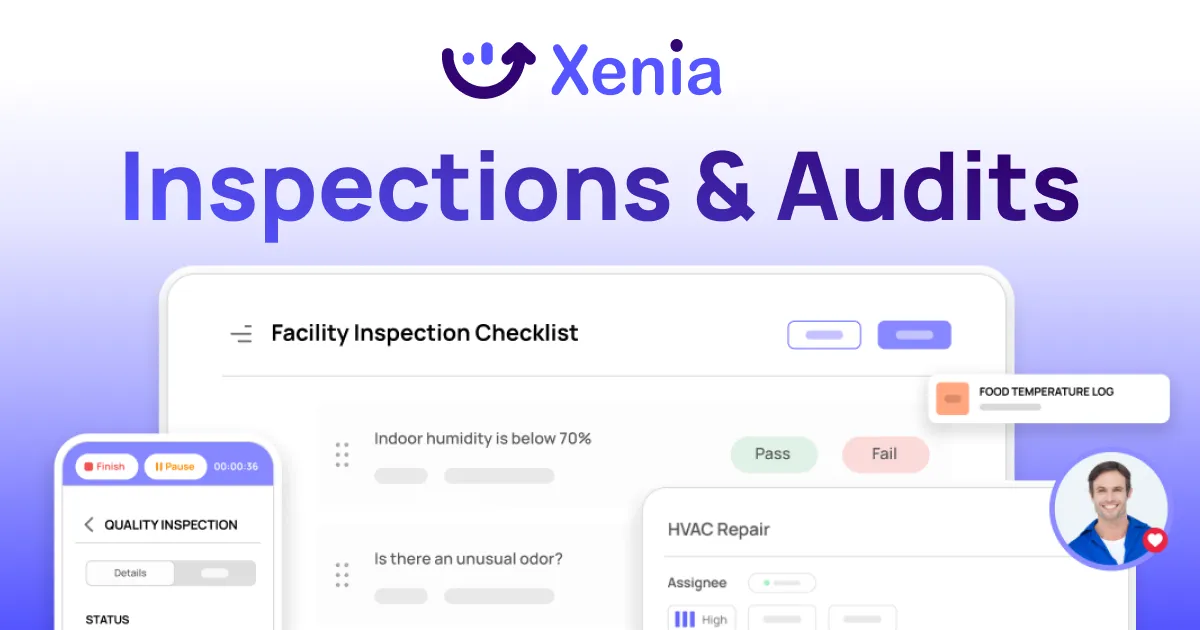
Setting up a QSC audit in Xenia takes about 30 minutes if you have your brand standards manual handy. The setup follows a five-step path from template build to live rollout.
- Open a new audit template and import your QSC structure. Drop in the three top-level sections: Quality, Service, Cleanliness. If you have an existing SOP PDF, the AI Template Agent converts it into a digital form with conditional logic and required fields in minutes. Franchise compliance teams have used this to convert 14 corporate SOPs in a weekend.
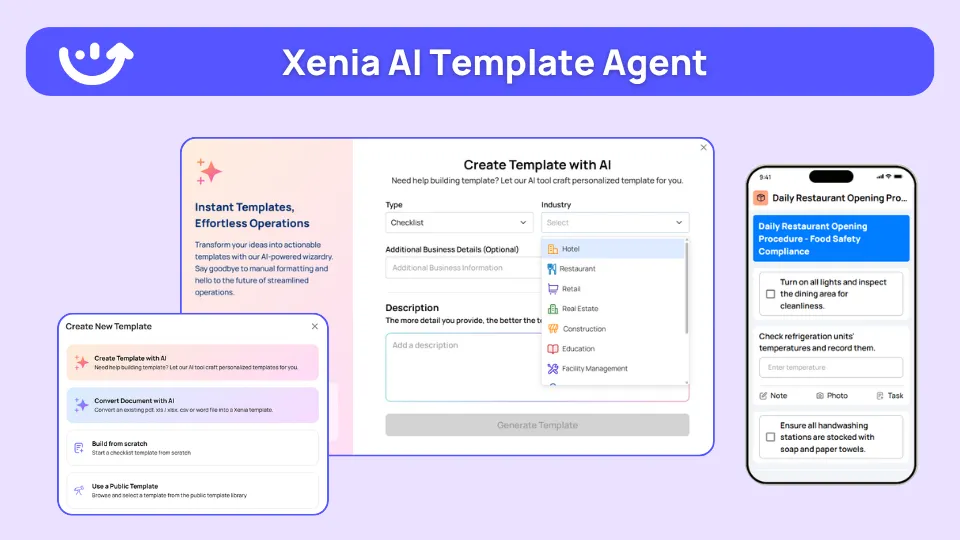
- Set the weights. Quality, Service, and Cleanliness percentages should add to 100. Inside each section, assign point values per question. Critical items get 10 points, important items 5, minor items 1. Pass and fail thresholds drive corrective action automatically.
- Enable conditional visibility per format. Tag each question with the format it applies to: drive-thru, patio, espresso bar, dine-in. Stores see only the questions that apply to their format. No more N/A penalties on missing equipment.
- Build the corrective action rules. For every critical item, define the auto-generated work order, the assignee role (kitchen manager, DM), the deadline (24 hours typical for food safety), and the escalation path. Failed audit line items auto-generate work orders, route to the assigned manager, and require acknowledgment before closeout.
- Pilot at 3 to 5 locations, then roll out. Run the audit at a small cohort first. Tighten weights and conditional logic based on what the pilot exposes. Then deploy the template across the rest of the chain.
A common pairing for QSC audits is mapping which questions need to be conditionally hidden per format. See conditional audits explained, one template for 100-plus store format variations for the design pattern. If your chain runs mixed formats, this is the read that prevents you from duplicating templates per banner.
Where do operators see results?
QSC programs drive measurable operational outcomes when the audit is paired with weighted scoring, conditional visibility, and a corrective action loop that closes. Without that loop, the audit is a dashboard. With it, the audit is a process.
This is the corrective action workflow advantage. Audit failure leads to an automatic corrective task, tracked to resolution, with escalation if not addressed by deadline. Most platforms collect audit data. Few drive it to closure. That loop is what turns an audit score into operational reality.
On the legacy-QSC side, Tacala Companies (a large Taco Bell franchisee) reported a 6% improvement in brand audit scores after deploying Zenput, per Crunchtime's Tacala case study. The lesson there is that even legacy-QSC tooling moves scores when operators commit to the cadence.
The peer-reviewed nuance on QSC scoring is worth flagging here. DiPietro, Parsa, and Cain's 2011 study in the International Journal of Contemporary Hospitality Management analyzed 18 months of QSC inspection data across 25 quick service restaurants and found the relationship between QSC scores and financial performance is weaker than vendors imply.
The authors recommended adding a Financial lens, "FQSC," and warned operators against tying QSC inspections directly to merit raises without that overlay. Operators who use QSC to drive operations (consistency, evidence, closure) get the value. Operators who use QSC to drive sales (deterministic ROI) get disappointed.
For audit programs that adapt to brand format variation across QSR, fast-casual, and convenience, the cross-cluster read is the patio vs no-patio audit problem and how conditional visibility solves it. For chains operating across the broader restaurant industry, see the audit and inspection programs hub and the audit management hub.
Frequently Asked Questions
Got a question? Find our FAQs here. If your question hasn't been answered here, contact us.
What does QSC stand for in restaurant audits?

Who originated the QSC framework?
How is a QSC audit scored?
Should QSC and food safety audits be combined?
How long does a QSC audit take in a QSR?
Can I customize the QSC categories per brand?


A Modern, AI-Powered Platform Built for Restaurant Operations
Xenia brings kitchen operations, food safety, audits, and team communication into one mobile-first platform. Restaurant teams execute daily work consistently, maintain compliance, and resolve issues faster, while leadership gets real-time visibility across all locations.
.webp)
Why Restaurant Operators Choose Xenia:
🤖 AI-Powered Operations, Convert paper logs instantly and verify food presentation and kitchen cleanliness automatically. Get instant answers about food safety trends without building reports.
🍽️ Food Safety & Compliance, Track line checks and temperature logs with automated alerts. Trigger corrective actions when readings exceed safe ranges. Maintain audit-ready records for health inspections.
📊 Multi-Location Control, Monitor food safety compliance and task completion across regions. Benchmark locations to identify training needs. Export reports for operational reviews.
One platform for kitchen operations, food safety, and compliance across all locations.

.svg)
.webp)
%201%20(1).webp)

.svg)
%201%20(2).webp)