

Post Summary
What Makes Front-of-House Training Different?
FOH training differs from BOH training because front-of-house staff are graded live by guests. They must learn service judgment, menu and allergen knowledge, and payment accuracy at the same time, not just a repeatable technique. In the back of house, consistency in technique and speed are the top priorities. Front-of-house staff juggle several jobs at once, in front of the people paying the check:
- Direct Customer Interaction: Handling different personalities, requests and complaints takes trained professionalism, built through constant practice.
- Fast-Paced Service: Servers, hosts and bartenders need to think on their feet and adapt quickly when a section gets double-sat or the kitchen goes down a station.
- Multiple Responsibilities at Once: FOH employees greet guests, take payments and watch table rotations, often in the same five minutes.
- Art of Anticipation: Great service meets the guest's need before they ask. Teach staff to refill water without cutting into conversation, bring bread without overdoing it, and check in at the right moments without hovering.
- Blending Technical and Soft Skills: It is not just running food or taking orders. FOH staff need communication, problem-solving and upselling skills that improve the guest experience.
- Emotional Intelligence: Teach staff to read guest cues. That includes spotting non-verbal signs of satisfaction or frustration, adjusting their style to the table, and handling difficult moments with empathy.
The side-by-side below shows where the two training tracks split. Role definitions follow the WebstaurantStore FOH vs BOH guide.
|  | Front of house (FOH) | Back of house (BOH) |
|---|---|---|
| Roles | Host, server, bartender, busser, food runner, FOH manager | Line cook, prep cook, dishwasher, kitchen manager |
| What "good" looks like | Guest-facing judgment, timing, accuracy | Consistent technique, speed, food safety |
| Training core | Steps of service, menu and allergens, POS and payments, alcohol service | Recipes, station setup, temps, HACCP, equipment |
| Main regulatory hooks | Allergen awareness (FDA Food Code), alcohol server certification (state) | Food Code temps, cooling, illness policy, sanitation |
| Proof of training | Sign-off checklist, policy acknowledgment | Line checks, temp logs, sign-off checklist |
The FOH core is the restaurant steps of service: greet, order, deliver, check back, pre-bus, present the check. Every other skill hangs off that sequence.


Priced on per user or per location basis
Available on iOS, Android and Web


Effective FOH Training Methods That Actually Work
The FOH training methods that work best are structured shadowing (show, shadow, solo), a vetted training buddy with per-shift objectives, short role-specific videos, and cross-training, each closed out with a manager sign-off. The five approaches below are the ones that hold up during a real dinner rush.

1. Peer-to-Peer Training (The Buddy System, But Smarter)
Many restaurants run a buddy system, but most never structure it. Pairing a new hire with whoever is on shift teaches them that person's shortcuts, not your standard.
Pick the trainer on purpose. A good training buddy delivers consistent service, knows your standards cold and actually wants to teach. Many operators pay a small training differential so the trainer does not resent the lost section.
Assigning a buddy is not enough. Each shift needs a written objective so both people know what "done" looks like. For a host, a Day 2 objective might read: "Greet and seat 10 tables using the standard greeting, and quote wait times from the waitlist." At the end of the shift, the trainer marks the objective complete or flags it to repeat. That one habit turns a vague buddy system into a training record you can review.
2. Shadowing (Observational Training with Purpose)
Shadowing is often wasted as passive watching. Effective restaurant front-of-house training makes it interactive and splits it into phases. The NYC SBS playbook calls this sequence show, shadow, solo, and it recommends at least 5-7 days of training for a new hire (NYC SBS Restaurant Training Playbook).
- Show: The trainee observes and takes notes on workflow, guest interactions and how the trainer solves problems.
- Shadow: The trainee takes light tasks under supervision, such as greeting guests, running food or resetting tables.
- Solo: The trainee handles full guest interactions while the trainer watches, before working the section alone.
The playbook also builds in daily feedback, a halfway check-in and an end-of-training wrap-up. Put those three touchpoints on the calendar before the trainee's first day, or they will get skipped when the dining room fills up.
3. Gamification (Making Training Competitive and Engaging)
Gamification is about memory and performance, not novelty. Many FOH employees find traditional training boring, and bored trainees forget what they heard.
Challenges, friendly competitions and real-world scenarios make front-of-house customer service training stick. Run a menu drill at pre-shift where the winner picks their section. Post a weekly leaderboard for upsell attach rate on the feature cocktail. Give a small reward for the cleanest allergen ticket flags of the week.
The scoreboard matters less than the follow-through. Track progress the boring way: checklist completion, trainer sign-offs and acknowledgment logs. Those records show a manager exactly where a trainee needs more coaching. When training feels like a challenge someone can win, staff engage more and remember more.
4. Team Building (Beyond Forced Social Activities)
Generic team-building exercises flop because they feel forced and have nothing to do with Friday night. Front-of-house training should build teamwork through the job itself.
Cross-training is the most useful version. Have servers work a host shift so they see why the host double-seats them. Have bussers shadow a server section before they move up. Have hosts run food for a shift so they learn table and position numbers. Bartenders who help on the floor during a slow lunch understand why tickets back up at the service well.
Each rotation builds respect for the other role and makes your schedule more flexible. It also creates a promotion path, which helps retention. For the host station specifically, see this guide to restaurant host training and what a host needs to master before working the stand alone.
5. Video Training (Short Clips at the Point of Need)
Video training in many FOH training guides is long, outdated and hard to follow. Nobody remembers a 40-minute orientation video.
Keep each video to one core concept: handling a complaint, suggesting an add-on, describing the new special. Keep it to five minutes or less. Then put it where the trainee needs it.
That last point is where most programs fall down. Xenia lets you embed training videos and reference documents directly into checklist steps for just-in-time guidance. A new server opening the sidework checklist sees the two-minute "how we pre-bus" clip on the exact step it explains. The video gets watched at the moment it is useful, not three days earlier in a break room.
 Short video SOPs embedded in checklist steps
Role-by-role FOH training timeline. Use this as a planning range. The 5-7 day server figure follows the NYC SBS playbook. Host and busser shift counts are a starting point you should set for your own concept.
| Role | Typical shadow and supervised shifts | Floor-ready sign-off covers | 30/60/90-day check |
|---|---|---|---|
| Host | 2-3 shifts | Greeting standard, waitlist and reservations, seating rotation, wait-time quotes | Peak-hour flow, complaint handoff |
| Busser or food runner | 2-3 shifts | Table reset standard, table and position numbers, allergen ticket flags | Pre-bussing, BOH handoff |
| Server | 5-7 days (show, shadow, solo) | Steps of service, menu and allergens, POS entry and splits, payments | Section size, check average, guest feedback |
| Bartender | 5-7 days plus state alcohol certification where required | Pour standards, recipes, ID checks, signs of intoxication | Inventory and comp accuracy |
The Critical Role FOH Plays in Restaurant Success
- Customer Satisfaction: Guests come back for the food and the service. A well-trained server can save an average meal.
- Revenue Generation: Trained FOH staff upsell, handle large parties and turn tables faster, which grows sales without growing costs.
- Brand Representation: Every guest interaction should match the brand's reputation, at every location.
- Team Cohesion: A strong FOH team communicates well with BOH, so fewer tickets get fired wrong and service runs smoothly.
Essential Components of an Effective FOH Training Program
Every FOH training program needs four components: written service standards, technical skills (POS, payments, reservations), menu and allergen knowledge, and operational procedures for opening, closing, safety and emergencies. Skip one and it shows up on the floor, usually as a comp.
1. Core Service Standards
Service standards define what great service means in your restaurant. Write them down. If they only live in the GM's head, every location runs a different version.
- Customer Interaction Protocols: How to greet guests, take orders and handle requests professionally, including the exact greeting and the time standard for first approach.
- Communication Guidelines: Teach FOH teams to speak clearly, read the table and talk with confidence.
- Problem Resolution Procedures: How to handle complaints, fix service mistakes and recover a bad experience, including who is allowed to comp what.
- Brand Voice and Values: Every restaurant has its own culture. Staff should understand the tone guests expect, whether that is fine-dining formal or neighborhood-bar casual.
Turn each standard into an observable behavior a trainer can check off. "Be friendly" is not trainable. "Greet within 60 seconds of seating, with eye contact and the house greeting" is. That is the difference between a standard and a slogan.
2. Technical Skills
Good service is not just friendliness. FOH staff need to be technically sharp too.
- POS System Operation: Ringing in orders, splitting checks, handling refunds and applying discounts. This guide to POS system training for restaurant staff covers the core skills.
- Table Management: Managing seating flow, waitlists and table turns.
- Payment Processing: Cash, credit card, gift card and mobile payments without errors.
- Reservation Systems: Managing online reservations and walk-ins without overbooking or leaving tables empty.
- Alcohol Service: ID checks, signs of intoxication and how to intervene. California requires on-premises servers and managers to be RBS-certified "within 60 days of their first date of employment," and certificates are valid for three years (California ABC Responsible Beverage Service Training). Other states run mandatory or voluntary server-training programs (NIAAA Alcohol Policy Information System). Check your state's rules.
Let new hires run practice transactions before they go live. When a POS change hits every store at once, treat it as a rollout, not a memo. Here is how to run a POS system training rollout across locations with acknowledgment tracking. Xenia's mobile app puts the step-by-step POS SOP on the trainee's phone, so the answer is there mid-shift. Xenia complements your POS. It does not replace one.
3. Menu Knowledge
FOH teams cannot sell what they do not understand. A deep knowledge of the menu covers:
- Item Descriptions and Ingredients: Servers should describe dishes confidently, especially to guests with dietary restrictions.
- Allergen Awareness: Staff must know which items contain nuts, gluten, dairy, sesame and the other major allergens. This is a regulatory duty, not a nice-to-have. The FDA Food Code makes the person in charge responsible for ensuring "employees are properly trained in food safety, including food allergy awareness as it pertains to their jobs" (FARE summary of the Food Code). Sesame became the ninth major allergen in the 2022 FDA Food Code. The 2026 Food Code, released September 17, 2026, adds allergen cross-contact clarification. California, Illinois, Massachusetts, Maryland, Michigan, Rhode Island and Virginia have their own restaurant allergen awareness or training rules. See this guide to allergy training for restaurants and how to run allergen control and cross-contact prevention between the floor and the line.
- Wine and Beverage Service: Basics of wine pairings, cocktail recipes and drink upsells.
- Upselling Techniques: Train employees to upsell specials and add-ons without being pushy.
Simplifying Menu Knowledge with Xenia
Menu knowledge drives guest satisfaction, server confidence and check size. It also changes constantly, with new specials, 86'd items and seasonal swaps. Xenia keeps the current version in one place:
- Study Dish Descriptions with Visual Aids: Build menu SOPs with embedded images and step-by-step details, so staff learn what each plate looks like and what is in it.
- Practice Upselling Scripts on Real Scenarios: Attach the suggested pairing or upgrade script to the menu SOP, and have the trainer run it with the trainee at pre-shift.
- Reinforce Allergen Awareness in Real Time: Staff scan a QR code to open the current allergen guide on their phone, so they answer the guest's question from today's menu, not last month's.
- Confirm It with a Sign-Off: The trainee completes the menu and allergen section of the training checklist. The trainer signs. The record is timestamped.
 Track who has opened the menu and allergen material
4. Operational Procedures
Beyond service, FOH staff must master daily restaurant operations to keep the shift running.
- Opening and Closing Duties: A standard sequence for setting stations and tables before and after service.
- Table Service Steps: The correct order for taking orders, serving food and clearing tables.
- Health and Safety Protocols: Hygiene standards, food handling and the serving-area hazards OSHA calls out: strains and sprains, slips, trips and falls, burns and scalds, workplace violence, and knives and cuts (OSHA Young Worker Safety in Restaurants eTool). The 2026 Food Code also adds a requirement for written employee illness policies that are maintained and available. Here is how to set up an employee health policy and illness reporting process.
- Emergency Procedures: What to do in a power outage, a medical incident or with a disruptive guest.
Perfecting Operational Procedures with Xenia's Digital Checklists
Xenia's digital training checklists give every FOH team member the same process for opening, closing and service steps, across shifts and locations. Paper checklists get lost, ignored or go out of date. A digital checklist gives you:
- Step-by-Step Guidance for Critical Tasks: Each shift starts with a checklist covering table setup, POS checks, menu updates and the pre-shift meeting.
- Live Progress Tracking and Accountability: Managers see which tasks are done and by whom, before doors open.
- Closing Procedures with Built-In Verification: Staff follow a shutdown checklist that covers sanitizing stations, securing cash, updating the reservation book and prepping for the next shift. Photo and signature response types capture the proof.
- On-Demand SOPs for Troubleshooting and Emergencies: A new hire stuck on a POS error or a health protocol opens the step-by-step guide instead of hunting down a manager.
- Standardization Across Multi-Location Operations: Restaurant groups and franchises run the same standard at every location. Already have SOPs in a binder? Upload the PDF or spreadsheet and Xenia converts it into a digital checklist.
The policy-change problem. Training a new hire is half the job. The other half is retraining the whole floor when something changes. A new allergen protocol rolls out on Monday. Store managers and servers acknowledge it and sign. By Friday, you can see exactly who has not. Xenia broadcasts the updated SOP to the FOH roles at every location, requires acknowledgment, and tracks it by person and location (Xenia Frontline Communication). That signed acknowledgment is your compliance evidence when a health inspector or a franchise auditor asks. Here is the full pattern for an allergen policy rollout with acknowledgment tracking.
Best Practices for Modern FOH Training Implementation
Modern FOH training works when onboarding has milestone sign-offs, lessons are short and on the phone, and every location trains from the same version of the same checklist. Here is how to make that happen without adding manager hours.
1. Structured Onboarding Process
Onboarding should not be rushed. New hires need a clear path with checkpoints, so nobody gets cut loose on a Friday before they are ready.
- Set milestones for each skill.
- Use competency checkpoints to confirm the trainee understands a skill before moving on.
A five-step sequence, based on the NYC SBS playbook:
- Before day one: Send the employee handbook, uniform standard and core SOPs. Capture a signed acknowledgment. This guide to new-hire SOP acknowledgment during onboarding shows how.
- Days 1-2 (show): Orientation, menu and allergen basics, POS practice. The trainer demonstrates each task.
- Days 3-4 (shadow): The trainee performs tasks while the trainer watches. Daily feedback at the end of each shift.
- Day 5 and beyond (solo): The trainee runs a section with trainer oversight. The manager completes the role sign-off checklist.
- 30, 60 and 90 days: Check-ins against the role evaluation, covering section size, check average and guest feedback.
2. Microlearning Approach
Nobody retains hours of training at once. Short lessons stick better.
- Keep training modules to 5-10 minutes, even for complex tasks.
- Use video demonstrations, menu drills and real-world scenarios.
- Make training mobile, so employees can review a lesson during downtime.
The best place for a short lesson is inside the checklist step it explains. When the trainee hits "set up the service well," the clip on how you set it up is right there. Retraining then happens at the point of need, not in a separate session nobody has time for.
Repetition matters too. A lesson seen once is forgotten in a week. Schedule recurring reminders on the topics that slip, such as allergen ticket flags, comp policy and closing sidework. This guide to training reminder broadcasts covers the cadence.
 Short, one-concept training content on the phone
3. Consistent Standards Across Locations
For multi-location restaurants, training must be uniform so guests get the same service everywhere.
- Use the same training materials at every location.
- Set clear performance metrics for FOH teams.
- Run service assessments on a regular schedule.
The practical version is one master training checklist and one SOP set, pushed to every location. When the standard changes, it changes everywhere at once. Location hierarchy keeps the view right for each seat. A franchise DM sees their units. Corporate sees every store. A GM sees their own location, without separate spreadsheets.
This is where paper breaks first. Store 3 is training from the 2024 binder. Store 7 printed the new version but never pulled the old one. Bacari Restaurants uses Xenia to standardize checklists and operations across its locations. For the full playbook, see how to manage training across multiple locations.
Creating an Effective FOH Training Checklist
An FOH training checklist lists every skill a new hire must show before working alone, grouped by pre-shift prep, guest service, safety and compliance, and role-specific tasks, with a trainer sign-off and date on each item. It keeps training consistent, accountable and quick, and it gives every trainer the same finish line.
Key Elements of an FOH Training Checklist
Build the checklist around the four groups below. Each line should be something a trainer can watch the trainee do, then sign. If a line cannot be observed, rewrite it until it can. Start from a ready-made server training checklist template (food and beverage knowledge, service etiquette, POS usage and customer service) or a hostess training checklist template, then adjust it to your menu and floor plan.
1. Pre-Shift Preparation
- Uniform and grooming standards
- Station setup and cleanliness
- Menu updates and daily specials
- POS system check
2. Customer Service Fundamentals
- Greeting guests and managing waitlists
- Communicating with guests and team members
- Handling special requests and dietary needs
- Upselling and suggestive selling
3. Safety and Compliance Requirements
- Food safety and allergen awareness, per the FDA Food Code and any state allergen rules
- Emergency response procedures
- Responsible alcohol service, including state server certification where required (for example, California's 60-day RBS rule)
- Illness reporting policy
- Handling complaints and guest incidents
4. Role-Specific Competencies
- Servers: Table service steps, large parties and course timing
- Bartenders: Cocktail knowledge, proper pours and responsible alcohol service
- Hosts: Reservation management, seating strategy and peak-hour flow
- Bussers and food runners: Table reset standard, table and position numbers, allergen-flagged plates
- FOH managers: Pre-shift huddle, comps and voids, closing sign-off
Sign-off and evidence. Close every checklist with the proof: trainer initials and date on each item, the trainee's acknowledgment of the handbook and key policies, and alcohol or allergen certification dates where your state requires them. Without this, the checklist is a to-do list. With it, it is a training record.
How Digital Checklists Improve FOH Training
Digital checklists improve FOH training because every task and sign-off is timestamped, assigned by role and shift, and updated at every location at once, so a manager can see who is trained, on what, and on which version of the SOP. Xenia's digital FOH checklists give you real-time tracking, instant updates and structured task completion for every shift.
|  | Paper binder or printed checklist | Digital checklist (Xenia) |
|---|---|---|
| SOP version | Whatever was last printed at that store | One version, updated everywhere |
| Proof of completion | Initials, if the page survives | Timestamp, person, photo, signature |
| Policy change rollout | Pinned to the board, hope it gets read | Broadcast with required acknowledgment, tracked by person and location |
| Missed steps | Found at the next DM walk | Alert to the manager while it can still be fixed |
| Multilingual teams | Separate printed copies | Bilingual checklists |
Capability sources: Xenia Checklists and SOPs and Xenia Frontline Communication.
1. Track FOH Training and Daily Tasks in Real Time
- Each checklist is assigned to specific employees by role and shift.
- Managers see live updates as tasks get done.
- A timestamped record shows every duty was completed on schedule.
2. Standardize Procedures Across All Locations
- Checklists sync across locations, so every restaurant runs the same service standard.
- Updates to procedures, like new specials or revised closing duties, reach every store at once.
- No more outdated printed checklists or confusion between teams.
 Manage training across all your locations
3. Provide Instant Access to Training and Troubleshooting Guides
FOH staff scan a QR code or open the checklist on their phone to reach:
- Opening and closing procedures, such as the restaurant opening checklist that sets up the shift
- Step-by-step guides for service tasks
- Troubleshooting for POS issues, reservations and guest complaints
New hires follow structured onboarding checklists, which closes training gaps.

4. Ensure Accountability with Completion Logs and Alerts
- Every completed checklist is timestamped and logged, showing who did what.
- Alerts tell managers about missed steps or incomplete tasks before they hit service.
- Digital records make health and safety inspections easier to prepare for.
There is a difference between "they opened it" and "they agreed to it." A read receipt shows a message was opened. An acknowledgment shows the employee confirmed they read and understood it. For training and policy changes, you want the second. Here is the breakdown of read receipts vs. acknowledgments, and how announcements with signature capture work. Keep the claim honest: acknowledgment timestamps and signatures are evidence of receipt. They are not legal proof of compliance with a specific regulation.

Common FOH Training Challenges and Solutions
The five most common FOH training problems are turnover, inconsistency between shifts, no time to train during service, language barriers, and staff forgetting what they learned. Each has a fix that does not need more manager hours.
1. High Turnover Impact
FOH positions turn over constantly, which creates an endless cycle of hiring, onboarding and retraining. The numbers are stark. Accommodation and food services quits averaged 4.2% in 2025, against 2.2% for all private industry (BLS JOLTS). Black Box Intelligence reported hourly turnover of 135% in limited-service and 96% in full-service restaurants in Q3 2024. Each hourly replacement costs about $2,305 (Black Box Intelligence).
- Reusable Onboarding Checklists and Acknowledged SOPs: Build the training path once and reuse it for every hire. Every new server starts on day one with the same standard and the same signed policies.
- Structured Progression Paths: People stay when they see a future. Lay out the path from server to shift lead to FOH manager, and tie training milestones to promotions.
- Culture-Driven Retention: Pay matters, but so do recognition programs, fair tip-sharing and flexible scheduling.
2. Consistency Across Shifts
The morning crew nails service and the night crew fumbles. Weekdays run smoothly and weekends fall apart. Guests notice, and they stop coming back.
- Front-of-House Training Checklist: Standard training materials set the same bar for every shift, no matter who is on duty.
- Cross-Training for Role Flexibility: Rotate staff across shifts so morning and night teams learn the same service flow.
- Pre-Shift Meetings and Recaps: Daily huddles reinforce standards, cover menu changes and fix what went wrong last shift. Send the huddle notes to every location with a shift huddle broadcast, so the closing crew gets the same message as the opening crew.
Gaps between shifts often start at the handoff. A documented restaurant shift change handover passes along 86'd items, open guest issues and unfinished sidework, so the next crew does not start blind.
3. Time Constraints for Training
Training feels impossible when the restaurant is slammed. Managers are juggling everything, and stopping to teach slows service down. The bench is thin, too. The National Restaurant Association reports that nearly three quarters of operators plan to hire in 2026 but expect difficulty finding experienced managers and chefs (NRA 2026 State of the Restaurant Industry).
- Microlearning and Shadowing: Use short, focused lessons instead of hours of training, and pair new hires with experienced staff for on-the-job learning.
- Dedicated Training Shifts: Train on slow shifts, not in the middle of the dinner rush when a new hire has no room to learn.
- Table-Side Coaching: Managers give real-time feedback, correcting mistakes and reinforcing good habits without stopping service.
4. Language Barriers in Training
A diverse FOH team is great for hospitality. It can also make training harder when English is not everyone's first language.
- Multilingual Training Materials: Use visuals, videos and translated guides in front-of-house customer service training. Xenia supports bilingual checklists (Xenia Checklists and SOPs), so a server can run the same opening checklist in English or Spanish. See how bilingual SOP acknowledgment works for policy changes.
- Buddy System: Pair new hires with bilingual team members who can bridge the gap.
- Simple, Universal Service Standards: Use non-verbal tools like color-coded charts, hand signals for table numbers and picture-based service steps.
Test understanding, not just attendance. Have the trainee show the step, not just nod at it.
5. Knowledge Retention Issues
A week after training, staff forget menu details, seating rules or how to handle a complaint. That is normal. Plan for it.
- Menu Drills and Quizzes: Reinforce menu knowledge and service procedures with quick, competitive drills at pre-shift. Offer small rewards for top scores.
- Interactive FOH Training Guides: Replace the binder with digital front-of-house training checklists that staff can open on their phones.
- Ongoing Refresher Training: Skip the one-and-done approach. Hold short monthly sessions on core service standards.
- Re-Acknowledge on Change: When the menu or a policy changes, push it out and require acknowledgment again. Last quarter's sign-off does not cover this quarter's allergen protocol.
Final Thoughts
Training is finished when you can prove it: every FOH hire signed off on every station, and every policy change acknowledged at every location. A good FOH training program does not stop at onboarding. It is ongoing reinforcement, with clear steps and steady tracking.
Well-trained FOH staff deliver consistent service, and guests feel it. Digital checklists make sure critical service steps do not get skipped, which cuts errors and keeps operations tight. Tracking training progress in real time shows managers where the knowledge gaps are, so they can adjust training before a guest finds the gap.
If you want to tighten FOH training this month, start with three moves:
- Write the role sign-off checklist for servers, hosts, bussers and bartenders, with a trainer signature and date on every line.
- Put your server timeline on the calendar: 5-7 days of show, shadow, solo, plus 30, 60 and 90-day check-ins.
- Pick the next policy change, likely allergens or comps, and roll it out with required acknowledgment instead of a note on the board.
A trained FOH team is the foundation for better service, better revenue and stronger morale. Xenia puts the pieces in one app: training checklists with sign-offs, SOPs with embedded video, and announcements with required acknowledgment, tracked by person and location. If your operation needs full course authoring and certification, pair it with one of the best LMS platforms for restaurants. Xenia covers the daily execution and the proof.
Ready to build your FOH training checklist and see who has actually signed off? Schedule a demo with Xenia today.
Frequently Asked Questions
Got a question? Find our FAQs here. If your question hasn't been answered here, contact us.
How do you keep FOH training consistent across multiple restaurant locations?

Do servers and bartenders need alcohol server certification?
Do front-of-house staff need allergen training?
What is the difference between FOH and BOH training?
What should a front-of-house training checklist include?
How long does front-of-house training take?

A Modern, AI-Powered Platform Built for Restaurant Operations
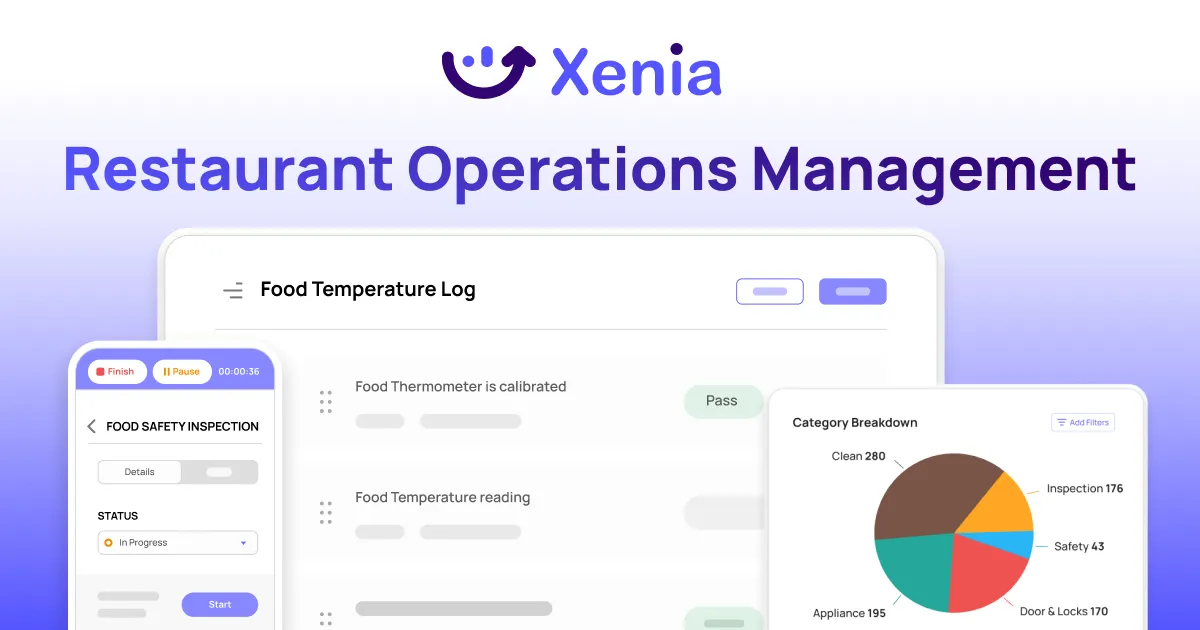
Xenia brings kitchen operations, food safety, audits, and team communication into one mobile-first platform. Restaurant teams execute daily work consistently, maintain compliance, and resolve issues faster, while leadership gets real-time visibility across all locations.
Why Restaurant Operators Choose Xenia:
🤖 AI-Powered Operations, Convert paper logs instantly and verify food presentation and kitchen cleanliness automatically. Get instant answers about food safety trends without building reports.
🍽️ Food Safety & Compliance, Track line checks and temperature logs with automated alerts. Trigger corrective actions when readings exceed safe ranges. Maintain audit-ready records for health inspections.
📊 Multi-Location Control, Monitor food safety compliance and task completion across regions. Benchmark locations to identify training needs. Export reports for operational reviews.
One platform for kitchen operations, food safety, and compliance across all locations.