

Summary
What is allergen control in a commercial kitchen?
Allergen control is the set of physical and procedural controls a kitchen runs every shift so an allergen ingredient never reaches a guest who reacts to it. It is execution, not paperwork. The clipboard allergen log nobody verifies until the inspector arrives is the exact failure mode this program is meant to solve.
The risk it manages is cross-contact. Cross-contact happens when protein from an allergen food transfers to a food that is supposed to be allergen-free, through shared equipment, surfaces, oil, or hands. It is distinct from cross-contamination, which usually means microbial transfer. Most kitchen teams say "cross-contamination" for both, so this guide uses both terms. Allergens are treated as a chemical hazard in food safety, which is why they belong in your hazard analysis, not just on a menu disclaimer.
Allergen control is most acute in restaurant and QSR kitchens. Line cooks share fryers across menu items, allergen orders land mid-rush, and a single borrowed cutting board can undo an entire prep protocol. It also lives in C-store food service with made-to-order programs, but it is not applicable to fuel-only formats with no kitchen. That difference matters later when you set up the audit.
Allergen control is not an allergen policy rollout. Rolling out an allergen policy is a one-time broadcast: corporate announces a new protocol, every manager acknowledges and signs, and the deliverable is "60 of 60 managers signed, with timestamps." That work lives on the allergen policy rollout and manager sign-off page. Allergen control is the recurring check that the policy is actually happening on the line. The deliverable here is "every allergen control check logged with photo proof, and a corrective action when a control drifts."
Regulatory framework
Federal law recognizes nine major food allergens: milk, eggs, fish, crustacean shellfish, tree nuts, peanuts, wheat, soybeans, and sesame. The FDA Food Code 2022 requires food establishments to disclose these allergens in writing for unpackaged food and to train food employees on allergen awareness. It does not set a specific standard for controlling cross-contact. That gap is the operator's to manage, and it is exactly why a recurring, audited control program matters.
Here is what the Food Code actually changed and what each piece requires:
The wedge for operators is the gap. The Food Code covers intended ingredients, disclosure, and training. It does not establish a specific regulatory requirement for managing or labeling cross-contact risk on the line. Regulation requires the disclosure and the training. The day-to-day prevention is on you.
For HACCP, allergens are a chemical hazard handled under HACCP Principle 1, Conduct a Hazard Analysis. The FDA HACCP principles and application guidelines call for analyzing each ingredient that contains an allergen and each process step where allergens are handled. Cross-contact controls are usually run as prerequisite programs, or as preventive controls in high-risk scenarios. The University of Florida IFAS guide to Principle 1 walks through the analysis. For the broader picture, see how this fits the regulatory frameworks behind food safety compliance.
**
Allergen requirement, FDA Food Code 2022 status, Who owns it day-to-day
Disclose 9 major allergens in unpackaged food-in writing, Required under Section 3-602.12(C), Operator (menu and signage)
Food-employee allergen-awareness training, Addressed under Section 2-103.11, Operator (training plus record)
Sesame recognized as 9th allergen, Effective Jan 1 2023 (Section 1-201.10(B)), Definitional-no action
Cross-contact prevention on the line, Not a specific Food Code standard, Operator (control program plus audit)
**
How does Xenia handle allergen control checks?
Xenia turns each allergen control into an audit line item a line cook completes on a tablet, with required photo proof at the moment of the check. When a control fails, the audit branches to a follow-up question, captures evidence, and auto-creates a corrective task with a deadline and an escalation path. The audit trail and the closure trail become the same record.
The workflow maps to a few core capabilities:
One sentence on the bridge to comms: the policy broadcast and manager sign-off live on the allergen policy rollout page, while the recurring control program lives here.
Where do the alternatives fall short? POS-side allergen tools like Lavu and Supy handle menu-side disclosure and ingredient tagging well. They cover what the guest sees and what is in the dish. They do not run the in-kitchen control audit: was the dedicated board used, was the glove changed, is the matrix current. SafetyCulture offers generic allergen inspection templates with photo evidence and corrective actions, which is real strength.
But it is a horizontal platform, not built for multi-unit franchise control with conditional visibility per store menu. Dave's Hot Chicken is the model for the machine an allergen program plugs into: 321 locations running weighted scoring and corrective action workflows after migrating from RizePoint.
.svg)

Priced on per user or per location basis
Available on iOS, Android and Web


The daily cross-contamination checks that catch drift
The daily allergen checks that catch drift verify five things on the line: separated prep surfaces, the dedicated color-coded utensils actually in use, a current allergen matrix the team can read, verified ingredient labels, and a glove change before every allergen order. Build each one as a check a kitchen manager can photograph and an auditor can verify.
- Separated prep zones and surfaces. Confirm allergen-free prep is happening in a dedicated zone or on a surface that was washed, rinsed, and sanitized. Cross-contact transfers through shared surfaces, oil, and equipment.
- Dedicated, color-coded utensils in use. The allergen kit (board, knife, tongs) is the dedicated set, stored separately. Purple is the common allergen convention, though FDA does not mandate a color code.
- Allergen matrix posted and current. The line can read which menu items carry which of the nine allergens, and the matrix matches the current menu. This is where a multi-unit chain drifts. A new LTO ships and the matrix does not get updated at every store.
- Ingredient labels verified. Supplier substitutions change allergen profiles. Verify the label on what is actually in the bin against what the matrix assumes.
- Glove change before an allergen order. Hands are a cross-contact vector. Change gloves, and often wash hands, before plating an allergen-aware order.
- Allergen-order sequencing and clean-down. Where possible, prep allergen-free orders first or after a full clean-down. Wash all surfaces and utensils in warm soapy water before allergen-free prep, per cross-contact prevention best practices and the complete cross-contamination prevention guide.
A control program is only as good as the day it stops being checked. The drift is silent. The matrix goes stale after an LTO. The dedicated board gets borrowed during a rush. The new hire skips the glove change. A daily audited check with photo proof surfaces the drift before a guest finds it.
Where do operators see results?
Operators see allergen control results in the dashboard, not as a completion percentage but as where the next failure is forming. The view shows which stores have a stale allergen matrix, which corrective actions are open past deadline, and which locations are trending toward a cross-contact gap.
The payoff shows up in a few places:
- Custom dashboards on issues. Dashboards surface what is coming up as a problem: open allergen corrective actions, stores trending toward failure, and which DM has the most flagged allergen items. The 50-location operator does not care as much about a completion percentage. They want to see what is coming up as an issue.
- Summaries. A one-paragraph briefing per store or region rolls up allergen control status and open corrective actions, so the DM gets the headline before opening the dashboard. It is descriptive, not predictive.
- Analytical Agent. Ask "which stores have the most open allergen corrective actions this month?" in plain language and get the list back with the underlying data view. No SQL, no BI license.
- Inspector-ready in one place. When the health inspector arrives, the written allergen disclosure (Section 3-602.12), the food-employee training record (Section 2-103.11), and the daily control logs with photo evidence are already in the system. No scramble. Xenia does not auto-file with health authorities. The trail is ready, and submission stays operator-driven.
The proof that this machine works comes from multi-unit kitchens already running it. Power Market cut task resolution time 40% across 360 C-store locations with bilingual checklists and QR deployment, which is the kind of rollout speed an allergen program needs. Mezeh saw a 60% reduction in manager phone calls once the line handled checks instead of the manager chasing them. Dave's Hot Chicken runs the same audit, weighted scoring, and corrective action machine across 321 locations. An allergen control program plugs straight into that for restaurant operators who need cross-contamination prevention to hold across every unit.
How to set up allergen control audits in Xenia
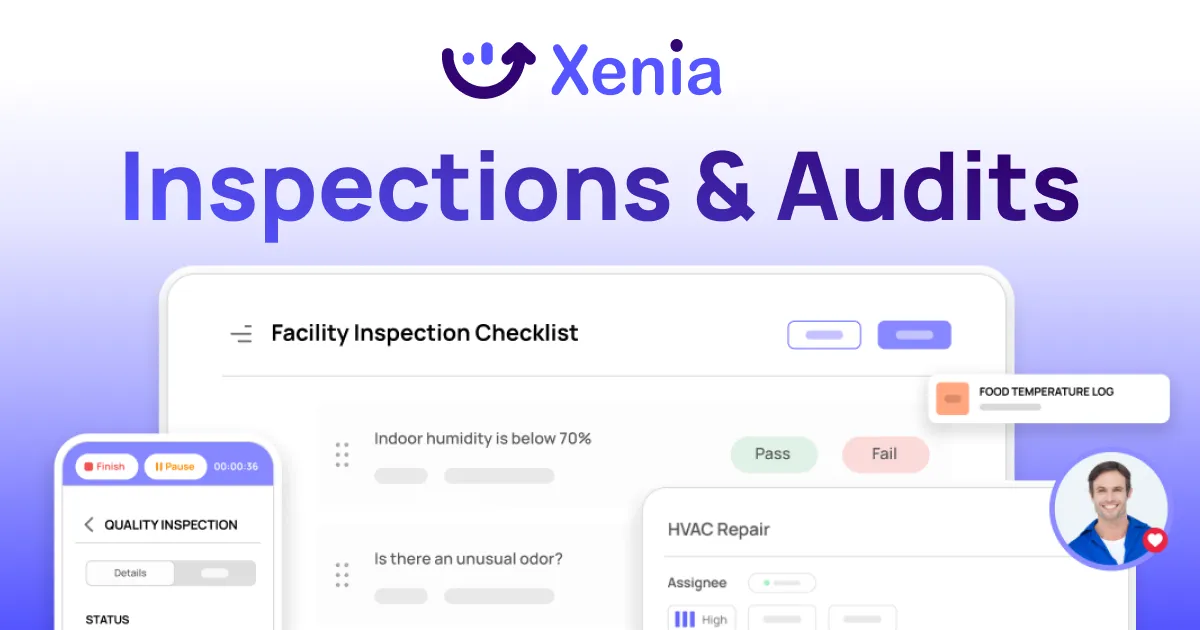
To set up allergen control audits in Xenia, build the daily check as an audit template, weight allergen items as critical, attach a required photo and follow-up question to each control, set the corrective action and escalation rule, and turn on conditional visibility so each store only sees the allergen checks its menu requires. Here is the build, step by step:
Conditional visibility is the standout here. Stores with different menus see different allergen checks, from one template, with no per-store duplication and no false-negative penalty for menus a store does not run. That is the gap SafetyCulture and POS allergen tools do not close at franchise depth. For the structural backbone, the HACCP checklist template shows how to anchor the whole thing to Principle 1.
Frequently Asked Questions
Got a question? Find our FAQs here. If your question hasn't been answered here, contact us.
What are the nine major allergens a kitchen has to control?

What does an allergen control check on the line actually verify?
How do you prevent allergen cross-contamination during prep?
What allergen records does a health inspector expect to see?
How is allergen control different from rolling out an allergen policy?
Can allergen checks vary by store when menus differ?


A Modern, AI-Powered Platform Built for Restaurant Operations
Xenia brings kitchen operations, food safety, audits, and team communication into one mobile-first platform. Restaurant teams execute daily work consistently, maintain compliance, and resolve issues faster, while leadership gets real-time visibility across all locations.
.webp)
Why Restaurant Operators Choose Xenia:
🤖 AI-Powered Operations, Convert paper logs instantly and verify food presentation and kitchen cleanliness automatically. Get instant answers about food safety trends without building reports.
🍽️ Food Safety & Compliance, Track line checks and temperature logs with automated alerts. Trigger corrective actions when readings exceed safe ranges. Maintain audit-ready records for health inspections.
📊 Multi-Location Control, Monitor food safety compliance and task completion across regions. Benchmark locations to identify training needs. Export reports for operational reviews.
One platform for kitchen operations, food safety, and compliance across all locations.

.svg)
.webp)
%201%20(1).webp)

.svg)
%201%20(2).webp)


