
Post Summary
Franchise systems have a software problem. It is not that there is no software to choose from. There is too much. You have tools for recruiting franchisees, tools for collecting royalties, tools for tracking brand standards, tools for scheduling, tools for reporting. Most franchise operators are stitching four or five of them together and hoping nobody notices the gaps.
Here is the thing nobody says clearly: "franchise management software" is not one thing. It is a category name that vendors have applied to at least three completely different software layers. When you go looking for the right platform, you are almost always solving one of those three problems, not all of them at once.
This guide maps the franchise software stack honestly. It shows you which layer does what, which platforms are best per layer, and how a multi-unit franchisee's needs differ from what a franchisor actually cares about. By the end, you will know exactly what to buy, what order to buy it in, and where the dangerous assumption is hiding.
.svg)

Priced on per user or per location basis
Available on iOS, Android and Web


Related Resources
If you are evaluating tools for multi-location franchise operations, these resources are worth reading alongside this guide:
Multi-unit operations execution covers how the execution layer works across a distributed franchise network.
Brand standards compliance explains how Xenia handles brand standard audits and corrective actions across franchise systems.
District and regional leader tools covers what district managers specifically get from an operations execution platform.
Multi-unit operations software is Xenia's core product page for multi-location operators.
Operations execution system guide explains the broader concept of operations execution and how it differs from operations management.
Scaling a restaurant group covers the operational challenges that come with growing a franchise network.
The 3 Layers of the Franchise Software Stack
Before you evaluate a single platform, you need to understand what problem it actually solves. Every tool in the franchise tech market fits into one of three layers.
Layer 1: Franchise CRM. This is the software that manages franchise leads and closes new franchisee agreements. It is a sales pipeline tool. It tracks prospects, manages disclosure timelines, and moves candidates from inquiry to signed FDD.
Layer 2: Franchise Management System (FMS). This handles the ongoing franchisor-franchisee relationship after someone signs. Royalty collection, territory management, compliance documentation, renewal workflows. It is the administrative backbone of the franchisor's business.
Layer 3: Franchise Operations and Analytics. This is what runs the actual stores. Daily task completion, brand standards audits, multi-location performance benchmarking, corrective actions, and frontline communication. It is the execution layer. This is where the guest experience is made or broken.
Most software conversations collapse these three layers into one. That is where bad buying decisions come from. A tool that is excellent at Layer 2 (royalty tracking) may be useless at Layer 3 (store-level accountability). Knowing which layer you need to fix is the starting point.
**
Layer, Function, Who Needs It Most
Layer 1: Franchise CRM, Lead-to-signed franchisee pipeline, Franchise Development teams
Layer 2: Franchise Management System, Royalty-FDD-territory-renewals, Franchisor operations/admin
Layer 3: Franchise Operations and Analytics, Store execution-brand standards-performance data, Multi-unit franchisees-District Managers-Ops Leaders
**
Layer 1: Franchise CRM (Best Platforms)
The franchise CRM is a development tool. It serves the franchisor's sales team, not the franchisee's store managers. If you are a multi-unit franchisee already running locations, you probably do not need this layer at all. You have already signed.
For franchisors building out their development pipeline, here are the platforms that run Layer 1.
FranConnect Sales is the default for enterprise-level franchise development. It integrates with the rest of the FranConnect suite, which matters if your franchisor is already on their system. Not cheap. Heavy implementation. Built for systems with large development pipelines.

Naranga runs a tighter mid-market CRM with solid workflows for lead nurturing and franchise agreement management. It is a reasonable choice for systems in the 50 to 300 unit range that do not want to pay FranConnect prices.
Salesforce with a franchise template makes sense when your HQ already runs Salesforce for the broader business. You are not buying a franchise-specific tool; you are extending an existing stack. The configurability is good. The implementation complexity is real.

HubSpot works well for smaller franchise systems, generally under 50 units, where the development team is small and the pipeline is manageable. The free tier gets you farther than you expect. It does not scale to enterprise development volumes.

Layer 2: Franchise Management Systems (Best Platforms)
This is the administrative layer. Royalties, compliance documents, franchisee communications, territory maps. The FMS keeps the franchisor-franchisee relationship organized and legally defensible.
FranConnect is the category leader at the enterprise level. It handles royalty calculations, performance benchmarks, document management, and renewal workflows in one system. If you are a large franchisor, this is probably already in your contract.
Naranga covers the mid-market at Layer 2 as well, with royalty tracking and franchisee portal features that work well for growing systems that have not yet justified FranConnect pricing.
ClientTether is worth looking at specifically for franchise development workflow management. It is not as broad as FranConnect, but for teams that want a tight workflow from lead to agreement to onboarding, it performs.

Profit Keeper fills the financial benchmarking gap. It aggregates financial data across franchise locations and lets franchisors benchmark unit economics system-wide. If you are trying to understand why some units outperform others financially, this is the tool.

Layer 3: Franchise Operations and Analytics (Best Platforms)
This is where the real work happens. Layer 3 is what your general managers, district managers, and frontline teams interact with every single day. It is also where most franchise software stacks have the biggest gap.
The franchisor cares about royalties and compliance paperwork. The franchisee cares about whether opening checklists are getting done, whether brand standards are being hit, and whether there is a way to see what is actually happening at each location without physically visiting every week.
Xenia is built specifically for franchise operations execution and brand standards compliance across units. For multi-unit franchisees and franchise systems that need real-time visibility into what is happening at the store level, Xenia covers the execution layer with a mobile-first platform designed for deskless frontline workers.
.webp)
What Xenia does in this layer: it gives franchise leadership and district managers real-time visibility into task completion, audit scores, and compliance across all franchise locations. Franchisees can run self-audits and share results with the franchisor.
Opening and closing checklists, food safety audits, and brand standards can be pushed to every location overnight using standardized SOPs and checklists. The platform supports multi-location hierarchy, so you can structure it as franchisor at the top, individual franchisee operators below, and individual locations underneath that.
The AI Photo Analysis feature is particularly relevant for franchise systems. It verifies compliance at franchise locations through photo submissions without requiring a physical district manager visit.
A store uploads a photo of a display, a food prep station, or a signage element, and the system analyzes it against the standard. That changes the economics of brand standard enforcement significantly.
You can also explore how Xenia's audits and inspections module handles weighted scoring and corrective actions across locations.
For a deeper look at how this plays out in restaurant franchise contexts, see the multi-brand QSR franchise operations guide.
**
Platform, Best For, What It Does Not Cover
Xenia, Franchise operations execution-brand standards-district manager visibility, Royalties-FDD-scheduling-payroll
Operandio, QSR franchise daily operations and food safety, Multi-brand franchise analytics
Tango Analytics, Franchise real estate and site performance analytics, Store-level daily operations
Geckoboard, Executive read-only KPI dashboards, Operations management of any kind
**
Operandio runs QSR franchise daily operations well, with task management and food safety features suited to high-volume quick service environments.
Tango Analytics covers franchise real estate analytics specifically. If your decisions involve understanding trade areas, site performance, or lease portfolios across a franchise network, Tango is the right tool. It does not cover store-level operations execution.
Geckoboard is useful for read-only franchise KPI dashboards at the executive level. You point it at your data sources, build the view, and distribute it. It does not manage operations; it surfaces numbers for people who need to see them.
For franchise systems already using brand standards audits, the brand compliance guide and the corrective action tracking page are also worth reading alongside this section.
How to Pick the Stack: A Decision Framework
Buying all three layers from the same vendor by default is a mistake. The vendors that cover all three tend to do one or two well and the rest adequately. Your job is to figure out which layer is actually broken and fix that one first.
Step 1: Do a size and complexity audit. How many locations are you running? How many brands? Is this a single-brand franchisee system or a multi-brand portfolio? The answer changes which platforms even apply to your situation.
Step 2: Check what your franchisor already provides. Many FMS tools are franchisor-mandated. FranConnect, for example, is often bundled into franchise agreements. If Layer 2 is already covered by the franchisor, your buying decision is purely about Layers 1 and 3.
Step 3: Pilot per layer. Do not buy a full stack in one shot. Identify your highest-pain layer, run a 60 to 90 day pilot with the best candidate for that layer, and get real user feedback from the people who will use it daily. Layer 3 tools that look good in a demo often fail when a 19-year-old shift supervisor has to use them at 6am.
Step 4: Roll out with franchisee training. This is where implementations break. The software does not fail. The adoption fails. Build the training plan before you buy, not after. Layer 3 tools specifically need to be usable by frontline workers with minimal tech familiarity. That is why mobile-first design matters so much in this layer.
What Multi-Unit Franchisees Actually Need (Versus What the Franchisor Needs)
This is the part most franchise software content ignores entirely. The franchisor and the franchisee have different problems. They often have different budgets. And they almost always need different tools.
The franchisor needs Layers 1 and 2. They need to sell franchises, collect royalties, manage compliance documentation, and enforce brand standards from above.
The multi-unit franchisee needs Layer 3. They need to run their stores, keep their general managers accountable, ensure their teams are executing properly, and benchmark their own units against each other. They need a manager and staff app that works on a phone, because their frontline workforce does not sit at desks.
Here is what a multi-unit franchisee software stack looks like in practice:
**
Stack Layer, What It Covers, Example Tools
Operations execution platform, SOPs-daily checklists-brand standards audits-corrective actions-district-level visibility, Xenia
Scheduling, Shift scheduling-availability management-time tracking, 7shifts (Xenia integrates-does not replace)
P&L and accounting, Unit economics-financial benchmarking, Restaurant365
POS system, Store-level transactions, Toast-Square
**
An operations execution platform covers SOPs and daily checklists, brand standards audits, corrective actions, and district-level visibility. This is the core of Layer 3. For restaurant and retail franchise operators, this is where the most operational value sits. You can also see how multi-location operations execution plays out across distributed franchise systems.
A separate scheduling tool handles shift scheduling, availability management, and time tracking. Xenia integrates with tools like 7shifts for this but does not replace them. Scheduling is a distinct problem from operations execution.
A separate P&L and accounting system handles unit economics. Restaurant365 covers this for restaurant operators. Xenia is not a financial management platform. If you are evaluating what Restaurant365 covers, the Restaurant365 alternatives guide is worth reading.
A POS system handles transactions at the store level. Toast, Square, and others run this layer. Xenia is not a POS and does not try to be.
The multi-unit franchisee mistake is buying an FMS that the franchisor uses and assuming it covers operations execution. It usually does not. FranConnect is excellent at Layer 2 and largely irrelevant to what a district manager needs at 8am on a Tuesday.
For franchise operators who want to go deeper on how frontline employee accountability works across multiple locations, and how frontline reporting gives district leaders the visibility they actually need, both are worth exploring alongside this section.
Conclusion
The franchise software category is confusing because the same label gets applied to tools that do completely different things. A royalty tracking system and an operations execution platform are not competing products. They solve different problems at different layers of the same franchise system.
If you are a multi-unit franchisee, the layer you need to fix is almost always Layer 3. That is where store execution holds together or falls apart.
Xenia is built for that layer. Brand standards audits, daily checklists, AI Photo Analysis, and real-time district visibility across every location, without requiring a physical visit. It sits alongside your FMS and scheduling tools rather than replacing them.
Book a demo to see how Xenia plugs into your franchise stack as the operations execution layer that keeps brand standards consistent across every unit.
Frequently Asked Questions
Got a question? Find our FAQs here. If your question hasn't been answered here, contact us.
What does franchise operations software actually need to do?

At minimum, it needs to let franchise locations execute standardized SOPs and checklists, give district managers real-time visibility into task and audit completion, surface corrective actions automatically when something fails, and work on a mobile phone because your frontline team does not sit at a desk. The best operations execution platforms also support multi-location hierarchy, AI-assisted auditing, and photo verification of brand standards.
How is franchise management software different from franchise CRM?
Franchise CRM manages the lead and sales process for recruiting new franchisees. Franchise management software (also called an FMS) manages the ongoing administrative relationship: royalty collection, territory management, renewal workflows, and compliance documentation. They solve different problems at different stages of the franchise lifecycle.
What is franchise CRM?
Franchise CRM is the software that manages the pipeline from franchise lead to signed franchisee agreement. It tracks prospective franchisees, manages FDD disclosure timelines, and handles the sales workflow of the franchise development team. It is a development tool, not an operations tool.


A Modern, AI-Powered Platform Built Specifically for Frontline Operations
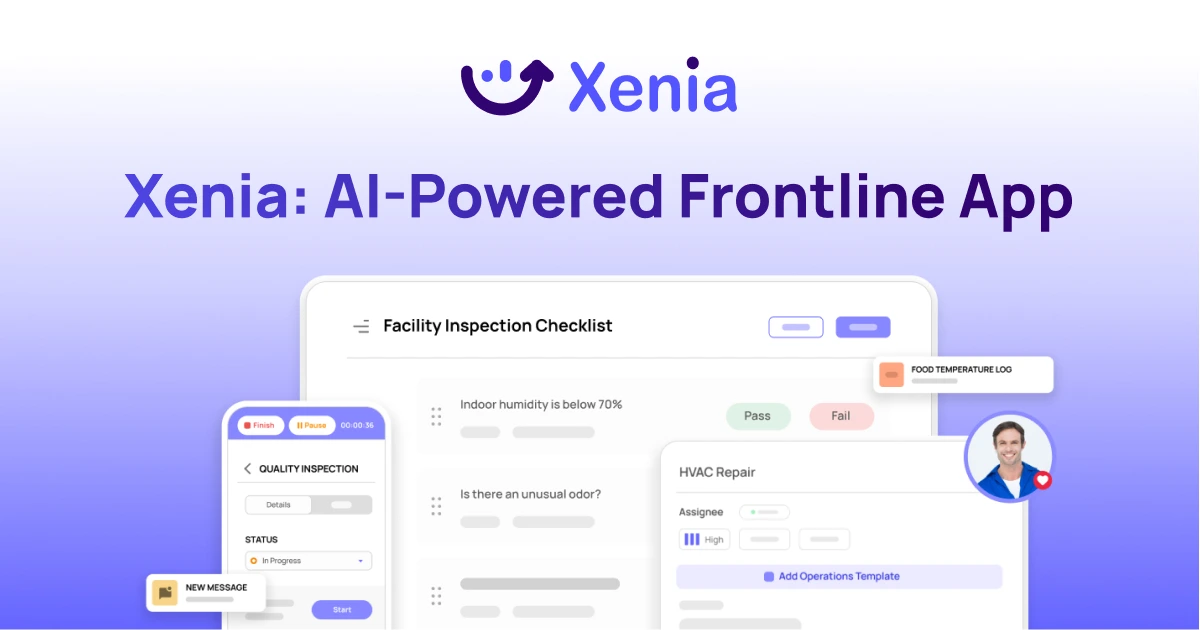
Xenia brings daily operations, maintenance, audits, and compliance into one mobile-first platform. Frontline teams execute work consistently across locations while leadership gets real-time visibility.
Why Multi-Location Operators Choose Xenia:
🤖 AI-Powered Operations, Create digital checklists instantly or convert paper forms with AI. Verify compliance automatically with photo analysis and get instant answers from your operational data.
✅ Daily Operations & Maintenance, Assign work across hundreds of locations in minutes. Report and route issues instantly. Schedule preventive maintenance to catch problems before downtime.
📊 Real-Time Visibility, Track completion, work orders, and performance across all locations through dashboards. Filter by site or asset to spot trends and take action.
Manage operations, maintenance, and compliance across all your locations from one platform

.svg)
.webp)
%201%20(1).webp)

.svg)
%201%20(2).webp)