

You opened your fifth location using the same approach that worked at your first. You walked the floor. You knew every shift leader by name. You could feel when something was off before anyone told you.
It worked.
Then you hit 15 locations. Standards started slipping at spots you hadn't visited in a few weeks. GMs made calls that contradicted brand standards. Opening checklists came back half-done. You couldn't quite name what was breaking, but something was.
Here's what was actually happening: the standardization approach you built for five locations was never designed for fifty. And what gets you to fifty will not survive five hundred.
This guide maps out exactly how multi-unit operations execution standardization needs to change at three critical scale thresholds. What fails at each stage. What to build before you hit the ceiling. And how to know when you've already outgrown your current approach.
.svg)

Priced on per user or per location basis
Available on iOS, Android and Web


What does it actually mean to standardize multi-unit operations execution?
Standardizing multi-unit operations execution means building the processes, assignments, and accountability mechanisms that make sure the same tasks get done to the same standard at every location.
It does not matter which GM is on duty, what staffing challenges a location is dealing with, or whether a district manager visited this week. The work gets done the same way, every time.
That is the difference between a brand standard that lives in a binder and one that actually gets enforced at the shift level, every day.
For multi-unit operators, this is not a documentation problem. It is a system problem.
Most operators already have a standard. They have a manual, a checklist, a training deck. What they do not have is a reliable way to make sure those standards are executed, verified, and corrected across every location without someone physically being there.
Related Resources
- Operations Execution System: What It Is and How to Build One
- Operations Execution vs Operations Management: What's the Difference
- Gemba Walk for Multi-Unit Operators
- Operations Execution Checklist: Daily, Weekly, Monthly Framework
- Operational Audit Guide
There are three layers every standardization system needs to hold together at scale:
**
Layer, What it means, Where operators most often fail
Format standardization, Everyone uses the same checklist-not their own version, Each location builds its own format over time
Task standardization, The same tasks are required at the same time at every location, GMs customize based on their own judgment
Verification standardization, Completion is confirmed the same way across every location, Self-reporting with no audit trail
**
All three must be in place. If even one is missing, standardization breaks down at scale.
A 120-page operations manual is not a standardized execution system. The manual describes the standard. The execution system enforces it. The gap between those two things is where most multi-unit brands lose consistency.
One operations manager at a 36-store chain put it plainly: "I had all of them send me their checklist because everybody has a checklist and they all said the same thing, but none of them are the same format."
That is the execution gap. And it compounds at every location you add.
How do you standardize operations at 5 to 15 locations, and when does it start to break?
At five to fifteen locations, most operators standardize through presence and proximity. The owner or founder is close enough to every location to course-correct in person. You can feel what is off. You can show up unannounced. You know the shift leaders.
It works. But only because you are the system.
What actually works at this scale:
- Verbal briefings reinforced by direct observation
- A shared template (even a consistent Google Sheet works) for key checklists
- The owner or founder acting as the de facto standards enforcer
- Role-based task ownership so "who is responsible" is never ambiguous
The system holds because the person who sets the standard is also the person who checks it.
The failure signal:
The first time you cannot visit a location for two weeks and standards slip without you noticing, you have outgrown presence-based standardization.
The second failure signal: a new GM interprets an SOP differently and nobody catches it for a month. Not because anyone was negligent. Because there was no verification mechanism that did not require a physical visit.
A senior leader at a five-location fine dining group described the moment of recognition well: "It's sort of a hodgepodge of different places we use things right now."
That hodgepodge feeling? That is format proliferation in its early stage.
What to build before you hit the ceiling:
- A single version of every core checklist, used identically at every location
- A completion verification method that does not depend on someone being there
- Clear role-based task ownership at each location
- A handoff protocol so new GMs step into a defined execution rhythm, not an inherited one
If you build these before you hit 15 locations, the transition to 50 is manageable. If you do not, the next scale tier will feel like everything breaking at once.
How do you standardize operations at 15 to 50 locations, and what breaks the presence-based model?
At 15 to 50 locations, the challenge shifts from consistency to scalable accountability.
No founder or owner can cover this many locations with any frequency. A district manager layer emerges. And with it, a new set of failure modes that your old system was never built for.
The district manager dependency problem:
Consistency now depends on how often DMs visit and how structured those visits are. Both are highly variable. One DM runs a tight 12-location portfolio. Another is winging it across 18 locations with no standard inspection criteria.
There is a pattern that shows up across almost every multi-unit operator at this scale.
One senior ops leader at a multi-location restaurant group named it clearly: "The operation is most dialed at that particular hour on that particular day. Then it degrades over the next six days and then it gets set back."
Call it the degradation cycle. Operations peak after a walkthrough. Then drift. Then get reset at the next visit. Repeat.
This is the behavioral evidence for why the scale ladder matters. When your accountability mechanism is a person visiting, your compliance curve follows that person's calendar.
The three things this scale requires:
**
Mechanism, What it does, Why it matters
Digital task management with role-based assignment, Tasks run automatically by role-not by WhatsApp reminders, Removes the DM as the only accountability trigger
Standardized DM review protocol, Every DM uses the same scoring criteria across their portfolio, Makes fleet-level comparison possible
Automated escalation for missed tasks, The system flags issues without waiting for the next visit, Closes the gap between visits
**
The new failure mode: format proliferation
Each location drifts toward its own version of the checklist. Each DM develops their own inspection approach. After 18 months at this scale, you have 30 different versions of what was supposed to be one standard.
The fix is centralized template management. All format changes originate at HQ and push to every location simultaneously. No GM can edit the master template. Every location runs the same version.
For the daily, weekly, and monthly checklist framework that goes inside this structure, see our operations execution checklist guide.
For how DMs should structure their field verification visits at this scale, the gemba walk for multi-unit operators is the right framework.
How do you standardize operations at 50 to 500+ locations, and what does the system need to do that humans cannot?
At 50 to 500+ locations, human-based accountability cannot maintain consistent brand standards execution on its own.
Even with a full district manager layer. Even with the best DMs you have ever hired.
This is the scale where an operations execution system either exists as a platform or does not exist at all.
What the platform must handle automatically:
- Role-based task assignment that triggers every shift without manual setup from anyone at HQ
- Auto-escalation to DMs when tasks are missed past the deadline window
- Compliance trend summaries across all locations so area managers see patterns without pulling individual reports
- Fleet-level dashboards that show where standards are held and where they are slipping
Without this, you are asking DMs to be both enforcer and analyst. At 15 to 20 locations per DM, that is not sustainable. The discovery work (calling locations, chasing reports, reading PDFs) eats the time that should go toward resolution.
The digital SOP management requirement:
At 500 locations, you cannot email an updated SOP and trust that all 500 versions get replaced.
You need a centralized document and checklist management system where updates push to all locations simultaneously. Version tracking that shows which locations have acknowledged the new version. No GM relying on a printed copy from eight months ago.
Without this, you have 500 locations running on 500 slightly different versions of your standard.
**
Scale, Accountability mechanism, What breaks without a platform
5 to 15 locations, Owner presence and direct observation, Nothing-until you cannot be there
15 to 50 locations, District manager visits and calls, Degradation cycle-format proliferation
50 to 500+ locations, Platform-driven task assignment and escalation, No visibility-no consistency-no scale
**
The regional accountability structure:
At 200+ locations, DMs manage 15 to 25 locations each. They cannot visit frequently enough to act as the primary accountability mechanism.
The platform is.
The DM's role shifts from enforcer to analyst. They review the data. They identify the patterns. They intervene on outliers. A DM who used to spend 40% of their time on discovery now spends it on the three locations where the data shows a compliance problem developing.
One McDonald's franchisee who runs 20 locations named the core problem: "We don't have a good way of following up and confirming that those things have been done."
At 200 locations, that problem does not just get harder. It becomes unmanageable without a system doing the confirmation work.
Platforms like Xenia handle these requirements natively: centralized template management that pushes updates to all locations at once, role-based task assignment that runs every shift without manual setup, and a compliance dashboard that shows area managers where standards are held and where they are slipping, without a single phone call.
What are the warning signs that your operations approach has not scaled with your business?
A lot of operators know something is wrong. They just cannot locate where.
Here are four signals that your multi-site operations management approach has not kept up with your location count.
1. Your compliance data is always old
If the most recent picture of how operations are running comes from last week's DM visit or last month's audit, your visibility has not scaled with your business. Real-time operations visibility is not a luxury at 50+ locations. It is the foundation of execution and control of operations at scale.
2. Every location has a different version of the same checklist
This is format proliferation in its most visible form. When you ask five GMs to show you their daily opening checklist and you get back five different documents, the standardization framework did not hold.
3. New GMs take months to reach brand standard
When a new GM's time to competence depends on who trained them and how thorough that person was, you do not have a standardized system. You have a training-dependent one. The difference: a standardized execution system means the new GM steps into a defined operations cadence on day one, not into whatever habits the previous GM left behind.
4. Your area managers spend more time finding out what is happening than fixing it
When district managers spend the majority of their time on discovery (calling locations, chasing status updates, reading reports) rather than resolution, the information architecture has not scaled. This is a structural problem, not a people problem.
One owner of a 10-location restaurant group named the pattern: "It's very reactive versus being proactive. Things slip or fall away."
That reactive posture is the natural outcome of a standardization system that has not kept pace with location count. It is not a management failure. It is a system failure.
The good news is that it is a fixable one.
How Xenia helps multi-unit operators standardize at scale
Multi-unit operators using Xenia get centralized template management that pushes SOP and checklist updates to every location simultaneously. Role-based task assignment runs automatically every shift without manual setup. When tasks are missed, the platform escalates to district managers without anyone having to chase it.
The compliance dashboard gives area managers a fleet-level view of where standards are held and where they are drifting, without a single phone call or report request.
For digital SOP management for multi-site operations at 50 to 500+ locations, this is the system layer that makes scalable accountability possible.
.webp)
Conclusion
Standardization is not a one-time project. It is a system that has to be rebuilt at each scale threshold.
What works at 5 locations breaks at 50. What works at 50 cannot handle 500. The operators who scale well do not use more discipline. They use different systems. Every operator who has scaled knows the moment when their old approach stopped working. The ones who got ahead of it built the next system before they needed it.
If you are building the checklist framework that lives inside this structure, start with the operations execution checklist guide. If you want the full system overview, the multi-location operations execution system pillar covers how the layers fit together.
Want to build a standardization system that scales with your location count?
Xenia gives multi-unit operators centralized template management, role-based task assignment, automated escalation, and a compliance dashboard. Standards that hold at 5 locations and at 500. Schedule a demo.
Frequently Asked Questions
Got a question? Find our FAQs here. If your question hasn't been answered here, contact us.
What is digital SOP management for multi-site operations?

It means your SOPs live in one place, not in a shared drive or a binder that someone printed eight months ago.
When you update a procedure, it goes to every location at once. You can see which locations have acknowledged the new version and which have not. Nobody runs on outdated information because they missed an email.
At 10 locations, a shared Google Drive can work. At 100, it is a liability.
When should a multi-unit operator switch from informal systems to a dedicated operations execution platform?
Two clear signals.
First: your compliance data is more than a week old by the time you see it. Second: your DMs spend more time figuring out what is happening than actually fixing anything.
Most operators hit this around 15 to 25 locations. By 50, running without a platform means your entire accountability structure depends on individual manager behavior. Some managers are great. Some are not. That inconsistency shows up in your locations.
What is the degradation cycle in multi-unit franchise operations?
Simple pattern. A DM visits a location. Standards go up. DM leaves. Standards drift. DM comes back. Standards go up again.
It repeats endlessly. Not because the team is lazy. Because the only accountability trigger is a human visit. Between visits, there is nothing catching the drift.
The only way to break the cycle is to make accountability continuous, not calendar-based.
How do you measure operational consistency across multiple locations?
Audit scores are not enough. They tell you how one location performed on one day when someone was watching.
Task completion rate, tracked by location and role over time, tells you what is actually happening every shift. That is the number worth watching.
When you compare completion rates across locations week over week, you can see which spots are drifting before a formal audit ever catches it. That is the difference between reactive and proactive operations.
What does "format proliferation" mean in multi-site operations management?
It means everyone ends up with their own version of the same checklist.
It never starts as a big decision. One GM removes a step they think is pointless. Another adds a few tasks that work for their team. Six months later, you have 30 locations running 30 slightly different versions of what was supposed to be one standard.
The fix is simple in theory: all checklist changes come from HQ and push to every location at once. No GM edits the master template. Everyone runs the same version.
What is the biggest difference between multi-unit operations at 15 locations versus 50 locations?
At 15 locations, you or your GMs are still physically close enough to catch problems. Someone walks in, sees what is wrong, fixes it. That works.
At 50 locations, nobody can be everywhere. So if your accountability still depends on someone showing up, you have a gap of days, sometimes weeks, where nobody is catching anything.
The real shift is this: at 15 locations, a person is the system. At 50 locations, you need an actual system. Digital task assignment, a standard DM review process, and automatic alerts when tasks get missed. Without those, compliance follows the DM's schedule, not your brand standard.


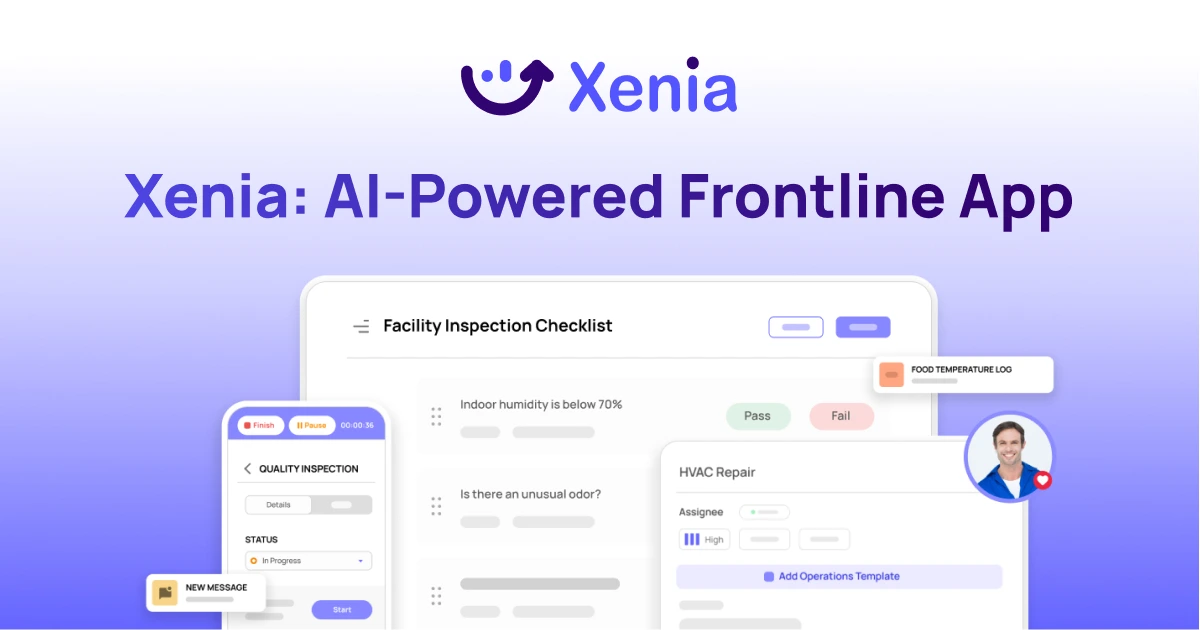
A Modern, AI-Powered Platform Built Specifically for Frontline Operations
Xenia brings daily operations, maintenance, audits, and compliance into one mobile-first platform. Frontline teams execute work consistently across locations while leadership gets real-time visibility.
Why Multi-Location Operators Choose Xenia:
🤖 AI-Powered Operations, Create digital checklists instantly or convert paper forms with AI. Verify compliance automatically with photo analysis and get instant answers from your operational data.
✅ Daily Operations & Maintenance, Assign work across hundreds of locations in minutes. Report and route issues instantly. Schedule preventive maintenance to catch problems before downtime.
📊 Real-Time Visibility, Track completion, work orders, and performance across all locations through dashboards. Filter by site or asset to spot trends and take action.
Manage operations, maintenance, and compliance across all your locations from one platform

.svg)
.webp)
%201%20(1).webp)

.svg)
%201%20(2).webp)
.webp)


