
.webp)
Post Summary
Your restaurant group has a detailed operations manual. Every procedure is documented. GMs were trained on it. You spent two quarters building it.
Last week, a location failed its health inspection for the third time. The inspector cited the same cooling log issue that your manual explicitly covers as something that "must be completed every shift."
That is not a training problem. That is not a documentation problem.
The manual is operations management. What it failed to create is operations execution. The mechanism that ensures the procedure actually runs. Every shift. At every location. Whether or not anyone is watching.
Multi-unit operators who have one without the other hit the same wall repeatedly. This article explains why, and what the difference actually looks like on the ground.
.webp)
.svg)

Priced on per user or per location basis
Available on iOS, Android and Web


Recommended Resources
- Multi-location operations execution system
- How to standardize multi-unit operations execution at 5, 50, and 500 locations
- Restaurant opening and closing checklists
- Frontline operations SOPs guide
- Operations execution software for multi-unit teams
What is operations management and what does it actually include?
Operations management is the planning and design layer. It is the set of decisions, documents, and systems that define how work should be done.
In a multi-unit context, that means your SOPs. Your training programs. Your operations manuals. Your quality standards. Your scheduling logic. Your brand guidelines.
All of it is the answer to one question: "How are we supposed to do this?"
Here is what operations management looks like in practice:
**
Component, What It Is, Where It Lives
SOPs, Step-by-step procedures for recurring tasks, Operations manuals-shared drives
Training programs, How you onboard and certify employees, LMS platforms-in-person training
Brand guidelines, How stores should look-feel-behave, Brand decks-brand portals
Quality standards, What "good" looks like at each location, Audit forms-inspection checklists
Scheduling logic, Rules for how shifts are designed, Manager playbooks-HR tools
**
The problem with operations management is not the content. The problem is what it does not do.
A well-designed operations management system describes the standard. It has no mechanism to ensure the standard is met shift by shift. It tells your team what the rules are. It does not verify those rules are being followed.
That verification is a different problem entirely.
What is operations execution and how is it different?
Operations execution is the doing layer.
It is the daily, shift-level completion of tasks, checklists, inspections, and corrective actions that turn the plan into actual store-level behavior.
Here is what operational execution looks like in practice:
- Task assignment sent to a GM or shift lead at the start of each shift
- Checklist completed with photo or timestamp verification
- Inspection that flags a non-compliant item in real time
- Corrective action routed to a supervisor when something is missed
- Dashboard showing completion status across 30 locations before noon
The difference between operations management and execution comes down to one thing: feedback loops.
Management says "here is the standard."
Execution says "did it happen? Who did it? When? What was the result?"
**
Aspect, Operations Management, Operations Execution
Definition, Planning and design of how work should be done, Daily completion and verification that work was done
Where it lives, Documents-training platforms-manuals, Mobile devices-task systems and frontline workflows
Who owns it, Operations leaders-COOs-brand teams, GMs-shift leads-crew members
How success is measured, SOP quality-training completion rates, Task completion rate-inspection pass rates and corrective action closure
Primary tool, Operations manual, Operations execution platform
**
That last row matters. You need both. But most growing brands invest heavily in the first and underinvest in the second.
"It's very reactive versus being proactive. Things slip or fall away." - Owner, 10-location restaurant group
Why do multi-unit operators have strong management but weak execution?
Most growing brands build a strong management infrastructure and a thin execution infrastructure. This is not accidental. It reflects how the work feels.
Building an operations manual is a project. It has a start date and an end date. You can see it, share it, and present it in a board meeting. It feels like progress.
Building execution infrastructure is different. Task systems, accountability workflows, and location-level visibility dashboards. These require ongoing commitment. They do not fit into a single Q3 initiative.
So management gets prioritized. Execution gets deferred.
The cost of that gap shows up in three places:
Operational inconsistency. Two locations following the same SOP get different outcomes because one has an execution mechanism and the other relies on a manager's memory.
Repeat audit violations. The same issue flags at the same locations quarter after quarter. Retraining happens. The violation returns. Because retraining is a management response to an execution problem. For a deeper look at how this plays out, see our operational audit guide.
DM burnout. District managers spend their days calling locations to check on things that should already be tracked digitally. That is not a management problem. That is a missing execution layer.
The scaling issue compounds this. At three locations, a strong COO can personally bridge the management-execution gap by physically visiting, calling, and checking in. At 30 locations, that is impossible. Every location added to the portfolio widens the gap if the execution infrastructure is not built.
This is why multi-location operations execution is not just a software category. It is the core operational challenge for any brand trying to grow past single-digit locations.
Why does confusing the two cause real problems?
Three failure scenarios that show up in almost every growing multi-unit brand:
The SOP that nobody runs. A food safety SOP exists. It was covered during training. Three months later, a health inspection flags exactly the procedure the SOP addresses. Managers are confused. "We have this in our manual." Right. The SOP was management. There was no execution mechanism. Nobody was checking whether it happened.
For what a proper restaurant SOP guide covers, that is the documentation side. The execution side is what enforces it daily.
The audit that surfaces the same issue repeatedly. A quarterly audit flags a closing checklist gap at four locations. GMs are retrained. The same gap appears next quarter. Retraining is a management response. Building a daily closing checklist with digital verification and an escalation trigger if it is missed is an execution response. They are not the same thing.
See our restaurant opening and closing checklist guide for what that execution layer looks like in practice.
The district manager who is also a firefighter. A DM is spending 60% of their time calling locations to ask whether tasks were completed. That is a sign the operation has management but no execution infrastructure. How top multi-unit brands execute operations shows what it looks like when that infrastructure is built correctly.
Our guide on how to standardize multi-unit operations shows what it looks like when that infrastructure is built correctly.
Why is this gap so hard to fix?
The execution gap is hard to fix for one main reason: it is invisible until something goes wrong.
Missed checklists do not create incidents. They create conditions. The incident shows up weeks or months later as a health inspection violation, a brand audit failure, or a customer complaint pattern. By then, the root cause is buried.
Understanding this is one thing. Actually fixing it requires confronting three named failure modes that most operators fall into:
The documentation trap. When execution fails, the instinct is to build better documentation. Longer manuals. More detailed SOPs. More thorough training materials. This is a management response to an execution problem. More documentation does not fix a missed checklist.
The management-layer assumption. Senior leaders assume that if they have communicated a standard and trained on it, execution will follow. This assumption underestimates the structural distance between a trained standard and a consistently enforced one. People know what they are supposed to do. That is different from having a system that ensures they do it.
The invisible execution gap. Because execution failures do not surface as incidents immediately, operators often do not know the gap exists. They believe locations are following procedures because nothing has gone wrong yet. The gap only becomes visible when an inspector shows up or a brand audit surfaces the same four violations at the same four locations.
The operational execution meaning here is not about knowing the standard. It is about having infrastructure that closes the loop between what is planned and what actually happens.
The operations execution system guide covers what that infrastructure looks like in full.
Operations execution vs operations management: a quick summary
If you want a single reference point:
**
Question, Operations Management Answer, Operations Execution Answer
What is the standard?, Defined in SOPs and manuals, Enforced via daily task workflows
Who is responsible?, Operations leaders, GMs and shift leads
How is it verified?, Periodic audits, Daily completion data
What happens when it fails?, Retraining, Corrective action routing
What does scaling it look like?, Better documentation, Better execution infrastructure
**
Operations and execution management are not the same discipline. They require different investments, different tools, and different accountability structures. Brands that understand this distinction build locations that actually perform to standard. Brands that do not keep retraining the same people for the same violations.
How Xenia helps close the execution gap
If you have read this far, you already have the management side covered. SOPs exist. Training happened. Standards are written down somewhere.
What is usually missing is the thing that makes those standards actually run. Not once during onboarding. Every shift.
That is what Xenia does. It takes your existing procedures and turns them into daily task workflows. Tasks get assigned by role, completed with photo or timestamp proof, and tracked in real time across every location. If something gets missed, it escalates automatically. If a task fails a quality check, a corrective action goes to the right person. No DM phone call needed.
One dashboard. Every location. No chasing.
.webp)
Conclusion
Most multi-unit operators have strong management and a weak execution layer. The manual exists. The training happened. The standard is documented.
What is missing is the infrastructure that ensures the standard runs every shift without someone manually checking.
That is the operations execution gap. And it only gets more expensive the longer it stays open.
If you have built the management layer, the next step is building the execution layer. Start with the multi-location operations execution system guide to see what that infrastructure looks like in practice.
The management is done. Now build the execution layer.
Xenia converts your existing standards into daily task workflows that get done, verified, and reported across every location.
Schedule a demo to see the difference.
Frequently Asked Questions
Got a question? Find our FAQs here. If your question hasn't been answered here, contact us.
What is operations and execution management?

It is both disciplines working together. Operations management covers the planning tools: training platforms, documentation, and SOPs. Execution management covers the doing tools: task workflows, digital checklists, and real-time compliance tracking.
Different problems. Different tools. You need both.
What is the difference between strategy and execution in operations?
Strategy sets the goal. Execution is what happens every shift to reach it.
Writing a food safety SOP is strategy. Making sure that SOP gets completed, verified, and flagged when missed at every location is execution. Both matter. Most operators only build one.
Why do operations management efforts fail without execution infrastructure?
Because management tells people what to do. It does not check whether they did it.
When there is no execution layer, task completion depends on a manager remembering to act. That works at two locations. It falls apart at ten. Add more locations and the gap gets wider, not smaller.
What is operational execution meaning in a multi-unit context?
It means having a system that assigns tasks, checks they were completed, flags what was missed, and routes it to the right person. Across every location. Every shift.
Without that system, your brand standard is a documented rule. With it, the rule becomes a daily behavior.
What is the difference between operations management and operations execution?
Operations management is the planning side. It is your SOPs, training programs, quality standards, and operations manuals. It answers one question: how should work be done?
Operations execution is the doing side. It is the daily task assignment, checklist completion, and verification that answers a different question: did the work actually happen?
One defines the standard. The other enforces it.


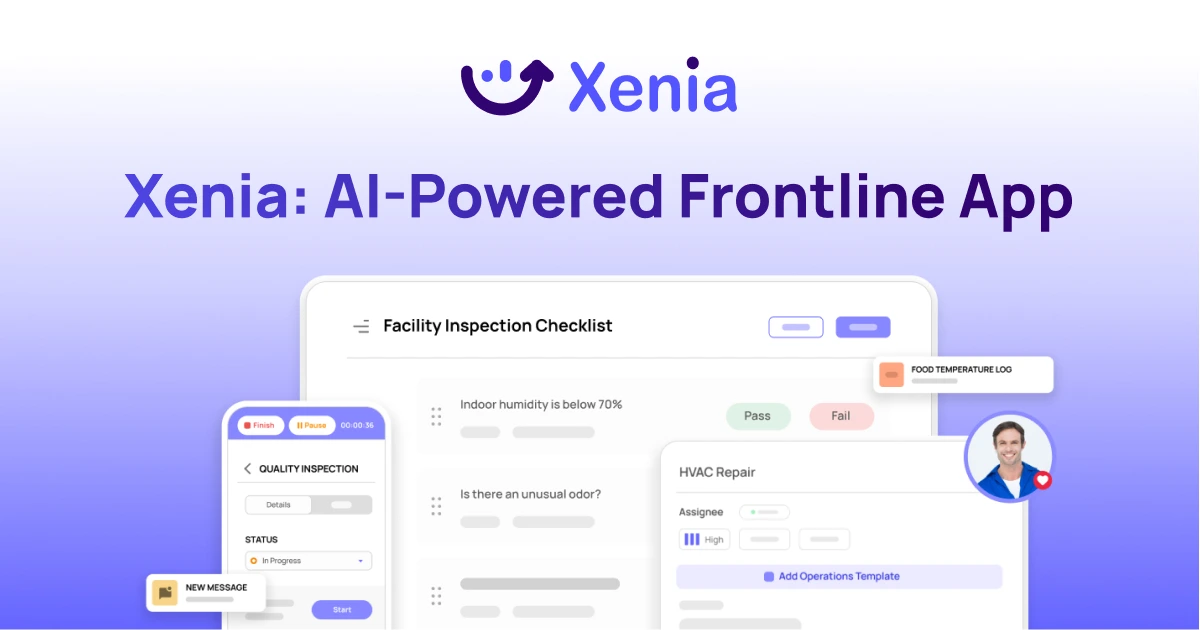
A Modern, AI-Powered Platform Built Specifically for Frontline Operations
Xenia brings daily operations, maintenance, audits, and compliance into one mobile-first platform. Frontline teams execute work consistently across locations while leadership gets real-time visibility.
Why Multi-Location Operators Choose Xenia:
🤖 AI-Powered Operations, Create digital checklists instantly or convert paper forms with AI. Verify compliance automatically with photo analysis and get instant answers from your operational data.
✅ Daily Operations & Maintenance, Assign work across hundreds of locations in minutes. Report and route issues instantly. Schedule preventive maintenance to catch problems before downtime.
📊 Real-Time Visibility, Track completion, work orders, and performance across all locations through dashboards. Filter by site or asset to spot trends and take action.
Manage operations, maintenance, and compliance across all your locations from one platform

.svg)
.webp)
%201%20(1).webp)

.svg)
%201%20(2).webp)