

Post Summary
The Critical Skills Every Retail Store Manager Needs
Retail store manager training is the structured program that takes a new or promoted store manager from hire to full productivity. It usually runs across a 30-60-90 day plan covering leadership, financial acumen (P&L, labor, shrink), operational standards, customer experience, compliance, and systems fluency. Most chains budget roughly 90 to 120 days before a manager runs the store unsupervised.
The money case for getting this right is unusually well documented. Research on store-level data from two large retail companies found that individual store managers account for approximately 25% to 35% of the variation in store productivity. Replacing a manager in the 10th percentile with one in the 90th percentile raises productivity by 50% to 100%, roughly the same as adding a fifth person to a four-person team. The same study found that simply allocating existing managers better across stores could raise company-wide sales by 2% to 6%.
That last number matters for a district manager. You do not always need to hire better. You often need to train and place better.
Six skill areas carry almost all of that variation. The live version of this page named five. The sixth, technology and systems fluency, is where new managers lose the most time in their first month and it belongs on every competency list.
| Skill | What good looks like | How you assess it |
|---|---|---|
| Leadership and team development | Every associate has a documented check-in within the last 60 days | Team turnover, coaching notes, engagement pulse |
| Financial acumen | Reads the P&L and names the two lines they can move this period | Labor % to target, shrink %, sales per labor hour |
| Operational excellence | Runs opening, mid-shift and closing checklists without prompting | Checklist completion %, store walk score |
| Customer experience | Resolves an escalation end to end without pulling in the DM | Mystery shop score, service survey, complaint volume |
| Compliance and risk | No open corrective actions past deadline | Audit findings, safety certification currency, acknowledgment rate |
| Technology and systems fluency | Runs POS, scheduling, ordering and the task app unaided by week four | Time to first unsupervised shift, support requests raised |
Operational excellence is the widest of the six. It covers inventory management and shrink control, planogram execution, visual standards, and receiving. Train it with real store data, not slides. A manager who has never reconciled a cycle count in your system has not been trained on inventory.
Compliance and risk is the narrowest and the most expensive to skip. Health and safety rules, loss prevention procedures, and wage-and-hour scheduling rules all sit on the store manager's desk. One untrained manager is one uninsured exposure.


Priced on per user or per location basis
Available on iOS, Android and Web


Why Comprehensive Store Manager Training Matters
Store manager training matters because an untrained manager costs real money on a schedule you can forecast. In convenience retail, hiring a store manager runs about $1,800 and training runs about $5,000 more, for nearly $7,000 total, with an average of 112 days to full productivity. That is one budget line and one calendar line, per manager, every time.
Now do the arithmetic a DM actually faces. C-store manager turnover ran 17.1% in the first half of 2025. On a 200-store chain that is roughly 34 manager replacements a year. At about $7,000 each, that is roughly $238,000 in hire-and-train cost. It also means 34 stores are running below full productivity for 112 days apiece. The cost is not the training. The cost is the gap before the training finishes.
Retail already spends more on this than any other sector and still runs short on time. US training expenditures rose 4.9% to $102.8 billion in 2025, and retailers and wholesalers spent the most per learner of any sector at $1,046 while average training hours per employee fell from 47 to 40. More money, fewer hours. Delivery efficiency is the constraint, not budget.
The pressure is not easing. Global manager engagement fell to 22% in 2025, down from 31% in 2022, while best-practice organizations run at 79%. Retail churn stays structurally high on the neutral measure too. The US Bureau of Labor Statistics put the 2025 annual average quits rate for retail trade at 2.6% per month against 2.2% for total private.
When store manager training is thin, four things show up in the numbers:
- High turnover cost, because disengaged teams leave and the replacement cycle restarts
- Inconsistent customer experience across stores in the same banner
- Compliance exposure, from safety findings to policy changes that never landed
- Lost sales from weak execution on promotions, planograms and labor scheduling
A structured program attacks all four at once because it makes the standard explicit and the proof visible. That is also why what retail store operations actually covers is the right scoping document before you build the curriculum. A frontline operations platform is what keeps the standard current across every location once the program exists.
What are the Core Components of Operational Excellence for Retail Store Managers?
Operational excellence for a retail store manager comes down to four things: knowing the standard, executing it on a rhythm, proving it happened, and fixing what failed before the DM has to ask. Training that only teaches the standard covers one of the four.
Most programs fail at the change itself, not the content. New processes, new tools and new systems all arrive on stores that are already busy. The DICE framework is the standard model for predicting whether a change initiative sticks, and it has four factors. The live version of this page explained three and quietly dropped one.
Duration. How long the change takes, and how far apart the checkpoints are. Long, vague timelines dilute even a good store manager training program. Short reviews every two to four weeks beat one review at the end.
Integrity. The capability of the team running the rollout. Do the trainers actually know the job, and do managers trust them? Weak integrity is fixable by training your DMs to deliver the content before you train the managers.
Commitment. Buy-in from the top and from the store. Even a well-built retail employee training checklist template fails when managers were not asked and do not agree.
Effort. The additional load the change puts on managers on top of the day job. This is the factor most retailers skip. If the new program adds six hours a week to a manager already working 50, effort will beat intent every time. Budget the hours out loud.
Change readiness also has a proof requirement. Two terms matter here. A policy acknowledgment is a recorded confirmation that a specific person received a specific version of a specific document. Compliance evidence is the retained record of that acknowledgment, with a name, a timestamp and a version. Without both, you cannot answer the only question an auditor asks: how do you know all stores got it?
Build the feedback loop as a standing rhythm, not an annual survey:
- Run a 30-day check-in with every new manager, with the same five questions each time.
- Send an anonymous pulse survey at day 60 so honest answers survive the reporting line.
- Hold a monthly open forum at district level where managers raise blockers.
- Route every raised blocker to a named owner with a date, the same way you close a corrective action.
Broadcast the change, capture the acknowledgment, and keep the signature. For retail, that is the loss prevention policy update that every manager signs off on, with the record sitting in one place instead of in a DM's inbox. The same mechanic covers new hire SOP acknowledgment during onboarding.
Selecting the Right Methodology for Effective Store Manager Training
There is no single best store manager training methodology. There is a best fit for your store count, your turnover rate and your bench depth. Most chains run two or three of these together, with a structured 30-60-90 plan as the spine and everything else hanging off it.
Here is the comparison the previous version of this page promised and never delivered.
| Methodology | What it is best at | Time to competence | Where it breaks at multi-location scale |
|---|---|---|---|
| On-the-job shadowing | Store-specific tasks, POS, opening and closing | 2 to 6 weeks for basics | Quality depends entirely on who is training. A manager in the far corner of the district gets a third of the contact hours. |
| Structured 30-60-90 onboarding plan | Sequencing, ownership, clear exit criteria per phase | 90 to 120 days | Falls apart without a written plan and a DM who checks it on a date |
| Blended digital plus in-store coaching | Consistency across stores with real practice attached | 60 to 90 days | Needs version control. The binder in store 14 is two revisions behind store 3. |
| Cohort or classroom program | Leadership, financial acumen, peer benchmarking | One to two cycles a year | Managers leave the floor. Coverage cost is real at small-format stores. |
| External certification | Credential, standardized fundamentals, a career path | One to two semesters | Teaches retail in general, not your brand standards or your planograms |
| 5-S workplace system | Backroom organization and operational discipline | 2 to 4 weeks per store | The Sustain step fails without a recurring audit or checklist behind it |
The 5-S system deserves its own note because retail keeps rediscovering it. Sort, Set in order, Shine, Standardize, Sustain. It is the cheapest way to fix a chaotic backroom and it standardizes receiving, stockroom layout and daily reset. Just remember that four of the five steps are one-time and the fifth is forever.
On the credential question, two named programs are worth knowing. The NRF Foundation RISE Up program offers six credentials including Retail Industry Fundamentals, Customer Service and Sales, Business of Retail, and Customer Conflict De-escalation, built with more than 20 retailers including Walmart, Macy's, The Home Depot and Nordstrom. The WAFC Retail Management Certificate is an eight-course community college program delivered in person and fully online, awarding two credentials. Neither is required by most employers. Both are useful for building a bench from hourly associates.
Be specific about delivery when you plan. Competitors publish their specs, and you should hold yourself to the same standard. Graff Retail, for example, publishes 26-week cycles, two cycles a year, roughly four-minute video modules, and a DM coaching loop. Pick your own numbers, write them down, and compare methods honestly against the best LMS options for retail and broader frontline employee training methods before you commit a budget.
8 Core Components of an Effective Store Manager Training Program
An effective store manager training program covers eight components, and each one needs a deliverable you can point at. Gallup found that managers account for at least 70% of the variance in team engagement, which is why the leadership component sits first. The gap between good and bad management is measurable in the same data: employees reporting to top-quartile managers on Gallup's enablement index are 50% engaged and 54% strongly agree they will still be there in two years. Bottom quartile lands at 36% and 39%.
-
Leadership and team management. Communication, delegation, conflict resolution, and running a shift with a partial crew. Deliverable: the manager runs a full team huddle and a one-on-one unsupervised. You know it worked when every associate has a documented check-in in the last 60 days.
-
Operational procedures, standards and systems. Opening, mid-shift and closing routines, plus hands-on time in the POS, the scheduling tool and the ordering system. Deliverable: the manager closes the store alone. You know it worked when checklist completion holds above 95% for a full period without reminders. Pair this with POS system training rather than treating systems as self-taught.
-
Inventory management and loss prevention. Cycle counts, receiving accuracy, markdown discipline, and shrink investigation. Deliverable: the manager runs a cycle count and explains the variance. You know it worked when shrink lands inside tolerance for two consecutive periods. Deepen it with structured loss prevention training.
-
Visual merchandising and store presentation. Planogram reads, seasonal resets, promotional setups and fixture standards. Deliverable: the manager executes a full reset with before-and-after photos. You know it worked when the store walk score on presentation matches or beats district average.
-
Customer service excellence. Service standards, complaint handling and recovery. Deliverable: the manager resolves a live escalation without the DM. You know it worked when service survey scores hold steady through a manager change. Build the store-level version with customer service training for retail teams.
-
Performance management and coaching. Setting expectations, giving feedback that changes behavior, and documenting it. Deliverable: three coaching conversations delivered and written up. You know it worked when the manager raises a performance issue before you spot it. Start with the mechanics of coaching retail employees.
-
Crisis management and problem solving. Safety incidents, theft, equipment failure, weather closures, staffing collapse. Deliverable: the manager walks through two scripted scenarios and knows who to call. You know it worked when the next real incident produces a complete incident report the same day.
-
Time management and prioritization. Which tasks a manager owns, which they delegate, and what gets dropped on a short-staffed Saturday. Deliverable: a written weekly operating rhythm for their store. You know it worked when the manager stops working the floor full time by week eight.
Every one of the eight needs a named owner, a date, and evidence. A component without a deliverable is a topic, not training.
Building an Effective Store Manager Training Framework
A store manager training framework has four parts: a phased onboarding plan, blended delivery, a single current version of every document, and progress you can see by store. This section covers what the framework contains. The next one covers how you roll it out.
The phased plan is the spine. Here is a retail-specific 30-60-90 day plan for a store manager, built around what a store manager actually controls rather than generic business onboarding.
-
Days 1 to 30, learn the store and the numbers. Shadow all three dayparts, including at least one full close. Complete brand-standards and safety SOP acknowledgments. Read the last two store walk or audit reports and the last six months of P&L. Meet every associate one-on-one. Learn the POS, the scheduling tool and the ordering system hands-on, not in a slide deck. Owned outcome: can open and close the store unsupervised.
-
Days 31 to 60, own the operating rhythm. Run the opening and closing checklists without prompting. Build and publish a schedule inside the labor target. Own cycle counts, shrink review and vendor receiving. Handle a customer escalation end to end. Deliver the first coaching conversations. Owned outcome: hits labor and shrink targets for a full period.
-
Days 61 to 90, own the store's results. Build a store action plan from the last audit score. Run a full performance conversation cycle with the team. Execute a promotion or planogram reset independently. Present the store's numbers to the DM. Owned outcome: store walk score at or above district average.
Here is the honest part almost nobody says out loud. The NACS data puts full productivity at an average of 112 days. A 90-day plan therefore ends roughly three weeks before the average manager is actually productive. Plan a days 91 to 120 stabilization phase: reduced DM contact, one live audit, and a first full period owned without a safety net. Then call the onboarding complete.
Underneath the plan, three supports carry it:
- Blended delivery. Hands-on execution in-store, short digital modules the manager can complete between tasks, and a named mentor from a nearby store. Build the associate-side version alongside it so the standards match, using your retail staff training program.
- One current version of every document. Centralize SOPs, checklists and brand standards so a manager in store 14 reads the same revision as store 3. See why consistency matters in store walk training.
- Progress you can see by store. Not a completion percentage for the company. Which manager, which phase, which item is overdue.
Track readiness on a competency matrix. A competency matrix maps each manager against each required competency, with the evidence that proves it and a date to reassess. Five-point proficiency scales give more signal than beginner, intermediate and advanced.
| Competency | Evidence of proficiency | Reassess |
|---|---|---|
| P&L and labor control | Hits labor % target three consecutive periods | Quarterly |
| Inventory and shrink | Cycle counts within variance tolerance | Quarterly |
| Scheduling and compliance | Schedule posted on time, no predictive-scheduling exceptions | Monthly |
| Brand and visual standards | Store walk score at or above district average | Per walk |
| Safety and loss prevention | Annual certification current, no open corrective actions | Annually |
| Coaching and performance management | All associates have a documented check-in in the last 60 days | Monthly |
| Customer escalation | Resolves without DM involvement | Ongoing |
| SOP and policy currency | All required acknowledgments signed and current | Per rollout |
That last row is the one most chains cannot answer. The matrix is only as good as your proof that each manager received and acknowledged the current version of each SOP.
Building an Effective Store Manager Training Framework Implementation
Rolling out a store manager training program is a project with owners, dates and a pilot. The framework is what you teach. The rollout is who does what, in what order, and how you know it landed. Six steps, in this order.
Step 1, weeks 1 to 2, owned by the Director of Retail Ops: define the outcomes. Write the exit criteria per phase before you write a single module. "Can open and close unsupervised" is an outcome. "Understands store operations" is not. Tie each outcome to a metric you already report.
Step 2, weeks 3 to 4, owned by Ops plus L&D: map content to the existing stack. Inventory every SOP, checklist and brand standard you have. Mark which are current, which are two revisions behind, and which live only in a binder. This step surfaces more problems than it creates.
Step 3, weeks 5 to 6, owned by the DM group: build location-specific and role-based tracks. A small-format store and a flagship do not get the same plan. Neither does a promoted assistant manager and an external hire. Account for the unique retail training challenges each store format carries.
Step 4, weeks 7 to 10, owned by one DM: pilot in a single district. This is the step the previous version of this page was missing, and it is the one that saves the rollout. Run the full plan with two or three new managers in one district. Fix what broke. Then go wide. A pilot costs four weeks. A failed chain-wide rollout costs a year of credibility.
Step 5, weeks 11 to 14, owned by Ops: go wide with version control. Publish one current version of every document. Broadcast each change, capture acknowledgment, and keep the record. A rollout is not complete when it is sent. It is complete when every manager has acknowledged the current version. The mechanics are the same ones you would use for a POS training rollout or any other procedural change.
Step 6, ongoing, owned by the Director of Retail Ops: review quarterly and adjust. Pull completion, store walk scores and time-to-competence together. Cut modules nobody finishes. Add the ones managers keep asking for.
These are the consistency failures the rollout has to design against, in the language DMs actually use:
- The binder in store 14 is two revisions behind store 3, and nobody knows which one the new manager read.
- Training happens whenever the DM is physically in the store, so the far end of the district gets a third of the contact hours.
- A new manager gets certified on the POS but never on the close, because the person who trained them works days.
- Corporate sends the new policy by email, three managers miss it, and it surfaces six weeks later as an audit finding.
The last one is the expensive one. Practical fixes for the first three sit in guidance on how to manage training across multiple locations and how to reduce training time across locations.
Overcoming Common Challenges with Digital Solutions
Four problems break most store manager training programs, and each has a mechanical fix rather than a motivational one. Digital tools help only where they change the mechanism. Here is what actually moves each one.
Challenge 1: turnover keeps restarting the clock. At roughly $7,000 and 112 days per replacement, a chain with 17.1% manager turnover never finishes onboarding. The fix is shortening time-to-competence, not wishing for lower churn. Start with the retention lever you control: Gallup reports that 42% of voluntarily departing employees say their manager or organization could have prevented their exit. Manager development is a retention program that happens to also be a training program.
Challenge 2: training is inconsistent across locations. The mechanism is version drift, not effort. When SOPs live in binders, email threads and three shared drives, stores diverge by default. Centralize to one current version per document and make the publish date visible on the store's device. Then the question "which revision did store 14 read?" has an answer.
Challenge 3: engagement drops because training sits outside the work. Managers do not skip training because it is boring. They skip it because it happens on a laptop in a back office at the end of a 10-hour shift. The fix is delivery in the flow of work: the procedure surfaces on the phone at the moment it is needed, the checklist is the training, and completion is visible by store rather than by individual. That is the same principle behind a well-built training reminder broadcast.
Challenge 4: no proof the training actually landed. This is the one that turns into an audit finding. Corporate sends the new policy, three managers miss it, and six weeks later a store is out of compliance on a procedure nobody can prove was received. The fix is broadcast with acknowledgment and signature capture, scoped by location hierarchy, with the record retained as compliance evidence. When the auditor asks how you know every store got the update, you show 60 of 60 acknowledged with timestamps. That is what frontline communication software is for, and it is the same evidence trail that supports retail compliance training.
Note what is not on this list. Automatic translation and AI-generated video lessons get promised often in this category. Judge any tool on whether it changes one of the four mechanisms above.
Streamlining Store Manager Training with Xenia
Xenia is not an LMS and does not issue certifications. Xenia is the layer that makes the training stick in the flow of work and produces the evidence that it landed. If your coursework lives in an LMS, keep it there. What follows is what sits underneath it.
Location-aware delivery. DMs see their district. Regional managers see all regions. Store managers see their store. One account, multiple scopes. For a retail chain, that means a district manager sees assigned stores and the banner lead sees the banner, with no extra licenses. It is what makes a training rollout auditable by district instead of by spreadsheet.
Announcements with acknowledgment and signature. Broadcast the SOP change, policy update or safety bulletin. Every manager acknowledges and signs. The auditable trail of who saw what and when sits in the system. For retail, the common case is a loss prevention policy update that every store signs off on. This captures evidence of acknowledgment. It is not a notarized e-signature, and you should not describe it that way to your legal team.
Daily ops checklists with photo proof and timestamps. Opening, mid-shift and closing, role-based and location-based. For a new manager, the completion percentage on the opening checklist becomes the store's pulse and your first honest read on whether week-four training took. Build them from your existing digital checklists and SOPs.
Dashboards on issues, not just completion. A 50-store group does not need another completion percentage. The useful view shows planogram compliance by store, which corrective actions are open past deadline, and which locations are trending badly. For a DM tracking two new managers, the question is which store is forming a problem, not what percentage of modules got clicked.
QR code point-of-need access. The manager scans the code on the equipment or the fixture and gets the step-by-step procedure at the moment of need. No hunting through a binder in the middle of a task.
AI Template Agent. Upload a SOP PDF and it becomes a digital form with conditional logic, required fields and calculations, in minutes. A compliance officer with 14 corporate SOPs in PDF can have 14 working forms over a weekend instead of a six-week template build.
Here is the honest scope line, because the distinction matters when you are buying.
| Job to be done | An LMS | Xenia |
|---|---|---|
| Course catalog, quizzes, certificates | Built for this | Not built for this. Xenia does not issue certifications. |
| Proof a specific manager received a specific SOP version | Usually course-level only | Acknowledgment and signature per person, per version, with timestamp |
| Daily execution of what was taught | Out of scope | Daily ops checklists with photo and timestamp proof |
| What failed and who is fixing it | Out of scope | Corrective actions with owner, deadline and escalation |
| Visibility by district and banner | Reporting by learner | Location hierarchy with scoped permissions |
For a picture of what consistent execution looks like at scale, Adidas digitized visual merchandising audits and retail execution across 100 plus stores with Xenia. That is the execution-consistency problem a store manager training program is ultimately trying to solve, running across a full retail footprint. The broader pattern sits in multi-unit operations software.
Conclusion
Measure store manager training the way you measure the rest of the store. Most retail programs stop at a survey or a quiz, which tells you whether managers liked the training and whether they remembered it. Neither tells you whether the store got better. The Kirkpatrick model has four levels, and retail already owns the instrumentation for all four.
| Level | Generic measure | What a DM already has |
|---|---|---|
| 1. Reaction | Post-course survey | New manager 30-day check-in |
| 2. Learning | Quiz score | SOP acknowledgment and sign-off rate |
| 3. Behavior | Observation | Store walk score, checklist completion %, corrective actions closed on time |
| 4. Results | Business impact | Sales per labor hour, shrink %, associate turnover, days to full productivity |
Levels 3 and 4 are already in your ops reporting. Nobody connects them to training. Connect them, and the training conversation with finance changes from cost to return.
The return is measurable. Gallup found that managers who complete strengths-based development courses see up to 18% higher team engagement, a 20% to 28% lift in other manager performance metrics, and 21% to 28% less turnover on their teams.
One specific next action. Pick your next three new store managers. Give them the 30-60-90 plan in this article with the days 91 to 120 stabilization phase attached, and track exactly two numbers for each: days to first unsupervised close, and store walk score at day 90 against district average. That single comparison will tell you more about your program than a year of completion reports.
When you are ready to run it at scale, put the plan, the acknowledgments and the daily execution in one place with store manager software and connect it to your retail task management rhythm so the training and the work stop being two separate systems.
Frequently Asked Questions
Got a question? Find our FAQs here. If your question hasn't been answered here, contact us.
How do you train store managers consistently across multiple locations?

How much does it cost to train a store manager?
Do retail store managers need a certification?
What is a 30-60-90 day plan for a retail store manager?
What is included in a store manager training program?
How long does store manager training take?

A Modern, AI-Powered Platform Built for Retail Operations
Xenia brings store operations, merchandising, audits, and loss prevention into one mobile-first platform. Store teams execute daily work consistently, maintain brand standards, and resolve issues faster, while regional and corporate leadership get real-time visibility across all locations.
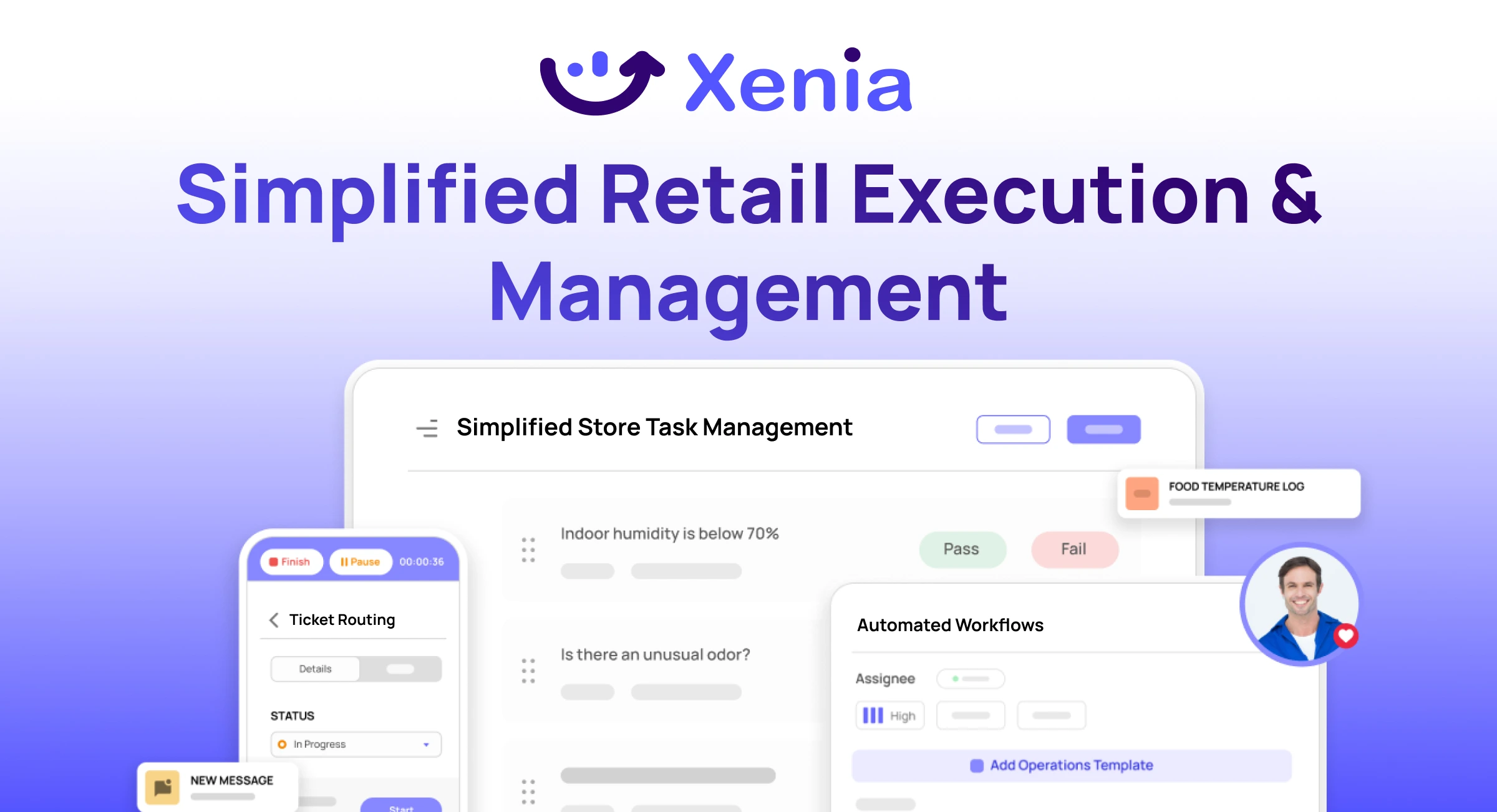
Why Retail Operators Choose Xenia:
🤖 AI-Powered Merchandising, Verify planograms, displays, and brand standards automatically with AI photo analysis. Build digital checklists instantly or convert existing merchandising guides.
🏬 Operations & Loss Prevention, Assign opening procedures, store walks, and resets across locations. Track theft, cash discrepancies, and security incidents with evidence and approval workflows.
📊 Real-Time Visibility, Compare audit scores and task completion across stores. Identify top and underperforming locations. Export reports for leadership reviews.
One platform for operations, merchandising compliance, and loss prevention across all locations.