

Post Summary
What retail compliance training must cover across every store
Retail compliance training must cover every obligation that applies to a given store, not one universal curriculum. There is no blanket "all retail employees must complete X" rule. Requirements stack by framework, by state, by headcount, and by product category. A cashier handling credit cards in a California store that sells tobacco carries a different stack than a stockroom associate at a fuel-only site.

Here are the core obligations most multi-location retailers have to map:
| Obligation | What it requires | Who it applies to |
|---|---|---|
| OSHA workplace safety | Hazard Communication training at initial assignment and when a new hazard appears, plus the General Duty Clause for hazards with no specific standard | Every employer |
| EEOC anti-harassment | Documented, interactive anti-harassment training that supports the employer's affirmative defense | Every employer (state hour minimums vary) |
| PCI DSS 12.6.3 | Security-awareness training at hire and at least every 12 months, with acknowledgment collected from each person | Any retailer handling card data |
| FTC Act Section 5 | Reasonable data-security practices, including employee training, enforced through consent orders | Retailers handling consumer data |
| State workplace-violence laws | A written prevention plan plus training on the state cadence, such as California SB 553 and New York's Retail Worker Safety Act | Retailers over the state headcount threshold |
| Age-restricted sales | Age-verification and refusal training under FDA Tobacco 21 and state responsible-vendor rules | Stores selling tobacco or alcohol |
Each row traces to a named authority. Read the primary sources on OSHA's Hazard Communication standard, the EEOC's model anti-harassment program, PCI DSS security-awareness training, and California's workplace-violence-prevention rules.
The cost of getting this wrong is real. The 2025 IBM Cost of a Data Breach Report puts the US average breach at a record $10.22 million. Retailers that serve EU residents also fall under GDPR. Serious violations there carry fines up to 20 million euros or 4% of worldwide annual turnover, whichever is higher, per GDPR.eu's penalties guidance.
Two rules keep this honest. Never tell staff "the law requires this training" as one universal line. And scope every requirement to its framework, state, headcount, or product category. Multi-banner chains that manage this across states lean on a retail operations platform and use policy rollout tracking to prove which store received each update.
Build a role, location, and jurisdiction training matrix
A training matrix maps each role to the exact topics it needs, then filters those topics by the state and product category of the store where that person works. Retail employee compliance training only works when the topics match the role and the store's jurisdiction. This is the single biggest gap in most retail programs. Everyone gets the same slideshow, so cashiers sit through manager content and no store's stack is right.
Build the matrix with role on one axis and the topic stack, verification owner, and jurisdiction sensitivity across the top:
| Role | Core required topics | Who verifies | Jurisdiction sensitivity |
|---|---|---|---|
| Store associate or cashier | HazCom, anti-harassment, PCI security awareness if handling cards, age-verification where applicable, workplace-violence training where required | Manager confirms on shift | High |
| Shift lead or keyholder | All associate topics, plus opening and closing security and incident-reporting procedures | Manager or DM | Medium |
| Store manager | Supervisor-level harassment training, workplace-violence plan administration, PCI role duties, recall procedures | DM or regional | High |
| Loss-prevention team | Workplace violence and de-escalation, use-of-force and detention policy, data privacy for surveillance footage | Regional or compliance officer | High |
| District or regional manager | Cross-location audit ownership, multi-jurisdiction plan review, completion and overdue oversight | Compliance officer or VP Ops | High |
The multi-location twist is what makes this hard. A cashier in a California store needs SB 553 workplace-violence-prevention (WVP) training. The same chain's cashier in a state with no WVP law does not, yet. New York's Retail Worker Safety Act adds its own interactive training for employers with 10 or more retail staff, per SHRM's summary of the New York requirements.
So the matrix has to filter by location, not just by role. One policy update should apply to every affected store at once, without re-editing a template per site. That single-source approach is the core move behind announcements with captured signatures. It is also why scoped visibility matters. A DM sees the stores they own, corporate sees every banner, and no one edits a spreadsheet to reconcile it.
Verify acknowledgment, understanding, and on-shift execution
Retail training verification works three ways, not one. A signature proves someone received the policy, a quiz proves they understood it, and an observed check on the floor proves they actually perform it. Most check-the-box training stops at the click. Auditors, regulators, and plaintiffs' counsel look for more.
Define the three tiers before you build them:
- Policy acknowledgment: a timestamped, signed confirmation that an employee received and read a specific policy. It is evidence of receipt and intent, not proof of understanding or of regulatory compliance.
- Knowledge check: a quiz or assessment that confirms the employee understood the content. A passing score, not a click-through.
- On-shift execution: a manager or auditor confirms the employee performs the procedure correctly on the floor. This is the highest tier of proof.
Together these three make up your compliance evidence: the retained artifact set an auditor, regulator, or plaintiff's counsel can inspect.
| Tier | What it proves | Evidence artifact | When it is enough |
|---|---|---|---|
| Policy acknowledgment | Receipt and intent | Timestamped signed acknowledgment | PCI DSS 12.6.3 acknowledgment, "we never got that policy" disputes, SOP rollout |
| Knowledge check | Understanding | Quiz score or pass record | EEOC effective-training defense, onboarding gates |
| On-shift execution | Correct performance on the floor | Manager-observed check, photo or video, dated store walk | Age-verification, de-escalation drills, brand-standard execution |

Here is why the tiers matter. PCI DSS 12.6.3 itself requires acknowledgment from each employee, not just a completion record. A completion record without explicit acknowledgment is now insufficient in a QSA (Qualified Security Assessor) review. And the EEOC's affirmative-defense guidance leans on documented, interactive training, which is where a quiz score earns its keep.
This is where Xenia fits the workflow. It broadcasts policies and SOPs with signed acknowledgment capture (Tier 1), delivers knowledge-check quizzes (Tier 2), and captures photo or video and observed-execution evidence on the mobile app during store walks (Tier 3). Push a loss-prevention policy update or a new SOP, staff acknowledge and sign, and the auditable trail of who saw it and when sits in the system. When an observed step needs proof, an out-of-standard finding can trigger a follow-up question and a required photo at the moment of the check, not after. One caution: acknowledgment timestamps and signatures are evidence of receipt and intent, not legal proof of compliance with a specific regulation. That still depends on the framework and your counsel.
Ace Retail Group is the proof point. It moved from Bindy to Xenia to consolidate enterprise audits, frontline comms, and multi-banner support into one app, and kept its MS Viva Engage HRIS integration. Per-seat pricing had broken at the district-manager layer, where every new DM meant another license. Now SOP rollouts run with signature capture, so every store acknowledges and the auditor has the evidence. See how that works in policy rollout tracking that shows who saw the SOP, who acknowledged, and who signed, or how one-tap announcements with signature capture compliance evidence. Managers run all three tiers from the mobile app without leaving the floor, part of the broader frontline communications and acknowledgment workflows.
.svg)

Priced on per user or per location basis
Available on iOS, Android and Web


A 30-60-90 day retail compliance training rollout
Roll out retail compliance training in three phases. Baseline and assign in the first 30 days, verify understanding and stand up records in the next 30, then observe execution and close gaps by day 90. Multi-location retail training scales only when the rollout is phased, so each store hits its own regulatory clock. No top-ranked competitor gives you a dated plan, so this is where a program gets real.

Days 1 to 30: baseline and assign
- Inventory every location by state and product category (alcohol, tobacco, card-present) to see which framework stack applies where.
- Build the role, location, and jurisdiction matrix from the section above, and map each topic to its authority.
- Load core policies and SOPs, then capture a signed acknowledgment with a timestamp from every current employee.
- Set completion deadlines by role and by regulatory due date. The PCI 12-month clock runs per employee from their own training date.
Days 31 to 60: verify understanding and stand up records
- Deploy knowledge-check quizzes for high-risk topics: harassment, workplace violence and de-escalation, PCI security awareness, and age-verification.
- Turn on the per-location training record so every completion, acknowledgment, and quiz score is retained and retrievable.
- Train managers and DMs to observe and log on-shift execution during store walks.
- Sync with your HRIS so new hires auto-enroll on day one.
Days 61 to 90: observe execution and close gaps
- Run the first full round of observed-execution checks at every location, with photo or video evidence captured on the mobile app.
- Pull the compliance dashboard for completion rate, overdue training, and stores trending toward failure.
- Remediate overdue or failed stores, and document the corrective action.
- Set the recurring cadence: annual or biennial refreshes tied to each framework's clock, plus event-triggered retraining after a new hazard, a plan change, or an incident.
The pain this fixes is familiar to anyone who has run store training. A training reminder broadcast that pushes refreshers to every shift addresses why the once-a-year slideshow fails, and mobile checklists and SOPs make refreshers stick. For a ready-made starting point, use the retail employee training checklist template. A same-shift safety alert with captured sign-off covers event-triggered retraining after an incident.
Create an audit-ready training record for every location
An audit-ready retail training record is a per-employee, per-location, timestamped log that ties each required topic to its completion, its signed acknowledgment, and its observed-execution evidence. The test is simple. When an auditor, regulator, or plaintiff's counsel says "prove this person was trained," you retrieve the packet in minutes, not days. Strong retail compliance training records are per-employee and per-location by design.
Each framework expects a specific record you can pull on demand:
- PCI DSS 12.6.3: completion plus explicit acknowledgment, per employee, on a 12-month cycle. Completion alone is insufficient in a QSA review.
- EEOC affirmative defense: documented, interactive anti-harassment training records that show the policy was distributed and training delivered on a regular basis.
- OSHA HazCom: a record that training happened at initial assignment and whenever a new hazard was introduced.
- State workplace-violence laws: WVP training records on the required cadence, plus the incident log required by California SB 553 and New York's Retail Worker Safety Act, per California's workplace-violence-prevention guidance.

The failure mode is predictable in multi-location retail. Records spread across stores. Certificates get stored manually and go missing between locations. Audit logs come up incomplete, and managers cannot confirm who completed what. Missing documentation is one of the most common inspection failures, which is why retrievability matters as much as the training itself.
An audit trail closes that gap. It is the immutable, timestamped log of who was assigned what, who completed it, who acknowledged it, and when, retrievable per employee and per location. Xenia keeps that trail in centralized document and records management, available for operator-driven inspection. One honest limit: it produces the evidence, but it does not auto-file reports with regulators. Submission stays operator-driven.
Measure completion, overdue training, incidents, and audit readiness
Measure retail compliance training with operational numbers you can pull from a dashboard, not a vendor time-savings promise. The right metrics show where the next failure is forming, not just whether last quarter's slideshow got clicked. Track these six:
- Training completion rate: percent of required assignments completed, by location and by role.
- Overdue training count: assignments past their regulatory or policy due date, such as the PCI 12-month clock or the SB 553 annual cycle.
- Acknowledgment capture rate: percent of policy rollouts with a signed acknowledgment from every assigned employee. This is your "we never got that policy" defense metric.
- Time-to-audit-ready: how fast you can retrieve a complete evidence packet for one employee or one store.
- Incident correlation: safety, harassment, or workplace-violence incidents cross-referenced against training completion at that location. Does the store with overdue WVP training also have the incident?
- Stores trending toward failure: which locations are passing, which are slipping, and why.
 Track employee compliance easily with Xenia.
This is what a dashboard should surface: what is coming up as a problem. Flagged items, overdue corrective actions, and high-risk locations, not just a completion percentage. Corrective action tracking from finding to closed resolution lets a DM see the store trending toward a failed audit and gives an overdue or failed store a task, a deadline, and an escalation, not just a red number. If your program spans both store types, how retail and restaurant audits compare shows where the scoring models differ.
Retail compliance training implementation checklist
Use this checklist to stand up a retail compliance training program that produces audit-ready evidence across every store. Work it top to bottom, then keep it as your recurring cadence.
- Map every location to its state and product-category framework stack.
- Build the role, location, and jurisdiction training matrix.
- Load policies and SOPs, and enable signed acknowledgment for all staff.
- Deploy knowledge checks for high-risk topics.
- Stand up the per-location audit-ready training record.
- Train managers to log on-shift execution during store walks.
- Sync with your HRIS so new hires auto-enroll.
- Set completion deadlines by regulatory clock, per employee where required.
- Turn on the compliance dashboard for completion, overdue, acknowledgment, and trending-to-fail views.
- Run the first full observed-execution round at every location.
- Remediate overdue or failed stores, and document the corrective action.
- Lock in the recurring and event-triggered retraining cadence.
The order matters. Steps 1 and 2 decide what each store owes. Steps 3 through 8 build the evidence. Steps 9 through 12 keep it current. A multi-location program that runs this loop turns compliance training from a once-a-year scramble into a standing record you can hand an auditor on any day. It also gives district and regional managers one place to see which stores are current and which are slipping. To start faster, adapt the retail employee training checklist template to your role-by-location matrix, then wire the acknowledgment and dashboard steps into your frontline communications and announcement workflows.
Frequently Asked Questions
Got a question? Find our FAQs here. If your question hasn't been answered here, contact us.
How do you prove the ROI of retail compliance training without a time-savings claim?

How do you handle compliance training for seasonal and high-turnover retail staff?
Does a signed training acknowledgment hold up as legal proof of compliance?
How long do we need to keep retail compliance training records for an audit?
Who is responsible for retail compliance training across a multi-location retail organization?
How often should retail compliance training be repeated?

A Modern, AI-Powered Platform Built for Retail Operations
Xenia brings store operations, merchandising, audits, and loss prevention into one mobile-first platform. Store teams execute daily work consistently, maintain brand standards, and resolve issues faster, while regional and corporate leadership get real-time visibility across all locations.
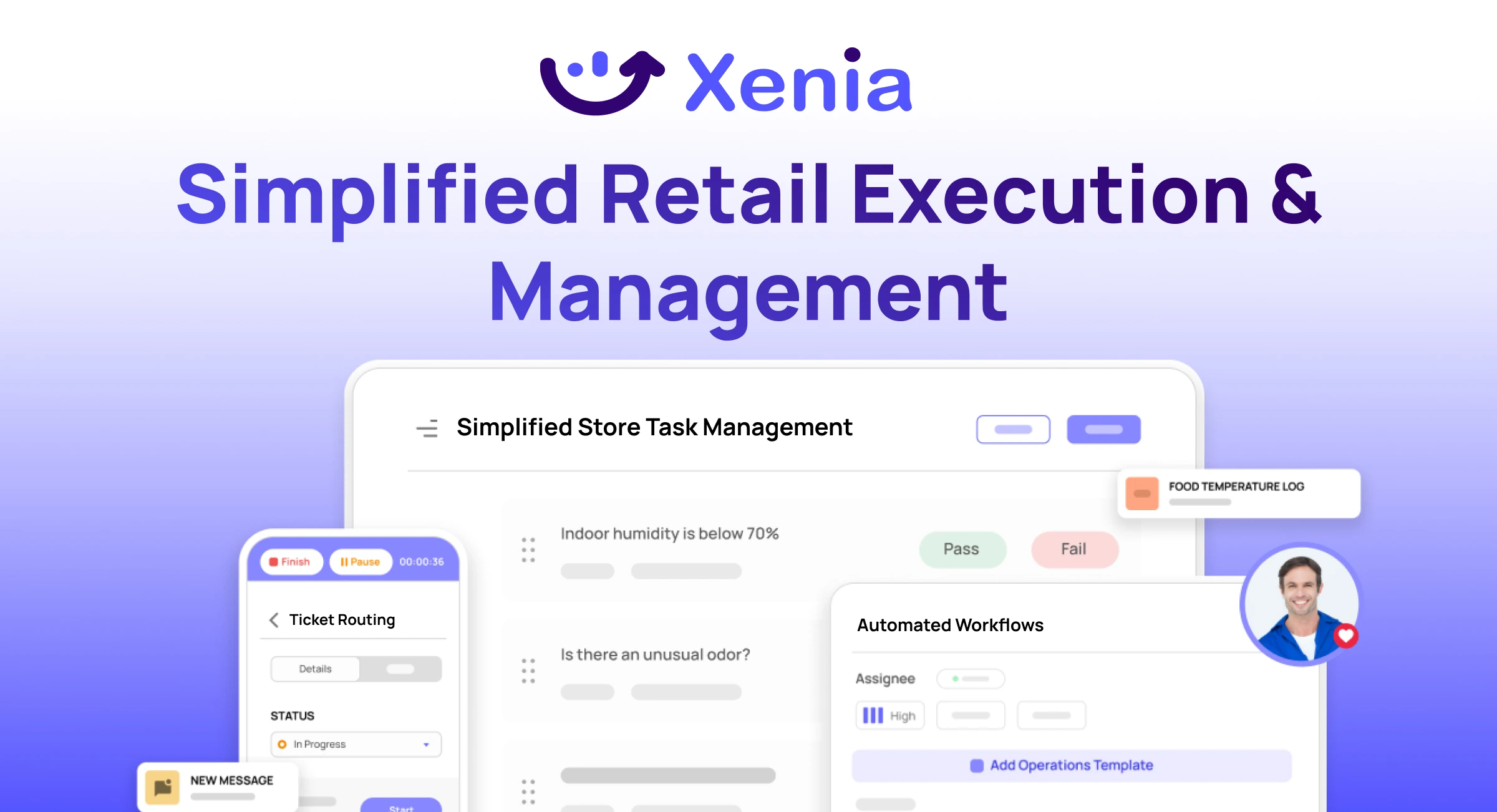
Why Retail Operators Choose Xenia:
🤖 AI-Powered Merchandising, Verify planograms, displays, and brand standards automatically with AI photo analysis. Build digital checklists instantly or convert existing merchandising guides.
🏬 Operations & Loss Prevention, Assign opening procedures, store walks, and resets across locations. Track theft, cash discrepancies, and security incidents with evidence and approval workflows.
📊 Real-Time Visibility, Compare audit scores and task completion across stores. Identify top and underperforming locations. Export reports for leadership reviews.
One platform for operations, merchandising compliance, and loss prevention across all locations.

.svg)
.webp)
%201%20(1).webp)

.svg)
%201%20(2).webp)