
.webp)
Post Summary
You walk into a store you visited 18 days ago. The promotional display is three weeks behind. The planogram is off in two zones. The opening checklist is signed as complete, but at least 4 items clearly were not done.
Nothing was flagged. Nobody called. On paper, this store passed.
That is the gap at the center of multi-location retail. Not bad intentions. Not a lazy team. The problem is structural: HQ sets the standard, but there is no reliable system connecting that standard to what actually happens on the floor every single day. A DM can visit every two weeks. An Area Manager might walk 12 stores in a month. Between those visits, most brands are essentially operating blind.
Retail operations execution is the term for the layer that is supposed to close that gap. It is everything between the mandate and the store reality. When it works, your 40 locations look and run the same way. When it does not, you spend most of your week reacting to whoever called with a problem last.
This guide lays out the five-component framework for building a retail operations execution system that actually works. Not a checklist app. Not a new visit schedule. A system.
.webp)
.svg)

Priced on per user or per location basis
Available on iOS, Android and Web


Recommended Resources
- Retail Execution Strategy: How DMs Drive Brand Standards
- Retail District Manager Store Walkthrough and Audit Checklist
- Multi-Unit Operations Execution
- Retail Task Management
- Operations Execution System
What is retail operations execution (and why it is not the same as retail management)?
Retail operations execution is the sum of everything that happens at store level, on a daily basis, to turn your standards into visible, measurable reality. It is the opening checklist getting done correctly before the first customer walks in. It is a planogram getting set to spec, not just close enough. It is a spill cleaned, a price tag updated, a display changed out on the day it was scheduled, not four days later.
Retail management is the layer above that. It covers organizational structure, strategic planning, resourcing, and decisions that shape how the business runs. Management determines what the standard should be. Execution determines whether that standard ever actually reaches the floor.
**
Aspect, Retail Management, Retail Operations Execution
Primary focus, Direction-planning-structure, Daily delivery of standards at store level
Sets, Brand standards and policies, Verifies those standards are applied
Operates, Above-store, At store level
Measures success by, Strategy and decisions, Task completion-compliance rate-issue resolution
Fails when, Strategy is unclear, Execution layer is missing or broken
**
Most multi-location retail brands have competent management. Clear brand standards. Documented procedures. Structured district teams. The weak link is almost always the execution layer sitting between those well-documented standards and what store teams actually do each day.
Here is the simplest way to think about it.
Management answers: what should our stores look like and how should they operate?
Execution answers: did that happen today, in all 40 locations, and can we prove it?
When brands treat execution as a management problem, they typically respond to inconsistency by adding meetings, increasing visit frequency, or applying more pressure.
None of that works long-term because the underlying architecture has not changed. The standard is still not reaching the floor reliably. Compliance is still self-reported. Issues are still discovered on visits rather than flagged before visits.
For multi-location retail operations, this distinction is not semantic. Getting it right determines how you invest in tools, processes, and team development.
Why brand standards keep breaking down, even when DMs are trying
The primary reason brand standards break down across a retail network is not effort. Most DMs are working hard. Most store managers want their location to look right. The problem is visibility. A DM visits once or twice a month. What happens in the other 26 days is largely invisible without a proper system in place.
When store teams know that verification only happens during a scheduled visit, the incentive to maintain standards every single day weakens naturally. Not because people are dishonest, but because human nature responds to accountability structures. No visibility, no consistent accountability. No consistent accountability, no consistent execution.
Understanding that is the starting point. But there are several other factors that compound the breakdown in retail store execution.
Here are the specific mechanisms that cause brand standards to slip, even on well-managed retail networks:
Paper-based processes have no proof layer. A printed checklist signed off at 7:15am tells you one thing: someone held a pen. It does not tell you whether the task was completed, whether it was completed correctly, or whether the person who signed it even looked at the items listed. There is no timestamp. No photo. No way to verify remotely. A DM gets a form that says "done." The floor may say otherwise.
Pencil-whipping distorts your compliance picture. Pencil-whipping is the practice of marking tasks complete without actually doing them. It is more common in retail than most brands acknowledge openly, and it is not always intentional dishonesty.
Store teams face genuine time pressure. Short-staffed shifts, rushed openings, competing priorities. The checklist becomes a formality rather than a record of work. The result is that brands believe their compliance rate is 90% when the actual store reality is closer to 60%.
Geography caps what a single DM can cover. A DM managing 15 stores and visiting each one twice a month is physically present in each location for roughly four to six hours out of a 30-day period. That is a structural ceiling.
No matter how skilled or dedicated that DM is, the math limits how much direct oversight is possible. The stores that are hardest to visit often develop the widest execution gaps.
There is no structured escalation path for small issues. A store associate notices that a display fixture is broken. There is no system to flag it formally, assign it to someone, and track the fix. So the associate either mentions it to the store manager verbally or ignores it.
The store manager may tell the DM on the next call or forget entirely. Six weeks later, the same broken fixture comes up on a visit report. Nothing malicious happened. The process just had no mechanism to surface and resolve small issues before they compounded.
Promotional rollouts rely on trust, not verification. A new campaign launches. Assets are distributed. Stores are briefed. But there is no way to confirm that all 40 locations set the display correctly on day one unless someone visits each store.
Brands routinely discover mid-campaign that a third of their locations executed the promotional setup wrong. By then, the window for correction is already half-closed.
"I have no idea what's happening across my stores between visits. By the time I find out something is wrong, it has already been wrong for two weeks." - Regional Director, multi-unit retail chain
This is why adding more visits or applying more management pressure rarely solves the problem. You are not dealing with a motivation gap. You are dealing with a structural gap in your retail operations execution architecture.
The 5 components of a retail operations execution system
A functional retail operations execution system is not a single software platform or a better-designed checklist. It is five connected components working together to close the loop between what HQ mandates and what store teams deliver daily.
These five components are the framework that anchors the entire retail execution cluster. Each one matters on its own. But the system only produces consistent multi-location retail operations when all five are in place and connected.
**
Component, What it replaces, Execution outcome it enables
Standards definition, Printed binders-emailed PDFs, Every store runs the same current standard
Task distribution, Verbal reminders-group texts, Right task to the right person at the right time
Verification, Self-reported sign-offs, Photo proof-timestamped-remotely reviewable
Corrective action, Phone calls-email threads, Tracked loop from issue to documented resolution
Visibility dashboard, Monthly visit reports-gut feel, Real-time cross-location performance data
**
1. Standards definition
Execution starts with clarity. If your brand standards are not documented precisely, version-controlled, and visually clear, you cannot hold stores accountable to them consistently.
"The display should look right" is not a standard. A photograph of the correct setup with labeled components and placement measurements is a standard.
Standards definition means:
- Every procedure exists in a single, accessible location
- Visual references accompany written instructions wherever clarity requires it
- Version control ensures every store is working from the current standard, not a version from 18 months ago
- Updates reach all locations simultaneously rather than trickling through email chains
When this component is missing, you end up with stores following four different versions of the same procedure because they printed the checklist at different points in time. Enforcement becomes inconsistent because the reference point itself is inconsistent.
2. Task and checklist distribution
Once standards are defined, they need to reach the right person, in the right role, at the right time. Not via a shared folder that people theoretically have access to. Not via a group text at the start of the week. Directly, in a mobile format, assigned specifically to the individual responsible for completing each item.
A store associate should not have to search for their morning checklist. It should appear on their device at the start of their shift, with their specific role's tasks already filtered in. A closing manager should receive a different set of tasks than an opener. A department lead's checklist should not look the same as a general floor associate's.
This is where retail task management becomes a core structural component rather than an administrative convenience. Proper task distribution is the mechanism that connects standards to the people responsible for executing them. Without it, you are relying on memory, verbal handoffs, and paper handouts. All of which degrade quickly across a multi-store network.
Role-based, scheduled, mobile task distribution also builds a natural accountability rhythm. Tasks are time-stamped. Completion is logged. Overdue items are flagged automatically. Nobody needs to follow up manually on whether something got done.
3. Verification
This is the component most retail brands are missing entirely, and it is the one that changes everything about how compliance works across a large network.
A task marked complete is not the same as a task completed correctly. Verification means photo proof, not self-reported status. When a store team member completes a display setup, they photograph it. When a cleaning checklist item is done, a photo confirms it. When opening procedures are finished, the condition of the store at that moment is documented.
That photo record does several things at once:
- A DM can review execution quality across 15 stores without leaving their desk
- An Area Manager can confirm that a promotional rollout was set correctly at all 40 locations on day one
- Discrepancies between the signed checklist and the photo become visible immediately
- Over time, the photo record creates a performance baseline for each location
Without verification, your completion rate data is not data. It is self-reporting. It tells you how often store teams say they completed tasks. It does not tell you whether they did, or whether the quality met standard.
Photo-based verification also changes the dynamic on the store floor. When teams know that completion is documented visually, pencil-whipping stops being viable. This is not about surveillance. It is about creating an honest record that actually reflects what happened.
4. Corrective action
Every retail network has issues. Displays that go up wrong. Procedures that get skipped. Equipment that breaks down and does not get reported. The question is not whether issues occur. It is whether the system catches them quickly and closes the loop.
A corrective action workflow means: issue identified, task created, owner assigned, deadline set, resolution documented. That loop needs to happen inside the same system where the original task lived, not in a parallel chain of texts and emails.
Right now, most retail brands handle corrective action through informal communication. A DM spots a problem on a store walk, tells the manager, texts a follow-up reminder two days later, and hopes it got resolved before the next visit. There is no record. No escalation path if it does not get fixed. No visibility from above.
That process works fine for a five-store operator with one DM who visits weekly. At 30 or 50 stores, it falls apart completely. Issues get lost. The same problems come up on consecutive visits. DMs spend a disproportionate amount of time chasing resolutions that the system should handle automatically.
A closed-loop corrective action workflow makes every issue visible, owned, and tracked from identification to sign-off. It is what separates a retail execution system from a compliance checklist.
5. Visibility dashboard
This is what ties everything together for Area Managers, Regional VPs, and above. A real-time cross-location dashboard that shows task completion rates by store, corrective action close-out times, repeat violation flags, and trend data over rolling time periods.
Without this, a Regional VP is making decisions based on the most recent visit report or the last conversation they had with a DM. That is inherently reactive. By the time a problem appears in a visit report, it has already been a problem for days or weeks.
With a visibility dashboard, the Regional VP can see on any given morning which stores are below task completion threshold, which corrective actions have been open longest, which locations keep flagging the same issue across multiple cycles, and which DMs are generating the most actionable findings per visit.
That is a completely different leadership posture. Instead of reacting to problems that have already developed, field leaders can intervene early, allocate coaching time to the locations that most need it, and recognize stores that are consistently performing.
How execution accountability works at scale without adding headcount
Scaling retail store execution without scaling headcount is the core challenge for every growing multi-location brand. The instinct is to respond to inconsistency by hiring more DMs or adding more visits. That approach has a ceiling, and it is lower than most brands think.
When you have 10 stores, a small team of DMs can personally follow up on almost everything. When you have 50, the same model collapses. Each DM becomes a full-time follow-up machine. Phone calls, texts, check-in visits. Their calendar fills with reactive work and leaves almost no room for the coaching and development conversations that actually build long-term store performance.
A properly designed retail operations execution system moves accountability into the workflow itself rather than placing it entirely on the DM's bandwidth.
Here is what scalable execution accountability actually looks like:
Automated alerts replace manual follow-up calls. When a task is overdue, the system sends a notification. The store manager sees it. The DM gets visibility into which stores have unresolved overdue tasks without having to call each one. The problem surfaces automatically rather than getting discovered on the next visit.
Daily completion rate views replace monthly visit impressions. Instead of waiting for a store walk to assess execution health, an Area Manager checks a dashboard each morning. Stores consistently below threshold get prioritized for follow-up. Strong performers get recognized. The signal is daily, not episodic.
Escalation paths are built into the workflow. An unresolved issue at store level automatically escalates to the DM tier after a defined time window. A DM-level issue that is not addressed escalates to the Area Manager. Nobody had to make a phone call. There is a visible, time-stamped trail showing exactly how long each issue has been open and who is responsible for closing it.
Recurring tasks run without management intervention. Opening procedures, closing checklists, daily cleaning schedules, weekly display audits. Once the system is set up, these tasks appear on the right devices at the right times automatically. A DM does not need to remind anyone. The workflow handles distribution and tracks completion.
This is the shift that lets a single DM manage 15 stores at a high standard. The system handles the routine monitoring and follow-up. The DM handles coaching, development, and exception management. That is a better use of a skilled field leader, and it produces measurably better outcomes over time.
For a practical breakdown of how DMs can operationalize this cadence day-to-day, the Retail Execution Strategy guide covers visit structure, accountability rhythms, and team development in detail.
How to evaluate whether your execution system is working
Most retail brands have a sense that their execution could be better. Fewer have a clear way to measure exactly where it is breaking down. These four metrics give you a reliable diagnostic.
**
Metric, What it tells you, Warning signal
Task completion rate, Daily execution health across the network, Below 85% consistently across locations
Corrective action close-out time, Whether identified issues actually get resolved, No tracking system exists
Repeat violations, Whether fixes are sticking, Same flag appearing on consecutive store visits
DM visit-to-issue ratio, Quality and thoroughness of field inspection, Low ratio combined with low completion rate
**
Task completion rate across all locations
This is the most direct signal of daily execution health. If stores are consistently completing 60 to 70 percent of their assigned tasks, the system is not working regardless of what visit reports say. A healthy baseline for a functioning retail execution system is above 90 percent.
Anything below that warrants a structured conversation: Is the task list unrealistic in volume? Are tasks assigned to the right roles? Is the distribution method actually reaching people? The completion rate tells you something is wrong. The conversation after tells you what.
Corrective action close-out time
How long does it take from when an issue is identified to when it is resolved and documented? If the honest answer is "we do not track that," you do not have a corrective action system. You have a flagging system that stops at identification.
Close-out time tells you whether your execution loop is actually closing. A growing backlog of open corrective actions is one of the clearest early indicators that a retail network is heading toward a compliance problem at scale.
Repeat violations
The same issue appearing on two consecutive store walks is the most direct signal that your corrective action process is not working. The fix was either applied incorrectly, was not applied at all, or addressed a symptom without touching the root cause.
Tracking repeat violations by location and by issue type lets you distinguish between isolated failures and systemic patterns. An isolated failure is a people conversation. A systemic pattern is a process conversation.
DM visit-to-issue ratio
How many actionable items does a DM typically generate per store visit? This metric is useful when paired with task completion data. A low visit-to-issue ratio in a store with consistently low completion rates is a red flag. It suggests that either the DM's inspection process is not thorough enough, or issues are being identified and then not formally logged.
A high ratio in a store with strong completion rates suggests the visit is working correctly: the system is catching most routine compliance gaps automatically, and the DM is surfacing edge cases and development opportunities.
What consistent retail execution makes possible
When the five components are working together, the experience at your stores changes at every level. Not just for DMs and Regional VPs. For everyone.
Store teams operate with clarity. Tasks are assigned, visible, and time-specific. A store associate does not have to guess what needs to happen by the end of their shift. A closing manager does not need to reconstruct the procedure from memory.
The work is laid out. Completion is tracked. Issues that go beyond a team member's authority to resolve have a clear path to get flagged and owned.
That clarity reduces friction on the floor. Less time figuring out what to do, more time doing it. Smaller teams can maintain higher standards because the system is carrying some of the coordination burden.
DMs make the shift from firefighting to coaching. This is probably the biggest operational change that comes with a functioning execution system.
When follow-up, verification, and escalation are handled in the workflow, a DM's time in the store becomes about people development rather than issue discovery. Visit conversations shift from "here is what I found wrong" to "here is what the data shows, let us talk about how to improve it."
That is a materially better use of a DM's skill set. And over time, it produces better store performance because store managers are getting substantive coaching rather than reactive corrections.
Promotional rollouts actually land. A campaign goes live across 35 locations. By end of day, the Area Manager has photo verification from every store confirming the display is up and correct. No calls required. No next-visit discovery that six stores did it wrong. The execution is visible, documented, and confirmed the same day.
For multi-location retail brands, the ability to verify a same-day rollout across every location is genuinely transformative. It means the marketing investment in a promotional campaign is not diluted by inconsistent field execution.
Brand standards hold without creating a surveillance culture. When accountability is built into the workflow rather than enforced primarily through unannounced visits and disciplinary follow-up, the relationship between field leadership and store teams changes in tone. Standards are maintained because the system makes compliance easy and visible, not because people are anxious about getting caught.
Store teams tend to respond well to this. Clear expectations, visible completion, straightforward escalation when something needs fixing. That is a more professional environment than one where accountability only appears in the form of a critical visit report.
Area Manager time shifts to high-value strategic work. When repeat issues are flagged automatically and completion rates are visible in a real-time dashboard, the Area Manager conversation becomes genuinely strategic.
Which stores need infrastructure investment? Which DMs need development support in specific areas? What trends are emerging across the region before they become systemic problems? Which locations are ready for increased responsibility?
That is the conversation an Area Manager should be having. It only happens consistently when the execution layer is handling routine monitoring automatically.
This is what a functioning multi-location operations execution system produces across the network over time. Not a single dramatic improvement, but a sustained lift in standards, consistency, and field leader effectiveness.
How Xenia closes the gap between HQ standards and store reality
Xenia is a retail operations execution software built for multi-unit retail brands. It connects all five components of retail operations execution in a single mobile-first platform: digital checklists with role-based assignment, photo-based verification, closed-loop corrective action, and real-time dashboards that give Area Managers and Regional VPs cross-location visibility without waiting for a visit report.
Schedule a demo to see how Xenia unifies task management, photo verification, and multi-location dashboards into a single retail execution system.
.webp)
Conclusion
Inconsistent stores rarely come down to bad people. They come down to a broken system.
When there is no proof layer, no structured escalation, and no cross-location visibility, gaps will fill themselves. Standards slip. Issues compound. DMs spend their weeks reacting instead of leading.
The five-component framework fixes the architecture. Standards, distribution, verification, corrective action, visibility. Get all five working and stores run to standard without a DM needing to be present every week. Field leaders coach instead of chasing. Above-store leaders see the full picture in real time instead of waiting for the next visit report.
That is what retail operations execution looks like when it is built correctly.
If your network is still running on paper checklists, manual follow-ups, and visit-based accountability, Xenia is worth a look. It is built specifically to close the gap between what HQ mandates and what actually happens on the floor, across every location, every day.
Schedule a demo to see how it works.
Frequently Asked Questions
Got a question? Find our FAQs here. If your question hasn't been answered here, contact us.
How is retail field operations different from general store management?

Store management is one location. Field operations is the layer above it: DMs, Area Managers, and Regional VPs managing consistency across many stores. The job is not running a single store well. It is making sure 20 or 40 stores all run the same way, without being physically present in each one every week.
Can a DM effectively manage more stores without lowering standards?
Yes. When the system handles alerts, flags overdue tasks, and escalates unresolved issues automatically, the DM is freed up to actually coach. The monitoring work shifts to the platform. The DM handles people. That is how you scale without hiring more headcount.
What does a full retail operations execution system include?
Five things: clear and version-controlled brand standards, mobile task distribution by role, photo-based verification, a closed-loop corrective action workflow, and a real-time dashboard across all locations. You can have one or two of these and still have gaps. All five working together is what makes execution consistent.
What four metrics best measure retail store execution performance?
These four tell you most of what you need to know:
- Task completion rate by location
- Corrective action close-out time
- Repeat violations (same issue, multiple visits)
- DM visit-to-issue ratio
Together they show whether stores are hitting standards daily, whether fixes are actually sticking, and whether your DMs are surfacing the right issues in the field.
What is pencil-whipping and how does it affect retail compliance?
Pencil-whipping is checking off tasks that were never done. It happens when store teams are short on time and checklists have no proof layer. Nobody verifies. So the task gets marked complete and life moves on. The result: your compliance data looks healthy while your stores are not. Photo verification kills this problem fast.
Why do brand standards keep slipping even in well-managed retail networks?
Because DMs can only be in one place at a time. A store gets visited once or twice a month. Everything in between is invisible. Paper checklists get signed whether tasks were done or not. Issues have no clear place to go. By the time a DM finds the problem, it has been a problem for two weeks. That is not a people failure. That is a visibility failure.
What is the difference between retail operations management and retail operations execution?
Management is the planning layer. It sets standards, allocates resources, and structures the organization. Execution is what happens on the floor every day. Did those standards actually get followed? In every store? That is the execution question. Most retail problems live in the gap between the two.


A Modern, AI-Powered Platform Built for Retail Operations
Xenia brings store operations, merchandising, audits, and loss prevention into one mobile-first platform. Store teams execute daily work consistently, maintain brand standards, and resolve issues faster, while regional and corporate leadership get real-time visibility across all locations.
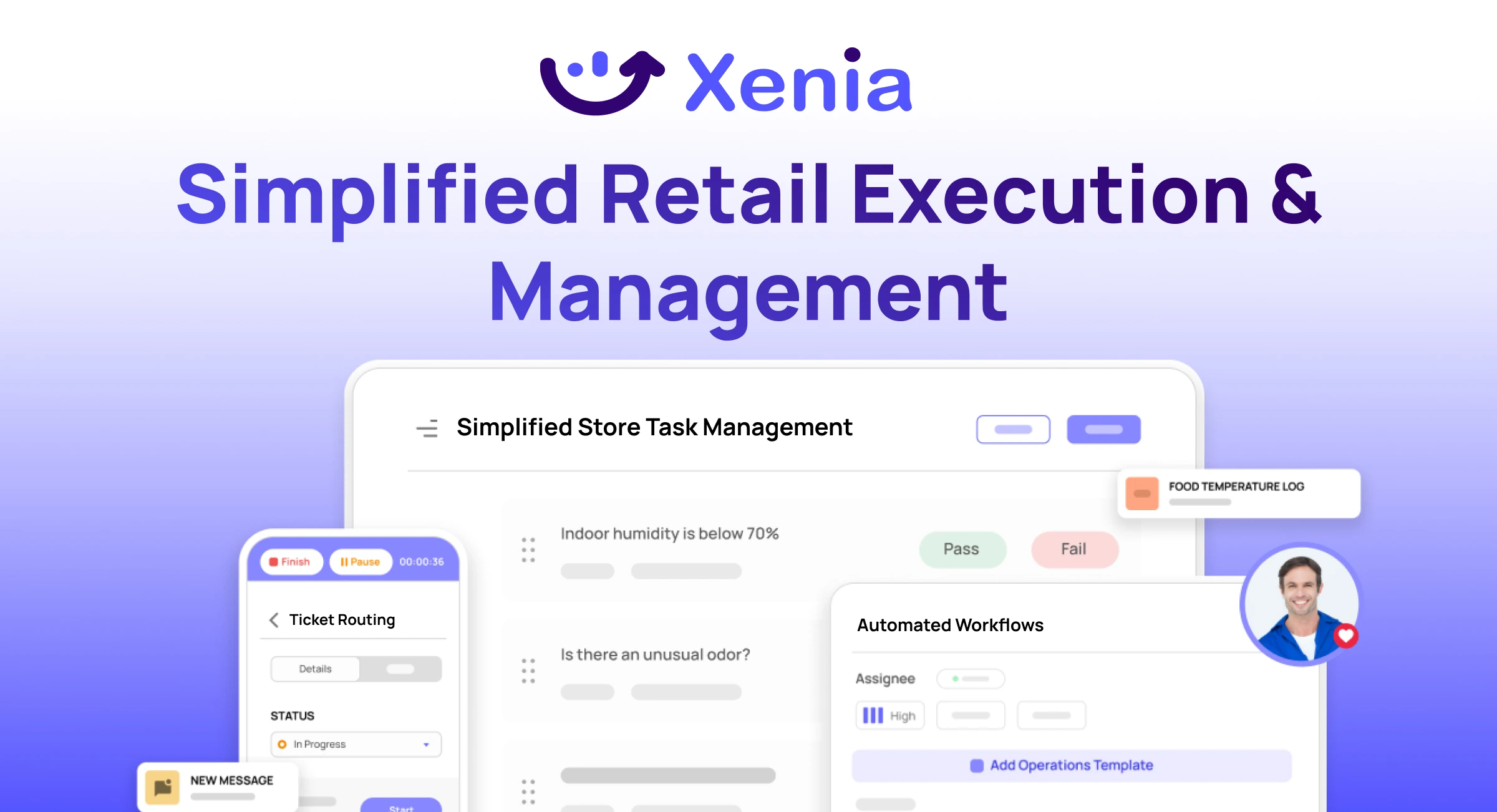
Why Retail Operators Choose Xenia:
🤖 AI-Powered Merchandising, Verify planograms, displays, and brand standards automatically with AI photo analysis. Build digital checklists instantly or convert existing merchandising guides.
🏬 Operations & Loss Prevention, Assign opening procedures, store walks, and resets across locations. Track theft, cash discrepancies, and security incidents with evidence and approval workflows.
📊 Real-Time Visibility, Compare audit scores and task completion across stores. Identify top and underperforming locations. Export reports for leadership reviews.
One platform for operations, merchandising compliance, and loss prevention across all locations.

.svg)
.webp)
%201%20(1).webp)

.svg)
%201%20(2).webp)