
.webp)
Post Summary
Retail shrinkage is not a new problem. But at scale, it gets expensive fast.
According to the NRF's 2023 National Retail Security Survey, shrink hit $112.1 billion in 2022. That is 1.6% of total retail sales. For an operator running 20, 50, or 100+ locations, that number translates to millions written off every year before a single customer complaint lands on your desk.
Here is what most loss prevention content gets wrong. Training alone does not move the shrink rate. You can run the best LP program in the industry and still watch numbers spike at locations where cycle counts are skipped, receiving is unsupervised, and GMs have never seen how their store compares to the rest of the network.
What actually works is an operational system. One that runs the same way at every location, catches variance early, and closes the gap before a 0.5% problem turns into a 4% problem.
This is that playbook.
.webp)
Related resources
.svg)

Priced on per user or per location basis
Available on iOS, Android and Web


The 5 sources of inventory and retail shrinkage
Before you can build a prevention system, you need to know what you are actually preventing. Shrinkage does not come from one place. It comes from five.
**
Source, Share of Total Shrink, Common Examples
External theft / shoplifting, 35-40%, Grab-and-go-organized retail crime-return fraud
Employee theft, 28-35%, Cash skimming-discount abuse-product theft
Administrative and paperwork errors, 15-20%, Mislabeled products-pricing errors-scan errors
Vendor fraud and receiving errors, 5-10%, Short shipments-substituted products-improper credits
Damage and waste, 5-8%, Food spoilage-breakage-improper handling
**
This breakdown matters operationally because each category needs a different response. A CCTV investment only addresses external theft. An audit program that catches receiving errors does nothing for employee discount abuse. You need coverage across all five, or your shrink rate will never consistently drop.
The 65% of shrinkage that comes from internal causes (employee theft plus administrative error plus vendor fraud) is the part most operators underinvest in. It is also the part most responsive to operational controls.
Why shrinkage is harder to control at 50+ locations
Running one store is hard. Running 50 is a different problem entirely.
Location-level variance is the first challenge. One of your stores might run at 0.5% shrink. Another runs at 4.8%. Both get the same LP training. Both have CCTV. The difference is almost always operational, not situational.
Manager turnover destroys controls. Every time you turn over a GM, the institutional knowledge of "what we do here" walks out the door. If your shrink controls are tribal knowledge rather than documented, enforced processes, they evaporate with the people who held them.
Your LP team cannot be everywhere. Even if you have a dedicated loss prevention officer, they cover a territory. Stores between visits have no consistent external pressure. Without daily operational controls baked into the GM's routine, those stores drift.
Inconsistent cycle counts are another common gap. Some locations count weekly. Some count monthly. Some count "when we get around to it." Without a standard cadence enforced across every location, your inventory data is unreliable, and you cannot benchmark locations against each other meaningfully.
The result is that your shrink % across locations looks like a lottery ticket, not a managed metric. Some locations accidentally get it right. Most just contribute to the average.
A 6-step operational shrinkage prevention system
This is the system that actually moves shrink %. Not any one tactic in isolation, but all six working together.
Step 1: Weekly cycle counts by category
Cycle counts are the foundation. Not annual physical inventory, not quarterly, but weekly counts by category or zone. The purpose is not to count everything at once. It is to catch variance fast enough to investigate it while the trail is still warm.
A location running weekly cycle counts will catch a receiving discrepancy in days, not months. That is the difference between recovering the loss and writing it off.
Step 2: Theoretical vs actual variance review
Every week, your POS should be telling you what you should have sold. Your inventory counts should tell you what actually left the shelf. The gap between those two numbers is your variance. If you are not reviewing this weekly at both the location and district level, you are flying blind.
Run this as a standard part of your weekly ops review. Flag locations where variance exceeds your threshold. Assign follow-up. Close the loop.
Step 3: Daily audit and line check enforcement
Daily operational checks are where shrink is caught at the source. Receiving dock controls, cash register reconciliation, high-value merchandise spot checks, and line checks should all be part of the daily routine at every location.
The problem with paper-based or informal processes is that they do not get done consistently, and when they do, there is no way to verify the data is real. Xenia's Audits and Inspections platform lets you build weighted audit workflows that flag critical failures automatically and route corrective actions to the right person without waiting for a district manager visit.
Step 4: Per-shift cash handling controls
Cash is still one of the most common vectors for shrink in both retail and restaurants. Per-shift reconciliation with dual-control verification and digital sign-off removes the ambiguity from cash handling. It also creates an audit trail that makes investigation far easier when discrepancies surface.
See Xenia's related guide on cash handling procedures for retail for a detailed breakdown of controls that work at scale.
Step 5: CCTV and EAS as the reactive layer
CCTV and electronic article surveillance are important. But they are reactive by nature. They document theft rather than prevent the operational conditions that allow it to flourish. Use them as a layer in your system, not as the system itself. Pair them with vendors like Solink or Verkada for analytics capability, and Auror or ThinkLP for LP-specific incident tracking.
Step 6: The corrective action loop
This is the step most operators skip, and it is the reason shrink stays flat year over year despite good intentions. Every variance, every audit failure, every receiving discrepancy needs to generate a corrective action that is assigned, tracked, and verified. Not noted. Not discussed in a meeting. Actually closed.
Without this loop, your audit data is just a snapshot. With it, it becomes a system. Xenia's corrective action tracking functionality connects audit failures directly to assigned tasks with due dates and completion verification so nothing falls through.
Multi-location shrinkage benchmarking
Here is something that changes the dynamic at most multi-unit operations: once you have consistent data across locations, you can rank them.
**
Shrink %, Classification, Action
Below 0.8%, Top performer, Document and replicate playbook
0.8% to 1.5%, On target, Maintain controls-monitor variance
1.5% to 2.5%, Watch list, Increase audit frequency-review cycle counts
Above 2.5%, Investigate, District manager visit-root cause analysis
**
The top 3 worst-performing locations get a root cause investigation, not just a warning. Is it a receiving gap? A cash handling issue? A specific category driving the variance? You cannot fix what you have not diagnosed.
The bottom performers, your best locations, are where you mine for the playbook. What are they doing that others are not? That answer is almost always operational, not situational.
Ranked benchmarking across locations moves the average faster than any individual location intervention. If every location can see where they sit relative to their peers, performance improves without a single additional LP hire. Xenia's multi-unit operations dashboard surfaces this kind of cross-location data in real time.
Restaurant vs retail shrinkage: same categories, different tactics
The five categories of shrink are universal. But the tactics to address them look different depending on your format.
Retail shrinkage focus areas:
- Shoplifting and organized retail crime at high-value merchandise areas
- Employee discount abuse and unauthorized returns
- Receiving errors and short shipments
- Return fraud (9% of all returns are fraudulent per NRF's 2025 data)
- Administrative pricing and scan errors
Restaurant shrinkage focus areas:
- Food spoilage from improper storage and rotation
- Portion drift (theoretical food cost vs actual)
- Comp and void abuse at the POS
- BOH theft of high-value proteins and alcohol
- Receiving discrepancies on produce and protein orders
The operational controls look similar at a process level: cycle counts, receiving checklists, variance review, corrective action loops. But the daily execution is format-specific. A restaurant needs temperature logs and prep waste tracking. A retailer needs blind count verification and return processing controls.
For teams managing both formats, see the related guides on retail loss prevention training and restaurant loss prevention training to understand the format-specific LP training layer that sits on top of these operational controls.
Tools that support multi-location shrinkage prevention
No single tool solves shrinkage. You need a stack that covers the different layers of your prevention system.
**
Category, What it does, Examples
Operations execution, Audits-corrective actions-daily checks, Xenia
POS exception reporting, Flags unusual transaction patterns, Built into most POS platforms
CCTV with analytics, Video monitoring with loss pattern detection, Solink-Verkada
LP-specific platforms, Incident tracking-ORC case management, Auror-ThinkLP
Inventory management, Food cost and inventory variance, MarketMan-Restaurant365
**
Xenia sits in the operations execution layer. It is not a replacement for LP-specific tools like Auror or ThinkLP. What it does is give you the operational substrate that those tools cannot: daily audits, cycle count enforcement, corrective action workflows, and cross-location benchmarking. Those are the controls that determine whether shrink is a managed metric or a managed excuse.
For a comparison of ThinkLP alternatives in the broader LP software category, see the related article on ThinkLP alternatives.
Common multi-location shrinkage prevention mistakes
Most operators are not failing at shrinkage because they lack awareness. They are failing because of specific operational decisions that look reasonable in isolation.
Buying LP software without operations integration is the most common trap. You can invest in Auror, CCTV analytics, and EAS hardware, and still have a 3% shrink rate if your daily operational controls are inconsistent. The LP tools catch incidents. The operations system prevents the conditions that create them.
Treating shrink as a one-time audit project is the second mistake. An annual or quarterly shrink audit tells you what happened. It does not tell you what is happening right now, and it gives you no leverage to intervene before a location goes from 1.5% to 4%.
Not measuring variance weekly is the third. Weekly is the minimum frequency where variance becomes actionable. Monthly or quarterly, you are managing history.
Letting LP own it solo is the fourth and arguably the most expensive. LP can investigate and document. But shrink is a GM and DM accountability issue. If general managers are not held to a shrink % target as part of their performance metrics, LP owns the problem but not the leverage to fix it.
Conclusion
Shrinkage is a managed metric. The operators running below 1% are not lucky. They have a system: daily audits, weekly counts, variance reviews, corrective actions. That is it.
The gap between 1% and 3% shrink across 50 locations is real money. And it is almost always an operations problem, not a security one.
LP tools catch incidents after the fact. What actually moves the number is consistent daily execution at every location. Xenia's audits and inspections, inventory management, and operations platform tie your daily checks, cycle counts, cash controls, and corrective actions into one system your frontline team can actually use.
Book a demo and see how it works for your locations.
Frequently Asked Questions
Got a question? Find our FAQs here. If your question hasn't been answered here, contact us.
What is the difference between shrinkage and shrink rate?

Shrinkage is the total dollar loss. Shrink rate is that loss as a percentage of sales. Shrink rate is the number worth comparing across locations. A $40K loss at a $2M location and a $16K loss at an $800K location are both 2% shrink rates. Same problem, different scales.
How do multi-location retailers reduce shrink?
They treat it as an ops metric, not just a security metric. Weekly variance reviews, location-level benchmarking, GM accountability tied to shrink targets, and daily audit workflows that run whether or not the DM is in the building. The locations that consistently outperform have tighter daily discipline, not more LP headcount.
What is an acceptable shrinkage rate in retail?
1.5% of sales or below is the general benchmark. Top-performing locations run below 0.8%. The industry average has historically sat around 1.5% to 1.6%. If you are above 2%, that is an operations problem worth investigating, not just a theft problem worth monitoring.
How do you prevent inventory shrinkage?
You need a system, not a single fix. Weekly cycle counts, theoretical vs actual variance reviews, daily operational audits, per-shift cash controls, and a corrective action loop that actually closes gaps. Tools support the system. Consistent execution is what moves the number.
What are the main causes of retail shrinkage?
Five sources drive shrink: external theft (35-40%), employee theft (28-35%), administrative errors (15-20%), vendor and receiving fraud (5-10%), and damage or waste (5-8%). Most operators fixate on external theft. But internal causes account for over 60% of total shrink. Administrative controls and employee accountability matter just as much as security hardware.


A Modern, AI-Powered Platform Built for Retail Operations
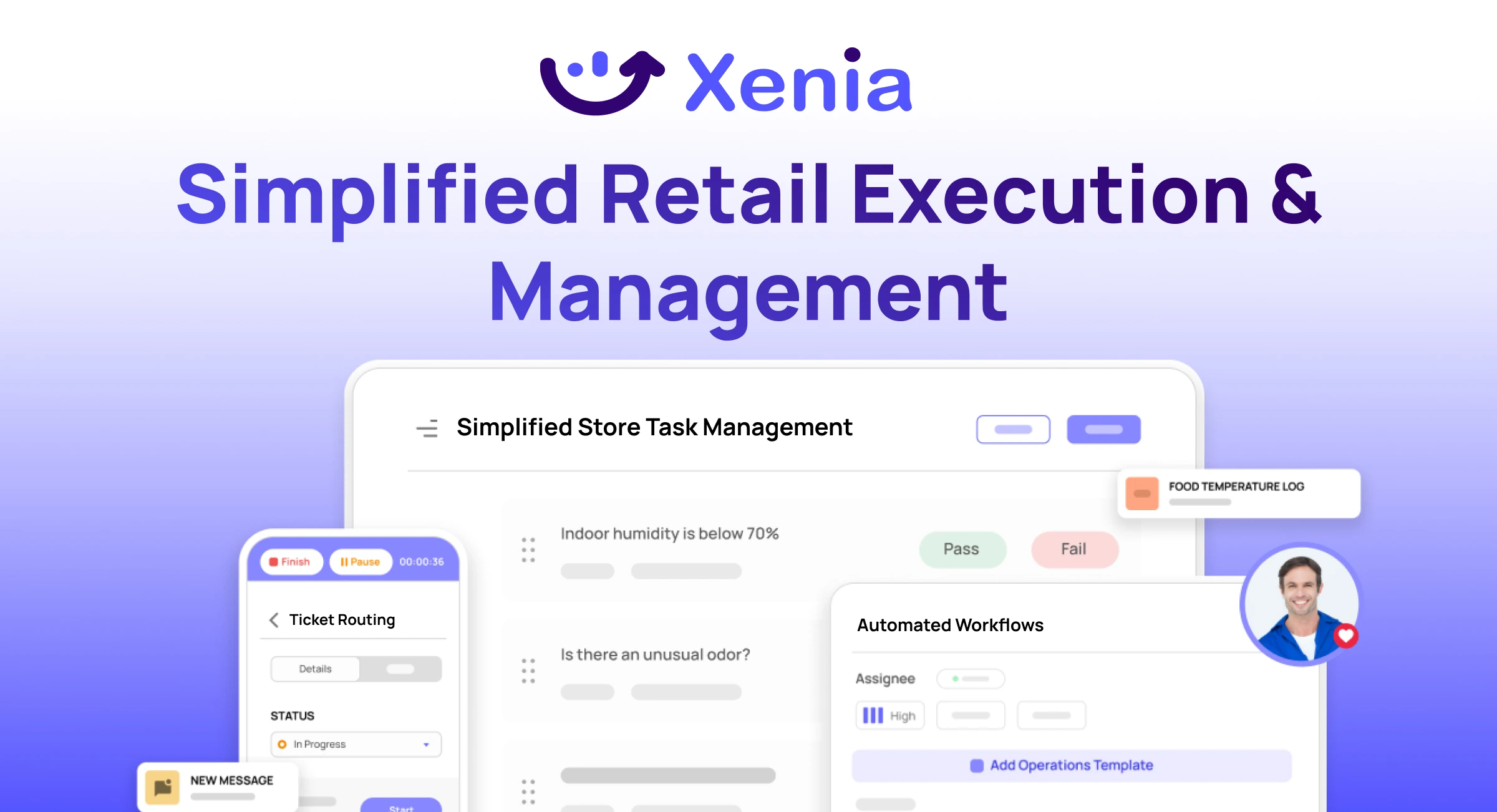
Xenia brings store operations, merchandising, audits, and loss prevention into one mobile-first platform. Store teams execute daily work consistently, maintain brand standards, and resolve issues faster, while regional and corporate leadership get real-time visibility across all locations.
Why Retail Operators Choose Xenia:
🤖 AI-Powered Merchandising, Verify planograms, displays, and brand standards automatically with AI photo analysis. Build digital checklists instantly or convert existing merchandising guides.
🏬 Operations & Loss Prevention, Assign opening procedures, store walks, and resets across locations. Track theft, cash discrepancies, and security incidents with evidence and approval workflows.
📊 Real-Time Visibility, Compare audit scores and task completion across stores. Identify top and underperforming locations. Export reports for leadership reviews.
One platform for operations, merchandising compliance, and loss prevention across all locations.

.svg)
.webp)
%201%20(1).webp)

.svg)
%201%20(2).webp)