
Post Summary
Most employee engagement programs are built for desk workers. People with corporate email. People who attend all-hands meetings and fill out annual surveys.
That is not your workforce.
Annual turnover in frontline sectors runs at 87% in quick-service restaurants, 81% in retail, and 73% in logistics and warehousing. Those numbers do not budge with a pizza party. They do not budge with a Gallup survey either. (Fountain)
What actually moves the needle is a system. One built for shift schedules, high turnover, and workers who never open a company email.
This article covers exactly that. A 3-pillar frontline engagement framework covering employee rewards programs that fit hourly reality, upward feedback that does not get filtered out, and frontline leadership training that sticks past day one.
.svg)

Priced on per user or per location basis
Available on iOS, Android and Web


Related resources
- Retail employee engagement: 15 methods that work
- Frontline employee training guide
- Deskless worker team communication
- Strategies for effective frontline employee communication
- Frontline operations platform rollout and adoption
- How to prevent employee burnout
Why standard engagement frameworks fail frontline teams
This is the part nobody wants to admit. Most engagement programmes are designed for the wrong person.
Here is what the frontline reality actually looks like:
No corporate email. Most frontline staff do not have company email addresses. If your engagement survey goes to an inbox they never open, your response rate will be around 8%. That data tells you nothing.
90-day average tenure. Annual engagement surveys measure a workforce that no longer exists. By the time the results come back, half those people have left.
No time for long training. A supervisor opening a store at 7am does not have 60 minutes for a training module. Every engagement tool you deploy needs to fit inside the shift, not compete with it.
Feedback gets filtered. Most frontline feedback has to travel through a direct manager before it reaches anyone with power to act on it. That manager is often the subject of the feedback. You can guess what happens to it.
These four realities explain why hourly employee engagement initiatives fail. Not because engagement does not matter. Because the tools were never built for this environment.
The 3-pillar frontline engagement framework
Here is the framework at a glance before going deeper on each pillar.
**
Pillar, What it solves, Cadence
Employee rewards program, Recognises performance tied to real KPIs, Weekly or per shift
Upward feedback, Gives staff a direct voice to leadership, Weekly pulse survey
Frontline leadership training, Builds supervisor behaviours that retain people, Pre-shift microlearning
**
Each pillar works on its own. But when all three run together as a single weekly workflow inside your existing shift structure, the impact compounds.
Pillar 1: employee rewards programs that actually work for hourly staff
Most frontline rewards programs are designed for corporate employees. Annual bonuses. Year-end awards. Quarterly recognition cycles.
That is the wrong design for hourly workers. Here is what actually works.
Frequency beats size every time. A $10 gift card given the same week as the behaviour you want to reinforce is worth more than a $200 bonus that arrives months later with no clear connection to anything specific. Shorter gap between action and reward equals stronger signal.
Peer recognition matters as much as top-down. When your employee rewards program only flows from managers downward, you create a ceiling. When peers can recognise each other, recognition becomes part of the team culture, not a management checkbox. Platforms like Kudos, Bonusly, and Awardco are built for this model.
Tie rewards to operational KPIs. Rewarding "great attitude" is subjective and impossible to scale. Rewarding a team for hitting a weekly audit pass rate, a service speed target, or a customer satisfaction score gives recognition a real anchor. It also connects your frontline rewards directly to the numbers you already track.
Mix cash and non-cash options. Not every reward needs to be money. Schedule priority, public shoutouts at team huddles, extra break time, and branded merchandise all carry genuine value for hourly workers.
**
Reward type, Best use, Suggested frequency
Gift cards ($10-25), Individual KPI milestone, Weekly or bi-weekly
Peer shoutouts, Culture building, Daily or per shift
Schedule priority, Consistent top performers, Monthly
Team celebration, Location hitting a group target, Quarterly
Public recognition board, Visible individual wins, As earned
**
Xenia's employee accountability platform lets managers log recognition moments directly inside the system, tied to specific task completions or audit results. Recognition stays grounded in operational data, not personal opinion. That matters when you are managing across 20, 50, or 100 locations.
For retail-specific tactics, the guide on retail employee engagement covers 15 format-specific methods that sit well on top of this framework.
Pillar 2: upward feedback that actually gets heard
Upward feedback means feedback from frontline staff to their manager and to the leadership above them.
Most organisations say they want it. Almost none have a system that delivers it without distortion.
The problem is structural. In most frontline environments, the only channel for upward feedback is the direct manager. That same manager is often the subject of the feedback. Even with the best intentions, this creates a filter that most honest input does not survive.
Here is what fixes it.
Mobile-first anonymous pulse surveys. Instead of an annual survey nobody fills in, a two-question weekly pulse pushed to a mobile device gets real data from the people doing the actual work. Keep the questions short and specific. "Did your manager give you clear direction this week?" beats "How satisfied are you with your working environment?" every single time.
Weekly micro-pulses beat annual surveys for three reasons:
- The data is current. You catch problems in days, not quarters.
- You can spot a dip at one location before it becomes a resignation wave.
- Staff see their feedback reflected in changes, which drives continued participation.
Closed-loop response is non-negotiable. If staff submit feedback and nothing visibly changes, participation drops to zero within two months. Leadership needs to respond, even briefly. One sentence. "We heard you on break room scheduling. Here is what we are changing." That closes the loop and tells your team the system is real.
At scale you cannot read every response manually. You need aggregation by location and automatic flagging of outliers. A location where manager clarity scores drop significantly over two weeks is worth a district manager conversation before it shows up in turnover data.
Xenia's frontline communication platform supports two-way communication between frontline staff and leadership, with mandatory acknowledgment tracking so you always know who has seen what.
For a broader look at building communication systems that actually reach your frontline team, see the guide on stategies for effective frontline employee communication.
Pillar 3: frontline leadership training
Here is the uncomfortable truth. The shift supervisor is the most important variable in frontline employee engagement.
Not your rewards platform. Not your pulse survey. The person running the floor.
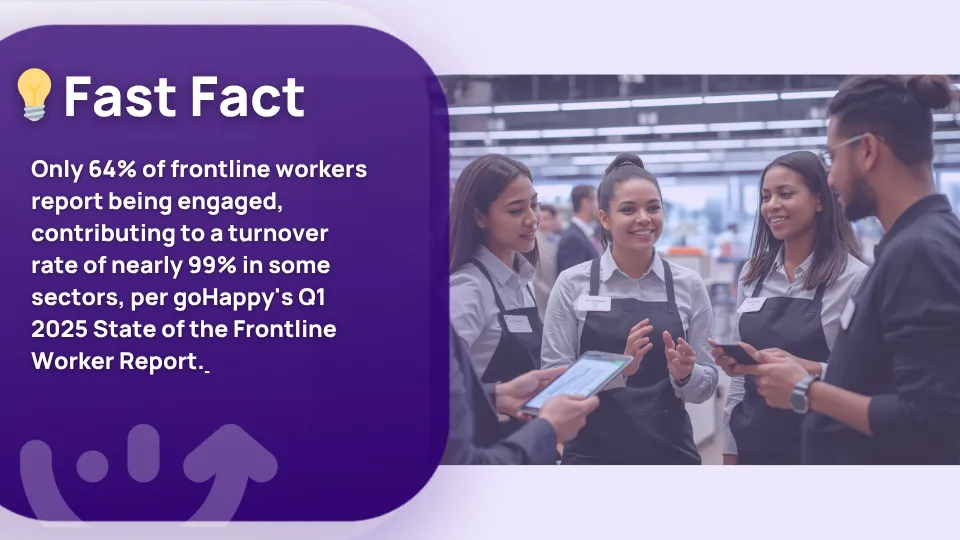
Only 63% of frontline employees believe their manager leads by example and creates a trusting workplace. In food service, that number drops to 59%, per goHappy's 2025 State of the Frontline Worker Report. (Hospitality Technology)
That gap is where engagement dies.
What shift supervisors actually need training on:
- How to give specific positive feedback in under 30 seconds
- How to address a performance issue without it becoming a confrontation
- How to run a 5-minute pre-shift huddle that leaves people feeling prepared
- How to spot a disengaged team member early and have a real conversation before they quit
None of this is HR theory. All of it is a practical behaviour that can be practised the same shift it is learned.
The right format: microlearning before the shift. A 3-minute video or a single reflection question pushed to the supervisor's phone before they clock in is something they will actually engage with. A 2-hour classroom module is not. This is the most important design decision in your entire frontline leadership training programme.
How to measure whether it is working. Track engagement scores by team, not just by location. If the same location shows strong engagement under one supervisor and tanks when they rotate out, you have your signal. Some supervisors are changing behaviour. Others are not. That tells you exactly where more coaching is needed.
For the software layer that supports microlearning delivery at scale across multiple locations:
Tying it together: the integrated weekly engagement workflow
Each pillar works independently. But here is what the full system looks like running together inside a single week.
**
Day/Time, Action, Who
Monday pre-shift, 3-minute microlearning module on giving feedback, Supervisor
During the shift, Recognition moment logged in system tied to a specific KPI win, Manager
End of shift, 2-question anonymous pulse completed on mobile, Staff
Within 48 hours, Pulse results reviewed-flagged items addressed at next huddle, Manager
Monthly ops review, Engagement scores by location reviewed alongside audit and task data, District Manager
**
No new meetings. No new headcount. Just consistency inside the structure you already have.
This is also the secret to successful change management for frontline engagement. Keep the workflow attached to existing operational rhythms. Do not ask people to do something new. Ask them to do something slightly different inside what they already do every day.
Change management: rolling out a new engagement program
Most frontline engagement programs are dead by month three. The design is usually fine. The rollout is the problem.
Here is what works.
Pilot in three locations first. One strong performer, one average, one struggling. If the system works in all three contexts, scale it. If it only works at the strong location, you have a design problem, not a rollout problem. Do not skip this step.
Put engagement scores on the operations dashboard. Not in a separate HR tool. On the same dashboard where audit scores and task completion rates live. If operations leaders never see it, it will never drive behaviour.
Run a monthly leadership review for the first six months. Thirty minutes. Engagement scores by location, recognition frequency by manager, pulse response rates, and key feedback themes. That is enough to catch problems before they compound.
The most common reason frontline engagement initiatives fail is that they get launched and then handed to HR to own. Hourly worker engagement at scale is an operations problem. It needs operations ownership.
For broader guidance on change management in frontline rollouts, see the guide on frontline operations platform rollout and adoption.
Common frontline engagement mistakes
These are the patterns that show up again and again across multi-site operators.
Running annual surveys instead of weekly pulses. By the time you have the data, half the respondents have already left.
Recognition only flowing top-down. Top-down recognition does not build culture. Peer-to-peer does. If your employee rewards program only has one direction, it is incomplete.
Training that ignores shift reality. A supervisor who learns coaching skills in a classroom but never practises them on the floor reverts within two weeks. Training needs to be embedded in the daily routine, not separate from it.
No closed-loop response on upward feedback. If staff do not see their input reflected in any change, they stop giving it. Full stop.
Tracking engagement in a silo. Engagement scores that only live in an HR platform become invisible to the people who can actually move them. They belong next to audit scores and operational KPIs, not in a separate system nobody opens.
For related reading on preventing the people-side consequences of poor engagement, see the guide on how to prevent employee burnout and deskless worker team communication.
Conclusion
Frontline engagement is not a culture project. It is an operations problem with an operations solution.
Rewards tied to real KPIs. Upward feedback that reaches leadership without getting filtered. Supervisors trained on behaviours they can use the same shift they learned them.
When all three run together inside the shift structure your team already has, turnover drops and performance improves. Not because you inspired people. Because you built a system that actually works for the way they work.
Xenia's employee accountability and frontline communication tools turn recognition, feedback loops, and team communication into on-shift moments that fit inside your existing workflow.
Book a demo and see how it works for your locations.
Frequently Asked Questions
Got a question? Find our FAQs here. If your question hasn't been answered here, contact us.
How is hourly worker engagement different from corporate engagement?

Four things. Measurement has to be weekly, not annual. Delivery has to be mobile, not email. The shift supervisor matters more than any platform or programme. And small frequent rewards beat large delayed ones every time. Most corporate frameworks get all four wrong, which is why they fail on the frontline.
How do you train shift supervisors for engagement?
Not in a classroom. Push a 3-minute module to their phone before the shift. Focus on real behaviours: giving specific feedback, running a tight huddle, spotting disengagement early. Then track engagement scores by their specific team, not the location overall. That shows you who is actually changing.
What is an example of upward feedback?
A weekly mobile pulse asking "Did your manager give you clear direction this week?" is upward feedback. Three things make it work: anonymity, mobile delivery, and a visible response from leadership. Remove any one of those and participation dies within weeks.
What is the best frontline employee engagement program?
Frequency, specificity, and direction. Weekly or per-shift recognition tied to real KPIs beats an annual bonus every time. Add peer-to-peer on top of top-down and you have a program that actually builds culture rather than just checking a box.


A Modern, AI-Powered Platform Built Specifically for Frontline Operations
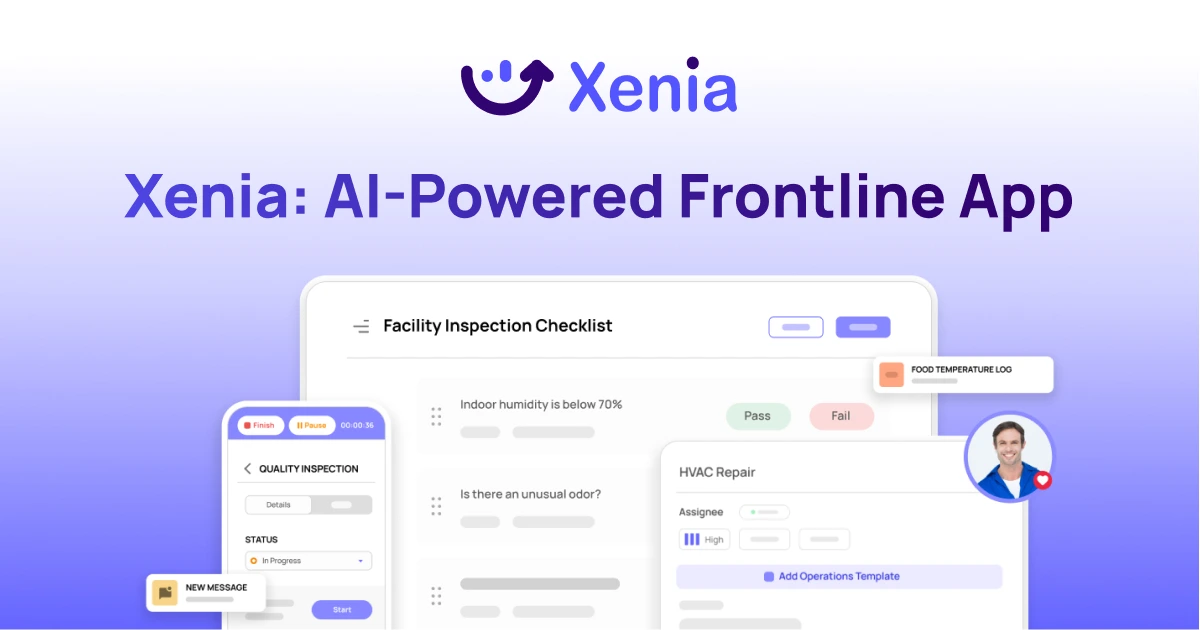
Xenia brings daily operations, maintenance, audits, and compliance into one mobile-first platform. Frontline teams execute work consistently across locations while leadership gets real-time visibility.
Why Multi-Location Operators Choose Xenia:
🤖 AI-Powered Operations, Create digital checklists instantly or convert paper forms with AI. Verify compliance automatically with photo analysis and get instant answers from your operational data.
✅ Daily Operations & Maintenance, Assign work across hundreds of locations in minutes. Report and route issues instantly. Schedule preventive maintenance to catch problems before downtime.
📊 Real-Time Visibility, Track completion, work orders, and performance across all locations through dashboards. Filter by site or asset to spot trends and take action.
Manage operations, maintenance, and compliance across all your locations from one platform

.svg)
.webp)
%201%20(1).webp)

.svg)
%201%20(2).webp)