
.webp)
Post Summary
Picture this: A health inspector walks in at 11:45 AM. Your lunch rush is starting. Your newest prep cook has been on the line for four days. The walk-in cooler was running at 44°F last Tuesday and someone circled it and moved on.
Are you ready for that visit?
Most restaurant operators want to say yes. But wanting to be compliant and having a system that proves it are two completely different things. That gap is where foodborne illness incidents happen. It is where violations get cited. It is where licenses get threatened.
A restaurant safety checklist, built the right way, closes that gap. Not a clipboard with 40 items nobody reads. A working system with the right checks, the right owners, and the right follow-through.
This guide gives you 10 steps to build one from scratch. Plus free restaurant food safety checklist templates you can start using today.
.webp)
.svg)

Priced on per user or per location basis
Available on iOS, Android and Web


Related Resources
- Food safety training for restaurant employees
- Restaurant hygiene checklist guide for 5-star reviews
- Food safety standards for restaurants
- Food safety thermometer guide
- Food storage chart for restaurants
- FSMA compliance software guide
Why Your Current Restaurant Safety Checklist Probably Isn't Working
Here's the honest version of what happens at most restaurants.
A manager builds a checklist. It goes on a clipboard. Staff complete it at the end of a long shift, working from memory, checking boxes in two minutes. A manager initials it without looking. It goes in a binder. Repeat.
Nobody is lying exactly. But nobody is catching anything either.
The checklist is not the problem. The system around it is. A restaurant food safety checklist only does its job when three things are true at the same time. First, it covers the right hazard areas. Second, it gets completed on a consistent schedule. Third, someone actually reviews the results and acts on failures.
Take away any one of those three, and what you have is documentation theater. Looks fine in a binder. Protects no one.
The steps below fix all three.
Step 1: Walk Your Restaurant Before You Write Anything
This sounds basic. Most operators skip it anyway.
Before you write a single checklist item, do a physical walk of your entire restaurant. Every room. Every station. Every storage area. The goal is a real-world hazard map, not a theoretical one based on what you think happens during service.
Most kitchens have obvious zones everyone remembers: the hot line, the walk-in, the prep tables. The ones that cause inspection failures are usually the ones nobody thinks about during the walk.
Here is a zone map to start with:
**
Zone, Key hazards to check
Receiving dock, Delivery temps-pest entry points-damaged or unlabeled packaging
Dry storage, Pest activity-FIFO labeling failures-chemicals near food items
Walk-in cooler, Temperature drift-door gasket condition-shelf organization
Walk-in freezer, Temperature logs-frost buildup-product date labels
Prep stations, Cross-contamination risks-surface sanitation-allergen separation
Hot cooking line, Cook temps-holding temps-equipment damage
Dish station, Final rinse temperature-sanitizer concentration-clean storage
Front of house, Allergen handling process-handwashing access-spill response
Bar, Ice handling-glass sanitation-alcohol compliance documentation
Restrooms, Soap and paper towels-handwashing signage
Fire safety zones, Extinguisher charge and access-hood suppression tag-exits clear
**
Do this walk yourself at least once before you delegate it to anyone. You will find things your team has been normalizing for months.
Step 2: Understand What Health Inspectors Are Actually Looking For
A restaurant health and safety checklist built around real inspection criteria will always outperform a downloaded template.
Health departments across the US use different scoring systems. But the violations they cite most often come from the same places. The FDA Food Code and HACCP principles drive almost all of it.
The highest-risk violations on most restaurant safety inspection checklists:
- Hot and cold food held outside safe temperature ranges
- Handwashing skipped between raw protein handling and ready-to-eat food prep
- Raw proteins stored above ready-to-eat items in the cooler
- Pest evidence anywhere in the kitchen or storage areas
- Employees working while showing illness symptoms
- Cooked food cooled too slowly through the temperature danger zone
- Sanitizer at the wrong concentration
- Food stored directly on the floor
Every item on that list should appear in your restaurant food safety checklist as a daily check. Not weekly. Not when someone remembers. Every single shift.
Xenia's food safety audit checklist for restaurants is built around real inspection criteria and fully customizable for your kitchen layout. The article on food safety standards for restaurants covers the regulatory foundation behind each of these requirements if you want to go deeper.
Step 3: Stop Putting Everything on One Checklist
One of the most common restaurant safety checklist mistakes is making a single monster list that covers everything from daily temperature logs to annual hood cleaning.
Your opening line cook does not need to verify the suppression system tag before first service. But they absolutely need to check cold rail temps. Mixing urgent daily items with monthly or quarterly tasks is how daily items get buried and skipped.
Build three separate layers and keep them distinct.
Daily checks (every shift, no exceptions):
- Food temperatures on the hot line and cold rail
- Sanitizer bucket concentration and replacement timing
- Handwashing stations: soap, paper towels, and signage in place
- Equipment visual check for damage or malfunction
- Staff wellness and hygiene observation before service
- Walk-in cooler and freezer temperature logs
- Date and time labels on all prepped food
Weekly checks:
- Deep clean verification for fryers, hoods, and grease traps
- Pest activity sweep including traps and potential entry points
- First aid kit check and restocking
- Fire extinguisher visual inspection
- Chemical storage and MSDS binder verification
- Refrigeration coil and door gasket condition
Monthly checks:
- Hood suppression system status and tag date
- Fire exits clear and signage in good condition
- Food handler certifications current for all staff
- Thermometer calibration verification
- Full HACCP log review and corrective action follow-up
- OSHA restaurant safety checklist compliance walk
Xenia's health inspection checklist for restaurants already separates checks by frequency with pass/fail fields and photo prompts built in.
Step 4: Embed HACCP Thinking Into Your Food Safety Checklist
HACCP is not just for food manufacturers with 200-page food safety plans. Every restaurant food safety checklist should reflect HACCP thinking even if you are running a 40-seat neighborhood spot.
The practical version for a restaurant is straightforward. Identify the kitchen steps where a food safety hazard can occur. Define what safe looks like at each step. Then verify those conditions every shift.
Here is how that maps in a working kitchen:
**
Kitchen stage, What to control, Safe standard
Receiving, Incoming protein temperature, 41°F or below at delivery
Cold storage, Walk-in cooler, 35°F to 38°F at all times
Cooking proteins, Internal food temperature, Poultry 165°F-ground beef 155°F-whole cuts 145°F
Hot holding, Held food temperature, 135°F or above throughout service
Cold holding on line, Refrigerated holding, 41°F or below throughout service
Cooling, Speed of temp drop, 135°F to 70°F within 2 hours-then to 41°F within 4 more
Reheating, Reheat speed and temp, 165°F within 2 hours
**
When those checkpoints have mandatory fields and photo verification, you have an actual paper trail if a guest complaint or inspection ever questions your processes.
Xenia's HACCP food safety template and HACCP audit checklist follow this structure exactly.
Step 5: Add Kitchen Physical Safety to the Mix
Food safety gets most of the attention. Physical kitchen safety is where the worker injuries are.
Burns, cuts, slips, and chemical exposure are among the most frequent workplace injuries in foodservice. They are also the areas where OSHA restaurant safety standards apply directly to your operation. Skipping this on your restaurant kitchen safety checklist is a compliance gap and a liability.
**
Hazard category, What your checklist should verify
Slip and fall, Floor mats in good condition-wet floor signage available-non-slip footwear policy enforced
Burns and heat, Oven mitts and aprons available at stations-fryer guards intact-hot surface markings visible
Cuts, Knife storage with blade guards in place-cut-resistant gloves stocked-broken glass protocol posted
Chemical safety, Chemicals stored separately from food-dilution ratios posted at each station-MSDS binder accessible
Fire safety, Hood suppression tag current-extinguisher accessible and fully charged-range and fryer area clear of combustibles
Equipment safety, Slicer guards in place-no frayed electrical cords-all equipment powered off before cleaning
**
The restaurant fire safety checklist deserves its own dedicated document. Xenia's fire extinguisher inspection checklist and fire prevention checklist cover suppression systems, extinguisher placement, and exit protocols in the level of detail a fire marshal actually wants to see.
Step 6: Build a Dedicated Allergen Control Section
Allergen incidents are expensive. In some cases they are fatal. Eight allergens drive the majority of severe reactions in the US: milk, eggs, fish, shellfish, tree nuts, peanuts, wheat, and soybeans.
Your restaurant food safety checklist needs a dedicated allergen section. Not a note at the bottom of the kitchen sanitation section. Its own area with specific items and a named owner.
A working allergen control section includes:
- Allergen matrix posted in the kitchen and visible to prep staff at every station
- Separate prep utensils, cutting boards, and cookware designated for allergen-free orders
- Clear process for how front-of-house staff communicate allergen requests to the kitchen
- Verified cleaning protocol for allergen-free prep surfaces before each accommodation
- Manager sign-off required before every allergen accommodation order goes to the table
- Shift log of all allergen accommodation requests with staff initials
For multi-location operators, allergen protocol consistency across locations is where the real risk concentrates. An untrained new hire at location four does not affect your other restaurants. Until it does.
Xenia's food allergen log template gives your team a structured way to document every request. The platform's conditional logic can auto-trigger allergen verification steps the moment a team member flags an accommodation order on their checklist.
Step 7: Set Specific Temperature Logging Standards
Temperature control generates more health inspection violations than any other single category. Your restaurant safety checklist needs time-stamped temperature logs for every critical zone. Spot checks are not enough.
Minimum standards for a compliant temperature logging system:
**
What you're logging, Safe temperature target, How often to log
Walk-in cooler, 35°F to 38°F, Every shift
Walk-in freezer, 0°F or below, Every shift
Hot holding units, 135°F or above, Every 2 hours during service
Cold holding on the line, 41°F or below, Every 2 hours during service
Dishwasher final rinse, 160°F or above, Each use during service
Sanitizer solution, Per manufacturer specification, Each bucket change
**
Manual logs work at a single location with a reliable team. At two locations they become inconsistent. At five or more they are a compliance liability.
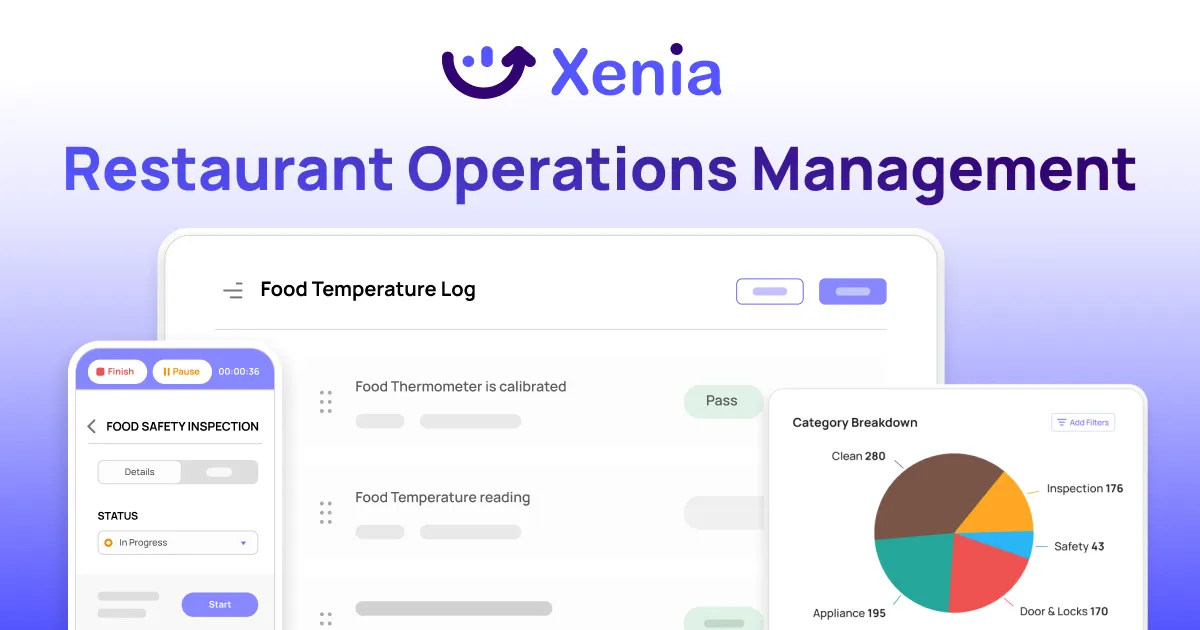
Xenia's IoT temperature monitoring connects Bluetooth and LoRaWAN sensors to track refrigeration units 24 hours a day. When a cooler drifts outside the safe range, the alert goes out right away, not the next morning when someone pulls the paper log. The food temperature log template handles manual checkpoints alongside the sensor data.
The food safety thermometer guide covers how to pick and calibrate thermometers correctly if your team is still using consumer-grade probes on a commercial kitchen operation.
Step 8: Make Corrective Actions Part of the Checklist Itself
A checklist that catches a problem and stops there is only half a system.
The moment a team member logs a failed temperature, a missing extinguisher pin, or a sanitizer bucket that tested out of spec, the next step needs to be built into the checklist. Not a separate process. Not a note to follow up on later. Built in.
For every critical checklist item, define four things before you publish the checklist:
- What is the acceptable range or standard?
- What does the team member do the second it fails?
- Who gets notified, and how fast?
- What documentation is required before the item can be marked resolved?
Here is what that looks like in practice for a cold holding failure:
- A line cook checks the cold rail. Product reads 46°F.
- Immediate action: Move product to a working cooler. Pull affected items from service right now.
- Notification: Alert the kitchen manager within 15 minutes.
- Documentation: Log the time of failure, which product was affected, the action taken, and a confirmation temp after the move.
- Follow-up: Kitchen manager submits a work order for the refrigeration unit before end of shift.
Xenia's weighted audit workflows assign severity levels to each checklist item. When a critical item fails, the platform auto-generates a corrective action task, assigns it to the right person, and tracks it until it is closed. Nothing waits until the next morning's manager meeting.
Step 9: Give Every Section an Owner
A restaurant health and safety checklist with shared responsibility is a checklist with no responsibility. This is the most common reason restaurant safety programs drift.
Every section needs a named role and a completion window. Not "kitchen staff." A specific position. Not "during service." A specific time.
**
Checklist section, Who owns it, When it must be done
Opening kitchen safety check, Opening cook or sous chef, Before first service-every day
Hot and cold line temperature logs, Line cook at each station, Every 2 hours during service
Allergen accommodation log, Expo or FOH manager, Each accommodation order-in real time
Closing sanitation verification, Closing manager, Before final lockup-every night
Weekly pest sweep, Kitchen manager, Every Monday before open
Monthly HACCP log review, General manager, First five days of each month
Monthly OSHA compliance walk, GM or operations lead, Once per month-documented
**
When checklists are digital, every submission carries a timestamp and the name of who completed it. Managers can see in real time which locations are compliant and which shifts are skipping steps. No end-of-week binder review required.
Xenia's FOH opening checklist and restaurant server opening checklist are solid role-specific starting points for the front-of-house side of ownership.
Step 10: Review the Checklist Every Quarter. Not Just When Something Goes Wrong.
A restaurant safety checklist goes stale. Menus change. Equipment gets replaced. Health codes update. Seasonal staff join. The checklist needs to keep pace with the actual operation, not the operation as it existed when someone first built the form.
Put a quarterly review on the calendar. For each review, work through these questions:
- Did any health inspection violations happen last quarter? What was the root cause?
- Were there near-misses or corrective action events the current checklist did not catch early?
- Has the menu, equipment, or kitchen layout changed since the last update?
- Are there any updated OSHA or local health code requirements to reflect?
- Are team members flagging any checklist items as unclear or inconsistent?
The strongest signal a checklist needs updating is when the same corrective action repeats. The same violation three months in a row means the checklist is documenting a problem, not preventing it.
Xenia's flagged response tracking shows which checklist items generate the most failures across your locations. You target the actual problem instead of refreshing the whole document from scratch every quarter.
Xenia's food safety audit checklist and HACCP audit checklist work well as the structure for your quarterly review sessions.
Free Restaurant Safety Checklist Templates
No need to build every checklist from zero. Every template below is free, built around real inspection and compliance criteria, and ready to customize for your operation.
Food safety audit checklist for restaurants. Get template
Food and kitchen safety and sanitation checklist. Get template
Food safety checklist PDF. Get template
Food safety compliance checklist. Get template
Health inspection checklist for restaurants. Get template
HACCP food safety template. Get template
HACCP audit checklist. Get template
Food allergen log. Get template
Food temperature log. Get template
Food safety risk assessment checklist. Get template
Food delivery and storage checklist. Get template
Fire extinguisher inspection checklist. Get template
FOH opening checklist. Get template
Food safety checklists app. Get template
How Xenia Helps You Run Safety Checklists Across Every Location
Paper checklists break down fast across multiple locations. Xenia keeps them running.
It is an operations execution system built for multi-unit restaurant operators. For checklist compliance specifically:
- Weighted audit workflows flag critical failures and auto-assign corrective action tasks until resolved
- AI powered photo verification confirms staff actually completed the check, not just marked it done
- Multi-location dashboards show real-time completion rates and open failures across every site
- The AI Template Agent builds role-specific checklists from a prompt in minutes
- Mobile-first design means kitchen staff complete checklists on their phones, even offline
No more end-of-week binder reviews. No more guessing which location skipped the temperature log.
Start with the restaurant checklist app or grab any free template above.
Conclusion
A restaurant safety checklist works when it makes safe behavior the default, not the exception.
Map your hazards. Split tasks by frequency. Build corrective actions in from day one. Assign named owners. Review every quarter.
Most restaurants that fail inspections have a checklist. They just do not have a system behind it.
Xenia gives you that system. Digital checklists, weighted audits, built-in corrective actions, and real-time compliance visibility across every location.
Book a demo to see how it works for your operation.
Frequently Asked Questions
Got a question? Find our FAQs here. If your question hasn't been answered here, contact us.
What are the most common restaurant food safety violations?

Food held at wrong temperatures, skipped handwashing, cross-contamination between raw and ready-to-eat items, pest evidence, employees working while sick, and sanitizer at the wrong concentration. Every one of these belongs in the daily section of your restaurant safety checklist.
What is the difference between a food safety audit checklist and a health inspection checklist?
A health inspection checklist mirrors what the health department checks during an official visit. A food safety audit checklist is an internal tool, usually with weighted scoring and corrective action tracking. Run the internal audit regularly and you catch the problems before the inspector does.
What temperatures do foods need to stay at to pass a health inspection?
Hot food stays at 135°F or above. Cold food stays at 41°F or below. Between those two points is the temperature danger zone. Food sitting there for more than four cumulative hours gets discarded. Doesn't matter how it looks or smells.


A Modern, AI-Powered Platform Built for Restaurant Operations
Xenia brings kitchen operations, food safety, audits, and team communication into one mobile-first platform. Restaurant teams execute daily work consistently, maintain compliance, and resolve issues faster, while leadership gets real-time visibility across all locations.
.webp)
Why Restaurant Operators Choose Xenia:
🤖 AI-Powered Operations, Convert paper logs instantly and verify food presentation and kitchen cleanliness automatically. Get instant answers about food safety trends without building reports.
🍽️ Food Safety & Compliance, Track line checks and temperature logs with automated alerts. Trigger corrective actions when readings exceed safe ranges. Maintain audit-ready records for health inspections.
📊 Multi-Location Control, Monitor food safety compliance and task completion across regions. Benchmark locations to identify training needs. Export reports for operational reviews.
One platform for kitchen operations, food safety, and compliance across all locations.

.svg)
.webp)
%201%20(1).webp)

.svg)
%201%20(2).webp)