
Post Summary
Here is a problem most Directors of Operations know well.
Your opening checklist lives in one tool. Your SOPs live in a shared drive. Your district managers run audits in a third app. And when someone in store 14 asks which version of the food safety SOP is current, nobody is quite sure.
That is not a people problem. It is a systems problem. It happens when workflow management software and document management systems get treated as separate purchases instead of one unified need.
Across 50 locations, that disconnect costs thousands of hours a year. Hours spent hunting for the right SOP version, cross-referencing tools, and chasing updates that never made it to the floor.
This article covers what features actually matter when evaluating a combined workflow and document management systems for a multi-site operation, how to run a buying process that does not waste 90 days, and which platforms are real candidates in 2026.
Related Resources
- How Xenia handles multi-unit operations execution across locations
- SOP software options compared: what to look for in 2026
- How operations execution differs from operations management
- Streamlining restaurant operations with SOPs
Workflow software vs document software: why multi-site operators need both unified
Workflow management software handles task execution. It tells your team what to do, when to do it, who is responsible, and whether it got done.
Document management systems do something different. They store and version your SOPs, policies, and reference materials. They control who can see what and make sure the right version reaches the right location.
Most operators buy these separately. Workflows run in one tool. Docs live in another. The two never talk to each other.
The result is what you could call the stitching cost. Here is what that looks like in practice:
- Your DM publishes an updated allergen SOP in the shared drive, but the checklist in the workflow tool still references the old version.
- Your store manager completes the opening checklist but cannot pull up the procedure it is based on.
- Someone fails an audit step and there is no direct link to the training document that would fix it.
Generic project management tools like Asana, Monday, and ClickUp make this worse. They were built for desk-based knowledge workers managing project timelines. They have none of what a frontline multi-site operator actually needs.
**
What generic tools lack, Why it hurts frontline ops
No location hierarchy, You cannot separate HQ from DM from store-level views
No role-based access, Everyone sees everything or you manage permissions by hand
No photo-evidence audit trail, Compliance requires timestamped proof-not checkboxes
No mobile-first SOP rendering, A line cook mid-service needs a phone-friendly procedure
**
Multi-site frontline operators need workflow and document management unified at the location level, not at the project level.
8 features multi-site operators need in a combined platform
This is the list to score every platform against before you request a demo. Any platform that cannot say yes to at least six of these eight was not built for frontline multi-site operations.
1. SOP version control with location-level rollout dates
When you update a policy, you need to know which locations received which version and when. The platform should log this automatically, not rely on email confirmations.
2. Role-based access by hierarchy
HQ sees everything. District managers see their region. Store managers see their location. Frontline staff see only what is relevant to their role. A platform that treats all users the same will not scale past 10 locations.
3. Mobile-first frontline UX
Your store staff are not sitting at desks. If the platform is a desktop product with a mobile app bolted on, adoption will be low. The mobile experience needs to be the primary one, not an afterthought.
4. Checklist-to-SOP linkage
Every task should reference the procedure it is based on. When a team member completes a line check, they should be able to pull up the relevant food safety SOP in the same interface without switching apps.
5. Audit trail for compliance
Who completed what, at what time, with what photo evidence. This is what health inspectors and franchisors actually ask for. A completion log without photo verification is not enough.
6. Multi-location push
Publish a new checklist or updated SOP once from HQ and it deploys to every relevant location automatically. No manual distribution, no email chains, no version confusion.
7. Offline capability
Walk-in coolers, back-of-house storage areas, and loading docks often have poor connectivity. The platform needs to work offline and sync when the connection returns.
8. Integrations with HRIS, POS, and maintenance systems
Your workflow and document platform should pull from your existing systems. HRIS integration means new hires automatically get access to the right documents. POS integration means operational data can feed into task triggers.
How to evaluate platforms: a 5-step buying framework
Most buying processes for the workflow management software category are too long and test the wrong things. Here is a tighter approach.
Step 1: Map your current workflow and document spread
Before you look at any platform, write down every tool your team currently uses for tasks, checklists, SOPs, and reference documents. Count the handoffs between them. This is your baseline.
Step 2: Score each platform against the 8 features above
Give each a yes, partial, or no. More than two "no" answers mean the platform was not built for multi-site frontline operations. Move on.
Step 3: Test mobile UX with actual store staff, not just HQ admins
Put the platform in the hands of a store manager and a frontline team member for one week. If they cannot complete a checklist or pull up an SOP without training, adoption after rollout will be poor.
Step 4: Run a 30-day pilot in two contrasting locations
Pick one high-performing location and one that struggles with compliance or consistency. The platform needs to work in both.
Step 5: Measure adoption at week four
The number that matters is what percentage of staff are active on the platform by end of week four. Below 70 percent means either the UX or the rollout process is failing. Fix it before full rollout or reconsider the tool.
The 5 best workflow and document management systems for multi-site operators in 2026
.svg)
.webp)

1. Xenia

Xenia is purpose-built for multi-site frontline operations across restaurants, retail, convenience stores, and hospitality. It is the only platform on this list that treats workflows and documents as one unified layer rather than two separate modules bolted together.
The checklists and sops module handles everything from daily opening procedures to brand standards audits. Each checklist links directly to its source SOP, so staff can complete tasks in the context of the correct procedure. Conditional logic means team members only see steps relevant to their role and location.
Document and records management handles versioning, role-based access, and location-level distribution. When HQ updates a policy, it pushes to every relevant location automatically. District managers see which locations acknowledged the update and which did not.
The multi-unit operations dashboard gives regional leaders a single view of task completion rates, SOP acknowledgment, and audit scores across every location.
Location hierarchy and permissions handle role-based access properly. HQ sees everything. DMs see their region. Store managers see their location. Frontline staff see only what is assigned to them.
The AI Template Agent builds checklists and SOPs from natural language prompts, cutting the time to build a new workflow from hours to minutes.
For more on how the operations execution layer differs from general operations management, operations execution vs operations management is worth reading before you evaluate.
Book a demo to see how it works across your locations, or start a free trial and explore the platform yourself.

Priced on per user or per location basis
Available on iOS, Android and Web


2. Process Street
Process Street turns policies into automated workflows with task assignment, deadline enforcement, and audit trails. It works for compliance-heavy teams in finance, HR, and professional services who need to document recurring processes.
The gap is significant for any frontline operator. It was built for desk-based teams, not store-level staff. There is no location hierarchy, no mobile-first UX for frontline workers, no food safety workflows, and no brand-level visibility across locations.
Running it across 20-plus sites requires manual workarounds that add up fast. For operators who have looked at it, Process Street Alternatives explains where it falls short for multi-site frontline operations.
3. GoSpotCheck by FORM

GoSpotCheck handles field audits and merchandising inspections for retail and consumer goods teams. Offline mode works and reporting gives managers visibility into field activity.
The gap is that it covers a narrow slice of what multi-site operators actually need. There is no SOP management, no versioned document control, and no location-level policy rollout. It is an inspection capture tool.
Operators running restaurants, hospitality, or c-stores will find it does not cover their core workflows at all.
4. Bindy
.webp)
Bindy handles store visit checklists, corrective actions, and inspection scheduling for retail and hospitality. Inspections work online and offline with photo verification and GPS stamps.
The gap is that it does not go much further than that. There is no SOP version control, no location-level document distribution, no checklist-to-SOP linkage, and no unified workflow layer.
It captures what happened during a visit but does not manage the daily operational procedures that prevent issues from happening in the first place. Operators who need more than a store visit tool will outgrow it quickly.
5. Trainual

Trainual creates role-based training playbooks from existing SOPs and onboarding materials. It is useful when the primary problem is getting procedures out of people's heads and into a searchable format.
The gap is that it stops at documentation. There is no daily task execution, no compliance audit trail, no location-level rollout tracking, and no way to verify that the SOP was actually followed on the floor.
Operators quickly find they need a separate operations platform alongside it, which means two tools, two logins, and two sources of truth.
Where generic tools fall short for multi-site operators
Asana, Monday, Notion, and ClickUp come up in almost every evaluation conversation. They are familiar, well-designed, and relatively affordable. But they were built for desk-based project teams, and the gaps show up fast in multi-site frontline operations.
**
Gap, Why it matters for multi-site ops
No location hierarchy, You cannot filter task completion by region-district or store without manual workarounds
No role-based SOP access, Everyone sees everything or you manage permissions manually at scale
No photo-evidence audit trail, Compliance documentation requires timestamped photos-not checkbox confirmations
No mobile-first SOP rendering, Staff cannot pull up procedures mid-service on a phone in a usable format
No multi-location push, Publishing a new checklist requires manual distribution to each location
No checklist-to-SOP linkage, Tasks and procedures live in separate tools with no connection between them
**
The risk of paper-based operations is well documented. But the risk of the wrong digital tool is just as real. A platform not built for your operational model generates workarounds, not compliance. For more on this, risk of paper-based operations makes the case clearly.
How multi-site operators migrate from separate tools to a unified platform
The migration from Google Drive plus Asana plus a checklist app to a unified platform is not a one-day project. But it does not need to take six months either. Here is how to do it in five phases.
Phase 1: SOP audit
Pull every SOP and policy document your operation uses. Identify which are current, which are outdated, and which locations are running on old versions. This step is usually the most uncomfortable because version drift is worse than most people expect.
Phase 2: Workflow audit
Map every recurring checklist and task your team runs across locations. Opening and closing procedures, line checks, shift handoffs, equipment maintenance logs. Write down where each one currently lives and who owns it. For daily checklist tools in use today, daily checklist planner tools covers the current landscape.
Phase 3: Map task-to-SOP relationships
For each workflow you identified, note which SOP it is based on. This mapping is what allows a unified platform to link a checklist step directly to its source procedure.
Phase 4: Pilot in two locations for 30 days
Use the evaluation framework above. Measure adoption at week four. If you are under 70 percent, the tool or the rollout plan needs work before you expand.
Phase 5: Full rollout with training
Roll out by region, not all at once. District managers should lead training in their locations. HQ should monitor adoption rates and completion data weekly for the first 60 days.
For operators who have tried rolling out a frontline operations platform before and struggled with adoption, frontline operations platform rollout and adoption covers the common failure points and how to avoid them.
Conclusion
Most multi-site operators are not running a workflow problem or a document problem. They are running both at the same time, with separate tools that create more friction than they solve.
The operators who get this right treat workflows and document management as one purchase, not two. They pick a platform built for frontline operations at the location level, not a project management tool stretched to cover a use case it was never designed for.
Xenia handles exactly this. Checklists and SOPs, Document and Records Management, and Multi-Unit Operations work together in one platform so your team always executes the right workflow against the right version of the right document. Every location. Every shift.
See how multi-site operators run workflows and documents in one platform. Book a demo.
Frequently Asked Questions
Got a question? Find our FAQs here. If your question hasn't been answered here, contact us.
How is workflow management software different from project management software?

Project management handles one-off work with a start and an end date. Workflow management for frontline operations handles procedures that repeat every single day at every single location. The two were built for completely different realities. A project board with cards and timelines is not a substitute for a daily checklist with photo verification and a compliance audit trail.
Why do multi-site businesses need unified workflow and document management?
Because separate tools create version drift. Your team completes a checklist based on an SOP that was updated three months ago but never pushed to the workflow tool. Nobody catches it until an audit does. A unified platform like Xenia keeps tasks and procedures in sync automatically so every location always runs on the current version.
Can I use SharePoint as a workflow management tool for multi-site operations?
SharePoint can store files and handle basic approvals. That is about it. It has no location hierarchy, no mobile-first interface for frontline staff, no photo-evidence audit trail, and no way to link a checklist to its source SOP. Most operators who try it end up duct-taping other tools on top of it. That is the opposite of the problem you were trying to solve.
What is the difference between workflow software and document management software?
Workflow software tells your team what to do, who does it, and tracks whether it got done. Document management stores and versions your SOPs and policies so the right people see the right version. Most multi-site operators need both. Running them in separate tools means your checklists and your SOPs drift apart, and compliance gaps follow.


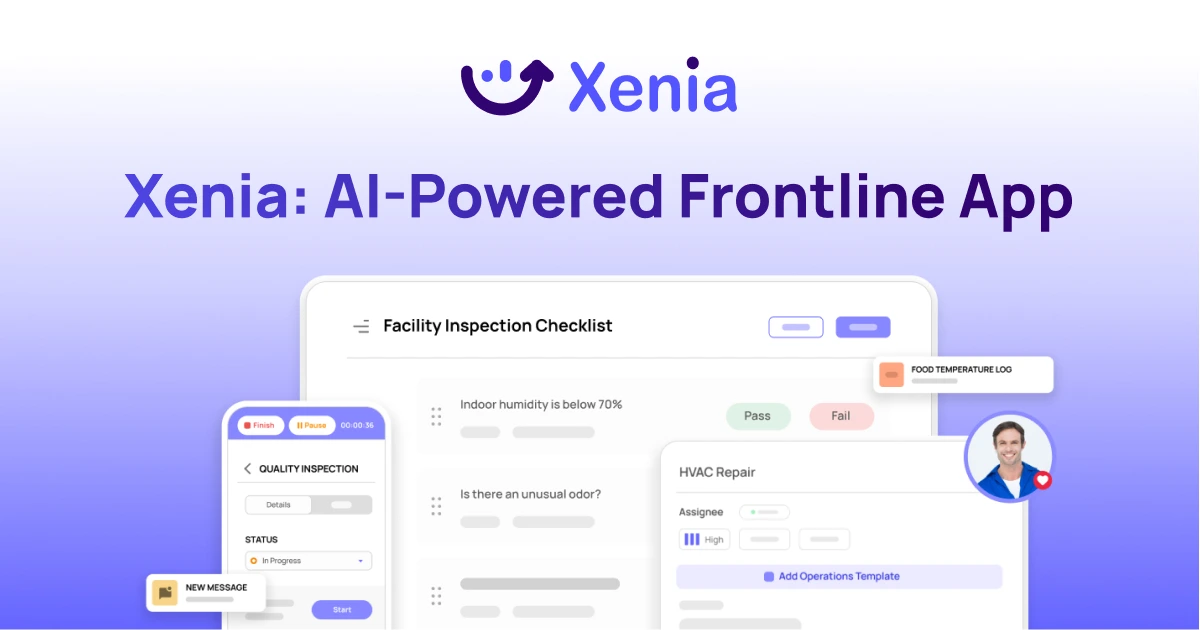
A Modern, AI-Powered Platform Built Specifically for Frontline Operations
Xenia brings daily operations, maintenance, audits, and compliance into one mobile-first platform. Frontline teams execute work consistently across locations while leadership gets real-time visibility.
Why Multi-Location Operators Choose Xenia:
🤖 AI-Powered Operations, Create digital checklists instantly or convert paper forms with AI. Verify compliance automatically with photo analysis and get instant answers from your operational data.
✅ Daily Operations & Maintenance, Assign work across hundreds of locations in minutes. Report and route issues instantly. Schedule preventive maintenance to catch problems before downtime.
📊 Real-Time Visibility, Track completion, work orders, and performance across all locations through dashboards. Filter by site or asset to spot trends and take action.
Manage operations, maintenance, and compliance across all your locations from one platform

.svg)
.webp)
%201%20(1).webp)

.svg)
%201%20(2).webp)