
.webp)
Post Summary
Why are businesses looking for Connecteam alternatives in 2026?
The best Connecteam alternative depends on what you outgrew. For multi-location operators who need scored audits, automatic corrective actions, and cross-location compliance reporting, Xenia is the strongest replacement. Connecteam's own Forms documentation describes conditional fields and auto-reports but no scoring, pass/fail thresholds, or automatic task creation from a failed answer, so audit follow-through stays manual.
That is the short version. The longer version is that most teams shopping for Connecteam competitors are not unhappy with the app they bought. They are unhappy with what happens after a form gets submitted. A 40-store c-store chain logging cooler temps, a 60-unit QSR running line checks before a health inspection, and a 25-store retailer running planogram resets all hit the same wall in the same place. The checklist gets filled. Then nothing happens. If that is your failure mode, you are shopping for multi-unit operations software, not a better chat app. Our multi-location audit software buyer's guide walks the full evaluation criteria.
What Connecteam genuinely does well
Be fair before you switch. Connecteam is not a weak product.
Read the July 2026 release list closely, though. Every item is chat, schedule, or time clock. Nothing shipped for forms, checklists, tasks, scoring, or reporting. If execution and proof are the next thing you need, that is a roadmap signal worth reading.
Where the math starts to hurt
Connecteam prices Operations, Communications, and HR & Skills as three separate hubs. Each hub carries its own Basic, Advanced, Expert, and Enterprise ladder. Published rates from connecteam.com/pricing, accessed August 2026:
**
Hub, Basic (first 30 users), Advanced, Expert, Each extra user (Expert)
Operations, $29 per month, $49 per month, $99 per month, $4.20
Communications, $29 per month, $49 per month, $99 per month, $3.00
HR & Skills, $29 per month, $49 per month, $99 per month, $3.00
**
The model is flat for the first 30 users, then per-user on top, with an 18% discount for annual billing. Do the arithmetic, because most comparison pages skip it:
Two more things push multi-unit brands up that ladder. Conditional form fields start at Operations Advanced. Smart Groups, the mechanism Connecteam uses to model multiple locations, also start at Advanced, per Connecteam's own doc on managing multiple locations. Auto-reports, API access, and webhooks sit at Operations Expert, so scheduled reporting is a top-tier purchase. There is also no native payroll on any plan, which Homebase states plainly.
Connecteam Alternatives Comparison
Six tools cover the realistic replacement set, ranked by how completely each one closes the gap a multi-location operator actually feels. Pricing was verified in August 2026.
**
Rank, Alternative, What it does that Connecteam doesn't, Pricing model (verified 2026), Best for
1, Xenia, Weighted and section-level audit scoring; conditional workflows that auto-create corrective tasks; QR work requests with no login; Bluetooth and LoRaWAN temperature monitoring; above-store analytics rollup, Per-location or per-user pricing across Starter Pro and Enterprise; quote-based; 14-day free trial, Multi-location restaurant c-store retail and hospitality brands where compliance has to be provable
2, Beekeeper (now part of LumApps), Enterprise frontline comms with automated workflows; learning content in 200+ languages; 500+ integrations; mobile access with no corporate email, Quote-only; no public pricing page since the domain migration, Global enterprises whose core problem is reaching a multilingual deskless workforce
3, Rippling, Native payroll; benefits administration; performance management; device and IT management; multi-country compliance, From $8 per user per month; modular; with modules priced separately, Growing companies that need one HR and IT system of record
4, Buddy Punch, Facial-recognition verification tied to each punch plus geofencing, $4.99 (Starter) - $6.99 (Pro) - $12.99 (Advanced) per user per month; each plus a $19 monthly base fee, High-turnover sites with a measurable punch-fraud problem
5, ClockShark (Simpro Group), Job costing and crew time tracking built for teams moving between job sites, $40 monthly base (Standard) or $60 monthly base (Pro); plus per-seat charges, Field service and construction crews; not fixed-location chains
6, Quinyx, AI demand forecasting and automated labor-law and union-contract checks on schedules, Quote-based; with Capterra listing a $5 per month starting point, Large shift-heavy enterprises in retail hospitality healthcare and warehousing
**
Read that table by failure mode, not by feature count. Rippling, Buddy Punch, ClockShark and Quinyx are all deeper than Connecteam on one specific workforce job: payroll, punch verification, job costing, or forecasting. None of them score an audit or open a work order. Beekeeper goes deeper on comms and reach. Xenia is the only tool on the list built for what happens after the checklist is submitted, which is why it sits at #1 for chains where a health inspector, a franchisor, or a regulator eventually asks for evidence.
Publish the review counts alongside the scores, because that is the honest comparison. On Capterra in August 2026: Xenia 4.9 from 23 reviews, Connecteam 4.6 from 5,307, Beekeeper 4.6 from 80, Rippling 4.9 from 4,859, Buddy Punch 4.8 from 1,124, ClockShark 4.7 from 1,911, and Quinyx 4.2 from 91. Xenia's score is the highest on the list and also rests on the smallest sample. If review volume is your primary buying signal, Connecteam and Rippling win that column outright.
Also worth a look if scheduling is the whole job
Three tools show up on more Connecteam-alternative lists than anything above, and all three are scheduling-first.
If your shortlist is really about rosters and punches rather than store execution, start with a workforce management software comparison instead of this one.
.svg)

.webp)
How does Xenia compare to Connecteam for multi-location operations?
Connecteam and Xenia solve different halves of frontline work. Connecteam runs the workforce layer: who is scheduled, who clocked in, who got the message. Xenia runs the execution-and-proof layer: what standard was met, what score it earned, what got fixed, and who signed off. Most operators do not swap one for the other.
They add the layer they are missing. Put plainly, Connecteam gives you forms. Xenia gives you answers.
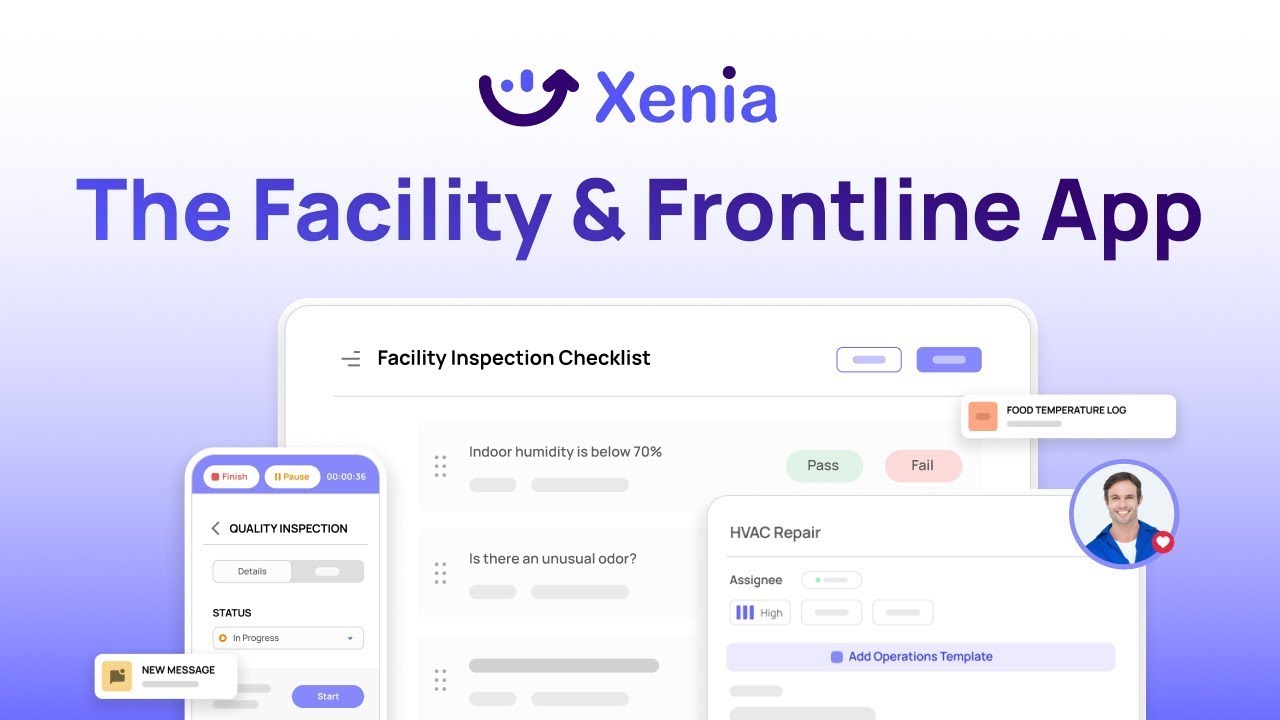
Xenia is an operations execution platform for multi-unit physical locations: restaurants, c-stores, retail, hotels, and field service. This section is about where Connecteam's documented ceiling sits and what a multi-location brand does about it.
What Connecteam's Forms documentation does and does not cover
Start with what Connecteam confirms it has. Per Forms: Must-Have Capabilities, Connecteam Forms support conditional logic on question visibility, required answers, location stamps, camera-only image capture, entry comments with attachments, PDF and push sharing, Manager Fields for status updates and signatures, scheduled Auto Reports, and per-field completion insight. Its conditional forms doc describes a "Show only if" toggle that keys a field's visibility to an earlier answer in the same form.
That is a real feature set, and two claims you will read on older comparison pages are now wrong. Connecteam's forms are not pass/fail only, and Connecteam does translate chat, not just posts. In-conversation message translation shipped, and AI message translation is listed in the Communications Expert tier.
What those same docs do not describe is narrower and more useful:
Connecteam's Forms documentation describes conditional fields, manager fields, auto reports, and completion insights. It does not describe scoring, pass/fail thresholds, or a task that creates itself when an answer fails.
The multi-location visibility picture is similar. Connecteam does support multiple locations by modeling them as Smart Groups filtered on a user field such as Branch, then scoping admin permissions to those groups.
Smart Groups need the Advanced plan. The doc also flags a permission footgun in its own words: "Don't forget to remove their permissions from the All Users Group. If you don't, they will still be able to see everyone."
Per-location rollup reporting is not documented, and Job Schedules are plan-capped (Operations Expert lists up to 12 schedules), which matters above roughly a dozen sites.
Seven places Xenia goes further
1. Scored audits with weighting and thresholds. Audit workflows with weighted scoring and corrective actions let you weight critical areas more heavily, calculate section-level scores, assign positive points for compliance and negative points for failures, and auto-assign letter grades or color ratings based on score thresholds. Cooler temp out of range is critical.
A crooked shelf label is cosmetic. Weighted audit scoring is the reason a 92% starts meaning something again.
.webp)
2. Conditional workflows that produce corrective work. A failed answer can require image capture, send an alert, ask follow-up questions, or open a corrective task routed to the store team with photo and context. Xenia also tracks completion rates on post-audit corrective actions by location and timeframe.
That is the gap in one line: most platforms collect audit data, few drive it to closure with corrective action tracking to closure.
3. Conditional visibility keyed to location attributes, plus nullify scoring. One template, many store formats. Stores with a tap system, a patio, or a drive-thru see those questions. Stores without them never see them and are not scored against them.
Connecteam's conditional logic branches on the previous answer inside the form, not on a store's physical attributes. Read conditional visibility and how nullify (N/A) scoring keeps a fuel-only site from failing a foodservice question.
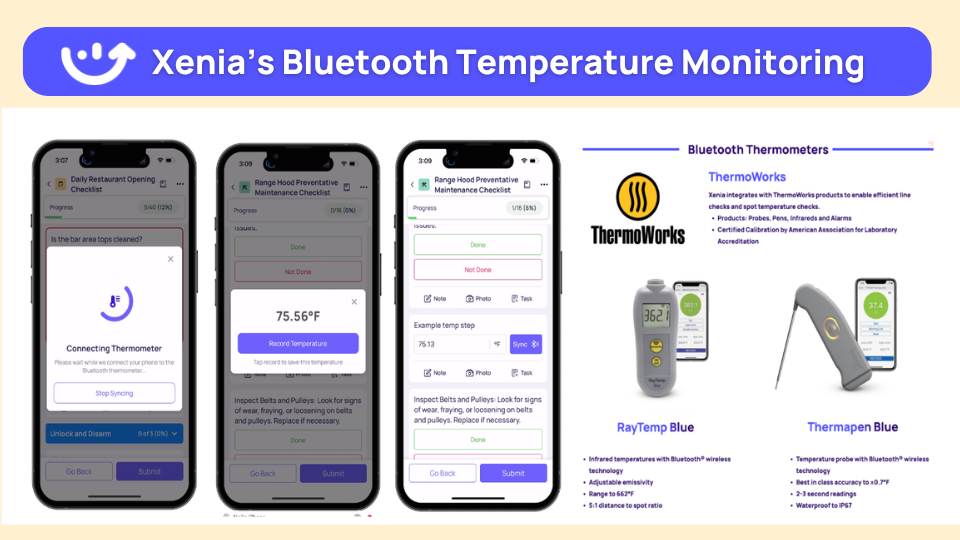
4. Temperature monitoring instead of typed numbers. Temperature monitoring via Bluetooth and LoRaWAN sensors covers Bluetooth probes, pens and infrared handhelds with data transfer up to 100 meters, plus continuous LoRaWAN sensors for coolers and freezers, automated alerts on out-of-range readings, and PDF or Excel export for the inspector.
Connecteam's Forms documentation describes manual field entry and image capture. It does not document Bluetooth probe or wireless sensor integration. Here is the Bluetooth thermometer setup if you want the mechanics.
5. QR-code work requests with no login. A QR-code work request with no login is a scan-to-submit maintenance ticket any employee, contractor, or guest can file without an account. The form pre-fills location, asset ID, category and default priority, and routing happens automatically by region, asset type, severity and time of day, with high-severity safety issues skipping approval queues.
A third-party tech can file a vendor work request without a login scoped to one store. Connecteam has no work-order module at all, which makes this the cleanest capability gap on the list.
6. AI photo review on submitted evidence. AI photo analysis for quality verification reviews every photo from checklists, audits and inspections to flag gaps in product quality, cleanliness and brand standards, compares submitted photos against display and signage guidelines, and flags blurry or badly angled images for resubmission. It surfaces variance for a human to judge rather than signing off on the work itself.
.webp)
7. Above-store reporting, faster rollout, and offline capture. Multi-location operational analytics puts every location's performance in one view, drills down by region, district and site, trends score by site against the org average, and schedules reports to send automatically with no manual pulling. Power Market digitized multi-store operations with Xenia across 280+ locations.
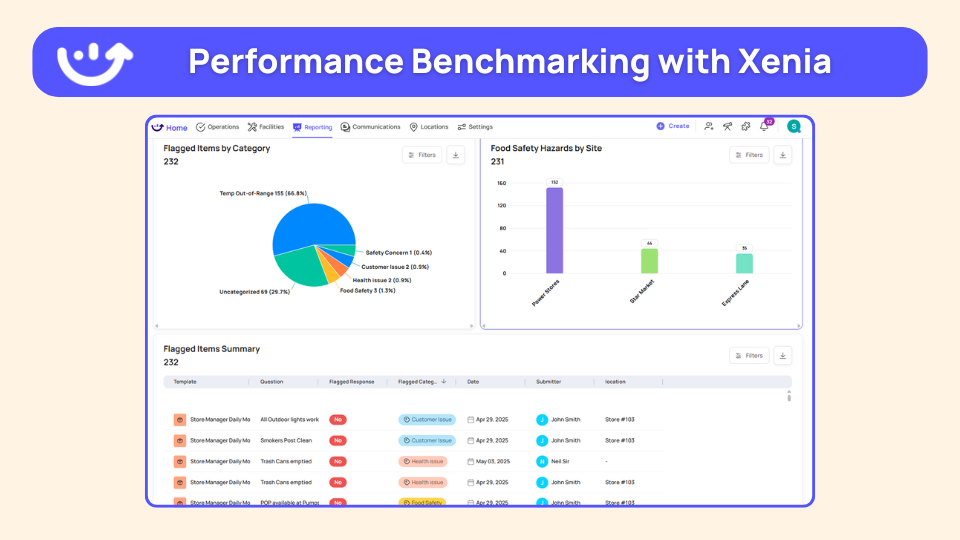
Rollout speed comes from the AI-powered template builder: upload an SOP PDF and get a working digital form with conditional logic and required fields, not a flat copy of the document.

Field capture runs on a mobile-first app with offline capability, which matters for rural fuel stops and backrooms with dead spots.
.webp)
On the systems side, Connecteam's integrations page names roughly 16 partners including Gusto, QuickBooks, Paychex Flex, Xero, ADP, Zapier and BambooHR, and does not list Workday or UKG. Clockify's February 2026 review counts 13. Xenia's HRIS integrations (Workday, ADP, UKG, 7shifts) cover the systems an enterprise ops team already runs. On comms, Xenia handles announcements with acknowledgment and signature so a fuel-price change or allergen policy update leaves compliance evidence behind, not just a read receipt.
Connecteam vs Xenia capability matrix
**
Capability, Connecteam, Xenia
Scored audits with weighting, Not documented in Forms docs, Custom weights; section scores; positive and negative points; grade thresholds
Conditional question logic, Branches on a previous answer; Advanced plan and above, Branches on the answer and on a location attribute; with N/A nullification
Automatic corrective action with closure tracking, Not documented; Manager Fields cover status; tagging and signature, Auto-created tasks routed with photo and context; closure rates tracked by location
Work orders, No module, Routing to internal teams or outside vendors; asset registers; photo and document attachments
QR no-login work request submission, No, Scan to submit with no account; pre-filled location; asset; category and priority
Scheduling and time clock, Core strength; GPS clock-in; geofencing; NFC; pay periods, Not offered
Frontline comms with acknowledgment, Chat; updates; polls; surveys; in-chat translation; e-sign capped by tier, Announcements with acknowledgment and signature capture
Temperature and IoT monitoring, Not documented, Bluetooth probes plus LoRaWAN continuous sensors with out-of-range alerts
Multi-location reporting rollup, Smart Groups from Advanced; per-location reporting not documented; auto-reports at Expert, Single view across locations; drill-down by region; district and site; scheduled delivery
Native payroll, Not offered on any plan, Not offered
Pricing model, Per hub and per tier; flat to 30 users then per-user per hub, Per location or per user; one platform
**
The pricing contrast is structural, not a discount argument. Connecteam's cost grows on two axes at once, hubs multiplied by users. Xenia's per-location pricing grows on one, and audits, work orders, comms and analytics are not separate purchases.
The honest limitation
Xenia does not do scheduling, time clock, payroll, or training-course delivery. If shift scheduling and clock-in are why you bought Connecteam, keep Connecteam for the workforce layer and add Xenia for compliance and execution.
The HRIS integrations exist so the two can run side by side. Xenia is also not a full CMMS at Limble's or ServiceChannel's depth on parts inventory, depreciation, or vendor invoicing. If those are your requirements, say so on the demo call. Get a demo or start free and test one audit template against your own stores before you decide.

Priced on per user or per location basis
Available on iOS, Android and Web


Other Connecteam alternatives worth evaluating
2. Beekeeper (now part of LumApps)
.webp)
The biggest 2026 fact on this list: Beekeeper is no longer an independent brand. The LumApps acquisition signed on 1 July 2025, creating a combined company valued at more than $1 billion serving over 7 million users across more than 2,000 clients, with 600+ employees and roughly $150M in recurring revenue. The domain migration is live, so beekeeper.io/pricing now redirects to lumapps.com and there is no Beekeeper pricing page any more.
LumApps is direct about continuity. Its Beekeeper page says Beekeeper "has evolved and become part of something much larger," that existing customers keep the same contracts, pricing, logins and support contacts, and that the unified product experience will "roll out in phases over the next 12 to 18 months."
The combined platform offers comms, workflow automation, learning content in 200+ languages, 500+ integrations, and mobile access without a corporate email account.
Beekeeper is still the strongest pick when the core problem is reaching and engaging a large multilingual deskless workforce, and Capterra rates it 4.6 from 80 reviews. Documented cons are worth reading: no calendar or scheduling, no task management integration, no video calling, and difficulty finding past posts.
It is not a like-for-like Connecteam swap. If you sign in the next year, ask LumApps directly which product surface you are being onboarded onto. See the Xenia vs. Beekeeper breakdown and our roundup of deskless worker communication platforms for the wider field.
3. Rippling

Rippling is the highest-rated, highest-volume tool on Capterra's own Connecteam alternatives list at 4.9 from 4,859 reviews, starting at $8 per user per month. That is what earns it the #3 slot here.
Read the pricing model carefully. Rippling is modular, and the $8 figure is the base HR platform, not the all-in cost. Payroll, benefits, IT and device management, and spend management price separately, and some carry their own monthly base fee. A buyer comparing $8 against Connecteam's $87 Basic hub stack is comparing two different things.
What Connecteam does not have here is substantial: native payroll on any plan, benefits administration, performance management, device and IT management, and multi-jurisdiction compliance. If your real problem is that employee data lives in four systems and payroll runs on a fifth, Rippling is the right shortlist. Be clear-eyed about the trade, though. Rippling will not score a brand standards audit, will not open a work order on a broken walk-in, and will not give a DM a store-by-store execution view. It replaces your HR stack, not your ops app.
4. Buddy Punch
Buddy Punch is the narrowest and most honest tool on the list. It verifies that the person clocking in is the person on the schedule. Published pricing is $4.99 per user per month on Starter, $6.99 on Pro, and $12.99 on Advanced, each plus a $19 monthly base fee. Add-ons price separately: real-time GPS at $2 per user, onboarding and tasks at $4, data retention at $2, scheduling at $1 on Starter, and payroll at $8 per user plus a $49 base. There is a 14-day trial with no card.
Note the tier gating before you quote it internally. GPS on punches is on every plan, but geofencing and facial recognition start at Pro, and scheduling is included from Pro up. Capterra rates it 4.8 from 1,124 reviews, and it is named as a Connecteam alternative by Capterra, by Homebase, and by Connecteam itself.
The buying test is simple. If punch fraud is a recurring, measurable line item on your labor report, biometric verification is the most direct fix on this list, and it is the one thing Connecteam's time clock does not do. One caution: collecting biometric data carries state-law obligations, Illinois BIPA among them, so a multi-state operator should clear it with counsel before rollout. Our guide to time theft covers the non-biometric controls first.
5. ClockShark (Simpro Group)

One ownership fact older comparisons miss: ClockShark has been part of Simpro Group since the acquisition announced 23 November 2021. Terms were not disclosed, and the ClockShark, Simpro and AroFlo teams were stated to operate independently with continued service on existing products. Simpro later took more than $350M in growth investment from K1. No sunset or repricing signal exists.
On price, Capterra lists a $40 monthly base on Standard and $60 on Pro, plus per-seat charges.
Third-party pricing guides put the per-user rate near $9 on Standard and $11 on Pro. Attribute that per-user number to those guides, not to ClockShark, and note that a bare "$9 per user" quote leaves out the base fee entirely. Capterra rates ClockShark 4.7 from 1,911 reviews, with documented cons on mobile functionality limits and occasional bugs.
Here is the nuance that decides it. 95% of ClockShark's Capterra reviewers are in construction.
It is built for crews that move between job sites, and its wedge over Connecteam is job costing that ties labor hours to specific jobs plus kiosk clock-in on a shared site device. On the Connecteam side, Timeero's hands-on review confirms that stops made during the workday are not shown. If your locations are fixed storefronts, skip ClockShark and spend the evaluation time elsewhere.
6. Quinyx

Quinyx is the enterprise workforce management option, Sweden-based, founded in 2005 by Erik Fjellborg, with $103M raised across five rounds. It acquired Concrete Platform for task management and employee engagement in 2022 and is still shipping actively.
The genuine strength is scheduling intelligence Connecteam does not attempt: AI demand forecasting, skills- and contract-aware auto-scheduling, and automated compliance checks against labor law and union agreements. Quinyx targets retail, hospitality, healthcare and warehousing at enterprise scale.
It is also the weakest intent fit of the six for a Connecteam shopper, and the reviews say why. Capterra rates it 4.2 from 91 reviews, the lowest score and thinnest sample on this list, with documented cons including a steep learning curve requiring substantial onboarding time, complex setup for user rights and shift templates, slower support response on urgent issues, and a web interface less intuitive than the mobile app.
Pricing is effectively quote-based. Anyone leaving Connecteam because three hubs got expensive and forms stopped scaling is unlikely to enjoy an enterprise WFM implementation. Consider Quinyx only if you are large enough, shift-heavy enough, and labor-law exposed enough to justify the onboarding weight.
Conclusion
Pick by failure mode, not by feature count.
One last honest note. Xenia does not replace scheduling, time clock, payroll, or training-course delivery. Most operators run Xenia alongside their workforce app, not instead of it.
If you are also comparing store-execution tools rather than workforce tools, the same evaluation logic applies in our Zenput alternatives roundup. When you are ready to test the execution layer against your own stores, book a demo and bring your worst audit template.
Frequently Asked Questions
Got a question? Find our FAQs here. If your question hasn't been answered here, contact us.
What does Xenia actually replace for multi-unit operators?

Can Xenia replace Connecteam entirely?
Does Connecteam have audit intelligence or corrective action workflows?
What is the difference between Connecteam and an operations execution platform?


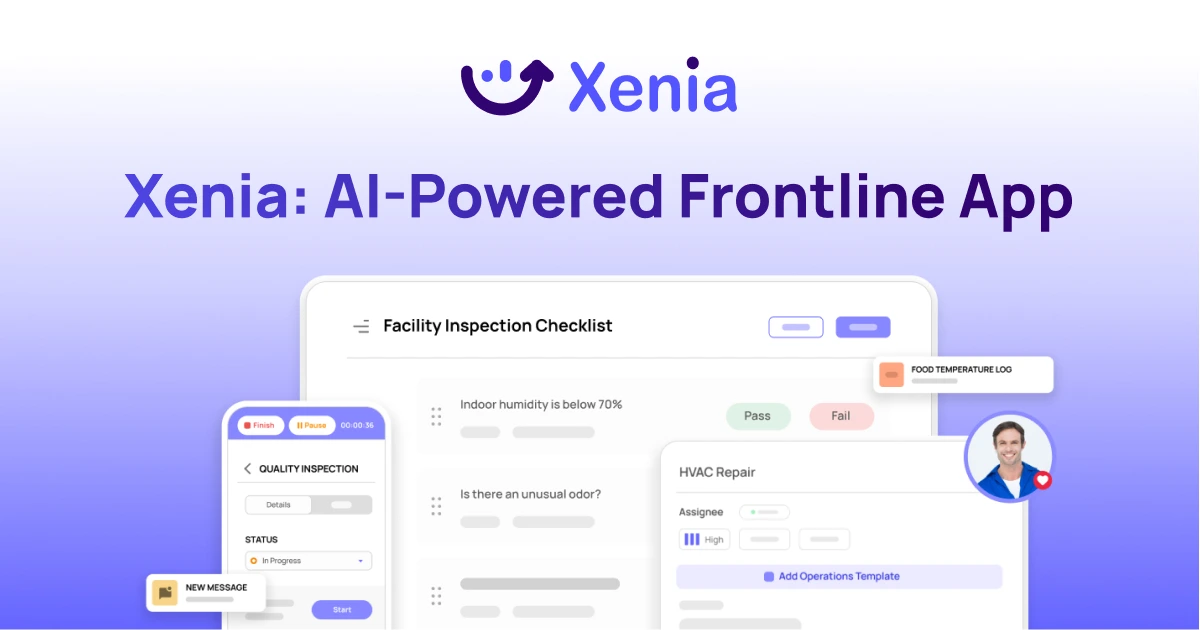
A Modern, AI-Powered Platform Built Specifically for Frontline Operations
Xenia brings daily operations, maintenance, audits, and compliance into one mobile-first platform. Frontline teams execute work consistently across locations while leadership gets real-time visibility.
Why Multi-Location Operators Choose Xenia:
🤖 AI-Powered Operations, Create digital checklists instantly or convert paper forms with AI. Verify compliance automatically with photo analysis and get instant answers from your operational data.
✅ Daily Operations & Maintenance, Assign work across hundreds of locations in minutes. Report and route issues instantly. Schedule preventive maintenance to catch problems before downtime.
📊 Real-Time Visibility, Track completion, work orders, and performance across all locations through dashboards. Filter by site or asset to spot trends and take action.
Manage operations, maintenance, and compliance across all your locations from one platform

.svg)
.webp)
%201%20(1).webp)

.svg)
%201%20(2).webp)