
.webp)
Post Summary
WorkJam was built for enterprise scale. Scheduling integrations, open shift marketplace, task management, communications, microlearning, it covers a wide surface area for large retail and hospitality organizations.
At $799/month minimum, it prices out the mid-market entirely, and even enterprise customers cite a consistent frustration: limited visibility into how operations actually perform across locations.
That's not a minor gap. Cross-store operational performance is often where compliance breaks down and costs compound. When the platform running your frontline workforce can't tell you whether locations are consistently executing, you lose visibility into the thing that matters most.
The alternatives below cover different parts of what WorkJam does. Some go deeper on operational execution than WorkJam has managed to build out so far.
This guide covers the 6 best WorkJam alternatives in 2026.
WorkJam Alternatives Comparison
**
Rank, Alternative, What it offers that WorkJam doesn't, Best For
#1, Xenia, Purpose-built operational execution-IoT monitoring-food safety-scored audits and work orders, Multi-unit operators needing real execution depth
#2, Factorial, International HR compliance and shift scheduling at a fraction of the cost, EU and global operations under 100 staff
#3, BambooHR, Full HR infrastructure-employee database-performance tracking and 150+ integrations, Growing SMBs centralizing people data
#4, Workvivo, Social intranet and employee recognition tools built for engagement and culture, Hybrid and distributed teams focused on retention
#5, Synchroteam, Field service dispatching with live GPS routing and mobile job management, Field service teams in HVAC-maintenance and plumbing
#6, Paycor, Native payroll processing tied directly to scheduling and time tracking, Mid-market businesses scaling past 50 staff
**
.svg)
.webp)
.webp)
1. Xenia - Best Operations Platform for WorkJam Users
- What WorkJam doesn't have that Xenia does: Native IoT temperature monitoring, AI-powered photo verification, full work order lifecycle management, HACCP-aligned food safety workflows, and cross-location compliance dashboards, all purpose-built, not recently added
- G2 rating: 4.9/5
- Capterra rating: 4.9/5
- Who uses Xenia: Enterprise and mid-market operators across food service, retail, hospitality, and convenience store chains, managing 50 to 1,000+ locations
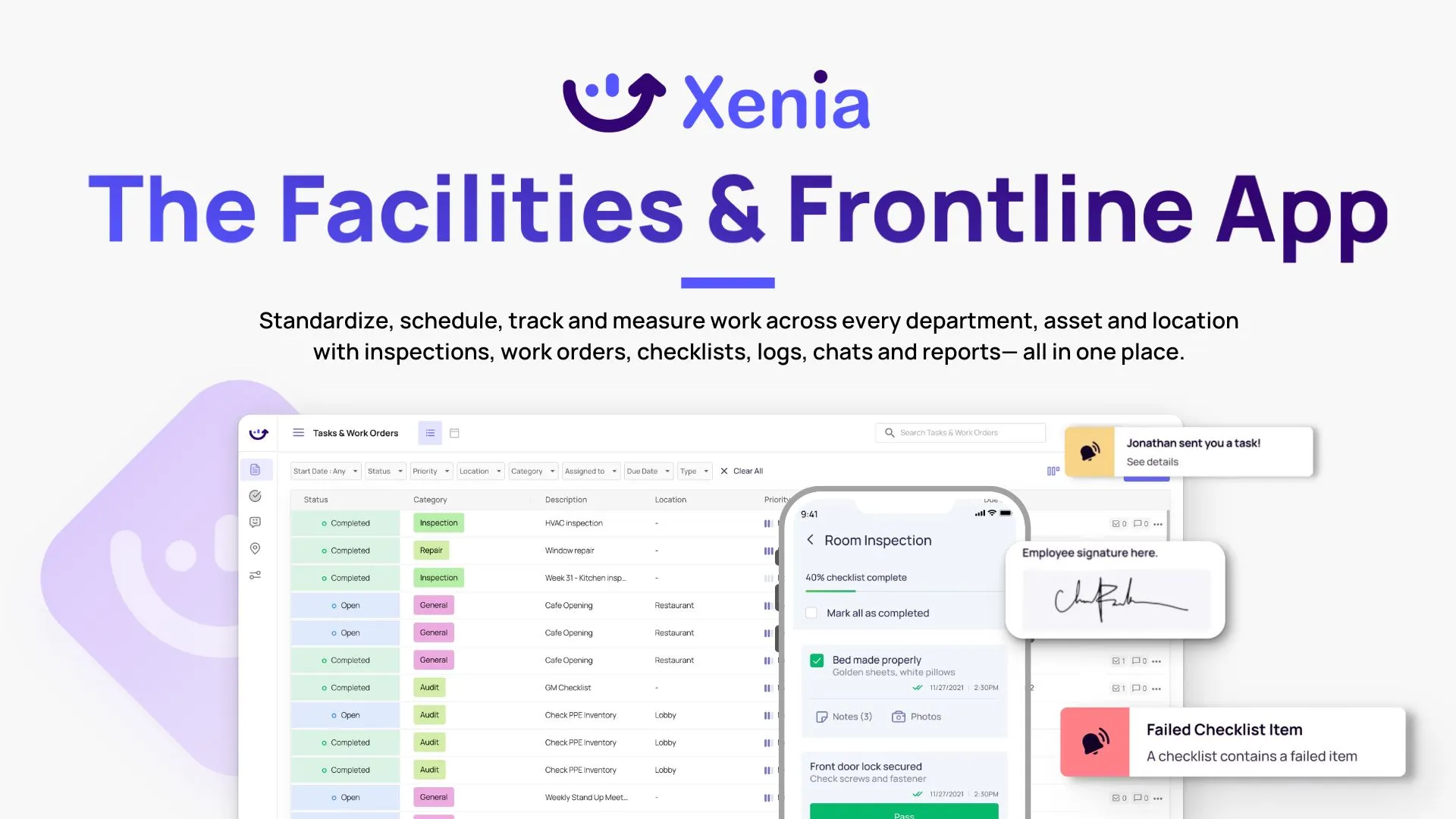
WorkJam added basic audit forms and image annotation in early 2026. That's a start, not a system.
Xenia has been purpose-built for operational execution for years. The difference between a recently added feature layer and a platform designed around it from the ground up shows up in ways that matter at enterprise scale.
What Xenia covers that WorkJam doesn't, and where it goes deeper
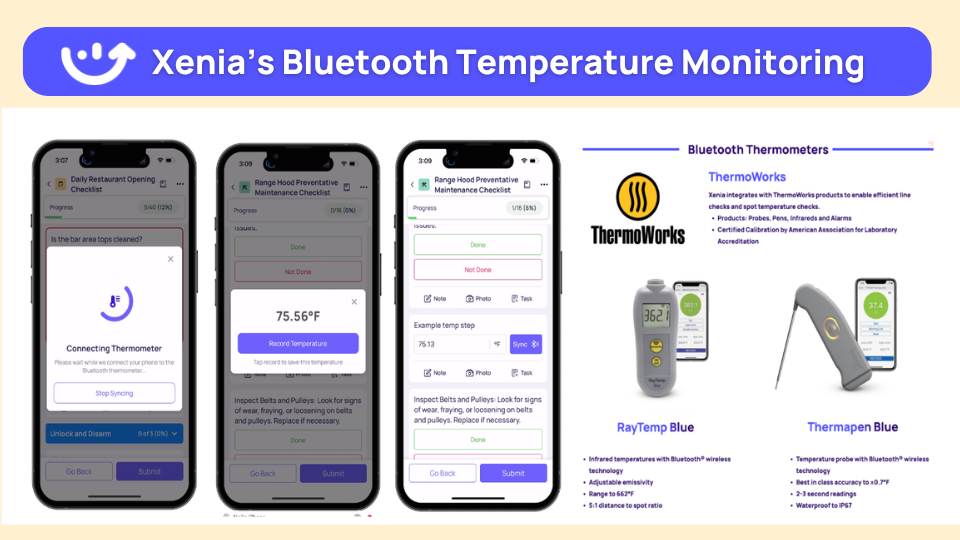
Native IoT temperature monitoring: WorkJam can trigger task notifications based on external IoT events. It has no native sensor integration, no continuous monitoring, and no hardware partnership.
Xenia integrates directly with Bluetooth thermometers and LoRaWAN sensors for 24/7 automated temperature logging across refrigeration units, hot holding equipment, and walk-in coolers. Alerts fire in real time when readings drift outside safe ranges. The audit-ready log is generated continuously, without any human initiating it.
AI photo analysis beyond annotation: WorkJam's early 2026 image annotation feature allows workers to manually mark up photos.
Xenia's AI goes further with actual object recognition. Planogram compliance gets verified automatically against reference images. Equipment damage gets assessed and categorized without a manager reviewing every photo. Cleaning standards get scored visually.
The difference between annotation and analysis is the difference between recording what someone claims and verifying what the photo actually shows.
.webp)
Full work order and preventive maintenance lifecycle: WorkJam has no work order system, no equipment asset tracking, and no preventive maintenance scheduling.
In Xenia, every piece of equipment carries a QR code linking to its full service history. Inspections that flag equipment issues route directly into prioritized work orders. Preventive maintenance schedules run automatically based on manufacturer intervals or usage thresholds. Regional managers can see open work orders across every location from a single view.

HACCP-aligned food safety workflows: WorkJam's audit capability is general-purpose and oriented toward retail task completion. It was not built for food safety.
Xenia provides templates aligned with HACCP requirements, digital corrective action automation when critical control points fail, and health-inspection-ready documentation with timestamped, geo-tagged evidence for every submission.
For food service operators, this distinction is the difference between passing an inspection with documentation and scrambling to reconstruct records.
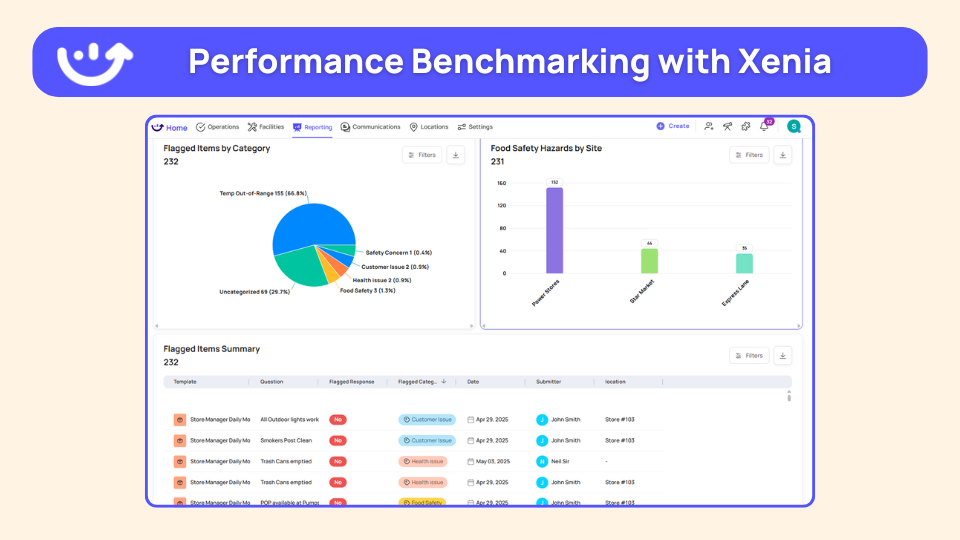
Cross-location operational analytics: Xenia's widget-based dashboards benchmark audit scores, task completion rates, and compliance trends across the entire location network.
Configurable reporting gets emailed automatically to relevant stakeholders on any schedule. Regional performance comparisons, flagged item trend analysis, and compliance gap identification are built into the standard product, not available as an add-on.
Honest limitation: Xenia does not replicate WorkJam's scheduling integrations, open shift marketplace, or learning management capabilities. Enterprise operators who need those features will still require a WFM platform alongside Xenia. Xenia covers the operational execution layer, not the full workforce management stack.

Priced on per user or per location basis
Available on iOS, Android and Web


2. Factorial
- What WorkJam doesn't have that Factorial does: Multi-country compliance automation, GDPR-ready data handling, and multi-language support at $4/user/month, a fraction of WorkJam's cost
- G2 rating: 4.6/5
- Capterra rating: 4.7/5
- Best for: International operations and EU-based businesses with 20 to 100 staff where WorkJam's US-centric model creates compliance gaps

WorkJam was built around the US market. Factorial was built for international operations. Multi-country labor law compliance, GDPR-ready data handling, and a multi-language interface make it the obvious choice for businesses operating across European markets where WorkJam's compliance depth doesn't reach.
At $4/user/month, it also makes WorkJam's $799/month minimum look difficult to justify for any business under enterprise scale.
Key features:
- Automated overtime and pay calculations across jurisdictions
- Shift swaps and employee availability management
- eSignatures and digital document management
- Multi-language interface
- EU labor law automation and GDPR compliance
Good if: Your operation spans multiple countries and WorkJam's compliance coverage doesn't extend to the markets you operate in
Consider if: You need WorkJam's enterprise communication and training infrastructure alongside scheduling
3. BambooHR
- What WorkJam doesn't have that BambooHR does: A proper HR infrastructure, centralized employee database, performance reviews, applicant tracking, and 150+ integrations that WorkJam's task-focused model doesn't provide
- G2 rating: 4.5/5
- Capterra rating: 4.6/5
- Best for: Growing SMBs with 20 to 200 staff that need structured HR rather than a frontline task platform

WorkJam manages frontline workers. BambooHR manages the HR layer beneath them. Employee records, performance tracking, time off management, onboarding workflows, and custom reporting are all built into a single system.
For businesses that have outgrown spreadsheets and disconnected tools but don't need WorkJam's frontline communication focus, BambooHR covers the HR foundation without the enterprise complexity.
Key features:
- Full employee lifecycle management
- Time off tracking and performance reviews
- Custom reporting and dashboards
- Applicant tracking and onboarding workflows
- 150+ integrations with scheduling and payroll tools
Good if: Building proper HR infrastructure is the priority and WorkJam's frontline task focus doesn't match where your problem actually sits
Consider if: You need frontline-specific scheduling, communications, or task management alongside core HR
4. Workvivo

- What WorkJam doesn't have that Workvivo does: A social intranet with recognition tools, pulse surveys, and an engagement-first design that builds culture across distributed teams, not just task completion
- G2 rating: 4.7/5
- Capterra rating: 4.6/5
- Best for: Hybrid and distributed frontline organizations where employee engagement and retention are the core business problem
WorkJam communicates. Workvivo connects. Social newsfeeds, recognition badges, pulse surveys, and analytics that measure engagement rather than just task completion give people managers a view of how their workforce actually feels, not just whether shifts are covered. For organizations where turnover is the most expensive operational problem, that engagement data matters.
Microsoft Teams and Slack integrations mean it layers into existing infrastructure rather than replacing it.
Key features:
- Social newsfeed with mentions and reactions
- Employee recognition and badges system
- Pulse surveys and engagement analytics
- Task assignment and progress tracking
- Microsoft Teams and Slack integration
Good if: Retention and culture-building are bigger priorities than task management or scheduling at $6 to $10/user/month
Consider if: Operational execution, compliance documentation, or scheduling depth are what your operation actually needs
5. Synchroteam
.webp)
- What WorkJam doesn't have that Synchroteam does: Purpose-built field service dispatching with live GPS routes, mobile job cards, customer signatures, and invoicing, none of which WorkJam's general task platform covers
- G2 rating: 4.5/5
- Capterra rating: 4.6/5
- Best for: Field service teams in HVAC, plumbing, maintenance, and facilities management with 10 to 50 technicians
WorkJam was built for retail and hospitality. Synchroteam was built for teams that drive to job sites. Drag-and-drop scheduling with auto-routing, live GPS tracking, mobile job cards with customer signatures, and invoicing that ties directly to completed jobs are all built in.
Field service businesses using WorkJam for basic task management typically find Synchroteam replaces it and a separate invoicing tool at the same time.
Billable hours increase by around 20% in documented deployments, largely because dispatching accuracy improves and travel time between jobs reduces.
Key features:
- Drag-and-drop scheduling with route optimization
- Mobile job cards with customer signatures and photo capture
- Live GPS tracking and geofencing alerts
- Customer portal and invoicing
- Integration with accounting platforms
Good if: Your team dispatches to job sites and WorkJam's general task focus doesn't match how field service operations actually work at $23/user/month
Consider if: Your operation is retail or hospitality-based where Synchroteam's field service focus doesn't apply
6. Paycor
- What WorkJam doesn't have that Paycor does: Native payroll that processes automatically from tracked hours, no exports, no reconciliation, no fixing mismatches between a task platform and a separate payroll system
- G2 rating: 4.4/5
- Capterra rating: 4.5/5
- Best for: Mid-market businesses with 50 or more staff where payroll accuracy and multi-state compliance are the primary pressure points
WorkJam doesn't process payroll. Paycor does, natively, from the same system where time gets tracked. For businesses currently running WorkJam alongside a separate payroll platform and spending time every pay period reconciling the two, Paycor removes that process entirely. Demand forecasting and labor budgeting are included alongside the payroll infrastructure.
The setup timeline is longer, 2 to 4 weeks, and pricing is custom. But for organizations at a size where payroll errors have real financial consequences, the investment tends to pay back quickly.
Key features:
- Timesheet-to-payroll automation
- Demand forecasting and labor budgeting
- Multi-state compliance rules
- Leave accrual management
- Custom compliance reporting
Good if: You're scaling past 50 staff and payroll accuracy between WorkJam and a separate system keeps causing problems
Consider if: You need WorkJam's frontline communication, microlearning, or open shift marketplace alongside payroll
Conclusion
WorkJam's price tag reflects what it is, an enterprise platform built for large retail and hospitality organizations with the resources to match. For those organizations, the breadth has value.
The problem shows up when you need to know what's actually happening on the floor. Scheduling, communications, training, WorkJam covers all of that. Operational execution is where it runs thin, even with the 2026 additions.
If that's where the gap is, audits failing with no follow-up, food safety running on paper, no clear view of compliance across locations, Xenia was built specifically for that problem. Scored audits, automated corrective actions, IoT temperature monitoring, and cross-location dashboards that WorkJam's task layer can't replicate.
Book a demo and see how Xenia works alongside your current setup.
Frequently Asked Questions
Got a question? Find our FAQs here. If your question hasn't been answered here, contact us.
What does Xenia replace for an operator currently on WorkJam?

Xenia typically consolidates standalone checklist apps, paper-based inspection forms, manual temperature logs, disconnected work order systems, and ad hoc audit documentation.
Operators using WorkJam for workforce management often run three to five separate tools for the operational side. Xenia collapses those into one platform.
Why do WorkJam users cite cross-store visibility as a recurring complaint?
WorkJam's reporting is designed around workforce metrics: scheduling efficiency, shift coverage, training completion.
Operational performance data, audit scores, compliance trends, and execution consistency across locations require a different data architecture. That's not WorkJam's primary focus, which is why operators who care about those metrics find the reporting insufficient.
Is Xenia a WorkJam replacement or a complement?
A complement. Xenia covers operational execution: inspections, food safety, IoT monitoring, facilities management, and corrective action workflows.
WorkJam covers scheduling coordination, communications, and learning management. An enterprise operator running both gets coverage across the full shift lifecycle, from workforce planning through execution accountability.
What specifically prompted WorkJam's audit form addition in 2026, and how does it compare to Xenia?
WorkJam added basic audit forms and image annotation in January 2026, likely in response to customer demand for operational execution features that were previously gaps. The capability is general-purpose and retail-oriented.
It lacks IoT integration, food safety depth, HACCP-aligned workflows, and work order management. Xenia was built around these capabilities from the ground up, which is reflected in the depth of each feature rather than their surface existence.


A Modern, AI-Powered Platform Built Specifically for Frontline Operations
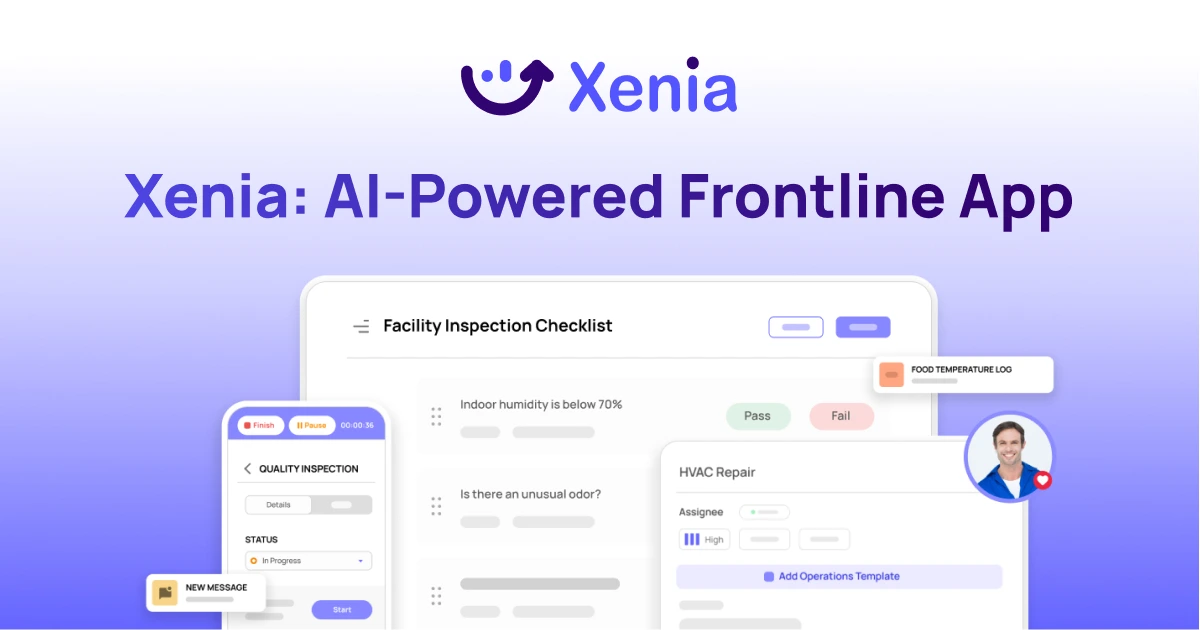
Xenia brings daily operations, maintenance, audits, and compliance into one mobile-first platform. Frontline teams execute work consistently across locations while leadership gets real-time visibility.
Why Multi-Location Operators Choose Xenia:
🤖 AI-Powered Operations, Create digital checklists instantly or convert paper forms with AI. Verify compliance automatically with photo analysis and get instant answers from your operational data.
✅ Daily Operations & Maintenance, Assign work across hundreds of locations in minutes. Report and route issues instantly. Schedule preventive maintenance to catch problems before downtime.
📊 Real-Time Visibility, Track completion, work orders, and performance across all locations through dashboards. Filter by site or asset to spot trends and take action.
Manage operations, maintenance, and compliance across all your locations from one platform

.svg)
.webp)
%201%20(1).webp)

.svg)
%201%20(2).webp)