
Conditional Audit Type
What is conditional visibility for state-specific compliance audits?
Conditional visibility is deterministic branching on audit questions, driven by attributes stored on the location record. It is not AI, not prediction, and not a general-purpose form builder. For state-specific compliance audits, the driving attributes are jurisdiction fields: state, county, and municipality, plus any local permit or program flag your compliance team maintains on the store profile.
It pairs with a second feature called nullify scoring. Nullify scoring removes hidden questions from that location's scoring denominator. A store that never saw six California questions is not scored against them. The two features are separate and they work together. Conditional visibility decides what renders. Nullify scoring decides what counts. Xenia covers the mechanics of both in more depth in conditional visibility for multi-format audit templates and how nullify scoring pairs with conditional visibility.
A location-based regulatory checklist is the same architecture viewed from the checklist side. Instead of maintaining twelve state checklists, you maintain one checklist with twelve question groups and a visibility rule on each.
How this differs from license-attribute branching
Two conditional patterns get confused, so name the difference out loud. License-attribute conditional audits answer a yes-or-no question about the store itself: does this location hold an alcohol or tobacco license. This page answers a different question: given that the store operates, which state's and city's rules govern how it must operate. One is about what the store is permitted to sell. The other is about the regional rule set that applies across every licensed and unlicensed location in that jurisdiction.
Why the regional layer exists at all comes down to two facts. The FDA Food Code is a model code, not federal law, and state and local agencies adopt it on their own timetables. The Retail Food Safety Collaborative Food Code adoption dashboard maps adoption in each state and territory as of July 2024 and lets you click a state to see its code and regulating agencies. Workplace safety splits further. OSHA confirms 29 approved State Plans, including 22 covering private sector workers, and those plans must be at least as effective as federal OSHA. That is the floor, not the ceiling. Two of your stores 40 miles apart can be inspected against different editions of the same model code.
Worked example, conditional visibility in action
A 90-location operator groups stores by state and municipality. The master audit holds 44 questions. Every store answers the same 30 brand and safety controls. California locations additionally see six operator-maintained state questions. New York locations see five. Licensed municipalities see three local questions on top of that. Nobody sees a question that belongs to somebody else's jurisdiction.
| Location group | Jurisdiction attributes on the location record | Question groups shown | Question groups hidden |
|---|---|---|---|
| Store 12, Fresno CA | State California, County Fresno | 30 core brand and safety controls plus 6 California controls | New York group, New York City local group |
| Store 31, Manhattan NY | State New York, City New York | 30 core controls plus 5 New York controls plus 3 New York City local controls | California group |
| Store 58, Nashville TN | State Tennessee | 30 core brand and safety controls only | California group, New York group, New York City local group |
Each store scores on the questions it actually saw. Store 58 answers 30 and can legitimately post 100%. Store 12 answers 36. Neither store is advantaged or punished by its address. That is the whole point of pairing branching with nullify scoring: N/A items do not tank the score, and the audit only counts what a location is supposed to have.
What the jurisdiction-only questions actually look like
Restaurant. In California, Cal/OSHA's indoor heat illness standard, Title 8 section 3396, went into effect on July 23, 2024, applies when the indoor temperature reaches 82 degrees Fahrenheit, and requires a written Indoor Heat Illness Prevention Plan (Cal/OSHA Heat Illness Prevention). California SB 553 adds a workplace violence prevention plan, a violent incident log, and record retention of five years for logs and investigation records (California SB 553). SB 476 requires each food facility to keep records showing every food handler holds a valid card (California SB 476), and the California ABC Responsible Beverage Service program certifies servers within 60 days of hire for three years. A kitchen in Fresno needs a cool-down-area question. A kitchen in Boise does not. In New York City, the health department has required a posted sanitary inspection letter grade since July 2010, with the card placed within five feet of the entrance and four to six feet off the ground (NYC letter grading for restaurants). That is a photographable audit item in five boroughs and almost nowhere else in the chain.
Convenience store. The under-30 photo ID check for tobacco purchases is federal and applies everywhere, effective September 30, 2024 per NACS. Flavored product restrictions are not federal. A planogram question reading "confirm no flavored tobacco facings" is a real control in Sacramento and Boston and a nonsense question in Nashville.
Retail. Price accuracy is the classic regional control. NIST's price verification guidance states plainly that pricing laws vary by state, and that under the examination procedure a store fails when more than 2% of verified prices differ from the price charged. NIST also reports that 28 state and 38 local jurisdictions took part in the 2024 National Price Verification Survey. Scale makes this worth solving. NACS counted 151,975 U.S. convenience stores as of December 31, 2025, with chains of 500 or more stores holding 22.2% of them.
Every requirement above is jurisdiction-specific and time-bound. Check the primary source before you write the question, and put a review date on the group.
How do location-based compliance audits differ from duplicate state templates?
Duplicate templates create one audit per jurisdiction. That means every brand-standard change gets edited in every copy, and the resulting scores are not comparable across states. A location-based template keeps one master, one edit path, and one scoring model.
| Dimension | Duplicate state templates | One location-based template |
|---|---|---|
| Templates to maintain at 12 states | 12 or more | 1 |
| Changing a national brand standard | Edit in every copy, drift is guaranteed | Edit once, applies everywhere |
| Updating one state rule | Find the right copy and hope it is the right one | Update one question group |
| Cross-state score comparison | Not comparable, different denominators | Comparable, nullify scoring normalizes the denominator |
| Store-level experience | Manager may open the wrong template | Store sees only its own question set |
| Audit trail for a regulator | Fragmented across templates | One record with one version history |
| Rollout of a new state | Clone and edit a full template | Add a question group and tag the locations |
Read the table from the compliance director's seat. The row that costs the most money is not the template count. It is the brand-standard row. When a national standard changes and twelve copies need the same edit, one copy gets missed. That gap surfaces six months later during a multi-state compliance inspection, and nobody can explain which version was live on the date the audit was run. The deeper treatment of that tradeoff sits in conditional checklists versus duplicate templates.
Be fair about where competitors actually land. Crunchtime Ops Execution, formerly Zenput, does support location attributes, and its attribute and hierarchy model is mature. Its own product documentation places attributes at the assignment layer, where "the Attributes tab can be used to assign projects and/or announcements based on specific characteristics of a location." That assigns whole projects to location groups. It is not the same as showing or hiding individual questions inside one audit. SafetyCulture's logic is a different shape again and it is well built. Its help documentation describes logic fields that control "what happens when a user selects a response in an inspection," with options including ask questions, require note, require media, and require action. That is answer-triggered follow-up logic, which Xenia also does. It is not location-attribute-driven visibility. For a head-to-head on that gap, see Xenia versus Zenput for multi-unit audits and the roundup of Zenput alternatives for multi-location operators.


Priced on per user or per location basis
Available on iOS, Android and Web


How to set up state-specific audit visibility in Xenia
- Add jurisdiction attributes to every location record. State at minimum. Add county and municipality where local rules apply, such as New York City, Los Angeles County, or Chicago.
- Build one master audit with the national controls first. These are the brand, safety, and food safety questions every store answers regardless of address. This block never branches.
- Group the jurisdiction questions your compliance team maintains. One group per state, plus municipal groups where needed. Name each group after the jurisdiction and its review date so ownership is visible inside the template.
- Set the visibility rule on each group. Show the California group when the state field reads California. Show the New York City group when the city field reads New York. Everything else stays hidden at that location.
- Turn on nullify scoring for the branched groups. Hidden questions drop out of that location's denominator, so a 30-question store and a 36-question store still sit on the same scale. Pair it with weighted audit scoring with critical-item thresholds so a missing heat illness plan does not carry the same weight as a smudged sign.
- Test against two contrasting stores before rollout. Open the audit at one California store and one single-jurisdiction store. Confirm the right groups render, the score math holds, and corrective-action routing reaches the right DM.
Add governance on top of the build. Assign a named owner and a review cadence to each jurisdiction group. Route every regulatory question change through your compliance or legal reviewer before you publish a new template version. Xenia carries version history on the template, so you can show which question set was live on the date an audit was completed. Xenia does not draft, validate, or update the regulatory content itself. That ownership line is worth writing into the SOP, because a regional audit template software rollout fails the first time nobody knows who owns the Massachusetts group.
Where do multi-state operators see results?
Lead with what changes operationally, not with a percentage nobody can verify. Five things move once the branching is live.
- Template count collapses. One master replaces the per-state copies. A national brand-standard change becomes one edit instead of twelve.
- Store-level noise drops. Managers stop marking N/A on questions that were never theirs. That habit is where audit data quality dies, and a local compliance checklist by location removes the temptation entirely.
- Scores become comparable. With nullify scoring on, a regional roll-up measures stores on the controls they actually own. A DM in Texas and a DM in California are held to the same bar.
- Regulatory change becomes a contained task. When one state changes a rule, the compliance owner edits one question group. No template hunt, no drift.
- The evidence trail holds up. Completed audits, photos, timestamps, and template version history sit in one record when a franchisor, insurer, or regulator asks what was checked and when.
The same location-attribute pattern shows up elsewhere in the collection. Franchise-tier conditional audits branch on who owns the unit. Seasonal conditions audits branch on the time of year. All of them start from the same hub, conditional audits and location-based question logic. When a jurisdiction group changes, the change usually needs to reach store teams too, and rolling out an age verification policy across c-stores shows how the broadcast and acknowledgment side of that works. For the food-safety layer underneath the state groups, regulatory frameworks for food safety programs covers how the model code, state adoption, and local enforcement stack up.
Say the limit plainly one more time. Xenia renders the question groups your compliance team builds, keeps version history, and routes the failures into corrective action. It does not track legislative changes, does not certify compliance, and does not tell you what any state requires. Requirements change and adoption is uneven. As of the end of 2024, Food Safety Magazine's reporting on the FDA's annual adoption data put 11 state agencies in 7 states on the 2022 Food Code, covering 16.06% of the population, while 30 state agencies in 24 states had adopted one of the two most recent versions (Food Safety Magazine). Those numbers move every year. Your review cadence is what keeps the audit honest, not the platform.
Frequently Asked Questions
Got a question? Find our FAQs here. If your question hasn't been answered here, contact us.
Can one audit show different questions by state or municipality?

Who is responsible for keeping state compliance questions current?
How are national brand standards kept consistent across regional variants?
Do hidden state-specific questions reduce another location's score?
Can compliance leaders update one regional rule without copying every audit?

A Modern, AI-Powered Platform Built for Restaurant Operations
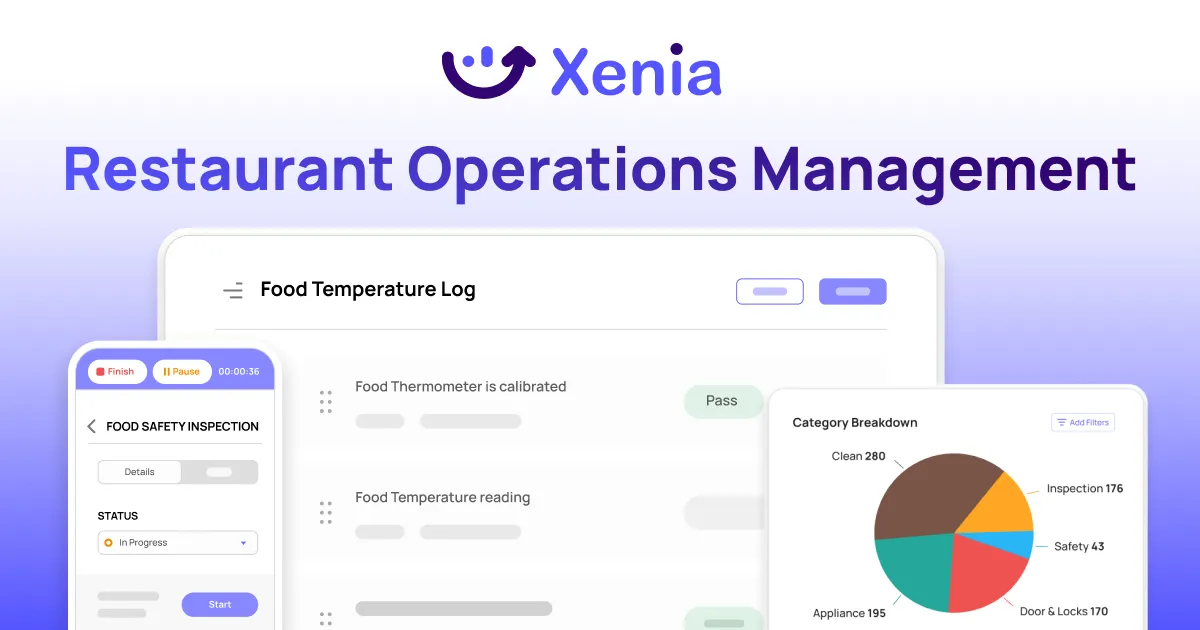
Xenia brings kitchen operations, food safety, audits, and team communication into one mobile-first platform. Restaurant teams execute daily work consistently, maintain compliance, and resolve issues faster, while leadership gets real-time visibility across all locations.
Why Restaurant Operators Choose Xenia:
🤖 AI-Powered Operations, Convert paper logs instantly and verify food presentation and kitchen cleanliness automatically. Get instant answers about food safety trends without building reports.
🍽️ Food Safety & Compliance, Track line checks and temperature logs with automated alerts. Trigger corrective actions when readings exceed safe ranges. Maintain audit-ready records for health inspections.
📊 Multi-Location Control, Monitor food safety compliance and task completion across regions. Benchmark locations to identify training needs. Export reports for operational reviews.
One platform for kitchen operations, food safety, and compliance across all locations.