

Conditional Audit Type
What is conditional visibility?
Conditional visibility is branching logic on audit and checklist questions tied to location attributes. When a location record is tagged with a format attribute (drive-thru yes/no, patio yes/no, tap system yes/no), the audit reads that tag and shows only the questions that apply. Questions for equipment a store does not have stay hidden. They do not appear on the form. When paired with nullify scoring, they do not count against the location's score.
This is not a general-purpose form-builder feature. It is purpose-built for multi-unit ops audits. It handles the case where the same brand runs 10, 50, or 200 locations with different physical configurations.
Conditional visibility and nullify scoring are different features that work together. Conditional visibility hides the irrelevant question from the auditor's view. Nullify scoring removes hidden question points from the score denominator so the store is not penalized for equipment it was never supposed to have.
A patio cleanliness question hidden by conditional visibility would, without nullify scoring, still count as zero points in the denominator. With nullify scoring enabled, those points are excluded entirely. The store with no patio competes on the same terms as the store with a patio. Both are scored only on what applies to them.
For a full treatment of the feature architecture, the conditional audits collection overview covers the full conditional visibility framework across restaurant, C-store, and retail verticals.
Worked example, conditional visibility in action
Here is a concrete walkthrough. A fast-casual QSR franchise with 100 units operates across five store formats.
**
Store Format, Applicable Questions, What Appears
Urban-counter-only-no patio-no drive-thru, 28 questions, Core food safety-line check-FOH/BOH cleanliness
Suburban-patio-no drive-thru, 32 questions, Core + patio cleanliness and maintenance
Suburban-drive-thru-no patio, 34 questions, Core + drive-thru speed-of-service and equipment
Suburban-patio and drive-thru, 38 questions, Core + patio + drive-thru
Flagship-patio + drive-thru + espresso bar, 41 questions, Core + patio + drive-thru + espresso bar equipment
**
Under the duplicate-template path, this chain maintains five templates. A new hot-hold temperature question requires five edits. An update to the drive-thru speed-of-service standard requires editing three templates (formats 3, 4, and 5). Over a year of quarterly audits plus monthly line checks, the compliance officer runs dozens of edits for what started as a single brand-standard change.
Under the conditional template path, the chain maintains one template. The new hot-hold question is added once. A conditional rule routes it to all five formats. The drive-thru standard update is added once and routed to the three formats that have a drive-thru. The template count stays at one regardless of how many formats are added.
C-store example, Huck's convenience stores: Huck's runs locations with and without tap systems. Without conditional visibility, every store receives tap-system temperature questions. A store without a tap system fails those questions by default, or an auditor has to mark them N/A manually on every visit. If the auditor forgets, the score drops. With conditional visibility, the tap-system questions do not appear at stores without tap systems. The tap-system vs. fuel-only C-store audit deep-dive covers this exact format variation in full.
Same audit template for 100 franchises, but units with drive-thrus see drive-thru questions, units with patios see patio questions, and units with espresso bars see espresso bar questions. No template copies, no score normalization work.
This is the fundamental difference: conditional visibility lets you ask different questions at different locations without penalizing stores for N/A items. One audit template handles 100+ format variations.
Weighted audit scoring with critical-item thresholds pairs directly with this setup. Weighted scoring determines how many points each applicable question is worth. Conditional visibility determines which questions appear. Together they produce an audit score that reflects what actually matters at each specific location.
How does conditional visibility differ from static audits?
Static audits present every question to every location regardless of format. The compliance team manually marks inapplicable questions as N/A during the audit. Either way, the question appears, the auditor interacts with it, and the scoring logic has to handle the N/A result correctly.
Conditional audits read the location record before the audit is presented. Questions that do not apply to this location never appear in the form. The auditor never sees them. The score denominator never includes them.
This distinction matters for three concrete reasons.
Audit speed. An auditor at a fuel-only C-store who scrolls past 12 food-service questions to mark them all N/A spends more time on the audit and makes more errors. DMs for Xenia customers have reported saving 30 to 45 minutes per audit by eliminating 50+ irrelevant clicks at non-applicable locations.
Auditor fatigue and pencil-whipping. When auditors encounter long sequences of N/A questions, cognitive load increases. When a template designed for the flagship format is applied to a smaller store, auditors routinely pencil-whip the N/A items or guess at applicability. Conditional visibility removes the judgment call entirely.
Score integrity. A static audit with 10 N/A items handled differently by different auditors produces inconsistent scores across locations. Conditional visibility plus nullify scoring produces mathematically consistent scores that can be rolled up, compared, and trended without normalization work.
**
Dimension, Static / Duplicate Templates, Conditional Audit (Xenia)
Templates maintained, One per format, One for all formats
Brand-standard update effort, One edit per template, One edit total
Score comparability across formats, Requires manual normalization, Comparable by design
Auditor experience at non-applicable items, Scroll past and mark N/A, Items never appear
Risk of template drift, Grows with each new format, Eliminated (one template)
Pricing impact on form-capped models, One form slot per template, Unlimited forms (Xenia)
Setup time for new format, Build a new template, Add a location attribute
**
Zenput's architecture does not include question-level conditional visibility tied to location records. G2 and Capterra user reviews note that "information from one form does not transfer to the follow-up form" and users cite friction in form customization. For a direct feature comparison, the Xenia vs. Zenput comparison covers the full displacement narrative including form-capped pricing and workflow depth.
Pricing context. Zenput's lower pricing tiers cap the number of forms an operator can deploy. A 10-format chain running quarterly and annual audits needs 20 form slots for those two audit types alone, before adding daily ops checklists or opening/closing forms. Each new format consumes another form slot. Xenia's flat per-location pricing includes unlimited forms at every tier. The conditional-vs-duplicate decision becomes purely operational rather than a budget constraint.
SafetyCulture's Smart Fields use answer-based branching: if question A equals X, show question B. Xenia's conditional visibility uses location-attribute branching: if this location has attribute Y, show question group B before the audit even starts. The auditor never sees inapplicable questions. SafetyCulture's model requires the auditor to be in the form before branching occurs.
.svg)

Priced on per user or per location basis
Available on iOS, Android and Web


How to set up conditional visibility in Xenia
The following steps reflect the Xenia setup process. A full setup can be completed in one working session.
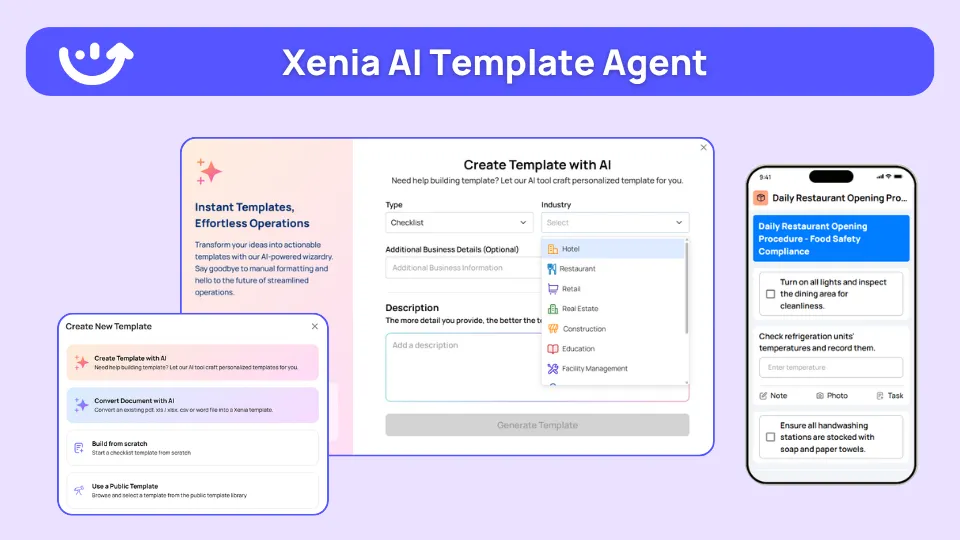
The Xenia AI Template Agent can accelerate the initial build. Upload existing SOP PDFs for each format. The agent converts them into a structured template with conditional logic pre-built. Compliance officers typically spend one working session reviewing and tuning the output.
For franchise chains with different audit requirements at corporate vs. franchisee vs. licensee units, franchise tier conditional audits covers the next layer of conditional logic beyond store format.
Where do operators see results?
Restaurant: Franchise Scale Without Template Sprawl
Newk's Eatery automated 100+ franchise locations in a single rollout. Field consultants generate PDF audit reports with integrated photos and automatic scoring. Template changes for menu updates or limited-time offers push once and reflect across the entire franchise network. The single-template approach means the compliance officer no longer opens 100 individual template records when a brand standard changes.
The International Franchise Association reports QSR franchised units grew 2.2% in 2024 to approximately 199,800 units. Leading chains including Subway, Taco Bell, and McDonald's are actively building multiple store formats: stadium kiosks, food court units, full-service, drive-thru-only, and campus locations. Every new format added to a duplicate-template model is another branch of the maintenance problem.
Graham Enterprise migrated from Zenput to Xenia with conditional visibility as a primary driver. Zenput's checklist-only architecture had no question-level conditional visibility tied to location records. One conditional template replaced the folder of Zenput templates. The migration is confirmed in Xenia's competitive migration data: drivers were facilities workflow and conditional visibility.
For teams running multi-unit restaurant operations and needing to track audit compliance across locations, the multi-unit restaurant operations platform index covers the full audit and inspection program.
C-Store: Tap-System vs. Fuel-Only
Huck's implemented conditional checklists specifically for tap-system stores vs. non-tap stores. Their CS notes capture the exact pain: "that would come in handy for like the cold temps because not all of our stores have like a tap system." The phrasing says it all: running a temperature log question across all stores when only some have tap systems creates both auditor friction and score inaccuracy at non-tap stores.
Power Market (H&S Energy) deployed Xenia across 360+ locations, achieving 40% faster task resolution. Multi-format C-store operations at that scale require one conditional template to handle the range of store formats without building and maintaining a separate template for each.
The NACS State of the C-Store Industry reports C-stores added 2,222 new locations in 2023, outpacing every other US retail format. Format variation is accelerating as C-stores compete on prepared food and beverage. Each new food-service format that gets added to a duplicate-template model adds maintenance overhead indefinitely. For operators in this segment, the convenience store operations software hub covers the broader audit and daily ops program.
Roll-Up Reporting Stays Clean
A common objection to the single-conditional-template approach: "Does roll-up reporting break when one template serves many formats?"
The answer is no. Nullify scoring calibrates each location's denominator to its applicable questions. A 28-question urban store and a 41-question flagship both produce a score expressed as "applicable questions passed divided by applicable questions total." Roll-up reports aggregate these percentages cleanly. The regional VP sees one consistent metric across all formats, not five incomparable score scales that require manual normalization before the weekly review.
The patio vs. no-patio audit article covers the restaurant format variation proof case in more detail, including how scoring integrity holds across the roll-up.
Frequently Asked Questions
Got a question? Find our FAQs here. If your question hasn't been answered here, contact us.
When does duplicating a template per format actually make sense?

How does maintaining one conditional checklist save edit time across formats?
Do roll-up reports break when one template serves many formats?
How do you migrate from a folder of duplicate templates to one conditional checklist?
Does a conditional checklist make audits harder for store-level staff to complete?
How does form-capped pricing punish the duplicate-template approach?


A Modern, AI-Powered Platform Built for Restaurant Operations
Xenia brings kitchen operations, food safety, audits, and team communication into one mobile-first platform. Restaurant teams execute daily work consistently, maintain compliance, and resolve issues faster, while leadership gets real-time visibility across all locations.
.webp)
Why Restaurant Operators Choose Xenia:
🤖 AI-Powered Operations, Convert paper logs instantly and verify food presentation and kitchen cleanliness automatically. Get instant answers about food safety trends without building reports.
🍽️ Food Safety & Compliance, Track line checks and temperature logs with automated alerts. Trigger corrective actions when readings exceed safe ranges. Maintain audit-ready records for health inspections.
📊 Multi-Location Control, Monitor food safety compliance and task completion across regions. Benchmark locations to identify training needs. Export reports for operational reviews.
One platform for kitchen operations, food safety, and compliance across all locations.

.svg)
.webp)
%201%20(1).webp)

.svg)
%201%20(2).webp)


