

Conditional Audit Type
What is conditional visibility?
Conditional visibility is branching logic on audit and checklist questions that shows or hides each question based on a location's attributes. For a new store opening audit, the controlling attribute is the opening phase the unit is in, not its permanent physical format. A pre-open store and a grand-open store run the same template. They just see different question groups.
This is what makes opening-phase branching different from every other conditional pattern. Most conditional audits branch on a permanent attribute (patio vs. no-patio, drive-thru vs. dine-in) or on who owns the unit (corporate vs. franchisee). A franchise-tier conditional audit branches on ownership.
An opening-readiness audit branches on a transient stage every new unit passes through once and then exits. A unit sits in pre-open for weeks, soft-open for days, and grand-open forever after. The opening-phase field on the location record changes as the unit advances, and the audit re-renders each time.
Conditional visibility lets you ask different questions at different locations without penalizing stores for items that do not apply yet. One audit template handles 100-plus format and stage variations. See the full conditional visibility explainer for the underlying mechanics.
It pairs with nullify scoring, which keeps hidden or not-yet-applicable items out of the denominator so a store can reach a true 100 percent on the set it is actually responsible for. The two features solve different problems. Conditional visibility hides the wrong-phase questions. Nullify scoring makes sure the hidden items do not tank the score. Keep them distinct.
One more distinction matters here. This is not the daily restaurant opening checklist a store manager runs every morning for the life of the store. The new store opening audit is a one-time lifecycle audit. It runs once per unit and retires when the unit reaches steady state.
Worked example, conditional visibility in action
A growing brand opens 25 units a year and runs one opening-readiness template carrying 58 questions across three phases. Each location's opening-phase attribute on the record decides which question groups appear. A unit in pre-open sees 22 punch-list questions. A unit in soft-open sees 30 readiness questions. A unit in grand-open sees the 16 steady-state brand-standard questions, and the pre-open punch-list group hides automatically.
The phases carry real, store-grounded content:
Nullify scoring keeps the phases a store has already cleared out of the current walk's denominator, so a soft-open unit can score a true 100 percent on the soft-open set instead of failing on grand-open items it has not reached.
**
Tier / Condition, Question groups shown, Question groups hidden
Unit in pre-open phase, Punch list (signage-utilities-equipment commissioning-health pre-inspection), Soft-open readiness- grand-open brand standards
Unit in soft-open phase, Soft-open readiness (staff training-POS live test-line check under real volume), Pre-open punch list- grand-open brand standards
Unit in grand-open phase, Grand-open steady-state brand standards, Pre-open punch list-soft-open readiness
**
A growing fuel-and-foodservice brand opens new sites the same way. C-store chains with mixed formats can run one audit and hide irrelevant questions per group. Pre-open covers forecourt signage, pump commissioning, cooler temps verified, and the fuel-price systems going live.
Soft-open covers shift staffing, cooler and hot-hold line checks under real traffic, and vendor delivery flow. Grand-open is the steady-state store walk every mature site runs. The pattern holds across weighted scoring on the underlying audit and across the conditional checklist vs. duplicate templates decision every multi-unit operator faces.
How does conditional visibility differ from static audits?
A static opening audit shows every question to every unit regardless of phase, which means a pre-open store gets marked down on grand-open brand standards it was never supposed to meet yet. A conditional opening audit shows only the current phase's questions and scores the unit only against what it is responsible for today.
**
Dimension, Static opening checklist, Conditional opening audit (Xenia)
Template count, Three separate templates (pre-open-soft-open-grand-open) maintained by hand, One template-58 questions- phase-driven rendering
What a soft-open store sees, All questions-including grand-open brand standards, Only the 30 soft-open readiness questions
Score on not-yet-applicable items, Counted as failures-tanks the score, Nullified-kept out of the denominator
Advancing a unit, Manually swap to the next template and re-train field teams, Change the opening-phase attribute-the audit re-renders
Cross-unit rollup, Three template versions to reconcile, One record per unit-one above-store view
Maintenance when standards change, Edit three templates-risk drift between them, Edit one template-every phase stays in sync
**
For the franchise compliance officer, the table reads as a maintenance and accuracy problem. Three hand-maintained templates drift. The pre-open version gets a wording fix that never lands in the soft-open version. A conditional audit edits once and stays in sync. For the ops director, it reads as a scoring-honesty problem. A soft-open store that fails on grand-open items produces a number nobody trusts, so nobody acts on it.
The competitor field confirms the gap. GrowthFactor publishes a strong strategic narrative and a 47-point grand-opening checklist with soft-versus-grand framing, but no per-question conditional rendering. It is a reading guide, not a branching audit. GoAudits ships a flat store opening and closing template organized into fixed sections, with separate checklist variants per vertical rather than conditional branches inside one template.
That is exactly the duplicate-template problem Xenia removes. 1TouchPoint, PopProbe, and SafetyCulture all publish flat opening templates with no phase logic.
Zenput (now inside Crunchtime) is checklists-only with no question-level conditional visibility, so operators running a new-store program in Zenput maintain separate phase templates by hand. Graham Enterprise migrated from Zenput to Xenia with conditional visibility as a named driver. RizePoint sells conditional logic as an expensive add-on rather than native. See the best Zenput alternatives breakdown for where the displacement math lands.
.svg)

Priced on per user or per location basis
Available on iOS, Android and Web


How to set up conditional visibility in Xenia
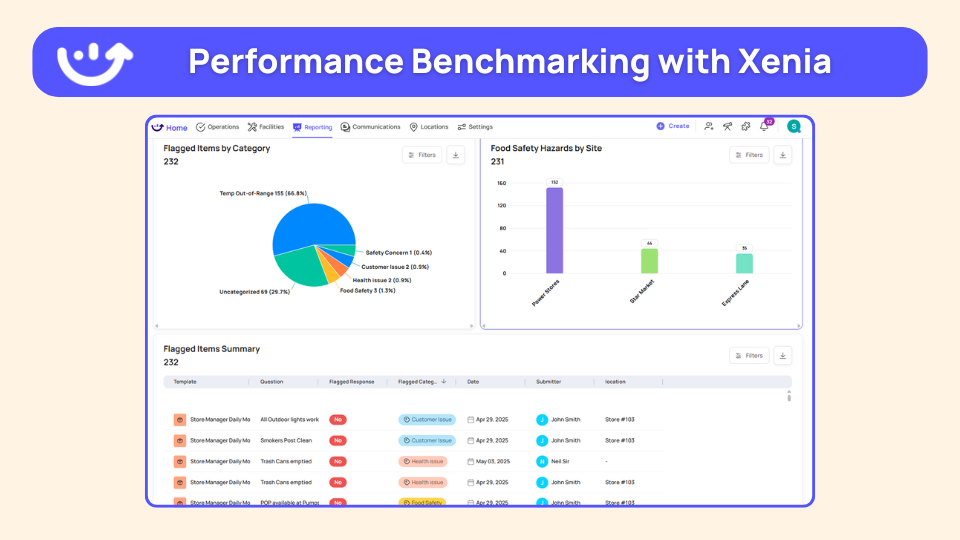
You set up a new store opening conditional audit once, then advance each unit through the phases by changing one attribute on its location record. There is no template swap and no field re-training as a unit moves from pre-open to grand-open.
A few supporting features make the punch list close to evidence, not to a report. A failed equipment-commissioning item triggers a follow-up question at the moment of failure: describe what you found, photo required. That failure auto-creates a corrective task with an assignee, a deadline, and escalation if it is not closed in time. Location hierarchy means the franchise compliance officer sees every opening unit across the portfolio while the DM sees only their openings. For remote new C-store builds with no connectivity on site yet, offline mode lets the field team run the punch list and sync when they get signal.
Where do operators see results?
Operators running a multi-unit opening program see results in three places: one template instead of three, soft-open stores scoring honestly instead of failing on items they have not earned, and a single above-store view of every unit's opening phase at once.
Newk's Eatery ran 100-plus franchise locations and automated its field audit process, eliminating manual Excel-based reporting and adding automatic scoring and corrective-action documentation. Field Business Consultant Brad Forsythe said Xenia "saves us a ton of time" as the brand scales. Read the Newk's Eatery franchise rollout story for the full picture.
Huck's runs conditional checklists for tap-system versus non-tap stores, validating the same conditional pattern in a real C-store deployment. Power Market went live across 360 locations with bilingual checklists and QR deployment and reported 40 percent faster task resolution, which shows what multi-location rollout speed looks like at scale.
For the ops-director persona, lead the dashboard with the issues view, not the completion percentage. A 50-location operator does not care as much about completion metrics. They want to see what is coming up as a problem.
For an opening program, the issue view is concrete: which of my 25 in-flight openings are stuck in pre-open past their target date, which soft-open units are failing the line-check group, which units are clear to advance to grand-open.
The market makes the case for one template. Franchising is projected to add more than 20,000 new units in 2025, a 2.5 percent expansion to 851,000 total units, per the IFA 2025 Economic Outlook.
The QSR segment alone added roughly 4,301 franchised units in 2024, reaching 199,808 units, as reported by Restaurant Dive. Brands open at real cadence. Tropical Smoothie Cafe opened 161 new cafes in 2024, with over 70 percent driven by existing franchisees, per Franchising.com's 2025 growth report. A brand opening 100-plus units a year cannot manage three opening templates per unit by hand.
Flat per-location pricing means a brand adding 25 units a year pays for the location count, not per new template. Zenput's form-capped model charges more for every template added, which punishes exactly the growth a new-store program represents. See Xenia pricing for the per-location math. For the broader pattern across formats and verticals, the conditional audits overview covers how store-lifecycle branching fits alongside permanent-format and franchise-tier branching.
Frequently Asked Questions
Got a question? Find our FAQs here. If your question hasn't been answered here, contact us.
What questions belong in a pre-open punch list versus a grand-open readiness audit?

How does conditional logic advance a store from pre-open to soft-open to grand-open questions?
Can one template cover every opening phase without building three separate audits?
How do you stop a soft-open store from failing on steady-state brand-standard items it hasn't earned yet?
How is an opening-phase audit different from a daily opening checklist?
How do operators track opening-readiness across many units launching at once?


A Modern, AI-Powered Platform Built for Restaurant Operations
Xenia brings kitchen operations, food safety, audits, and team communication into one mobile-first platform. Restaurant teams execute daily work consistently, maintain compliance, and resolve issues faster, while leadership gets real-time visibility across all locations.
.webp)
Why Restaurant Operators Choose Xenia:
🤖 AI-Powered Operations, Convert paper logs instantly and verify food presentation and kitchen cleanliness automatically. Get instant answers about food safety trends without building reports.
🍽️ Food Safety & Compliance, Track line checks and temperature logs with automated alerts. Trigger corrective actions when readings exceed safe ranges. Maintain audit-ready records for health inspections.
📊 Multi-Location Control, Monitor food safety compliance and task completion across regions. Benchmark locations to identify training needs. Export reports for operational reviews.
One platform for kitchen operations, food safety, and compliance across all locations.

.svg)
.webp)
%201%20(1).webp)

.svg)
%201%20(2).webp)


