
Post Summary
Something went wrong in your restaurant today.
Maybe a cook slipped near the prep station. Maybe a server cut their hand on broken glass. Maybe a customer flagged a food safety concern after leaving.
Your team handled it. Life moved on.
But if nobody wrote it down properly, that incident is now a ticking clock. One workers' comp dispute. One insurance denial. One OSHA inspection. One lawsuit. Any of those scenarios gets a lot harder without a proper workplace incident report on file.
This guide covers everything you need to know. What a workplace incident report is. What OSHA requires. What to include. How to write one properly. And how to stop doing this on paper.

.svg)

Priced on per user or per location basis
Available on iOS, Android and Web


Related resources
- Restaurant incident report template - free prebuilt form ready to use today
- Daily incident report form - for shift-by-shift documentation
- Employee incident report template - for staff injuries and workplace accidents
- Food safety incident report form - for contamination and food safety events
- Hazard report form - for near misses and safety violations
- OSHA restaurant compliance audit template - OSHA recordkeeping support
- Restaurant corrective action guide - what to do after an incident is filed
- Food safety audit guide - proactive food safety documentation
- Restaurant safety checklist - daily safety checks to prevent incidents
- Best incident management software - tools for managing incidents across multiple locations
What is a workplace incident report?
Simple answer: it is a written record of anything that went wrong at work.
In a restaurant that covers a lot of ground. A slip on a wet floor. A burn during food prep. A customer allergic reaction. A piece of equipment that broke and injured someone. A near miss that could have been much worse.
The report captures:
- What happened, in plain factual language
- Who was involved and their roles
- Where and when it occurred
- What the immediate response was
- What follow-up action is needed
One thing restaurants get wrong: they only file reports for serious injuries. That is a mistake. Minor cuts, near misses, equipment issues, food safety concerns, all of it needs a record. A small incident undocumented today becomes a major liability problem six months from now.
Why incident reports matter more than most operators think
Here is the honest version.
Most restaurants treat incident reports as paperwork. Something you do because you have to. That mindset is expensive.
A properly filed workplace incident report does four real things for your business.
It creates a factual record while details are still accurate. It supports your insurance claims and workers' compensation cases. It helps you spot patterns so the same thing does not keep happening. And it demonstrates to OSHA, health inspectors, and courts that your operation takes safety seriously.
The restaurants that handle incidents well are not doing more paperwork. They are protecting themselves from the incidents that come later.
OSHA requirements for restaurant incident reporting
This is the section most operators get wrong. Let us make it simple.
**
Incident type, Deadline, What you must do
Work-related fatality, 8 hours, Notify OSHA directly + log on Form 300
In-patient hospitalization, 24 hours, Notify OSHA directly + log on Form 300
Amputation, 24 hours, Notify OSHA directly + log on Form 300
Loss of an eye, 24 hours, Notify OSHA directly + log on Form 300
All other recordable injuries, 7 calendar days, Complete OSHA Form 300 and Form 301
**
OSHA Form 300 is the Log of Work-Related Injuries and Illnesses. Every recordable incident gets entered here.
OSHA Form 301 is the detailed Injury and Illness Incident Report for each individual case. You have 7 calendar days to complete it after the incident occurs. Keep these records for a minimum of 5 years.
Who needs to keep OSHA records? Restaurants with more than 10 employees must maintain OSHA injury and illness logs. But every employer covered by the OSH Act must report fatalities, amputations, eye loss, and in-patient hospitalizations regardless of size.
How long do you keep incident reports? OSHA Form 300 stays on file for 5 years. General incident reports should be kept for 2 to 3 years minimum. Active legal cases or your state's laws may require longer.
The 4 types of workplace incidents every restaurant must track
**
Incident type, What it covers, Why you document it
Near miss, Something that almost caused harm but did not, Catches hazards before someone actually gets hurt
Injury or illness, Burns-cuts-slips-back injuries-food-related illness, OSHA compliance-workers' comp-legal protection
Property damage, Equipment failure-water leaks-theft, Insurance claims-financial protection
Safety violation, Skipped protocols-improper equipment handling, Identifies training gaps before they turn into injuries
**
Near miss reports
A near miss is an incident that almost happened. The wet floor that got mopped five minutes before someone walked through. The box sitting dangerously close to the edge of a shelf. The knife that almost slipped.
These feel like nothing. They are not nothing.
Near misses are early warning signals. If you document them, you can fix the hazard before it injures someone. If you do not document them, you find out about the problem the hard way.
Injury and illness reports
This is your most critical documentation category. File a report for every injury. Not just serious ones.
That small cut that gets infected two weeks later? Major legal problem without an original incident report. A minor fall that escalates to a workers' comp claim? Much harder to defend without documentation.
Every minor incident is a potential major claim. Document all of them.
Property damage reports
A refrigerator that fails overnight and ruins $4,000 of product. An oven that malfunctions mid-service. A theft from the stockroom. All of these need proper documentation.
Without a report, insurance claims get complicated. Without a report, the same equipment fails again because nobody tracked the issue.
Safety violation reports
When an employee skips a safety step or handles chemicals incorrectly, that goes on record. It tells you where your training gaps are. It also shows regulators that you identified the problem and addressed it. That distinction matters during an inspection.
What a restaurant incident report must include
Use this as your checklist. Every field matters.
Basic details:
- Date, time, and exact location of the incident
- Names and job roles of everyone involved: employees, customers, witnesses
- A plain description of what happened, written as facts not opinions
- Description of any injury, illness, or property damage
Response documentation:
- Immediate actions taken: first aid, securing the area, contacting emergency services
- Who was notified and when: manager, HR, OSHA where required
- Witness statements collected the same shift
Evidence:
- Photos of the scene, equipment, or injuries
- Video footage if available
- Equipment logs or temperature records relevant to the incident
Follow-up:
- Root cause identified
- Corrective action planned and assigned
- Responsible person and completion deadline documented
Nothing optional here. A report with missing fields is nearly as problematic as no report at all. Use a digital form that requires every field before submission so nothing gets skipped under pressure.
How to write a restaurant incident report: step by step
Step 1: handle the emergency first
Medical attention before documentation. Secure the scene. Shut down faulty equipment. Do not pick up a pen until the immediate situation is under control.
Step 2: gather information while it is still fresh
Restaurant environments move fast. Memories fade within hours. Collect witness statements before the shift ends. Take photos of the scene before anything gets cleaned up. Write down times and observations while people are still present.
Step 3: write in plain, factual language
No blame. No speculation. Just what happened: who, what, when, where, and what the response was. Short sentences. Simple words. If someone with no context can read it a year from now and understand exactly what occurred, you have done it right.
Step 4: fill in every required field
Use a standardized form. Attach photos directly to the record. Do not store supporting evidence separately where it can get lost.
Step 5: file it the same shift
The manager on duty completes the report, ideally with input from everyone involved and any witnesses. File it before that shift ends whenever possible. For OSHA recordable incidents: 7 calendar days maximum. For fatalities and severe injuries: hours, not days.
Step 6: identify the root cause
Describing what happened is not enough. You need to know why it happened.
Was there no wet floor sign? A tool that had been damaged for weeks? A training gap that nobody addressed? Root cause analysis is what actually prevents the next incident. Without it, you are just documenting the same problems over and over.
Step 7: complete corrective action and document it
Assign the fix to a specific person with a specific deadline. Document that it was completed. This is what demonstrates to OSHA, your insurer, and any court that you took the incident seriously and responded properly. An open corrective action is almost as bad as no action at all.
The real cost of poor incident reporting
Let us put some numbers to this.
OSHA fines. Serious violations cost $16,550 per violation in 2026. Willful or repeat violations can exceed $165,000. Incomplete recordkeeping triggers citations regularly during restaurant inspections.
Workers' comp disputes. An undocumented injury creates a he said, she said situation. Without a contemporaneous record, you lose negotiating ground on every claim.
Legal liability. A customer who slips and falls with no incident report on file is a much harder case to defend than one with a complete timestamped record showing your team's response. Courts treat missing documentation as negligence.
Staff trust. When incidents get mishandled or ignored, your team notices. It tells them their safety is not a priority. In an industry already dealing with 130%+ annual turnover, that is a retention problem on top of a safety one. See how frontline employee training connects to safety culture and retention.
Repeat incidents. Without root cause analysis and documented corrective action, the same thing keeps happening. By the second time, there is less excuse and more exposure. The restaurant corrective action guide covers exactly how to close that loop.
Quick tips for writing better incident reports
These apply to every report your team files, every shift.
- Write it the same day. Memory fades fast in a restaurant.
- Use plain language. Write how you talk.
- Stick to observed facts. No blame, no assumptions.
- Attach photos every time. Visual evidence wins disputes.
- Get witness statements before people leave.
- Fill in every field. Incomplete reports create gaps.
- Proofread before submitting. Vague language weakens the record.
- Keep it confidential. Share only with HR, safety officers, and authorized personnel.
- Follow up on corrective actions. Document when the fix is actually done.
- Maintain consistent format. It makes audits and reviews far easier.
How Xenia helps restaurants manage incident reporting
Paper incident reports get lost. Email chains disappear. Neither holds up under legal or compliance pressure.
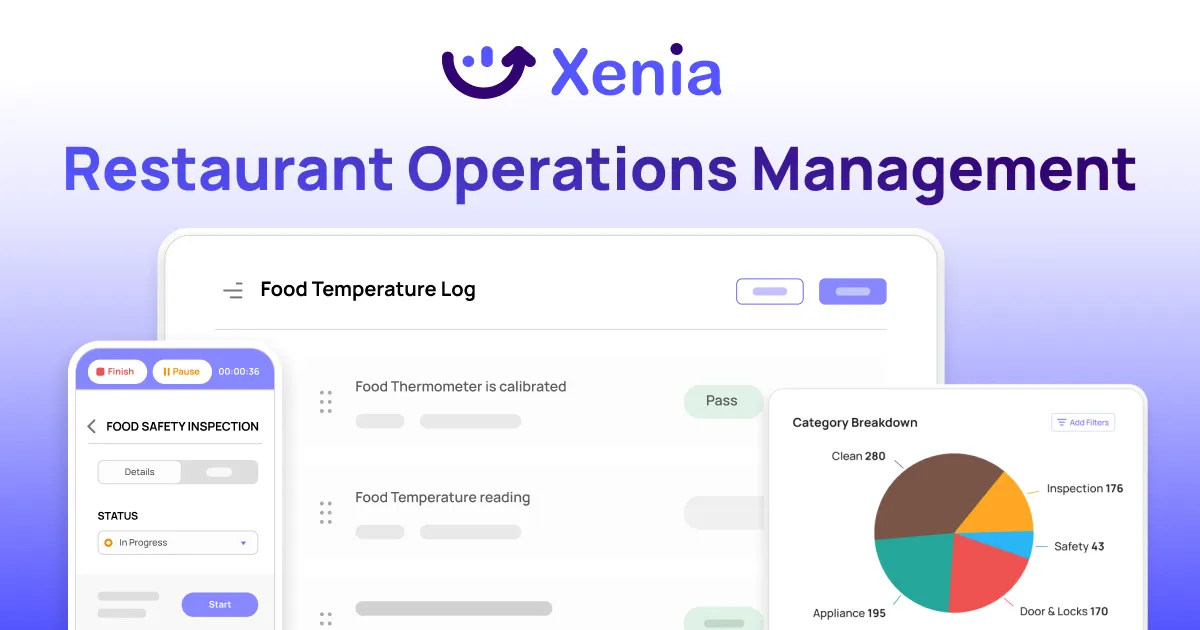
Xenia makes incident reporting digital and fast. Staff file reports from their phones in under two minutes, with automatic timestamps, photo attachments, and required fields that prevent incomplete submissions.
When an incident needs follow-up, Xenia generates a corrective action task automatically, assigns it, and tracks it to completion. No manual chasing. No gaps in the record.
Managers see incident trends by location, shift, and category through the frontline reporting dashboard. Everything connects to your food safety tools, HR workflows, and checklists.
Start with a free restaurant incident report template.
Start for free or book a demo.
Conclusion
Incidents happen in restaurants. Every shift, every location, every week.
The ones that damage your business most are not always the serious ones. They are the undocumented ones. The near miss nobody wrote down. The minor injury that turned into a major claim because there was no record. The food safety complaint that became a lawsuit because the response was not documented.
Good incident reporting is not about compliance paperwork. It is the record that protects your team, your finances, and your ability to keep operating.
Xenia makes that record fast, complete, and digital so your managers spend less time on paperwork and more time running the restaurant.
Start for free or book a demo. Free plan for up to 5 users. No credit card required.
Frequently Asked Questions
Got a question? Find our FAQs here. If your question hasn't been answered here, contact us.
Is there a free incident report template for restaurants?

Yes. Xenia offers a free restaurant incident report template and a daily incident report form. Both cover all required fields for OSHA recordkeeping and workers' compensation documentation. Free to start, no credit card required.
What happens if a restaurant does not file incident reports?
OSHA fines up to $16,550 per serious violation. Workers' comp disputes with no supporting documentation. Insurance claim denials. Personal injury liability. And the same incident happening again because nobody identified or fixed the root cause.
Who files the incident report in a restaurant?
The manager on duty is responsible, ideally with input from the staff involved and any witnesses. File it the same shift the incident occurred whenever possible.
How long do restaurants need to keep incident reports?
OSHA Form 300 records must be kept for 5 years. General incident reports should be retained for at least 2 to 3 years. Active legal matters or state law may require longer.
What must be included in a restaurant incident report?
Date, time, and location. Names and roles of everyone involved. A factual description of what happened. Injuries or damage. Immediate actions taken. Witness statements. Photo evidence. Root cause identified. Corrective action assigned.
When does a restaurant have to report an incident to OSHA?
Fatalities must be reported to OSHA within 8 hours. In-patient hospitalizations, amputations, and loss of an eye must be reported within 24 hours. All other recordable injuries must be logged on OSHA Form 300 within 7 calendar days. Restaurants with more than 10 employees must maintain OSHA injury and illness logs.


A Modern, AI-Powered Platform Built for Restaurant Operations
Xenia brings kitchen operations, food safety, audits, and team communication into one mobile-first platform. Restaurant teams execute daily work consistently, maintain compliance, and resolve issues faster, while leadership gets real-time visibility across all locations.
.webp)
Why Restaurant Operators Choose Xenia:
🤖 AI-Powered Operations, Convert paper logs instantly and verify food presentation and kitchen cleanliness automatically. Get instant answers about food safety trends without building reports.
🍽️ Food Safety & Compliance, Track line checks and temperature logs with automated alerts. Trigger corrective actions when readings exceed safe ranges. Maintain audit-ready records for health inspections.
📊 Multi-Location Control, Monitor food safety compliance and task completion across regions. Benchmark locations to identify training needs. Export reports for operational reviews.
One platform for kitchen operations, food safety, and compliance across all locations.

.svg)
.webp)
%201%20(1).webp)

.svg)
%201%20(2).webp)