

Post Summary
Here is the part nobody says out loud.
Most upskilling content assumes your employee has a laptop, a quiet desk, and an hour free. Your frontline worker has a rush service starting in 15 minutes.
The gap is real. According to Toast's analysis of Bureau of Labor Statistics data, the average annual restaurant industry turnover rate is 79.6 percent over the past decade. Retail hourly staff often leave within 90 days. And in that window, most L&D programs are still trying to get new hires to finish an onboarding module they opened once and forgot.
The problem is not that frontline workers cannot grow. It is that standard training frameworks were built for a completely different workforce. This playbook is for the one you actually have.
.svg)

Priced on per user or per location basis
Available on iOS, Android and Web


Related Resources
- How Xenia supports HR workflows and employee development tracking
- Frontline employee training: what actually works for hourly workers
- Best LMS platforms for restaurants in 2026
- Restaurant staff training topics: what to cover and when
- How to prevent employee burnout in frontline operations
Upskilling vs reskilling vs cross-skilling: definitions that matter for frontline
These three terms get used interchangeably. They are not the same thing, but the distinction matters less for hourly frontline staff than the framework you apply to all three.
Upskilling means developing existing capabilities to a higher level. A line cook learning advanced prep techniques. A retail associate learning upselling skills.
Reskilling means building new capabilities for a different role. A FOH server cross-trained to manage delivery coordination. A store associate trained to run stock receiving.
Cross-skilling means building flexibility across roles. A team member who can work both the drive-through and the counter, or both BOH prep and front-of-house support.
For hourly frontline staff, what matters more than the label is cadence. A quarterly training module does nothing if the skill is never practiced on shift.
The question is not what category of development you are running. It is whether the learning is woven into daily operations or sitting in a learning management system that nobody opens.
The frontline skills reality: why standard L&D frameworks fail
Most employee skills assessment frameworks were designed for annual performance cycles. Frontline operations do not work that way.
Here is why standard approaches break down in a frontline environment.
Hourly schedules make course-based learning impractical. A 30-minute eLearning module requires a quiet space, a device, and uninterrupted time. Most frontline workers do not have any of those things during a shift. Pre-shift huddles last 5 to 10 minutes. That is your training window.
High turnover changes the ROI math completely. If average tenure is 6 months, a 12-week training program is not viable. Skills development needs to deliver value within weeks, not quarters.
Training content alone never moves behavior. This is the one most L&D teams get wrong. A new hire can complete every module in your onboarding program and still hold a product at the wrong temperature, handle a customer complaint badly, or skip a step on the closing checklist. Content teaches. Systems and reinforcement change behavior. The two are not the same thing.
For more on how frontline training translates into actual on-floor execution, frontline employee training covers the gap between training completion and performance change.
How to run a skills gap analysis for a frontline workforce: 5-step framework
This is the featured snippet target. Run this framework before you buy any platform, design any course, or build any development plan.
Step 1: Map every role to the 8 to 12 capabilities required to do the job at standard
Start with your highest-volume roles. Line cook, retail sales associate, shift supervisor. For each role, list the capabilities that define "performing at standard." Not job tasks. Capabilities. There is a difference between "can complete a closing checklist" and "understands why each step matters and can train a new hire on it."
Step 2: Score current staff against those capabilities
Use three inputs. Manager observation, peer input, and evidence from operations data. What does your audit completion rate tell you about checklist discipline? What does your customer complaint rate tell you about service capability? Do not rely on self-assessment alone.
Step 3: Identify gaps at three levels: individual, location, brand
Some gaps are individual. One team member who struggles with allergen protocols. Some are location-level. One site where closing procedures consistently fail. Some are brand-level. A skill development gap that exists across every location in your portfolio. Each level needs a different response.
Step 4: Prioritize by operational risk
Food safety and compliance gaps go first. A team member who does not understand temperature danger zones is a health code violation waiting to happen. Customer experience gaps go second. Revenue-affecting skill gaps go third. Not everything needs a development plan at once.
Step 5: Build the development plan with explicit on-shift practice and measurement
A skill gap analysis that produces a list of training modules is not a development plan. A development plan identifies what the person will practice on shift, how often, who will coach them, and what operational metric will tell you the gap is closing.
For related reading, restaurant staff training topics covers the content layer. This framework covers the system around it.
6 skills every frontline worker needs by 2026
The skills gap in frontline operations is not just about food safety procedures or product knowledge. It is broader than that.
1. Tech literacy
Your team needs to use mobile ops tools, digital checklists, and reporting apps as a basic part of the job. Workers who cannot navigate a mobile form or a digital temperature log are a compliance risk. Tech literacy for frontline staff is not about coding. It is about being able to operate the platform their role depends on.
2. Customer experience judgment
Specifically, complaint handling. Any team member can follow a script. The skill is knowing when the script does not fit the situation and having the judgment to act without escalating every interaction to a manager. This is the skill that drives guest satisfaction scores at the location level.
3. Food safety and compliance fundamentals
Temperature danger zones, FIFO, allergen protocols, HACCP basics. This is table stakes for any frontline worker in food service. But knowing the rule and applying it consistently under pressure during a busy service are two different things. The competency is the application, not the knowledge.
4. Cross-functional task flexibility
The ability to cover adjacent roles when volume shifts, a team member calls out, or a station needs support. This is the skill that keeps a shift running when it should fall apart. Cross-skilling for flexibility is one of the highest-ROI investments a multi-unit operator can make.
5. Upward and peer communication
Can your team member tell a manager about an equipment issue before it becomes a crisis? Can they hand off a shift in a way that actually transfers context, not just a clipboard? Communication as a frontline skill is about operational continuity, not soft skills.
For how shift handoff documentation works in practice, restaurant shift handoff documentation is a useful companion read.
6. AI tool literacy
This one is new but growing fast. Scheduling AI, inventory forecasting tools, and voice-driven reporting are moving into frontline operations. Workers who can interact with these tools as part of their daily workflow will have an advantage.
Training for AI tool literacy does not need to be formal. It starts with the tools you are already deploying and whether your team actually knows how to use them.
Building employee development plans that stick
Most employee development plans fail for one of three reasons. They are too long. They have no coaching attached. Or they treat completion as success rather than behavior change.
The three-pillar framework that works for frontline:
Pillar 1: Capability
What specific skill are you developing? Be precise. "Improve food safety" is not a capability. "Correctly execute temperature logging on the hot and cold line without prompting" is.
Pillar 2: Cadence
How often will the skill be practiced on shift? Daily repetition beats monthly training every time. Build the practice into the existing workflow. If you want temperature logging done right, put it on the daily checklist and verify it.
Pillar 3: Coaching
Who is watching, giving feedback, and adjusting? Without a coach, content is just content. The coach does not need to be a dedicated L&D professional. It is usually the shift supervisor or a designated location champion.
Example 1: Line cook to kitchen manager (12-month plan)
Months 1 to 3 focus on food safety certification and consistent execution of all line check procedures. Months 4 to 6 add ordering and inventory count responsibilities. Months 7 to 9 add shift leadership during lower-volume services. Months 10 to 12 add training delivery for new BOH hires. The competency management system tracks capability milestones, not just course completions.
Example 2: Retail sales associate to district trainer (18-month plan)
Months 1 to 4 focus on product knowledge depth and upselling technique with measurable conversion rate improvement. Months 5 to 9 add visual merchandising verification and planogram execution. Months 10 to 14 add peer coaching responsibilities at the location level. Months 15 to 18 include co-facilitation of new-hire onboarding at two additional locations. Progression is tied to audit scores and peer coaching feedback, not tenure.
For how employee accountability tools support development plan tracking, employee accountability covers the ops execution layer that makes these plans visible.
Knowledge sharing and peer-to-peer learning: the multiplier
Top-down training content works for foundational knowledge. Peer-to-peer learning is what actually moves skill development at scale.
Here is why. A training module tells a new line cook how to do a cooler temperature check. A shift coach who does the check alongside them for two weeks and gives feedback in real time is what makes the behavior stick.
For frontline operations, peer-to-peer learning looks like this:
- Shift coaches: One team member per shift designated as the on-the-floor learning resource. They are not a manager. They are the best practitioner in the room, and they get credit for developing others.
- Location L&D champions: One person per site who owns the development culture, tracks skill milestones, and surfaces training needs to HQ.
- Pre-shift microlearning: 3 to 5 minutes before a service starts. One skill, one scenario, one question. Repeated weekly, this creates more behavior change than a quarterly training day.
Knowledge sharing does not need a formal platform. It needs structure. The structure is the shift, the huddle, and the coach. The platform supports tracking and accountability.
For how communications tools can support peer knowledge sharing across locations, frontline communication covers the operational layer.
Competency management systems vs LMS: what is the difference for frontline?
This question comes up in almost every L&D conversation for frontline operations.
**
Aspect, LMS, Competency management system
What it tracks, Content completion, Capability development
Primary output, Course completion rate, Skill proficiency level
Best for, Onboarding content-compliance training, Role-to-skill mapping-development planning
Frontline reality, Often underused-mobile UX varies, Closer to what frontline ops actually needs
Integration needed, Yes-with ops platform, Yes-with daily execution layer
**
An LMS delivers and tracks training content. A competency management system maps roles to skills, assesses current proficiency, and tracks development over time. Most frontline operations need both, but most only buy the LMS.
The missing piece is the connection between the LMS and daily operations. A team member completes a food safety module. Does that change what happens on the hot line tomorrow?
Only if the skill is reinforced through the checklist, the audit, and the coach. That reinforcement layer is what HR workflows and checklists and sops provide in a platform like Xenia.
For a broader look at frontline LMS options, 7 best frontline LMS covers the platform landscape. For restaurant-specific LMS considerations, best LMS for restaurants is worth reading before you buy.
Measuring upskilling ROI on the frontline
Completion rates are a vanity metric. They tell you someone opened a module. They do not tell you anything changed.
Here are the operational metrics that actually prove training worked.
**
Metric, What it measures, Why it matters
Audit pass rate by location, Whether trained behaviors are executing consistently, Directly ties training to operational compliance
Customer complaint rate, Whether service skills are improving, Guest experience is the output of frontline skill development
Time to promote, Whether development plans are moving people forward, Validates that your competency framework is working
Voluntary turnover percentage, Whether investment in development is being felt, Employees who see a path stay longer
Skills graduation rate, Percentage of staff who advance one tier per year, The headline metric for your L&D program
**
The skills graduation rate is the one to build into your board deck or CFO presentation. If 30 percent of your frontline workforce advances one skill tier per year, you have a development program. If zero do, you have a training program. Those are not the same thing.
For how operational dashboards track these metrics across locations, frontline reporting covers the visibility layer.
Common frontline upskilling mistakes
Most operators make at least two of these. Knowing them early saves significant time and budget.
Buying an LMS without connecting it to the daily ops platform
An LMS that lives outside your daily operations platform is a tool your team visits once and forgets. The skill has to show up in the checklist, the audit, and the coaching conversation for it to stick.
Training content that ignores mobile-first reality
A 45-slide PowerPoint rendered on a phone is not training. Frontline skill development content needs to be short, visual, and accessible on the device your team actually uses. If it does not work on a phone in a walk-in cooler, it will not get used.
Skipping coaching entirely
Content without coaching converts at a very low rate. A team member who watches a video and never has a conversation about it with a manager or peer is unlikely to change behavior. The coaching relationship is not optional. It is the mechanism.
Measuring completions instead of behavior change
Your training report shows 94 percent completion. Your health inspection score went down. Those two things can both be true at the same time. Completion is an input metric. Behavior change is the output metric. Measure what changed on the floor, not what was clicked in the platform.
For more on how training translates into operational execution, manage training across multiple locations covers the rollout and adoption layer.
Conclusion
Most frontline upskilling programs fail because they are solving a knowledge problem when the real problem is execution. Your team is not short on information. They are short on systems that reinforce the right behavior every shift.
The skills gap analysis gives you a map. The development plan gives you a path. Coaching and daily ops give you the reinforcement that turns training into behavior.
Xenia connects the L&D layer to daily operations through HR workflows, checklists and sops, and brand standards compliance. When a skill is being developed, it shows up in the checklist your team runs every shift and in the audit score your DM reviews every week.
See how multi-site brands turn training into on-shift execution. Book a demo.
Frequently Asked Questions
Got a question? Find our FAQs here. If your question hasn't been answered here, contact us.
How do you upskill hourly frontline workers effectively?

Keep it short and frequent. Five-minute pre-shift huddles beat quarterly training days. Assign a shift coach, not just a module. Tie the skill to a daily checklist so it gets practiced every shift. Measure what changes on the floor, not what gets clicked in the platform.
What is a good employee development plan example for frontline staff?
A line cook becoming a kitchen manager over 12 months. Months 1 to 3: food safety execution. Months 4 to 6: inventory and ordering. Months 7 to 9: shift leadership. Months 10 to 12: training new hires. Each stage has an operational outcome, not just a course completion.
How do you run a skills gap analysis for frontline workers?
Map each role to 8 to 12 capabilities needed to perform at standard. Score staff using manager observation, peer input, and operational data. Find gaps at the individual, location, and brand level. Prioritize by risk, food safety first. Then build development plans with on-shift practice and a metric to track progress.
What is the difference between upskilling and reskilling?
Upskilling builds existing skills higher in the same role. Reskilling builds new skills for a different role. For frontline workers, the label matters less than the cadence. Is the learning happening on shift, or is it sitting in a platform nobody opens?


A Modern, AI-Powered Platform Built Specifically for Frontline Operations
Xenia brings daily operations, maintenance, audits, and compliance into one mobile-first platform. Frontline teams execute work consistently across locations while leadership gets real-time visibility.
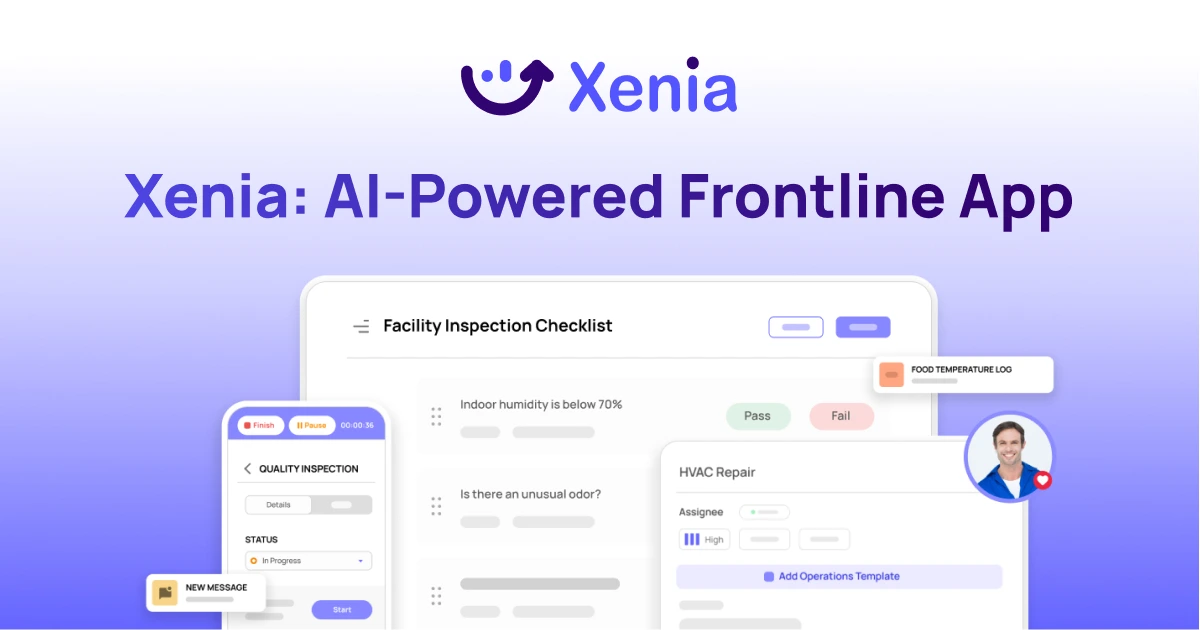
Why Multi-Location Operators Choose Xenia:
🤖 AI-Powered Operations, Create digital checklists instantly or convert paper forms with AI. Verify compliance automatically with photo analysis and get instant answers from your operational data.
✅ Daily Operations & Maintenance, Assign work across hundreds of locations in minutes. Report and route issues instantly. Schedule preventive maintenance to catch problems before downtime.
📊 Real-Time Visibility, Track completion, work orders, and performance across all locations through dashboards. Filter by site or asset to spot trends and take action.
Manage operations, maintenance, and compliance across all your locations from one platform

.svg)
.webp)
%201%20(1).webp)

.svg)
%201%20(2).webp)