
.webp)
Post Summary
A Steritech audit is not a surprise visit. It's a scheduled, brand-mandated QSR third-party audit used by major franchise networks across North America.
What IS a surprise is how many operators treat it as an event rather than a daily standard.
The operators who consistently score well aren't doing anything special before the audit. They're doing the same things they do every other week. Temperature logs completed every shift. FIFO labeling applied consistently. Ice machines cleaned on schedule. Corrective actions documented and closed.
One operator received a Steritech citation for temperature log entries that were identical every day. The inspector flagged it as impossible in a normal operating environment. Staff were guessing rather than measuring. Nobody had caught it because nobody was checking.
This guide covers what Steritech inspectors look for, how to build a prep system across multiple locations, and what top-scoring operators do differently. You'll also get a complete Steritech inspection checklist for internal mock audits.
Before you keep reading, three quick questions:
- Do you have documented corrective actions for every citation from your last Steritech audit?
- Are your temperature logs complete across all locations for the past 30 days with no gaps or identical entries?
- Do you know when the ice machine at each location was last deep cleaned?
If the answer to any of these is no, this guide is for you.
.webp)
.svg)

Priced on per user or per location basis
Available on iOS, Android and Web


Recommended Resources
- Steritech Food Safety Audit Checklist
- How to Pass a Restaurant Health Inspection: Prep Guide and Checklist
- Restaurant Food Safety Standards: What Every Operator Needs to Know
- How to Run Consistent Restaurant Audits and Inspections
- The Complete Restaurant Operations Management Guide
What is Steritech, and what does a Brand Excellence inspection cover?
Steritech is a third-party auditing firm that major franchise and QSR networks use to inspect franchisee locations. The goal is simple: make sure brand standards are being met consistently at every unit, not just the ones corporate owns.
The Steritech Brand Excellence Program covers more than just food safety. It looks at the full picture of how a location operates.
What Steritech inspects
- Food safety procedures: temperature control, cross-contamination prevention, handwashing compliance
- Sanitation and cleaning: equipment cleanliness, surface sanitization, pest evidence
- Product quality and brand standards: food preparation accuracy, portion compliance, recipe adherence
- Employee practices: handwashing observation, glove use, illness policy knowledge
- Facility condition: equipment maintenance, pest exclusion, general upkeep
How a Steritech audit is different from a health department inspection
**
Steritech audit, Health department inspection
Conducted by Steritech certified inspectors on behalf of the franchise brand, Conducted by government health department officials
Scores reported to franchisee AND franchisor, Scores reported publicly and to the operator
Low scores can trigger franchise compliance audit reviews, Low scores can result in closure or re-inspection
Applies brand standards verification on top of FDA Food Code, Applies FDA Food Code and local regulations
Scheduled in advance, Unannounced
**
Why the stakes are higher for multi-unit operators
Steritech certified inspectors conduct brand standards verification visits on behalf of the franchisor, not the government.
For multi-unit QSR compliance, this matters because a QSR third-party audit like Steritech is tied directly to franchise agreements. A single location that fails creates a brand-level record. Food safety excellence isn't just a health code requirement here. It's a franchise commercial requirement.
For operators managing 15 to 100 locations, a pattern of low Steritech scores can affect franchise renewal conversations, trigger mandatory retraining requirements, and put locations on watch status with the franchisor. One location's citation history doesn't stay at that location. It travels up to the brand.
What does a Steritech inspector evaluate and in what order?
Understanding the Steritech inspection sequence helps operators know what to have ready and what gets scrutinized first.
Opening review (first 5 to 10 minutes)
This is where most operators lose points before the inspector has seen a single piece of equipment.
- Manager on duty greeting: is the manager accessible, prepared, and cooperative?
- Documentation review: temperature logs from the current day and prior week, pest control records, food handler certifications, and corrective action documentation from any prior Steritech citations
A Steritech inspector who finds missing documentation on arrival starts scoring before they've walked into the kitchen. That's not a recoverable position.
Employee observation (approximately 15 minutes)
Steritech inspectors observe actual employee behavior, unscripted, in real operating conditions.
- Handwashing frequency at required trigger points
- Glove use and changes after handling raw proteins
- Cross-contamination practices during prep
- Employee illness policy knowledge: the inspector may ask a line employee directly
The most common early finding in a Steritech food safety inspection: employees who know the correct procedure when asked, but don't follow it on the floor. Training that lives in a classroom and dies on the line.
Kitchen and food safety review (20 to 30 minutes)
This is the core of the Steritech food safety inspection.
- Internal temperature checks of all proteins on the line using the inspector's own calibrated probe thermometer
- FIFO labeling: every item in coolers, on the line, and in storage with name, date, and use-by date
- Cooler and freezer temperature logs compared to actual temperatures. Any discrepancy is a major citation.
- Cross-contamination: storage hierarchy, surface sanitization, prep utensil separation
- Handwashing facilities: stocked, accessible, and clean
Facility and sanitation review (10 to 15 minutes)
- Equipment condition: fryers, grill surfaces, hood system, ice machine
- Pest evidence: corners, floor drains, below equipment, and delivery areas
- General sanitation: floor drains, walls near cooking equipment, dish machine interior
**
Inspection category, What gets checked, Most common citation
Documentation, Temp logs-pest records-certifications, Missing entries-identical readings
Employee behavior, Handwashing-gloves-illness policy, Correct knowledge-wrong behavior on the floor
Food safety, Protein temps-FIFO-cross-contamination, Unlabeled containers-temp violations
Facility, Ice machine-pest evidence-equipment, Ice machine cleaning gaps-pest signs
**
What are the most commonly cited items in Steritech inspections?
Knowing where most points are lost in a Steritech audit lets operators focus Steritech inspection prep effort where it actually matters.
1. Temperature log gaps. Missing entries, identical entries that suggest estimation rather than measurement, or logs that don't reflect actual cooler readings.
One operator told us directly: "I would be shocked if any of our restaurants has a log for temperature logs for food or refrigeration." Their inspectors came every three months. Steritech certified inspectors are trained to look for exactly this. A log with the same number every day for two weeks isn't a log. It's a liability.
2. FIFO labeling non-compliance. Unlabeled containers, expired labels still on items, undated prep. This is consistently one of the top Steritech citation sources because it requires ongoing daily discipline. You can't fix it the morning of the inspection. Either the habit exists or it doesn't.
3. Employee handwashing observation failure. Employees observed not washing hands at required trigger points: after glove changes, after handling raw proteins, before touching ready-to-eat food. The Steritech food safety inspection doesn't ask whether employees know the procedure. It checks whether employees actually do it.
4. Ice machine cleaning documentation gaps. Ice machines that haven't been deep cleaned on schedule, or that have no record of cleaning history. One of the most commonly missed items in steritech inspection prep because the machine looks clean from the outside. Inside, biofilm and mold grow on a schedule that doesn't care about appearances.
5. Pest evidence. Any evidence of pest activity, droppings, live insects, gnaw marks, triggers an immediate citation regardless of the location's overall cleanliness. Pest exclusion is a pass-or-fail dimension in the Steritech Brand Excellence Program.
6. Unclosed corrective actions. Prior Steritech audit citations with no documented corrective action, or actions that were addressed verbally with no written record. If the same item is cited in a second audit, it becomes a pattern violation. That elevates severity and draws direct franchisor attention.
How to build a Steritech inspection checklist and pre-inspection protocol for multiple locations
.webp)
The goal is not to prepare for Steritech. The goal is to operate at Steritech standards every day so the franchise compliance audit is a confirmation, not a crisis.
Here's a 30-day Steritech inspection prep framework:
30 days out
- Pull the last Steritech audit report. Review every citation. Confirm corrective actions are documented as resolved, not just verbally addressed.
- Verify food handler certifications are current and on file for every location. Not just the locations you're worried about.
- Check pest control logs at every location: is the vendor Steritech certified or equivalent? Are logs current? Any open action items?
- Run an internal mock franchise compliance audit at each location using a Steritech-aligned inspection form. The person running it should not be the location's own GM.
Use this template to run your internal check: Steritech Food Safety Audit Checklist
14 days out
- Confirm temperature log continuity for the past 30 days at every location. No gaps. No identical daily entries. No entries that clearly weren't measured.
- Ice machine deep clean documentation: when was the last one at each location? Is it within the required cleaning window?
- Run a focused employee food safety training refresh covering handwashing triggers, FIFO protocol, and illness reporting policy. Not a general training session. The specific behaviors that Steritech food safety inspection auditors observe directly.
7 days out
- Run a pre-inspection walkthrough at every location as if you're the Steritech inspector. This is where your steritech inspection prep actually happens, not the morning of the audit. A franchise compliance audit like Steritech rewards operators who treat this walkthrough as a regular operating rhythm, not a one-time event.
- Create a corrective action record for every finding, assigned to a named person with a deadline. Verify it's resolved before the inspection date.
- Confirm line temperature standards are being checked and logged twice daily at every location.
Day of inspection
- Documentation ready at the door: temperature logs, pest control records, food handler certifications, and corrective action documentation from any prior Steritech citations.
- Manager on duty briefed and present. Cooperative, transparent, and ready to answer questions directly. Steritech certified inspectors note evasive or unprepared management.
- Don't attempt to clean specifically for the inspection. This is visible to an experienced inspector and counterproductive. The preparation window is 30 days, not 30 minutes.
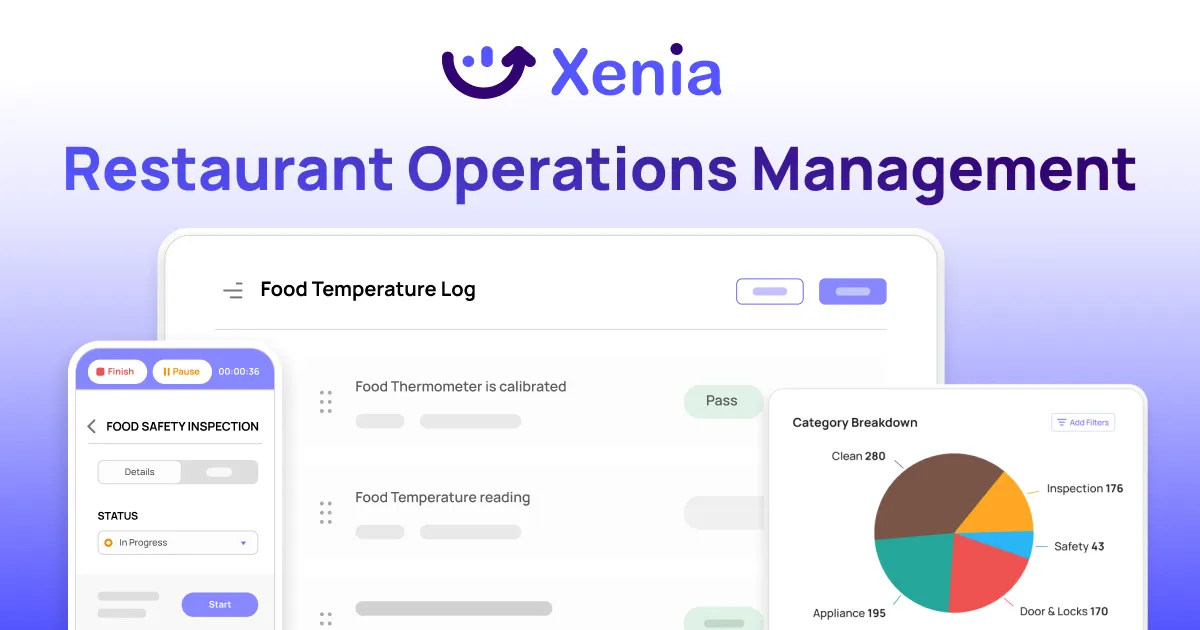
Xenia's pre-inspection readiness workflows keep every location on this steritech inspection checklist schedule automatically, with assigned tasks, required completion dates, and photo documentation at each step.
Managing this manually across 10 or 20 locations before every Steritech audit is where operators lose consistency. See how it works.
Why multi-unit operators struggle with Steritech consistency
Even operators who understand what a Steritech food safety inspection looks for run into the same friction points at scale.
The location-by-location prep problem. Operators with 15 or more locations can't do a thorough pre-inspection walkthrough at every location before every Steritech audit.
Without a system, steritech inspection prep is uneven. Some locations get walked. Others get a phone call. Scores reflect exactly that unevenness.
The documentation gap. Operators often have the food safety practices in place but can't prove them. A Steritech audit doesn't just observe. It asks for the paper trail.
"We do a ton of checklists, but they're half the time paper-based. We just have not made that really electronic at this point." That works fine until a Steritech certified inspector asks for 30 days of temperature log continuity and finds a binder with three weeks of entries and a week-long gap.
The ice machine timing problem. The deep clean window for ice machines is specific and non-negotiable. When an operator doesn't track the last cleaning date per location, they're running blind on one of the most commonly cited items in a Steritech food safety inspection. The machine looks fine. The documentation doesn't exist.
Corrective action amnesia. A Steritech citation from six months ago, addressed in conversation with no written record, becomes a pattern violation when the same item shows up in the next franchise compliance audit.
Pattern violations carry elevated severity. They draw direct franchisor scrutiny. They're almost always preventable with a proper steritech inspection checklist and corrective action tracking system.
Employee behavior under observation. Training employees to follow the right procedure when the manager is watching is the easy part. Getting them to do it consistently when no one is watching is what food safety excellence actually requires.
The Steritech Brand Excellence Program is built specifically to catch the gap between what employees know and what they do.
How Xenia helps
When every location is doing its own version of Steritech inspection prep, scores vary. That's just what happens when there's no system behind it.
Xenia gives multi-unit franchise operators one consistent pre-Steritech workflow across every location.
Temperature logs get prompted at the right shift intervals so nothing gets missed. Corrective actions from prior Steritech citations get assigned to a named person with a due date, so they don't disappear into a verbal conversation nobody followed up on.
District managers can see documentation status across every location before the inspection date, not after the report lands.
When a Steritech certified inspector asks for 30 days of temperature logs and corrective action records on arrival, everything is already there.
See how Xenia works for multi-unit franchise operators.
Conclusion
A Steritech inspection checklist is only useful if the daily operations behind it are real.
The score reflects what your team does every day without supervision. Not what they do when a Steritech certified inspector is in the building.
The most commonly cited items are all preventable. Temperature log gaps, FIFO failures, ice machine documentation, unclosed corrective actions. None of them require anything complicated. They just require consistency.
At one location, that's a management problem. At 15 or 20, it's a systems problem.
The operators who score well aren't doing anything extraordinary.
They've built the daily habits that make food safety excellence the default. When the inspector walks in, there's nothing to scramble for. The work was already done.
Frequently Asked Questions
Got a question? Find our FAQs here. If your question hasn't been answered here, contact us.
What happens if a location fails a Steritech audit?

The score goes to both the franchisee and the franchisor. Depending on severity, the result can be a mandatory re-inspection, required retraining, or a formal compliance review. Pattern violations carry more weight because they signal a systemic problem, not a one-off mistake.
What are the most common Steritech citations?
Temperature log gaps, identical daily entries, FIFO labeling failures, handwashing observation failures, ice machine cleaning gaps, pest evidence, and unclosed corrective actions. The ice machine and temperature logs are the two that catch operators off guard most often.
What do Steritech inspectors check first?
Documentation. Temperature logs, pest control records, food handler certifications, and corrective actions from prior audits. If anything is missing, they start scoring before they've seen the kitchen.
How is a Steritech audit different from a health inspection?
A health inspection is government-run and unannounced. A Steritech audit is run by a third-party auditor on behalf of the franchise brand and is scheduled in advance. Both follow the FDA Food Code, but Steritech adds brand-specific standards on top. Low scores can trigger compliance reviews and affect franchise renewal.
What is a Steritech audit?
A scheduled food safety audit conducted by Steritech certified inspectors on behalf of a franchise brand. It covers food safety procedures, employee practices, sanitation, and brand standards. Scores go to both the franchisee and the franchisor. That's what makes it different from a regular health inspection.
What is a Steritech inspection checklist?
A pre-audit document that covers every category Steritech evaluates: temperature logs, FIFO labeling, ice machine cleaning records, handwashing compliance, pest control documentation, and corrective actions from prior audits. Multi-unit operators use it to run internal mock audits before the official visit.


A Modern, AI-Powered Platform Built for Restaurant Operations
Xenia brings kitchen operations, food safety, audits, and team communication into one mobile-first platform. Restaurant teams execute daily work consistently, maintain compliance, and resolve issues faster, while leadership gets real-time visibility across all locations.
.webp)
Why Restaurant Operators Choose Xenia:
🤖 AI-Powered Operations, Convert paper logs instantly and verify food presentation and kitchen cleanliness automatically. Get instant answers about food safety trends without building reports.
🍽️ Food Safety & Compliance, Track line checks and temperature logs with automated alerts. Trigger corrective actions when readings exceed safe ranges. Maintain audit-ready records for health inspections.
📊 Multi-Location Control, Monitor food safety compliance and task completion across regions. Benchmark locations to identify training needs. Export reports for operational reviews.
One platform for kitchen operations, food safety, and compliance across all locations.

.svg)
.webp)
%201%20(1).webp)

.svg)
%201%20(2).webp)