
.webp)
Post Summary
Deputy built its reputation on one thing: labor compliance. Award interpretation, break rule enforcement, overtime limits locked into the schedule before it goes live.
For operators running across multiple states, or in Australia where award complexity is genuinely brutal, that focus is hard to argue with.
The problem shows up when you start asking what happened after the schedule ran.
Deputy has no answer for that. No checklists. No inspection workflows. No HACCP documentation. No way to route a failed equipment check into a work order. The shift gets scheduled and staffed. What the team does during it is completely invisible.
That's the gap different operators fill in different ways. This guide covers the 7 best Deputy alternatives in 2026.
Deputy Alternatives Comparison
**
Rank, Alternative, What it offers that Deputy doesn't, Best For
#1, Xenia, Full operational execution-checklists-food safety-inspections and work orders, Multi-location frontline businesses
#2, Turnozo, Flat-rate pricing with no feature tiers-everything included from day one, Budget-conscious SMBs under 50 staff
#3, TimeTrex, Native payroll processing built in-no exports-no sync errors, SMBs that need payroll and scheduling in one place
#4, Humanity Schedule, Visual scheduling with AI demand forecasting and multi-location heatmaps, Retail and hospitality chains with complex scheduling
#5, OnTheClock, GPS breadcrumb tracking throughout the entire shift-not just at clock-in, Mobile and field teams
#6, Hubstaff, Productivity monitoring with screenshots and activity tracking for remote teams, Remote and hybrid teams needing accountability
#7, ADP Workforce Now, Full HR suite-benefits-compliance reporting and enterprise-grade infrastructure, Growing SMBs scaling to 50 to 500 staff
**
.svg)
.webp)

1. Xenia - Best Operations Platform for Deputy Users
- What Deputy doesn't have that Xenia does: Any visibility into what happens during the shift, checklists, inspection workflows, food safety documentation, geo-stamped task verification, and work order management
- G2 rating: 4.9/5
- Capterra rating: 4.9/5
- Who uses it: Multi-location restaurants, retail chains, hospitality groups, and convenience store operators
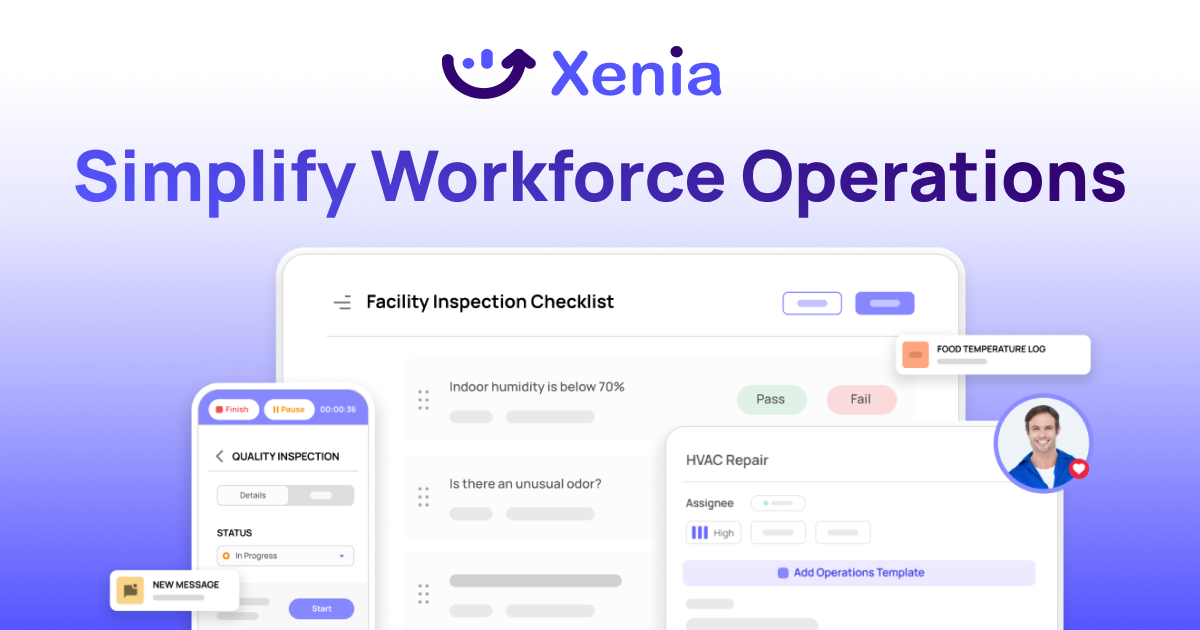
Here's where Deputy ends and where the real operational risk begins.
Deputy gets workers in the door on time and ensures the schedule is legally sound. After that, there's no visibility. Did the line check happen before service? Were temperatures logged? Did the closing team actually complete the sanitation walkthrough, or did someone just say they did?
Xenia is built for exactly that gap. Not as a Deputy replacement. As the platform that covers the hours Deputy schedules, but cannot see inside.
Multi-unit operators use Xenia to standardize what frontline teams do during every shift, verify that they did it, and surface problems across locations before they compound. The platform is built around mobile-first task execution, which matters when your workforce doesn't sit at a desk.
What Xenia covers that Deputy doesn't
Digital checklists and SOPs: Deputy has no checklist functionality at all. Opening procedures, station setup verification, cleaning protocols, shift handover documentation, all of that currently lives on paper, in a group chat, or nowhere. Xenia structures it into standardized templates that push to every location on a set schedule. Every submission carries a timestamp, a photo, and the name of who completed it.
.webp)
Inspection workflows with conditional logic: A failed inspection in Deputy doesn't exist because Deputy can't run inspections. In Xenia, a failed item in any inspection triggers a branching workflow. Escalation goes to the right manager. A corrective task gets created and assigned. The system tracks it through completion. The problem doesn't sit unresolved because no one noticed.
.png)
Food safety and HACCP compliance: Deputy is widely used in food service and offers nothing for food safety. Xenia provides Bluetooth thermometer integration for automated temperature logging, digital HACCP documentation with time and date stamps, and instant alerts when readings fall outside safe ranges. When a health inspector arrives, the audit trail is already there.
Geo-stamped task verification: Deputy's geofencing confirms where someone clocked in. Xenia extends that verification to actual work. Every inspection, cleaning record, and operational submission carries geo-tagged, timestamped proof of on-site completion. Marking something done from the parking lot isn't possible.
.webp)
Work order management: Deputy has no facilities management capability. When an inspection in Xenia flags a broken piece of equipment, a prioritized work order generates automatically. It gets assigned to the right person with a due date. The issue moves through a resolution workflow that's fully visible to managers above store.
.webp)
Honest limitation: Xenia does not replicate Deputy's scheduling engine, time and attendance tracking, or award interpretation. Operators whose primary problem is workforce scheduling and labor compliance will find Deputy the stronger tool for those specific functions. Xenia is the right addition when operational execution and compliance documentation are where the gaps live.

Priced on per user or per location basis
Available on iOS, Android and Web


2. Turnozo
- What Deputy doesn't have that Turnozo does: Transparent all-in-one pricing with every feature included from day one, no tiers, no hidden costs, free for teams under 10
- G2 rating: 4.6/5
- Capterra rating: 4.7/5
- Best for: Budget-conscious SMBs with 10 to 50 staff who find Deputy's tiered pricing hard to justify
.webp)
Deputy's pricing scales per user across multiple tiers. Turnozo charges $2.47/user/month with everything included. For a team of 25, that's $62/month versus Deputy's $150. No feature unlocks, no tier upgrades. Free for teams under 10 employees, which means most small operators can test it before spending anything.
Setup takes one day. For teams where Deputy felt like more than they needed, Turnozo covers the basics cleanly at a price that's hard to argue against.
Key features:
- GPS geofencing clock-in and out
- Drag-and-drop scheduling with shift templates
- Employee self-service for swaps and availability
- Multi-location support
- Real-time labor cost reports
Good if: Deputy's per-user pricing is the main frustration and you need scheduling and GPS time tracking without the complexity
Consider if: You need Deputy-level compliance automation or award interpretation
3. TimeTrex
.webp)
- What Deputy doesn't have that TimeTrex does: Payroll calculated and processed natively, no exports, no sync errors, no reconciling between separate systems
- G2 rating: 4.5/5
- Capterra rating: 4.6/5
- Best for: SMBs where payroll errors from Deputy's export dependency are a recurring problem
Deputy integrates with payroll tools. TimeTrex processes payroll natively. Taxes, overtime, and benefits calculate automatically inside the same system where time gets tracked. For businesses that spend time every pay period fixing mismatches between Deputy and their payroll platform, that distinction removes the problem at the source.
At $2.50/user/month, the cost sits well below Deputy's pricing while adding a payroll capability Deputy doesn't have.
Key features:
- Automated payroll with taxes, overtime, and benefits
- Attendance automation with exception alerts
- Employee self-service portal
- Job costing and custom reporting
- Multi-state compliance rules
Good if: Payroll sync errors between Deputy and your payroll platform are costing time every pay period
Consider if: You need Deputy's depth on labor law compliance across multiple states or award systems
4. Humanity Schedule
.webp)
- What Deputy doesn't have that Humanity does: Color-coded visual scheduling with heatmaps and AI-powered demand forecasting built specifically for multi-location chains
- G2 rating: 4.4/5
- Capterra rating: 4.5/5
- Best for: Retail and hospitality chains with 25 to 200 staff across multiple locations where scheduling complexity is the main problem
Deputy's scheduling interface is functional. Humanity makes it visual. Color-coded shifts, demand heatmaps, and AI forecasting that builds schedules around predicted volume rather than last week's template. For chains where scheduling across multiple locations is genuinely complex, that visual layer reduces the back-and-forth that eats up manager time.
Key features:
- Color-coded shift planning with demand heatmaps
- AI-powered demand forecasting
- Auto-scheduling by skills and availability
- Time clock and timesheet export
- Multi-location management tools
Good if: Scheduling across multiple locations is complex enough that Deputy's interface slows your managers down
Consider if: You need more than scheduling, Humanity doesn't cover operational execution or payroll natively
5. OnTheClock
- What Deputy doesn't have that OnTheClock does: GPS breadcrumb tracking that records movement every 200 meters throughout the shift, not just a single clock-in location
- G2 rating: 4.6/5
- Capterra rating: 4.5/5
- Best for: Delivery, field service, construction, and any team working across multiple sites per day
Deputy's geofencing is built around a fixed clock-in location. OnTheClock tracks movement throughout the entire shift with GPS breadcrumbs. For field teams moving between job sites, service calls, or delivery stops, that difference matters. Payroll exports to Gusto, QuickBooks, ADP, and Zapier are built in with no hidden per-feature costs.
Key features:
- GPS breadcrumbs tracking every 200 meters throughout the shift
- Geofencing with configurable radius per location
- Job code assignment and costing
- Unlimited exports to major payroll platforms
- Kiosk and shared device clock-in
Good if: Your team moves throughout the day and GPS accuracy that follows them matters at $4/user/mo
Consider if: You need Deputy's scheduling sophistication alongside GPS time tracking
6. Hubstaff
- What Deputy doesn't have that Hubstaff does: Screenshot capture and activity level monitoring that shows what remote workers are actually doing during tracked hours
- G2 rating: 4.4/5
- Capterra rating: 4.5/5
- Best for: Remote and hybrid teams where accountability during tracked hours is the core concern
Deputy tracks when people work. Hubstaff tracks what they do while working. Screenshots, activity levels, and project time tracking give managers visibility into remote productivity that Deputy's shift-focused model wasn't built for. For businesses managing a mix of remote and field workers, that monitoring layer addresses a problem Deputy doesn't touch.
Key features:
- GPS tracking with screenshot capture
- Activity level monitoring during tracked hours
- Project time tracking and invoicing
- 50+ integrations
- Agile project management tools
Good if: Remote accountability is your main concern and Deputy's shift-management focus misses the problem
Consider if: The $7/user/month pricing fits your budget and your team is comfortable with screenshot monitoring
7. ADP Workforce Now
- What Deputy doesn't have that ADP Workforce Now does: A full HR infrastructure, benefits administration, enterprise compliance reporting, recruiting integration, and scalability to 500+ staff
- G2 rating: 4.1/5
- Capterra rating: Strong enterprise ratings
- Best for: Growing SMBs with 50 to 500 staff that need Deputy-level scheduling plus full HR infrastructure in one system
Deputy is a scheduling and compliance tool. ADP Workforce Now is an HR platform that includes scheduling. Benefits, leave management, recruiting through ZipRecruiter, and compliance reporting that scales with headcount are all built in. For businesses at a size where Deputy handles one piece of a much bigger HR puzzle, ADP consolidates the stack.
The setup timeline is longer, four or more weeks versus Deputy's faster deployment. But for organizations planning HR expansion, the investment is in infrastructure that grows with them.
Key features:
- Mobile time collection and attendance tracking
- Leave management and accruals
- Custom compliance reporting
- ZipRecruiter integration for recruiting
- Benefits administration
Good if: You're scaling past Deputy's scope and need full HR infrastructure rather than a focused scheduling tool
Consider if: The implementation timeline and custom pricing fit your current stage
Conclusion
Deputy is good at what it does. Scheduling, compliance, labor rules, it handles all of that well.
But once the shift starts, it has no visibility. No checklists. No food safety logs. No way to know if the work actually got done right.
That's where Xenia comes in. It covers everything that happens during the shift, audits, food safety, inspections, corrective actions, and work orders across every location. The part Deputy was never built to see.
Book a demo and see how Xenia works alongside your current setup.
Frequently Asked Questions
Got a question? Find our FAQs here. If your question hasn't been answered here, contact us.
Which option is best for restaurant operators evaluating Deputy?

Deputy handles restaurant scheduling competently. For operators who also need food safety documentation, HACCP compliance, temperature monitoring, and kitchen inspection workflows, Xenia addresses the compliance gap Deputy leaves entirely open.
Does Xenia compete with Deputy on scheduling or time tracking?
No. There's no overlap. Xenia has no scheduling engine, no time clock, and no labor compliance features. The two platforms address entirely separate problems. Deputy manages the workforce. Xenia manages what that workforce does during every shift. Operators using both describe them as complementary, not redundant.
Where exactly does Deputy's coverage end?
Deputy handles three things: scheduling, time and attendance, and labor compliance. Outside those functions, it has no capability. There are no checklists, no inspection tools, no food safety workflows, no work orders, and no way to verify what frontline teams did during the shift. For operators in industries where that execution layer matters, a separate tool is necessary regardless of how well Deputy handles the workforce side.


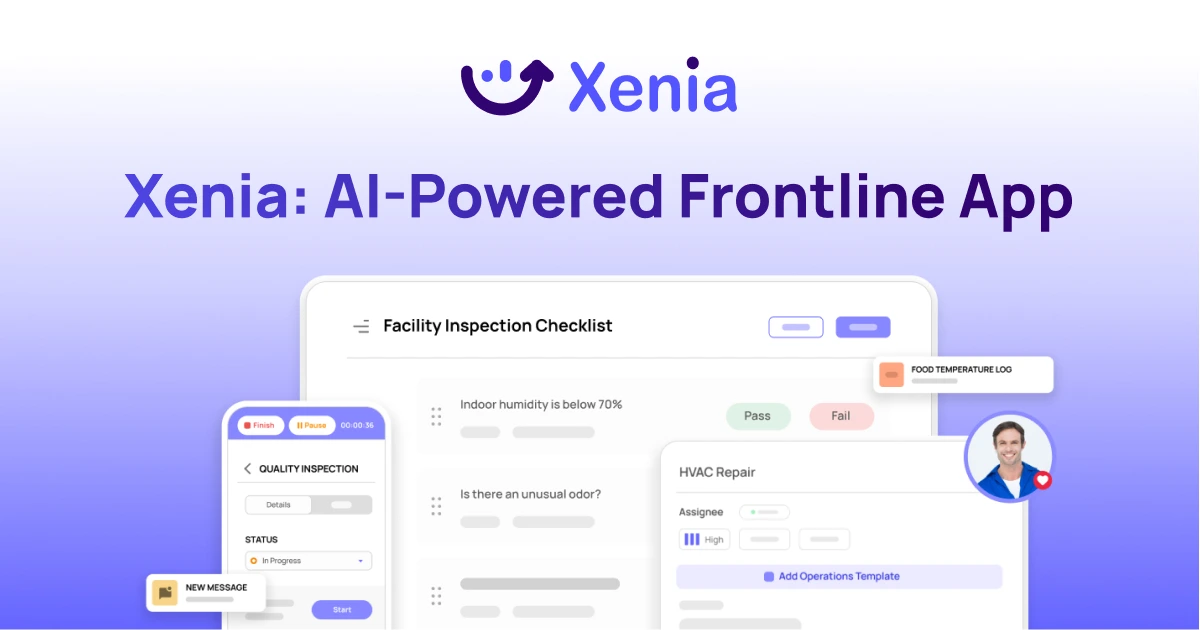
A Modern, AI-Powered Platform Built Specifically for Frontline Operations
Xenia brings daily operations, maintenance, audits, and compliance into one mobile-first platform. Frontline teams execute work consistently across locations while leadership gets real-time visibility.
Why Multi-Location Operators Choose Xenia:
🤖 AI-Powered Operations, Create digital checklists instantly or convert paper forms with AI. Verify compliance automatically with photo analysis and get instant answers from your operational data.
✅ Daily Operations & Maintenance, Assign work across hundreds of locations in minutes. Report and route issues instantly. Schedule preventive maintenance to catch problems before downtime.
📊 Real-Time Visibility, Track completion, work orders, and performance across all locations through dashboards. Filter by site or asset to spot trends and take action.
Manage operations, maintenance, and compliance across all your locations from one platform

.svg)
.webp)
%201%20(1).webp)

.svg)
%201%20(2).webp)