
Post Summary
Recommended Resources
Last reviewed: August 2026.
Automated inspection software is a mobile platform that replaces paper checklists and spreadsheet audits with scored digital workflows, live photo evidence, and corrective actions that route to a named owner. It is the same category most buyers search as inspection management software.
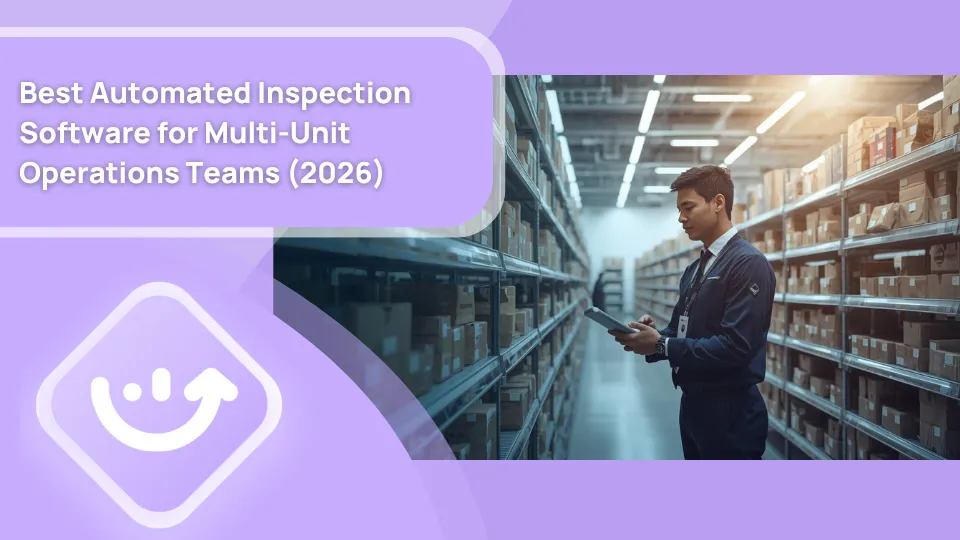
The complaint from district managers is consistent: they are running audits with a pen and a clipboard instead of walking the store and attaching the photo on the spot. This guide covers what the software does, how to evaluate it, and the 12 best automated inspection software platforms for restaurant, retail, convenience store, and hospitality operations teams in 2026.
The short version for ops leaders:
Want to see the closed-loop version before you read the roster? Compare Xenia's audits and inspections module or read the deeper multi-location audit software buyer's guide.
Recommended resources:
What is automated inspection software?
Automated inspection software is a mobile platform that replaces paper forms and spreadsheet audits with structured digital workflows. Your team runs the audit on a phone or tablet. Questions branch based on the answers. Photos attach on site with a timestamp. The location gets scored automatically. Failed items become corrective tasks routed to the right person, without anyone sending a separate email.
Buyers reach this category from four different search phrases that describe roughly the same product. Vendors pick one and build their marketing around it. The features underneath are the ones that matter, so define your requirement before you shortlist. Our inspection management software systems guide breaks the category down further.
What it replaces
Most multi-unit ops teams still run inspections on one of these:
None of these create data your leadership team can act on the same day. Automated inspection software does. The switch from paper is the single largest jump in data quality most operators will make, and it is usually the reason the project gets funded.
Software-driven vs hardware-based systems
One thing is worth clarifying before you evaluate anything. Two very different products share similar names.
Hardware-based machine vision systems use fixed cameras and sensors mounted on production lines to detect defects on parts. Vendors like Hexagon and GE Vernova sell into factories. That is industrial automated visual inspection, and it has nothing to do with running a store walk.
Software-driven inspection platforms are what operations managers at restaurant chains, retail groups, hotels, and convenience store networks need. These are mobile-first field inspection tools built around digital checklists, photo capture, multi-location reporting, and corrective actions tracked to close.
If you inspect a widget, you want machine vision. If you inspect a store, restaurant, hotel, or forecourt, you want the second category.
Inspection management software vs inspection tracking software vs inspection reporting software
Inspection management software is the umbrella term. It covers building the form, scheduling it, running it in the field, scoring it, and closing what it finds. When a buyer says inspection management software, they usually mean the whole loop.
Inspection tracking software emphasizes the middle of that loop. Which locations completed which inspections, on what date, and which items are still open. Tracking-first tools are strong on status and weaker on scoring depth. If your problem is that nobody knows what got done last month, tracking is the piece you are missing.
Inspection reporting software emphasizes the output. Branded PDF reports, cross-location rollups, and trend charts a regional director can bring to a quarterly review. Reporting-first tools produce beautiful documents. Check whether the report can also generate a corrective task, because many cannot.
Most platforms in the 2026 market do all three to some degree. Score vendors on the weakest of the three, not the strongest, because that is the one that will bottleneck your program.
Multi-site inspection scheduling and inspection intervals
Multi-site inspection scheduling means the platform pushes the right inspection to the right person at the right location on a recurring interval, then chases anything not started. That is the difference between an inspection program and an inspection idea.
Set intervals by risk, not by habit:
The best software solutions for tracking inspection intervals let you set the cadence per location group rather than per store, so a 220-store portfolio does not need 220 schedules. Our guide to choosing audit frequency by vertical covers where each interval earns its place.
How multi-unit ops teams use it daily
A district manager opens the app, completes a store walk on their phone, attaches photos live, and the location scores automatically. A failed item creates a corrective task for the store manager before the DM leaves the parking lot. Back at the regional level, every completed audit feeds a shared dashboard. Every location, every audit, every open corrective action, in one place.
That is the practical gap between paper and digital. Paper creates information that lives in a binder. Digital creates information your whole team can act on.
.svg)
.webp)
What does automated inspection software actually do?
Automated inspection software takes an inspection through five stages: build the form, schedule it, run it in the field with evidence, score it, and close the findings. Most platforms cover all five. Where they differ is how well each stage holds up across dozens or hundreds of locations.
Here is how the core capabilities map to what they replace.
| Capability | What it replaces | The practical gain |
|---|---|---|
| Digital checklists with logic and scoring | Printed paper forms | Consistent scoring, no skipped fields, weighted results |
| Live photo capture | Written descriptions | Visual proof taken on site, not backdated |
| Auto-generated corrective actions | Email follow-up threads | Issues assigned instantly and tracked to close |
| Scheduled recurring audits | Manual calendar reminders | Inspections happen on time without being chased |
| Cross-location dashboards | Spreadsheet summaries | Leadership sees the full portfolio the same day |
| Retained audit trail | Filing cabinets and shared drives | Defensible evidence for a regulator or franchisor |
Checklists with logic and scoring built in
Good inspection checklist apps do more than ask yes or no questions. A "no" answer on a food safety item surfaces a follow-up question and requires a photo. Weighted scoring means a failed temperature check moves the score differently than a smudged menu board. Required live photo fields stop the team from attaching an old gallery image to close an item out.
Two scoring behaviors matter most at scale. Weighted scoring assigns critical items 10 points and cosmetic items 1 point, so an 87 percent with a critical failure reads differently than an 87 percent with thirteen minor misses. Nullify scoring means N/A items count for nothing, so a fuel-only store is not marked down for missing food service equipment. See weighted audit scoring with critical-item thresholds for the setup detail.
Scheduled and recurring audits
Inspections run on a schedule: weekly store walks, monthly brand checks, quarterly deep dives. The platform pushes the right checklist to the right person at the right time and sends reminders for anything not started. Look for schedules that attach to location groups and roles rather than named individuals, because turnover will otherwise break your program every quarter.
Corrective actions that close the loop
This is where the real value sits. When an item fails, a corrective task gets created automatically, assigned to a named owner, and tracked with a due date. If it ages past the deadline, it escalates. The closed-loop corrective action process is what turns an inspection from a snapshot into an execution tool. Without it, audits pile up. With it, issues get fixed.
Audit failure leads to an automatic corrective task, tracked to resolution, with escalation if it is not addressed by the deadline. Most platforms collect audit data. Few drive it to closure. If a finding needs a technician rather than a store team, the same failure should open a work order, which is the inspection-to-repair workflow most operators run manually today.
Audit trail depth: who inspected what, when, and what changed
An audit trail records who ran the inspection, at which location, at what time, what they answered, what evidence they attached, and every change made afterward. Depth is the difference between a completed checklist and defensible compliance evidence.
Ask three questions during a demo:
Field inspection software for utilities, facilities, and franchise networks lives or dies on question three. If the export is a flat PDF with no item-level history, your regulator conversation will be painful. Read more on building an audit trail that stands up as compliance evidence.
Automated inspection reports
Yes, there are inspection apps that automate reports. The report generates itself from the completed inspection, applies your logo and formatting, and emails or shares it the moment the audit is submitted. Good inspection reporting software gives you three output types: a single-location branded PDF for the store, a district rollup for the DM, and a portfolio view for the VP.
Watch for the gap between a report and an action. A branded PDF that lands in an inbox is documentation. A report that carries live corrective-action status is an operating tool.
Cross-location dashboards and trend reports
A district manager covering 15 locations needs one view showing which stores are improving, which are slipping, and where the same issue repeats across the network. Cloud-based inspection software builds this automatically from completed inspections, so remote inspection review does not require anyone to email a spreadsheet.
The best dashboards surface what is coming up as a problem, meaning flagged items, open corrective actions, and high-risk locations, not just completion percentages. The 50-location operator rarely cares that 94 percent of checklists were finished. They care which four stores are trending toward a failure. Xenia's Analytical Agent answers those questions in plain language, and cross-location frontline reporting holds the standing views.

Priced on per user or per location basis
Available on iOS, Android and Web


What to look for when evaluating options
Score every vendor against how your field teams actually work, not against a feature grid. Eight criteria separate useful inspection tools from expensive ones for multi-unit restaurant, retail, c-store, and hotel ops.
Offline functionality is non-negotiable
Inspections happen in walk-in coolers, freezer boxes, stockrooms, fuel canopies, and basement mechanical rooms. Cellular signal does not exist in those places. Any mobile inspection software you evaluate needs true offline mode: the checklist loads on the device, progress saves locally, and results sync when connectivity returns.
Test the failure case, not the happy path. Start an inspection outside, walk into the walk-in, capture a temperature and a photo, walk out, and confirm the sync. Our offline audit app guide covers what to verify before signing.
Weighted scoring for fair location grading, and risk-based inspection logic
Risk based inspections software is weighted scoring with the vocabulary changed. A failed food temperature check is not the same event as a missing promotional sign, and the score should say so. Weighted scoring plus color-coded thresholds let you set critical items at 10 points and minor items at 1 point, which is the audit score that actually means something. Pass and fail thresholds then drive corrective action automatically.
Without it, a critical safety failure looks identical to a housekeeping miss on the district scorecard.
Live photo capture, not gallery uploads
There is a real difference between a photo taken during the inspection and a photo pulled from a camera roll three days later. If your program uses photos as brand-standard or compliance evidence, verify the platform enforces live capture rather than merely allowing attachment.
Corrective actions with clear accountability
A corrective action without an owner and a due date is a note. Look for software that generates the task from the failed item, assigns it to a specific person, and escalates when it goes overdue. This is the single feature that makes inspections improve locations instead of documenting them. See corrective action tracking across locations for the mechanics.
Works on iOS and Android, on the devices your team already carries
Ask which mobile inspection app works on both iOS and Android before you ask anything else. Store teams carry mixed devices, and a tablet rollout you have to fund is a project, not a purchase. Confirm three things: a native app on both stores, offline parity between the two, and photo capture quality on low-end Android hardware, which is what most hourly teams actually carry. Xenia ships a mobile app for frontline teams on both platforms.
Rollout effort: how fast can you run the first inspection?
Which automated inspection solutions are easiest to install and use? The honest answer depends on your template strategy, not the vendor's onboarding deck.
Run a controlled pilot on one district before the portfolio rollout. Fix the template with real store feedback, then scale.
AI that helps ops teams, and AI that does not
Restaurant operators are not AI-saturated yet. Per Restaurant Dive's reporting on the National Restaurant Association's 2026 industry report, 26 percent of operators say they use AI-related tools and 10 percent use AI for at least some administrative work. That is early, which means claims outrun capability across this category.
AI that helps today:
AI to interrogate carefully: any claim that software automatically verifies a submitted photo against your brand standard. Some vendors offer assistive first-pass image comparison, and Taqtics publishes that capability on its own site.
Xenia does not claim automatic visual variance detection. Xenia's Photo Rollouts push a reference photo of a planogram, fixture, or signage to every location with a match-this requirement, collect the store's photo back, and put the results in a compliance gallery where outliers are obvious in one pass.
That is faster evidence collection, reviewed by a human, and we would rather say so than oversell it.
District and regional reporting that is built in, not bolted on
Your VP of Operations will not click through 80 location reports. They need portfolio audit scores, open corrective actions by region, and score trends over time in one view, standard with the platform rather than a custom build. Anything worth evaluating at multi-unit scale has this on day one. See audit reporting dashboards for multi-location teams.
How to choose in 5 minutes
Ready to run your first weighted audit this week? Start free or book a 20-minute walkthrough.
What a strong inspection program looks like across locations
A strong multi-location inspection program runs on five repeatable steps, and step three is the one most operators skip. The margin math is why it matters. The National Restaurant Association's 2026 State of the Restaurant Industry outlook projects industry sales of 1.55 trillion USD while 42 percent of operators report their restaurant was not profitable and 60 percent report softer customer traffic.
On the convenience side, NACS reported in-store sales of 341.2 billion USD for 2025 across 151,975 locations, with direct store operating expenses up 4.2 percent and foodservice now 38.9 percent of in-store gross profit dollars. When margins are that thin, an unclosed corrective action is not paperwork. It is exposure on the part of the business that carries the profit.
Step 1: inspections get completed on schedule across every location
Completion stays high everywhere, not just at your best stores. Every location runs the same checklist, scored the same way, with live photo evidence. No location gets a pass because the manager was busy. Conditional visibility keeps this fair by showing different questions at different formats, so a store without a patio never sees patio questions and is never scored on them.
Step 2: failed items trigger corrective actions automatically
A failed food safety item on Tuesday does not sit in a report nobody reads. A corrective task goes to the store manager automatically with a 48-hour deadline. No email needed. No manual follow-up from the district manager.
Step 3: corrective actions get closed, not just opened
This is the metric worth tracking above all others. Corrective-action closure rate is the number of actions closed within their deadline divided by the number opened in the same window. Completion rate tells you the inspection happened. Closure rate tells you the location improved.
The two numbers move independently, which is why reporting only the first one hides the problem:
| Metric | What it measures | What a good number looks like | What it hides |
|---|---|---|---|
| Completion rate | Did the inspection get done | 95 percent and above | Whether anything found got fixed |
| Closure rate | Did findings get resolved on time | 90 percent and above within deadline | Nothing, this is the honest number |
| Repeat-finding rate | Same issue, same store, next cycle | Below 10 percent | Whether the fix was real or cosmetic |
An inspection that finds 10 issues and closes 2 has not improved the location. It has documented it. Track closure by district and by failure type, and the coaching conversation writes itself. G&M Oil replaced fragmented manual processes with Xenia across 220 stores, which is the scale at which closure tracking stops being optional. Food-safety teams should pair this with corrective action workflows for food safety findings and automated HACCP temperature logs.
Step 4: managers see score trends, not just snapshots
District managers need to know whether a location is improving, not just what it scored last week. Rolling weekly and monthly trends show which stores are on the right track and which need a closer look before the next visit.
Step 5: leadership gets one view across the portfolio
At the regional level, leadership needs to see which districts run consistent programs, which locations repeat the same finding cycle after cycle, and where scores are moving. That view makes coaching specific instead of vague. This is what multi-location operations execution looks like when the program works.
Sequencing a paperless inspection rollout
Paperless inspection software fails when it is switched on everywhere at once. Sequence it:
Here is what it looks like when it works. A location fails a food safety item on Tuesday. A corrective task is assigned automatically with a 48-hour deadline. The regional manager sees it on the dashboard that afternoon. By the time the district manager visits on Friday, the task is either closed with photo verification or already escalated and being handled. The visit is about what comes next, not what was missed last week.
Conclusion
Inspections that happen and inspections that improve locations are two different things. The first is about showing up. The second is about what happens after you leave.
Automated inspection software handles the part after you leave. Corrective actions go out. Tasks get tracked. Scores update. Your team knows what is open and what is resolved without anyone sending a follow-up message. That is the whole argument for replacing the clipboard, and it is the reason closure rate belongs on your district scorecard next to completion percentage.
Pick the platform that fits how your field team actually works. Verify offline in your worst location. Demand a corrective-action demo, not an audit demo. Pilot one district, fix the template, then roll the portfolio. Use the data to get better every cycle rather than to prove you were busy.
If you want inspections, corrective actions, work orders, and frontline comms in one app instead of three contracts, book a demo of Xenia or check the per-location and per-user pricing options. You can also start free and run your first weighted inspection this week. For a broader view of the category, start with the audit software hub and the digital audit checklist software guide.
Best automated inspection software for operations teams (2026)
Not every inspection tool is built for multi-unit operations. Some are built for construction sites. Some for manufacturing lines. The 12 inspection management software platforms below were verified live in August 2026 and fit the way restaurant, retail, convenience store, and hospitality teams work across locations.
| # | Platform | Best for | Real differentiator | Pricing model | Offline |
|---|---|---|---|---|---|
| 1 | Xenia | Multi-unit restaurant, retail, c-store, hospitality ops | Weighted and nullify scoring with closed-loop corrective actions and work orders in one platform | Per-user or per-site, flat by plan | Yes |
| 2 | SafetyCulture | Broadest template library and free pilots | 10,000+ templates with a free tier to 10 users | Per seat, 24 USD per seat per month annual | Yes |
| 3 | Crunchtime Ops Execution | Enterprise QSR already on Crunchtime | Ops execution tied to inventory, labor, and learning | Enterprise quote | Yes |
| 4 | RizePoint QMS | Franchise quality management plus supplier audits | Franchise-governance depth at enterprise audit volume | Enterprise quote | Yes |
| 5 | Bindy | Retail and hospitality brand standards | Geofencing, visit routes, and usage-based pricing | Priced by usage, not users | Yes |
| 6 | GoAudits | Fast, low-cost paper-to-PDF rollout | Branded reports generated instantly | Per user, 10 to 30 USD per user per month annual | Yes |
| 7 | Taqtics | Visual merchandising compliance | AI first-pass image comparison against brand prompts | Enterprise quote | Not stated |
| 8 | Zipline | Enterprise retail comms plus store walks | Audit module inside the communications platform | Enterprise quote | Not stated |
| 9 | WorkJam | Enterprise frontline consolidation | Audits alongside scheduling and learning | Enterprise quote | Not stated |
| 10 | Jolt | Food safety plus labeling hardware | Date-code labeling and remote temperature monitoring | Quote | Not stated |
| 11 | MaintainX | Asset and equipment inspection | CMMS-native inspection checklists | Free tier plus paid quote | Yes |
| 12 | OpsAnalitica | Stopping falsified logs | Exception reporting built around verification | Quote | Not stated |
1. Xenia: best operations execution platform for multi-unit teams
Key features: digital audits with conditional logic, weighted scoring, and nullify scoring. Letter grades or color ratings such as Platinum, Gold, and Silver based on score thresholds. Required live photo capture that works even without internet.
Closed-loop corrective actions with owner, due date, and escalation. Work orders and QR-code work requests in the same platform. Cross-location dashboards, plain-language querying through the Analytical Agent, and SOP-to-form conversion through the AI Template Agent.
Xenia rates 4.9 out of 5 from 23 reviews on Capterra.
"We moved everything from paper to online. Xenia helps automate everything."
Senior Director of Operational Systems,
, which digitized multi-store operations with Xenia across 280+ locations.
Good if: you run 10 to 500 or more restaurant, retail, c-store, or hospitality locations and want inspections, corrective actions, work orders, and frontline comms in one system instead of three contracts.
Consider something else if: you need warehouse-connected business intelligence or manufacturing machine vision.
Start free or get a demo.
2. SafetyCulture
Key features: the largest published template library in the category at 10,000 or more templates, offline mode, mobile inspections, and analytics. The company claims 76,000 or more organizations and more than 1 billion checks completed annually, and states customers spend 60 percent less time reporting.
Pricing: free up to 10 users and 5 active templates. Premium is 24 USD per seat per month billed annually or 29 USD monthly. Enterprise is custom, with site-based options.
Good if: you want a free tier to pilot and the broadest template starting point.
Consider something else if: per-seat cost across hundreds of hourly frontline workers is your budget problem. Compare the licensing models on our Xenia versus SafetyCulture breakdown.
3. Crunchtime Ops Execution (formerly Zenput)
Key features: ops execution across checklists, task management, and food safety, now bundled with Crunchtime inventory, labor, and learning. LineCheck is the mobile food-safety product check module with Bluetooth probe integration, and Squadle adds sensors with patented ZeroTouch temperature logging. Crunchtime states its software is used in more than 125,000 locations across 100 or more countries.
Good if: you are an enterprise QSR already running Crunchtime for inventory and labor.
Consider something else if: you are not, or if form-count-based packaging penalizes adding inspections. See alternatives to Zenput for multi-unit teams and the Xenia versus Crunchtime comparison.
4. RizePoint QMS (now part of FranConnect)
Key features: quality management for franchise and multi-location brands, covering location audits and supplier audits under one governance model. FranConnect acquired RizePoint in February 2024, and rizepoint.com now redirects to franconnect.com. At acquisition, RizePoint reported more than 2 million audits conducted annually and over one million users across 120 countries.
Good if: you need supplier audits plus location audits inside franchise governance.
Consider something else if: you want a lightweight DM-walk tool. See the Xenia versus RizePoint comparison.
5. Bindy
Key features: audits, tasks, and communications for retail and hospitality networks. Geofencing and visit routes, 28 built-in reports, corrective actions with owner and date tracking, and offline support on any device. Bindy states it serves 140 brands across convenience, petroleum, restaurants, hotels, and multi-unit retail, and that it is priced by usage, not users.
Good if: you want brand-standard audits with geofenced proof-of-visit and dislike per-seat pricing.
Consider something else if: you need work orders and maintenance execution in the same tool. See the Xenia versus Bindy comparison.
6. GoAudits
Key features: mobile auditing for hospitality, food and beverage, retail, and facility management. Offline on iOS and Android, instantly generated branded reports, and industry template libraries. GoAudits states customers report up to 5x faster inspections.
Pricing: Starter at 10 USD per user per month annually, Enterprise at 30 USD per user per month annually, with a 14-day trial and a 60-day money-back guarantee.
Good if: you want the fastest, cheapest path from paper to a branded PDF inspection report.
Consider something else if: you need weighted risk scoring plus maintenance execution. See GoAudits alternatives for multi-unit ops.
7. Taqtics
Key features: retail, restaurant, supermarket, and manufacturing operations from 10 to 1,000 or more stores. Visual merchandising execution, geo-fencing, asset QR tagging, and AI first-pass image comparison that flags submitted photos against brand prompts.
Good if: visual merchandising compliance is the primary object of your inspection program.
Consider something else if: food safety and temperature logging are the core need.
8. Zipline
Key features: enterprise retail communications with a mobile store-audit module built for DM store visits. Photo submission, in-app annotation by approvers, and on-the-spot corrective action.
Good if: HQ-to-store communication is your bigger problem and audits ride alongside it.
Consider something else if: you are a restaurant or convenience store operator, because the product is retail-shaped. See Zipline alternatives for multi-unit operators.
9. WorkJam
Key features: a frontline execution layer with six modules including Audits. Configurable audit forms with real-time scoring, auto-generated corrective action workflows, and centralized audit history across locations, alongside scheduling, learning, and earned wage access.
Good if: you are consolidating scheduling, training, and inspections into one enterprise contract.
Consider something else if: you only need inspections and do not want to buy a workforce suite. See WorkJam alternatives.
10. Jolt
Key features: operations management for food service, retail, hospitality, and convenience. Digital checklists, date-code labeling at 6 labels per second, and remote temperature monitoring with alerts.
Good if: food-safety logging plus label-printing hardware is the actual job.
Consider something else if: you need weighted multi-location audit scoring and district rollups. See the Xenia versus Jolt comparison.
11. MaintainX
Key features: a CMMS and enterprise asset management platform serving 14,000 or more companies. Work orders across multiple sites, preventive maintenance with condition-based triggers, inspection checklists, and parts inventory.
Good if: the inspections you care about are equipment inspections tied to asset history.
Consider something else if: you need brand-standard and food-safety audits with district scorecards. See the Xenia versus MaintainX comparison.
12. OpsAnalitica
Key features: location-aware SOP workflows, exception reporting, and automated scorecards, positioned squarely against pencil whipping. The company markets an OpsPhotoAnalyzer photo-verification capability.
Good if: falsified logs are your real failure mode rather than missing inspections.
Consider something else if: you want a broad frontline suite covering comms and work orders. See OpsAnalitica alternatives.
Also worth a look: Limble for maintenance-heavy portfolios, FORM OpX for compliance audits paired with field execution, Squadle by Crunchtime for sensor-based temperature logging, Operandio, and Lumiform.
Best fit for facility management teams
Facility management teams inspect assets and buildings, not brand standards. That changes the shortlist. If your inspections attach to an asset with a service history, a repair, and a cost, prioritize platforms where an inspection failure opens a work order in the same system. MaintainX and Limble are CMMS-first and strongest on asset lifecycle depth.
Xenia sits between the two categories, pairing scored inspections with work orders and QR-code work requests that a vendor can submit without logging in. Choose the CMMS if parts inventory and depreciation tracking drive your budget. Choose an operations platform if the same team also runs cleanliness, safety, and brand walks.
Best fit for large organizations and big field teams
At 200 locations and above, three things decide the winner: licensing shape, location hierarchy, and rollout speed.
Per-seat pricing gets expensive fast when every hourly team member needs access, so look at per-site or usage-based models. Location hierarchy has to scope automatically, meaning DMs see their district, regionals see their region, and corporate sees everything from one account. And the template build has to move in days, not a quarter.
Crunchtime and FranConnect win on enterprise governance depth. Xenia wins when a big field team needs inspections, corrective actions, work orders, and announcements without three separate rollouts. Newk's Eatery uses Xenia for audits and operations across 100+ locations, and Adidas digitized visual merchandising audits and retail execution across 100+ stores. For restaurant-specific shortlists, see our restaurant audit and inspection software roundup.
What does inspection software cost? Models split three ways: per seat, per site, and usage-based. Per-seat is cheapest to start and most expensive at frontline scale. Per-site is predictable as you grow. Usage-based sits between them. Xenia publishes both per-user and per-site options on the Xenia pricing page.
Frequently Asked Questions
Got a question? Find our FAQs here. If your question hasn't been answered here, contact us.
Is automated inspection software the same as compliance audit software?

How long does it take to get started?
Does inspection software work without a reliable internet connection?
What happens when an audit finds a failed item?
Can frontline employees use inspection software, or is it only for managers?
What is the difference between automated inspection software and industrial machine vision systems?


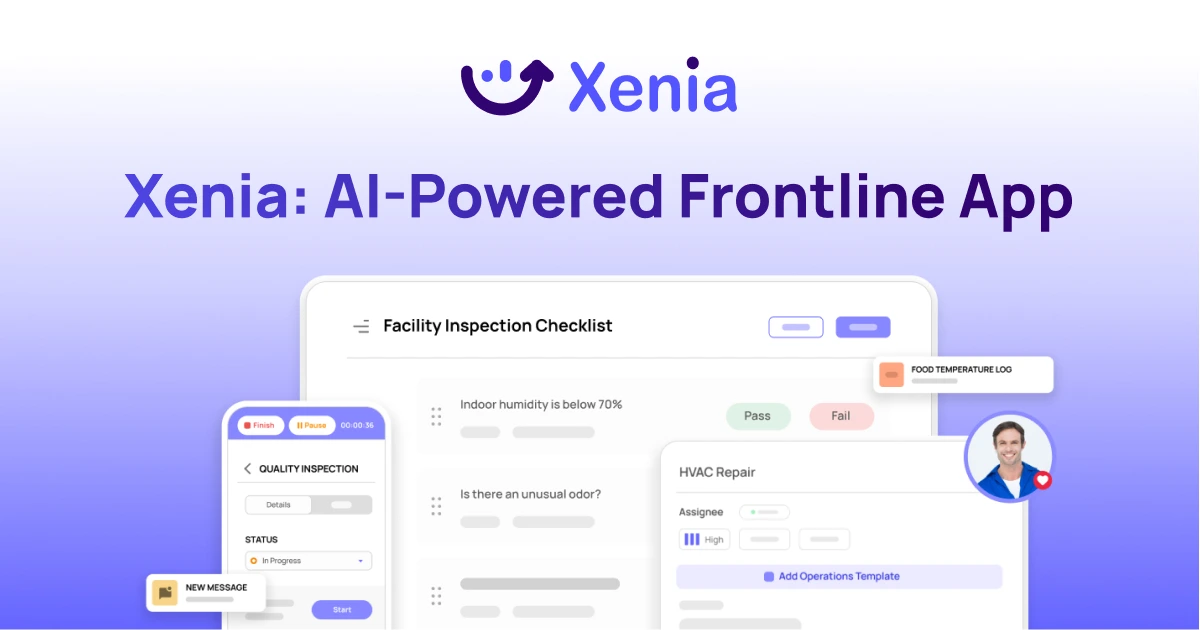
A Modern, AI-Powered Platform Built Specifically for Frontline Operations
Xenia brings daily operations, maintenance, audits, and compliance into one mobile-first platform. Frontline teams execute work consistently across locations while leadership gets real-time visibility.
Why Multi-Location Operators Choose Xenia:
🤖 AI-Powered Operations, Create digital checklists instantly or convert paper forms with AI. Verify compliance automatically with photo analysis and get instant answers from your operational data.
✅ Daily Operations & Maintenance, Assign work across hundreds of locations in minutes. Report and route issues instantly. Schedule preventive maintenance to catch problems before downtime.
📊 Real-Time Visibility, Track completion, work orders, and performance across all locations through dashboards. Filter by site or asset to spot trends and take action.
Manage operations, maintenance, and compliance across all your locations from one platform

.svg)
.webp)
%201%20(1).webp)

.svg)
%201%20(2).webp)