

.webp)
Post Summary
A store manager at a three-location retail group runs three separate scheduling calendars. One spreadsheet per location. Shared via email. Updated by three different managers in three different formats.
Every Monday morning, the area manager asks for a coverage summary across all three sites. It takes 45 minutes to pull together. Nobody can see the full picture in one place. A shift gap at Location A is invisible to the manager at Location B who might have someone available to fill it.
Sound familiar?
That is not a people problem. It is a structure problem. And it is more common than most multi-site operators want to admit.
This article covers the methods that work, how they differ from single-location approaches, and what separates a calendar that creates visibility from one that creates more work.
.webp)
.svg)

Priced on per user or per location basis
Available on iOS, Android and Web


What a scheduling calendar for multiple employees actually needs to do
Most operators think about scheduling calendars as a way to show who is working when. That is the single-location mindset.
For multi-site teams, the calendar has a bigger job. Here are the five things it must do that a single-location calendar does not.
Show coverage across all sites in one view
This is the requirement most calendar tools fail at.
A district manager who opens three separate files to assess coverage is not using a multi-site scheduling calendar. They are using three single-site calendars with extra steps. True multi-site visibility means one view, all locations, same screen. Anything short of that is manual consolidation dressed up as a system.
Prevent scheduling the same employee at two locations at once
When scheduling is managed in separate calendars per location, the same employee can be assigned to Location A and Location B for overlapping shifts without either manager knowing.
The employee calls out day-of. A coverage gap appears that did not need to exist. This is one of the most avoidable failures in multi-site scheduling.
Surface coverage gaps before the schedule publishes
Gaps visible before the schedule goes out are fixable. Gaps discovered during service are crises.
The calendar must show unfilled shifts across every location, not just the one the manager is currently looking at.
Support cross-location availability tracking
When an employee is available for extra hours at a nearby location, that information needs to reach the right manager at the right time.
A calendar that holds availability data only at the site level cannot enable cross-location labor sharing. That capability is invisible until it is built into the structure.
Allow role-level filtering across locations
A district manager reviewing weekend coverage does not just need to know how many people are scheduled. They need to confirm each location has the right mix of roles. Qualified shift lead, trained cashier, minimum coverage per role.
Role-level filtering across all sites makes that review possible in one pass.
What a multi-site scheduling calendar must do:
**
Requirement, Why it matters
Single view of all locations, Eliminates manual assembly by area managers
Cross-location conflict detection, Catches double-booking before it causes no-shows
Gap visibility before publishing, Turns day-of crises into fixable problems
Cross-location availability data, Enables labor sharing between sites
Role-level filtering, Confirms coverage quality-not just headcount
**
The four main methods for scheduling calendars across multiple employees
Four methods. Ranked from lowest to highest capability. Here is what each one actually works for and where it breaks down. If you recognize your current setup in one of these, that tells you something useful.
Shared spreadsheet calendars
Google Sheets or Excel shared across managers. Each location gets a tab or a separate file.
This works well for two to three locations with stable teams and one manager who owns the full update process. When the setup is small, it genuinely gets the job done.
It breaks down fast though. The moment more than one manager edits simultaneously, the employee count grows past about 15 per location, or the area manager needs a consolidated view, the system starts fighting you. That consolidated view has to be built by hand every single week. No cross-location conflict detection. No gap visibility across sites. No notification to employees when the schedule changes.
Most operators stay on spreadsheets two or three locations past the point where they still work well. The cost shows up every Monday morning.
Shared digital calendar apps
Google Calendar or Outlook with each employee added as a guest to their shifts.
Works for very small teams where individual notifications matter and scheduling is simple enough to manage as a series of calendar events. If you have eight people across two locations, this is fine.
The problem is these tools were built for personal scheduling, not workforce coverage planning. There is no concept of open shifts, role requirements, or labor cost visibility.
When the team grows past 10 or 12 people, managing individual shift events becomes unmanageable. And a district manager reviewing coverage gets an event feed, not a location-by-location coverage picture. That is not the same thing.
Scheduling templates with standardized formats
A standardized weekly schedule template, the same format at every location, makes it possible for an area manager to review all location schedules consistently. Even with manual updates, standardization dramatically cuts the time needed to compare coverage.
This is the lowest-cost way to make a distributed scheduling process more manageable before moving to a dedicated system. The value is not the tool itself. The value is that every manager is working in the same structure, so the area manager can interpret coverage rather than decode each manager's own format before the review even starts.
Purpose-built multi-location scheduling systems
Scheduling tools built specifically for multiple locations. Cross-site employee profiles, role-based shift assignments, real-time gap visibility, and a district manager view that shows all locations at once.
This is the right answer for any operation managing more than three to four locations or more than 30 to 40 total employees across sites. The capability gap between a purpose-built system and a spreadsheet is significant and it compounds with every location you add.
One thing to check before committing: the tool must be mobile-accessible for frontline managers and it must connect to your payroll and HRIS systems. A scheduling tool that does not talk to payroll creates a second manual reconciliation step that costs time every pay period.
Method comparison at a glance:
**
Method, Best for, Key limitation
Shared spreadsheets, 2-3 locations-stable teams, No conflict detection-manual consolidation
Digital calendar apps, Very small teams, No workforce coverage planning
Standardized templates, Pre-tool transition, Still manual-no cross-site visibility
Purpose-built systems, 4 or more locations-30 or more employees, Requires mobile access and HRIS integration
**
How to structure a multi-site scheduling calendar: step by step
Whether you are using a spreadsheet system or moving to a dedicated scheduling tool, these six steps apply.
Step 1: build a single employee roster covering all locations
Before scheduling anything, every employee across all locations needs to be in one master roster. Name, primary location, qualified roles, availability, hourly rate.
When employee data lives in separate files per location, cross-site scheduling is structurally impossible. The roster is the foundation everything else builds on. This step sounds obvious. Most multi-site operators have not done it.
Step 2: define minimum coverage requirements per location per shift
Each location needs a minimum coverage standard by role for each shift window. Not a headcount number. A role breakdown.
How many shift leads, servers, cashiers, or associates does Location B need on a Saturday afternoon? These minimums are the standard every schedule is built against. Without them, the calendar fills in names without confirming the right coverage is actually there.
For peak period planning specifically, the guide to optimizing staff scheduling for peak hours covers how to set these thresholds by demand pattern.
Step 3: build the calendar in a consistent format across all sites
Every location's schedule should use the same structure. Same day columns, same shift windows, same role categories.
When an area manager reviews three location schedules in the same format, the review takes 10 minutes. When each manager has built their schedule differently, the area manager has to interpret the format before they can even read the coverage. That interpretation time adds up every week.
Step 4: load availability and time-off constraints before assigning shifts
Confirmed availability, approved time off, and overtime restrictions should all be loaded before shift assignments begin.
Discovering a constraint after the schedule is drafted means a rebuild. Loading constraints first means the draft only contains viable assignments from the start.
Step 5: check for cross-location conflicts
Before publishing, verify no employee is scheduled at two locations for overlapping shifts.
In a spreadsheet system this is a manual check across all location tabs for the same employee. In a scheduling system this is automatic. Either way, it must happen before the schedule goes out. A conflict missed before publishing shows up as a day-of no-show.
Having a clear shift swap policy helps here too, when swaps are governed by a written rule, cross-location conflicts from informal arrangements are less likely to appear.
Step 6: publish on a consistent day and time every week
Every location should publish their schedule on the same day, at the same time, every week. Employees across all sites receive their schedules through the same channel.
Inconsistency in publication timing is one of the most common sources of no-shows in multi-site operations. An employee at Location C who gets their schedule two days later than employees at Locations A and B has less time to plan. They are more likely to call out. This one habit change costs nothing and solves a real problem.
In some states and cities, advance notice is not just good practice, predictive scheduling laws require it, with windows ranging from seven to fourteen days depending on jurisdiction.
The 6-step setup at a glance:
**
Step, What you do, Why it matters
1, Build a single master roster, Cross-site scheduling requires shared employee data
2, Define minimum coverage by role per shift, Confirms quality-not just headcount
3, Standardize the format across all locations, Cuts area manager review time every week
4, Load availability and constraints first, Prevents rebuilds after the draft is complete
5, Check for cross-location conflicts, Catches double-booking before the no-show
6, Publish on a consistent schedule, Reduces no-shows from late communication
**
Common mistakes in multi-employee scheduling calendars
Managing each location's calendar in isolation
When each location manager builds and owns their calendar with no visibility into the others, the area manager becomes the only person who can see the full picture and only after manually assembling it.
The fix is a shared calendar structure that any authorized manager can view at any time. Not just after someone compiles a report.
Using employee names instead of role codes
A calendar that shows only names tells a manager who is working. It does not tell them what coverage those people provide.
When a calendar shows role codes alongside names, gaps in qualified coverage are immediately visible during review. Four people working Saturday afternoon means something different when you can see that none of them are shift leads.
Not flagging open shifts distinctly
An unfilled shift that looks the same as a filled shift is invisible until someone checks individually.
Open shifts need to be visually distinct in every calendar format. A different color, a different row, a different notation. Gaps should surface during the review, not during service.
Rebuilding the calendar from scratch every week
A scheduling calendar rebuilt from zero every week wastes manager time and introduces new errors every cycle.
Reusable templates, a standard week, a peak period, a holiday pattern, should be the starting point for each new schedule period. The manager adjusts for the exceptions rather than reconstructing the base every time.
Conclusion
The 45-minute Monday morning review should take five minutes.
Most multi-site operators already know the problem. Three separate calendars. No single view. Gaps that only show up after the schedule goes out.
The fix is simpler than it sounds. One roster. One format. A conflict check before publishing. The same publish day every week.
Do that and the reactive work mostly stops.
See how Xenia works for multi-site scheduling and workforce management.
Frequently Asked Questions
Got a question? Find our FAQs here. If your question hasn't been answered here, contact us.
What does a scheduling calendar show that a timesheet does not?

A timesheet records hours after they are worked. A scheduling calendar plans hours before they happen. The calendar shows open shifts and coverage gaps before service starts. The timesheet is a payroll and compliance record. Both are necessary but they serve completely different purposes.
How do you manage part-time staff who work across multiple locations?
Add them to the master roster with all eligible locations and role qualifications listed. Track their total hours across all sites in one place to catch overtime before it happens. Without a shared roster, part-time employees who work across sites are the most common source of double-booking.
What is the difference between a scheduling calendar and scheduling software?
A calendar shows who is working when. Scheduling software does that plus conflict detection, labor cost tracking, employee notifications, and payroll connection. For one or two locations, a calendar works. For three or more, the gap between what each one can do becomes a real weekly cost.
How do you handle shift swaps across multiple locations?
Set a clear rule first. The employee requesting the swap finds their own cover. The replacement must qualify for that role at that location. Both location managers approve before it is confirmed. Without a process, swaps create gaps nobody owns.

A Modern, AI-Powered Platform Built Specifically for Frontline Operations
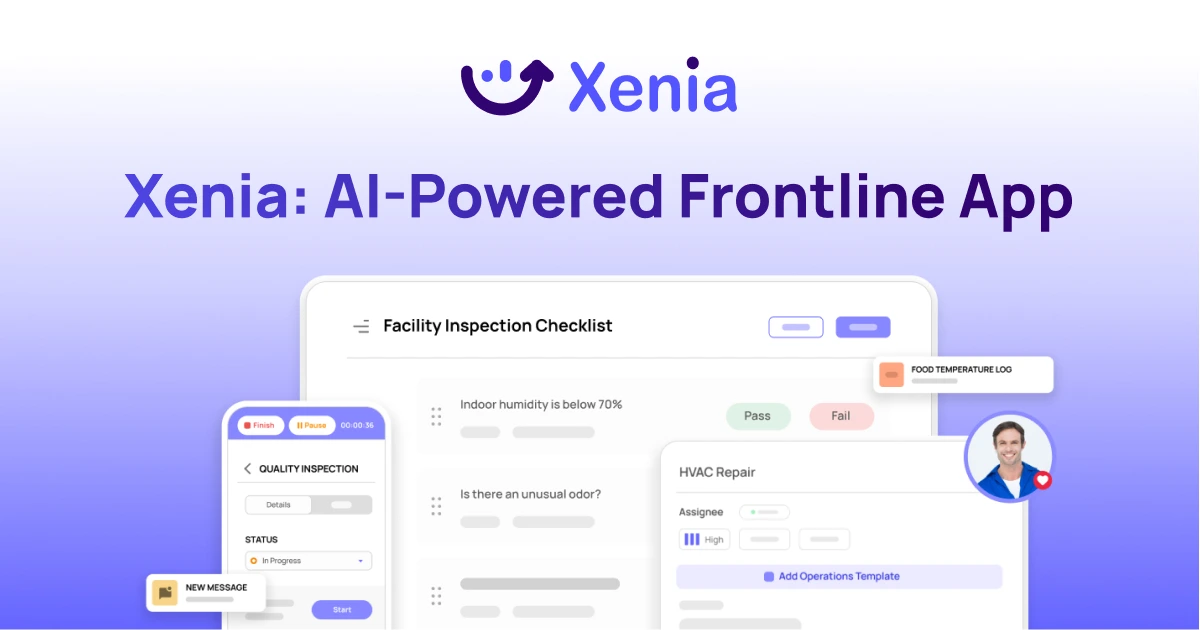
Xenia brings daily operations, maintenance, audits, and compliance into one mobile-first platform. Frontline teams execute work consistently across locations while leadership gets real-time visibility.
Why Multi-Location Operators Choose Xenia:
🤖 AI-Powered Operations, Create digital checklists instantly or convert paper forms with AI. Verify compliance automatically with photo analysis and get instant answers from your operational data.
✅ Daily Operations & Maintenance, Assign work across hundreds of locations in minutes. Report and route issues instantly. Schedule preventive maintenance to catch problems before downtime.
📊 Real-Time Visibility, Track completion, work orders, and performance across all locations through dashboards. Filter by site or asset to spot trends and take action.
Manage operations, maintenance, and compliance across all your locations from one platform

.svg)
.webp)
%201%20(1).webp)

.svg)
%201%20(2).webp)