

Post Summary
If you're searching for RizePoint alternatives, two years under FranConnect is probably why.
FranConnect acquired RizePoint back in February 2024. That's old news now. What matters is what's happened since: slower updates, a roadmap that bends toward franchise priorities over audit and compliance, support that feels less specialized than it used to.
A lot of customers built their entire compliance program around RizePoint. Mobile audits. Corrective actions. Inspection scoring. Supplier management. That's not easy to walk away from. But if the product still isn't getting the attention it needs two years later, it's worth knowing what else is out there.
This guide covers the best alternatives to RizePoint for restaurant, retail, and hospitality brands. Some are direct audit replacements. Others cover the full daily operations layer RizePoint never touched. We'll be straight about what each does and where it stops.
What is RizePoint?
RizePoint is a quality management system (QMS) built for mobile audits, inspections, and self-assessments across multi-location businesses. Its mobile auditor app lets field teams run digital inspections from any device. The management console gives compliance teams a centralized view of audit results across locations.
It's used in food service, retail, and hospitality for brand standards enforcement, food safety audits, supplier management, and corrective action tracking.
The core use case: a field auditor visits a location, runs through a digital checklist, flags issues, and those issues generate corrective actions. The compliance team sees performance across the network in one dashboard.
That's what it does well. Daily operational checklists, opening procedures, temperature logs, team training, frontline communication... those were always outside its scope.
Why operators look for RizePoint alternatives
The acquisition is the obvious trigger. But there are other reasons operators start evaluating RizePoint competitors.
The acquisition changed the support model
RizePoint operated as a focused, independent QMS vendor. Under FranConnect, your support now sits inside a larger organization managing a much broader product portfolio. For brands that need fast, hands-on customer success, that shift matters.
RizePoint solves only one layer
Your audit tool tells you what went wrong last Tuesday. It doesn't help you prevent it from happening this Tuesday. Daily checklists, temperature monitoring, task completion tracking, team training, and frontline communication all live outside RizePoint.
Post-acquisition pricing complexity
Standalone RizePoint pricing started at around $49.95 per user per month. Post-acquisition, pricing now falls under FranConnect's custom quote model. For brands that only want the quality management piece, getting bundled into a broader suite often means paying for more than you need.
Integration limitations
RizePoint integrates primarily with Dropbox and Microsoft Excel. For brands running HRIS systems like Workday, ADP, or 7shifts, that integration story is too narrow.
**
Pain Point, What Operators Report
Post-acquisition support, Less responsive under larger org structure
Scope, Audit-only-no daily ops layer
Pricing, Now bundled into FranConnect custom model
Integrations, Limited (Dropbox-Excel)
Daily execution gap, No checklists-training or communication tools
**
Best RizePoint alternatives in 2026
.svg)

.webp)
**
Tool, Best For, Audits, Daily Ops, Training, Supplier Audits
Xenia, Audit + full ops execution, Yes (weighted), Yes, Yes (microlearning), No
Bindy, Clean mobile audits, Yes, No, No, No
Intouch Insight, Customer experience compliance, Yes, No, No, No
Movista, Field team coordination, Yes, Partial, No, No
Wooqer, International multi-region brands, Yes, Yes, Partial, No
Audit Now, Simple audit deployments, Yes, No, No, No
Opus Inspection, Regulatory compliance, Yes, No, No, No
**
1. Xenia (Best for audit plus daily operations)
.webp)
Xenia is a frontline operations execution platform built for multi-unit restaurant, retail, and hospitality brands. It covers everything RizePoint does on the audit side. And it adds the full daily operations layer that RizePoint never touched. It’s a modern, AI-powered, robust platform.
Here's what that looks like in practice.
Weighted audit workflows that actually close issues
Build scored inspections where each question carries a weight based on criticality. A food safety violation scores higher than a signage issue. Failed items automatically trigger corrective actions assigned to the right person with a deadline attached. Photo verification confirms the fix was made.
This way, you're not just logging problems. You're closing them. For a deeper look at how weighted scoring works at the multi-location level, the weighted scoring guide walks through the methodology.
AI Photo Analysis for visual compliance
Xenia's AI photo rollouts tool lets you verify brand standards visually without waiting for a field visit. Your team uploads images from any location and the AI flags issues against your standards. Store layout off? Product display wrong? Signage missing? The system catches it.
This goes further than what a single field auditor's checklist can cover. It's visual compliance at scale.
Daily operations in the same platform
This is the real gap with RizePoint/FranConnect. Your audit program runs quarterly or monthly. Your frontline team is in those stores every single day doing opening procedures, temperature logs, prep checklists, and equipment checks.
In Xenia, all of that lives in the same app. Daily checklists and SOPs, temperature monitoring, opening and closing procedures, and food safety compliance all run alongside your audit workflows. Your team uses one tool for everything.
The restaurant opening checklist is a good example of how that daily layer integrates with your broader compliance program.
Microlearning training tied directly to your SOPs
Attach training content directly to the procedures your team executes. Short-form video lessons. Quizzes tied to specific steps. Course completion tracked by employee and location. Rolling out a new menu item? Build a 5-minute course, push it to all locations, see who finished it before launch.
Training isn't a separate project managed in a different system. It's built into how daily work gets done. This is how food safety training and operational training should work together.
Multi-location analytics in real time
Xenia's Location Pulse gives you a real-time view across your full network. Completion rates, open corrective actions, flagged audit items, and team performance. Filter by region, location type, or store. The analytical agent surfaces trends and flags issues before they become patterns.
No waiting for a weekly export. The data is there when you need it. This is frontline reporting built for operators, not analysts.
Communication with acknowledgment tracking
Send company-wide updates or location-specific announcements through Xenia's built-in frontline communication tool. Track who opened it, who confirmed it, who's still pending. For compliance teams that need proof a message reached the right people, announcements with signature tracking closes that gap.
For a direct head-to-head comparison of how these two platforms stack up, the Xenia vs RizePoint page goes into detail.
**
Feature, RizePoint, Xenia
Mobile audit app, Yes, Yes
Weighted audit scoring, Yes, Yes
Corrective action automation, Yes, Yes (with photo verification)
AI Photo Analysis, No, Yes
Daily operational checklists, No, Yes
Temperature monitoring, No, Yes (IoT + Bluetooth)
Microlearning training, No, Yes
Announcement with acknowledgment, No, Yes
Supplier audit management, Yes, No
HRIS integrations, No, Yes
Per-location pricing, No, Yes
Dedicated CS manager, No, Yes
Migration support, No, Yes
**
Pricing: Per-location model with unlimited users per store. Custom quote based on location count. Dedicated customer success manager and migration support included. Most teams go live in 4 to 6 weeks.

Priced on per user or per location basis
Available on iOS, Android and Web


2. Bindy
.webp)
Bindy is a field audit and inspection platform built for retail and hospitality brands. It's one of the more direct RizePoint competitors in the mobile audit space. Multi-unit retailers and restaurant groups use it for store visits, brand standards checklists, and compliance tracking.
The platform is clean and easy for field teams to use. Audit forms, photo documentation, corrective action tracking, and compliance reporting all work well.
Where it's more limited: Bindy is a field audit tool. Daily operations workflows, team communication, and training content aren't part of the platform. Moving from RizePoint to Bindy still leaves you with the same daily ops gap.
For a direct comparison of how these two platforms differ on the operations side, the Xenia vs Bindy page is worth reading.
Good fit for brands that want a clean, focused mobile audit tool without needing broader daily ops coverage.
3. Intouch Insight
.webp)
Intouch Insight is a customer experience and compliance management platform covering mystery shopping, field audits, and operational inspection workflows. It's used across restaurant, retail, and hospitality for brand standards enforcement with added focus on customer-facing compliance metrics.
Strong at measuring the customer experience layer of compliance: service standards, product quality, store environment. The reporting and benchmarking suite for multi-location brands is solid.
More limited on internal daily operations. It doesn't cover daily task execution, frontline training, or team communication. The mystery shopping focus makes it better suited for brands where external evaluation is part of the compliance model.
If you've been evaluating Intouch Insight, the Intouch Insight alternatives guide covers the full comparison.
4. Movista
Movista is a retail execution and field operations platform built for brands with distributed field teams. It covers store visits, merchandising compliance, task management, and workforce coordination across multiple locations.
Where it stands out: the workforce scheduling layer for field reps is more built out than most audit-only tools. If you're managing a team of field auditors with complex territory assignments, Movista handles that coordination well.
Where it's more limited: less suited for internal daily store operations. It's designed for the field-facing compliance team, not the frontline workers doing the daily work inside each location.
5. Wooqer
Wooqer is an operations and compliance platform used by retail and food service brands, well-established in Asia-Pacific with a growing footprint in other markets. It covers audits, task management, SOP delivery, and compliance tracking.
It combines operational checklists with audit workflows in a single interface, which is closer to the full-stack model than most pure audit tools. Compliance trend reporting across locations works well.
The limitation for US-based brands is support and implementation. Wooqer is less established in the North American market, which creates friction during setup and ongoing customer success. For a full breakdown, the Wooqer alternatives guide covers what to look for if you're evaluating this category.
Better suited for international brands operating across multiple regions.
6. Audit Now
.webp)
Audit Now is a purpose-built audit and inspection platform covering safety, quality, and compliance workflows across multiple industries. It has a solid form builder, offline mobile audit capabilities, and corrective action tracking.
The platform is easy to set up. Offline functionality is useful for field teams auditing locations with unreliable internet. Compliance reporting covers the basics.
What it doesn't cover: daily operations workflows, team training, and location communication. Like Bindy, it's a point solution for the audit layer. If that's all you need, it works. If you want one platform for audits and daily ops, you need something broader.
The audit and inspection guide walks through what to look for when evaluating tools in this category.
7. Opus Inspection
.webp)
Opus Inspection is a compliance management platform with strong regulatory and operational inspection capabilities. It handles scheduled inspections, random audits, and regulatory compliance documentation for multi-location operators.
Better suited for brands with heavy regulatory requirements. HACCP documentation for food service. Safety inspections for hospitality. The corrective action workflow is well-built for that use case.
Less strong on daily operational checklists and team communication. For operators who need regulatory compliance depth more than general brand standards execution, it's worth evaluating alongside the operational audit guide.
How to pick the right RizePoint alternative
The right choice depends on what you were actually using RizePoint for, and what gap you need to fill now.
If you need a direct audit replacement and nothing else, Bindy and Audit Now both deliver clean, focused mobile audit tools without the acquisition complexity.
If you need audit plus daily operations in one platform, Xenia is the clearest path. You get the weighted scoring and corrective action workflows RizePoint gave you, plus opening and closing checklists, temperature monitoring, microlearning training, communication, and real-time location reporting in one app.
If you need field team management for distributed auditors across territories, Movista handles the workforce coordination layer better than most audit-only tools.
Ask yourself one question: was your RizePoint program connected to what happened in the store every day? Or did it sit as a separate compliance program that field teams ran on a quarterly schedule?
If it was quarterly, a direct audit replacement works. If you want daily visibility into what's actually happening across your locations, not just during an audit visit, you need an operations execution system.
For brands in food service specifically, the food safety corrective action guide and HACCP temperature logs guide show how audit findings should connect to daily food safety execution.
Conclusion
RizePoint built a solid audit tool. The acquisition didn't break it. But it changed your support, your pricing, and your roadmap.
If all you need is a direct audit replacement, you have good options. If you want one platform that connects audits to what actually happens in your stores every day, that's a different conversation.
Book a demo to see how Xenia covers both.
Frequently Asked Questions
Got a question? Find our FAQs here. If your question hasn't been answered here, contact us.
What should I look for in a RizePoint alternative?

Four things. Weighted audit scoring. Automated corrective actions with photo proof. A daily ops layer (checklists, temp monitoring, training). And real-time multi-location reporting. Most tools cover audits. Very few cover the full execution layer too.
Can I still use RizePoint as a standalone product?
No. Since the February 2024 acquisition, RizePoint only exists inside FranConnect. There's no standalone version for new customers.
What is the best RizePoint alternative for restaurant brands?
Xenia. Food safety audits, temperature logs, opening and closing checklists, menu rollout training, and communication with acknowledgment tracking. All in one platform. Per-location pricing works better for high-turnover restaurant teams than per-user tools.
Are there free RizePoint alternatives?
Not really. Not at multi-location scale. Free tools don't hold up once you need weighted audit scoring, corrective action workflows, and reporting across 10 or more locations.
How is Xenia different from RizePoint?
RizePoint does audits. Xenia does audits plus everything else. Daily checklists, temperature monitoring, microlearning training, AI Photo Analysis, corrective actions with photo verification, and real-time reporting across every location.
What is RizePoint used for?
Mobile audits, inspections, and compliance tracking across multiple locations. It's used in food service, retail, and hospitality for brand standards and food safety. It handles audits only. No daily checklists, training, or team communication.
What happened to RizePoint?
FranConnect bought RizePoint in February 2024. It's now part of their platform. Your pricing and support as an existing customer now sit under FranConnect's model.


A Modern, AI-Powered Platform Built Specifically for Frontline Operations
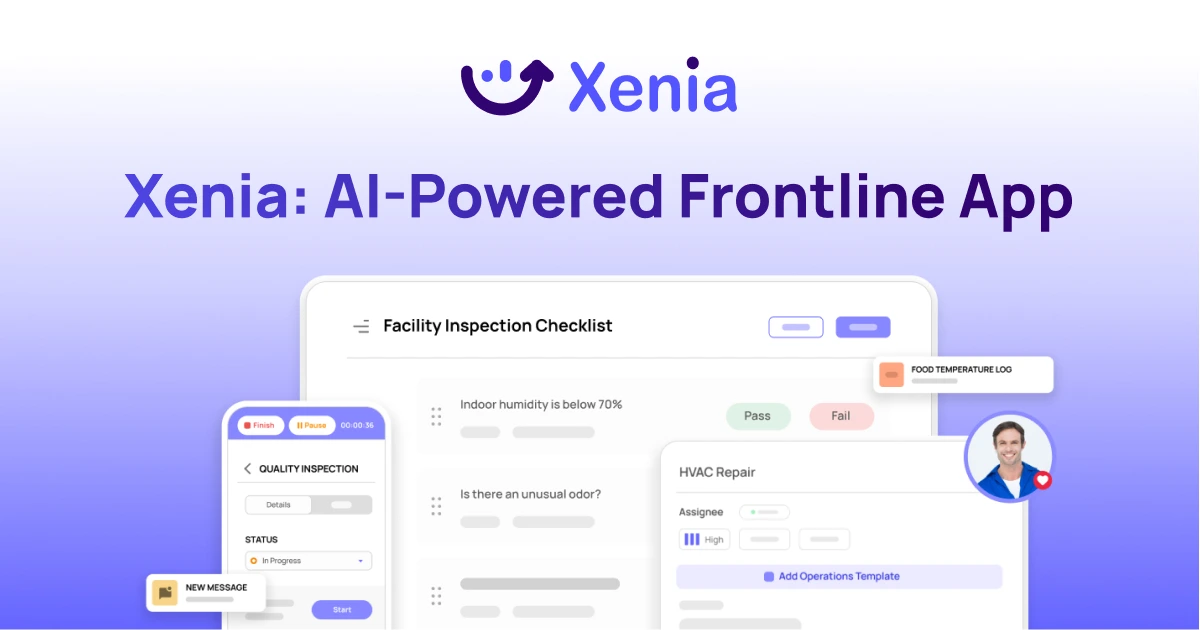
Xenia brings daily operations, maintenance, audits, and compliance into one mobile-first platform. Frontline teams execute work consistently across locations while leadership gets real-time visibility.
Why Multi-Location Operators Choose Xenia:
🤖 AI-Powered Operations, Create digital checklists instantly or convert paper forms with AI. Verify compliance automatically with photo analysis and get instant answers from your operational data.
✅ Daily Operations & Maintenance, Assign work across hundreds of locations in minutes. Report and route issues instantly. Schedule preventive maintenance to catch problems before downtime.
📊 Real-Time Visibility, Track completion, work orders, and performance across all locations through dashboards. Filter by site or asset to spot trends and take action.
Manage operations, maintenance, and compliance across all your locations from one platform

.svg)
.webp)
%201%20(1).webp)

.svg)
%201%20(2).webp)